


In this article we discuss email marketing and find out together why sending professional newsletters can increase your Company’s business.
Let’s start with an example.
You know when, at a party, you say something funny but no one listens to you?
Soon after, someone else comes along and says another funny thing, everyone listens to him, and he becomes the coolest character of the night?
Here, in the world of email marketing the same thing happens: a good email might go unnoticed if it does not have the right content, if it is not sent at the right time, and if it is not addressed to the right person.
Sending the right email, at the right time and to the right person is one of the most important concepts of this email-based content marketing tool.
It sounds trite and obvious, most likely you are asking yourself, “Why would I send the wrong email, at the wrong time to the wrong person?”
Unfortunately, it is not easy to structure an effective and efficient newsletter sending strategy as there are really so many factors involved.
Sending Professional Newsletter: elements to start from
Let’s look together at some basic aspects, which should always be considered, in your newsletter sending strategy.
- The content must have value, so you will be much more likely to reach your recipient by delivering the right message.
But not only that, this will help you establish a good relationship of trust with your stakeholders, which you can then continue to delight over time. - It is important to profile your contacts. For example, leads (potential customers) will definitely have different needs than your customers. Also, there may be leads who are already ready to buy and others, on the other hand, who need more time to make a decision.
Even your customers are not all the same; there may be active customers and others who are more dormant, old customers and new customers–each with different needs and specificities. - Never forget to determine what the goal of your email is.
Why are you sending it?
What are your expectations but more importantly, what added value do you want to offer your recipients?
Sending out professional newsletters and valuable content
A good newsletter sending process always aims to attract its contacts, through valuable content featured on your website.
A good strategy first starts with a clear objective: what do you want to achieve by doing email marketing?
Selling, loyalty, brand awareness? What is your Call to Action?
You can also have multiple goals but it is best if you define only one for each campaign you launch, that way the call to action that will accompany your email will be clear and precise and you will not risk confusing people.
In fact, keep in mind that users are easily distracted and if they are not routed in a well-defined direction, they will not complete any action.
Your open rate or clicks made will probably be extremely low.
Your ultimate goal as a marketer is definitely to sell, but you need to be aware that not all of your contacts are ready to buy.
It can take weeks or months before a lead turns into a customer.
In the meantime, however, you can create the conditions for this transformation to happen: through your emails you can in fact “nurture” your contacts and become a point of reference for needs related to your products and/or services.
How? By offering value through useful resources that do not have a purely commercial purpose: You must earn the trust of your contacts.
Newsletter sending: what are the objectives?
In fact, you cannot think of doing email marketing campaigns only with messages inviting purchase and emails full of discounts, offers and promotions: anyone can do this, and you run the risk of not getting any benefit from this activity.
You will be just one of many, on a par with spam, to be summarily read and trashed.
But what are the goals of sending newsletters? Let’s give some practical examples:
- Create a relationship of trust between your company and a potential customer;
- Retaining existing customers;
- Strengthen brand awareness and brand positioning in the user’s mind to be the first brand they think of for a specific need;
- Generate traffic to a page that is important to you;
- Turn simple contacts (leads) into customers;
- Convincing those who have already purchased to purchase again;
- Keep the relationship with a potential customer alive through constant communications.
Sending newsletter campaigns: the steps
The recipient will always face three important stages during his or her decision-making process:
- Awareness
- Consideration
- Decision
And his decision to take a particular action is nothing more than the result of careful persuasion and retention work, executed through a strategic newsletter sending process.
In short, the moment you manage to keep your email from unfortunately ending up in the trash, communicating valuable content and establishing interaction with your contacts, you can say you have achieved your goal.
Your goal, is none other than, thegoal of email marketing that is: the importance of sending the right email, at the right time, to the right person.
How do you send the correct email?
Let’s analyze how we can grow our business through a proper newsletter sending strategy:
- The right email
- To the right person
- At the right time
Send the right email
In sending the right email, content and context play a key role.
Today, we are in the new era of inbound marketing.
We at Factory Communication have chosen HubSpot as our CRM (Customer Relationship Management) and Inbound Marketing platform. Not only that.
HubSpot is also one of the most popular and widely used email marketing platforms worldwide.
N.B. If you are about to launch your startup in the market I take advantage of the special promotion that provides super discounted Hubspot prices for startups.
Now let’s find out together why.
Sending automatic newsletters: how and why
Companies can no longer afford to bully their users’ lives. People hardly accept being suddenly interrupted by intrusive messages.
They want to be the ones to choose companies, partners, suppliers to rely on or collaborate with.
How can we enter this process and make our business offer known to a customer or potential customer?
Simple, by winning his trust, through valuable content and messages that are first and foremost beneficial to the user, that is, our potential audience.
At this point we need a powerful, accurate, timely, and reliable engine to put our strategy into action.
You can send the right email to the right person through database segmentation.
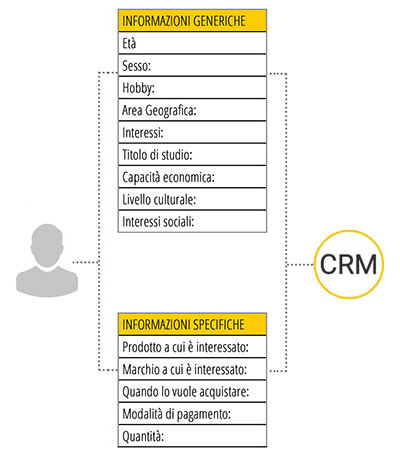
That is why at the initial stage of a proper newsletter sending strategy, contact profiling plays a key role.
The more information we collect about our users, the greater the ability to create specific, personalized and valuable content. In a word: effective.
Let’s take some practical examples.
It is very important to organize our email marketing database into groups with specific characteristics.
We can divide contacts by age, gender, city, buying habits, interests, etc… It depends on the characteristics of our offer and how we want to reach our target audience (customers and prospects).
Sending newsletter campaigns: segmentation
For each group, we can create one or more customized newsletter sending campaigns that leverage certain personal and specific characteristics of group subscribers.
Their relationship with our brand can also help us create effective groupings, for example:
- NEW ENROLLMENTS,
- Customers who purchased only once,
- Loyal customers who buy regularly.
Segmenting the contact database increases member engagement and reduces unsubscribe rates.
The level of list segmentation depends on the membership information we have collected over time.
Because of HubSpot’s integration with the website and Facebook Page, we have multiple points of contact with our potential customer and client.
This amplifies the business and profiling opportunities of the user who can decide to:
- Sign up for the newsletter: generally only an email address is required
- Fill out an information request form. In this case the information requested is more depending on how specific and vertical the business in which we operate is.
In addition, the better the reputation of our company in the market, the more information we can ask the user for. - Requesting information through the Chat present on the site, or the chat present on the Facebook page if our company has also prepared a Social Media strategy.
In this case, thanks to HubSpot, it is possible to provide a traditional chat, where the operator can respond in real time to user requests, or implement a conversational type of chat.
In this case, the implementation activity is definitely more articulated and complicated, but it allows us to be active 24 hours a day, 365 days a year.
Thanks to the newsletter subscription form, information request forms, and chats, it is possible to profile our user extremely accurately.
Not only that.
If we have created an online store using WooCommerce as an e-commerce platform, it can be connected to HubSpot, further implementing the information we can collect about our user.
The better and more detailed the picture of our customer and potential customer, the better and more precise will be the Marketing and Communication strategy we can put.
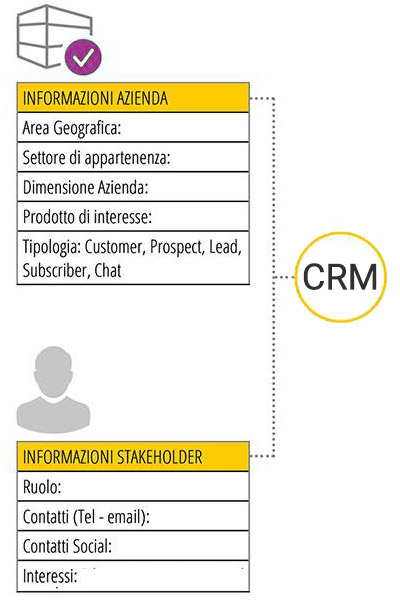
The more precise the sketch of our potential Client is, the greater the opportunities to build the right strategy and relationship with them.
In HubSpot as in all major CRMs, it is possible to collect information from both the individual person and the company in which that person works.
Not only that.
Of the individual registry we can collect both Generic and specific information.
For example, a user When subscribing to the mailing list, the user fills out the form or subscription form that we have prepared for this very purpose.
As you go, you can collect additional information about your user.
Newsletter sending: when to send?
Segmenting our databases also helps us understand what is the right time to send our email and especially identify when it is best not to send it.
How?
The first element to consider in sending the email at the right time is our contact’s needs, which vary according to their life cycle, in the famous initial awareness-acquisition-decision-making process.
We all know in life that “timing is everything,” and this concept also applies to email marketing strategy.
In order to send the right email, to the right person, at the right time, it is, in fact, extremely important to always take into account at what stage of the buying process our interlocutor is in.
For example, a contact who is in the awareness stage will need more educational or informational content than a contact who is in the decision stage who is looking for content on how to make a purchase.
A second, but not least, aspect that should always be taken into consideration is the email opening habit adopted by our user on a typical day.
How? You can help yourself study and analyze his habits by reading statistics that show you, for example, which days of the week your contact most often opens a communication.
Rather than the time when your communications receive the highest number of conversions, trivially of clicks on the call to action button.
Reading this data will help you in optimizing customized and scheduled email sends at times and days most conducive to achieving the goal.

When not to send a newsletter
Another important aspect is definitely to understand when not to email a contact.
How? Again, database segmentation will run to your aid.
We can give a practical example. A customer who has been a member of a gym for many, many years does not need to know about equipment and machines that he or she uses every day. Instead, this is very useful information to send to a new potential customer (lead).
It sounds trivial, but misdirection can cause more harm than good.
In fact, the customer who receives the wrong communication will not only feel devalued and underappreciated but may also lose trust in you, generating great harm and loss to your business.
Just think that one dissatisfied customer could in turn do negative word of mouth to many other customers or potential customers causing not just one harm but exponential harm.
What does a proper email look like?
Every time you press send is an opportunity to build trust, provide value, guide your recipients through the buying process and then continue to communicate with them by building loyalty and delighting them.
What are the most important elements to consider in order to send the right email, at the right time to the right person?
- Setting expectations
- The layout of the email
- Personalization
There is a model called AIDA that you can consider to structure your email, synonymous with Attention, Interest, Desire and Action.
The model steps are very simple and identify the classic funnel/funnel:
Sending newsletters: attracting Attention
Show the objective of your message and attract the attention of your recipients.
How?
A very important element is definitely the subject line of the email. Primary catalyst of attention that, together with the sender and preheader constitute the input that will lead to the opening of the communication.
You must have read millions of information about the hypothetical perfect object and the best words to use, those to avoid, the right length, etc…
Certainly, technical limitations must be taken into account: on mobile devices the space available for the object is limited; it is important that the key concepts we think will interest the user are expressed immediately in the first few words.
For example, overly articulated and complex formulas are to be avoided.
There are many gimmicks used over the years: from personalization (“Hello Marco, an offer for you”), to emoticons, to the teaser/clickbait effect (“You have no idea of the offer we have prepared for you”); all have a reason and effectiveness, but these must be seen in the overall context.
Indeed, it must be remembered that the purpose of the AIDA funnel (and all marketing strategies in general) is to bring as many people as possible to conversion: overdoing it in the early stages could lead to rapid disillusionment, which would then result in disaffection.
Also, don’t forget the importance of “putting your face to it,” try, for example, sending your communication from a personal email address e.g., mario.rossi@factorycommunication.it while avoiding a too-generic email address e.g., info@factorycommunication.it.
Don’t underestimate the importance of previewing your communication; always do a test send to check its readability from both desktop and mobile devices. Remember that, today, most communications are read quickly (mostly while on the go) and from smartphones.