



In this article we look at customer experience management and how it can be implemented with Inbound Marketing strategy.
This article takes its cue from a question Federica B. asked me last Sunday (May 24) on our website chat.
Federica asked , “I’m Federica, I’m involved in Customer Experience management in the Automotive sector so I would love to stay updated. Can I ask you a question since you were so quick and helpful? True, much of the experience is done in the field, but if I wanted to resume my studies to be associated with this path, would you recommend more Management or Work and Organizational Psychology? My goal is to provide a satisfactory experience for the client in all respects.”
From Sunday to today I have been thinking a lot about this request and this morning, opening my eyes, early … very early, I decided to write this article, which I will then send to Federica, since at the moment my response was not at all comprehensive.
I asked myself, what could be the most correct training path?
Let’s start by saying customer experience management what it is
Customer Experience Management (CXM) is the strategy and process used by companies to manage and improve all the interactions customers have with the brand.
The goal of CXM is to create positive and memorable experiences for customers that will lead them to:
- Being more faithful
- Purchase more
- Promote the brand to others
CXM is based on an in-depth understanding of customer needs and wants. Companies use a variety of tools and techniques to collect customer data about their experiences, including:
- Surveys
- Interviews
- Social media analysis
- Analysis of behavior on your website
- Analysis of information acquired from customer service (customer service)
This data can also be analyzed with an artificial intelligence program to identify the strengths and weaknesses of the customer experience and to develop strategies to improve it.
Customer experience management definition of some of the key elements:
- The definition of a customer experience vision
- The creation of a Customer Journey map
- The identification of key points of contact
- The Measurement of Customer Experience
- The implementation of strategies to improve CX
- The monitoring and continuous improvement of CX
Customer Experience Management in a Dealership?
And if they were to ask me, “What process would you adopt to improve customer experience management in a dealership or store?” what would my answer be?
What you are about to read is the fruit of the reflections of these days.
The process we are going to look at together now takes its cue from the basic concepts of Inbound Marketing, from which flows the buyer persona that then gives rise to Customer Experience Management.
Let’s start with the basic concepts of Inbound Marketing.
Inbound marketing is a marketing strategy based on the creation of valuable content that aims to attract a potential customer to our company and turn them into a happy customer.
Customer Experience Management and inbound marketing
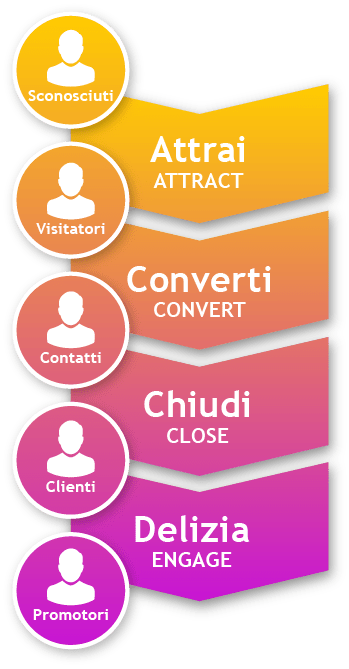
The inbound marketing strategy is developed in a path consisting of four different phases: attract, convert, close, delight.
You are probably wondering what inbound marketing has to do with customer experience. As we analyze the four phases of inbound marketing together, you will agree with me that they have many commonalities.
In my opinion, it is incomplete to speak of Customer Experience. I find the term Persona Experience more correct and comprehensive. It is a term that I do not think is in common use, but one that I coined by combining customer experience with the term buyer persona typical of inbound marketing.
Building the Buyer Persona is the strategy that leads you to build your ideal customer. That is, the one you would like to have in your store, in your company, in your dealership.
And also the one whom you “WOULD NOT LIKE TO HAVE.”
Now let’s see together why.
As they said inbound is based on these 4 phases:
- Attract
- Convert
- Close
- Delight
Now if we analyze the 4 phases they correspond to these 4 states:
- Prospect
- Lead
- Customer
- User
The customer experience and inbound marketing strategy
The customer experience strategy represents one of the 4 stages of interaction between the company and the potential customer or client.
Let us try to analyze a specific case.
Back to Federica’s question.
How do I improve the customer experience of the dealership where I work?
Good. Dear Federica We cannot consider only step 3 of the process, that is, when a user has already become a customer.
Because that phase is the result of the previous two, that is why I called the whole process the “Persona Experience.”
So let’s look at how to create a proper Persona Experience.
As I mentioned earlier this term is derived from “buyer persona” the method behind inbound marketing that allows us to build, design our “ideal customer.”
It is not the goal of this article to explain how to build a buyer persona. For simplicity’s sake, let’s say his name is Marco, he is 42 years old, an architect, and he is looking for a car, both for work and for his family. Marco has two children and a good income.
Step 1: Attract
It is essential to define a strategy to attract potential customers (PROSPECT) to our dealership.
This stage is extremely important because, in order to convince a person to enter our dealership, we are essentially “promising something.”
The simplest thing that, unfortunately too often is done, is a discount to buy the product.
Apart from this aspect, we promise that “our car is safe, reliable, comfortable, economical, low-polluting etc… and that in our dealership you will find only trusted mechanics, experienced salesmen, kind and helpful customer support etc…”
Without knowing it we make so many promises to our potential customer. So your experience with our Brand starts already at this stage.
Customer experience management: When does it begin for a potential customer?
The Experience begins exactly at the moment when a “Person” first comes into contact with our company.
So not at the dealership, but long, long before. Via the website because he did an online search, social networks because he clicked on a sponsored post, one of our billboards on the street, or even a commercial on television.
Or more simply learned about our company because someone mentioned us. The famous word of mouth. Please mark this point that is perhaps the most important–we will come back to it in a moment.
Question. What will the experience experienced by the “Person” be like at this first stage? Interesting, satisfying, complete, exhaustive, disappointing, irritating…? Will we keep our promises?
Let’s try to see a couple of scenarios. Which of these two Experiences would you like to live?
- I called the dealership to find out when they were open and was answered by a very nice young lady who said, “given the arrangements due to phase two of the corona virus unfortunately we can only receive by appointment….” then she gave me all the information I needed and asked when I wanted to schedule the test drive with her colleague. “She was very nice, I scheduled for tomorrow….” (ATTRACTED)
- I wrote on the dealer’s Facebook page chat and was answered by a person, dare I say quite rude. She said she “is the one who responds on Facebook and doesn’t yet know when the dealership will be reopened.” I wrote to another dealership they were definitely nicer. (LOST)
Step 2: Convert
If attracting (prospect generation) is an important stage, converting (LEAD GENERATION) is perhaps even more so.
This is an important stage because we turn an intrigued person into a potential customer. So much so that his “status” changes from Prospect to Lead.
In marketing, there are strategies and activities that are referred to as “Lead Generation” that is, the acquisition of potential customers.
Many times of a prospect we have very little information. In some cases we simply have an email because he or she decided to sign up for our newsletter.
The second stage is extremely important because it is the stage useful for building a deeper relationship with Marco, our potential customer.
For this reason, it is essential to collect as much information as possible:
- What is Marco really interested in?
- What kind of needs do you have?
- Do you mainly use the car for work or for driving around with your family?
- Since he has 2 children, does he need a big trunk?
The more information we gather about Marco, the better experience we can give him.
The more information we have about customers’ needs the greater the opportunity for them to have a great experience.
My advice is to use a CRM (Customer Relationship Management) to save all this information on “Marco.” We at Factory Communication use HubSpot, which is not only a very powerful CRM, but also the best Inbound Marketing platform in the world.
Marco had a positive experience with the “young lady who answered the phone,” so he decided to “drop by the dealership.”
His expectation is high. “They were polite on the phone and didn’t even know who I was; they’ll roll out a red carpet at the dealership…”
Marco arrives at the dealership.
The publicity is paying off, and Marco has to wait 20 minutes before he can talk to a “salesman.”
The next day he meets a friend of his who asks him “so Marco, did you buy the car yesterday?”
If you were the owner of the dealership what answer would you like to hear?
- “Hi John of course! I arrived at the dealership and unfortunately had to wait twenty minutes. The girl who had scheduled my appointment on the phone came right away.
She was very kind. While she was offering me coffee she explained that it was the first week of work and she made some mistakes, she apologized so much.
It happened I told her! The car is beautiful I took a ride with the salesman and bought it…..” (CONVERTED) - “Hi John but never mind…. I arrived at the dealership and they kept me waiting twenty minutes.
Not only had the chick who answered the phone made a mistake in scheduling my appointment, but she didn’t even offer me coffee.
Capers I was there to pick up a 50,000 euro car and they left me standing there like a pirate.
No I didn’t take it, by the time the salesman arrived I was nervous and didn’t feel like buying it anymore.
On my way out I called another dealer and tomorrow I’m going to go for a test drive…” (LOST)
In this case, whose fault is it for not selling?
Whose phone call did he make? Whose reception ? Of the salesperson who did not have the ability to change the mood of the potential customer?
In both cases Marco waited 20 minutes. While in the first case the promise “we are kind, considerate etc…”was kept in the second case the promise made on the phone was not kept.
Step 3: Close
From Lead to CUSTOMER. For many entrepreneurs, salespeople and companies it is considered the most important stage. I personally believe it is not.
The closing phase is the phase that leads a Lead (potential customer) to become a customer (client).
In theory, it’s the monetization phase, the contract phase, the turnover phase, the cache phase, the grain phase — define it as you like.
At last, the two negotiating actors have each achieved their goals.
Marco bought the car and the dealer sold the car.
But are they both happy? Let’s try to see.
The best sale is win-win, that is, when both parties win!
Hi Marco so did you buy the car yesterday?
- “Hi John yes. They were very nice and treated me well. Not only did they give me the discount that was written in the advertisement, but Luciano the seller, gave me an additional discount of 500 euros.
You know out of 50,000 euros it’s not a lot, but it’s the gesture that counts.
By the way John, if I am not mistaken you also wanted to buy a…. call them and tell Luciano that you are going on my behalf… you will see that he treats you well “ (CLOSED=WIN) - “Hi John but never mind. Not only did they make me wait 20 minutes standing there like a jerk. Luciano, the salesman, told me that the discounted model was gone and that if I wanted I had to order the standard one and I also had to wait three months for delivery.
I told him that the advertisement said ready for delivery etc… and if he gave me a little discount to come my way I would have bought it anyway… he told me he couldn’t.
They made me lose my Saturday afternoon. Tomorrow I go to another dealer and….” (LOST)
As you can see even in this case a promise was not fulfilled. In the first case we can call it Customer Experience, because Marco from a potential customer became a Customer.
In the second case, what can we call it? If we wanted to stick to Englishisms, we should say “Angry Person Experience.”
Not only that. In the example we saw, we generated an additional important aspect that I mentioned at the beginning of this article: word of mouth.
In the first case the experience was absolutely positive and pleasant, so Marco spoke very highly to his friend John of the dealer “…go in my name…you will see that he treats you well…”
In the second case Marco was very angry “…but forget it…tomorrow I go to another dealer…”
How do you think he will talk about that dealer to all the friends he meets?
Step 4: Delight
This is the stage at which a client moves on to the next stage of “USER” and/or “AMBASSADOR.” In my opinion, it is the most important stage.
Delighting means pampering, building loyalty, making our customer feel important after selling.
Not when he is sitting at our table with pen in hand, undecided whether to sign, or not sign the contract.
At that time, we would probably also give them our mother 😂😅.
No, I’m talking about the next stage, when he just wrote you a check for 50,000 and walked out of the dealership with his new car.
I personally consider this to be the most delicate stage of the whole process.
Customer Experience Management and Word of Mouth
A Happy Customer talks to other people generating visibility and business to your Company. Free of charge!
For the simple reason that you have sold and you think that in the short term Marco will not return to the dealership to buy another car.
Yes it’s true, he’ll come back to get a coupon but who cares. That right there is the turnover of the garage. I am the salesman and the boss “measures” me on how much I sell.
Here is the time when, potentially, we can make disasters. Because we are already focusing on the next sale.
For goodness sake, speaking of a dealer, the role of Luciano, the salesman, is potentially finished. But is that really the case?
I would say no because….
Hi Marco then how is your new car ….
- “Hi John it is great, then the people at the dealer are great. Just think, the other day I had a problem with the battery.
I called Luciano, the salesman, because I had to go to the construction site. Not only did they come right away to change my battery. But Luciano also came.
While the mechanic was doing the work Luciano offered me coffee. He apologized, told me that it had never happened to him that a battery broke after 4 days.
It happens I told him….I told you these guys are good” (POSITIVE PASSAGE). - “Hi John, but never mind. He thinks I had a battery problem the other day.
I called Luciano, the salesman, because I had to go to the construction site.
He told me he was busy, so he put me through the workshop. The workshop manager told me that before 4 hours he couldn’t do anything.
I explained to him that the car was new, that I only picked it up 4 days ago, but he told me he couldn’t do anything about it.
But giovanni, does this seem normal to you? Does that sound like this assistance?
I just gave him 50,000 euros ma….” (NEGATIVE WORD OF MOUTH)
It is important to base customer experience management on real data and not on our perception
Customer experience analytics is key to growing our businesses
If you know what the customer really thinks of you, you can improve your service or product
Only then can a good customer experience be built.
As is often the case, the example I give now is the result of personal experience.
Why am I sharing this experience with you? To talk about theimportance of customer experience.
The experience that customers have when they come in contact with the brand, its products and services.
Often times, in fact, we believe that our customers want one thing when, in fact, they want something totally different.
Last week I phoned, to a restaurant, to reserve a table.
The answer was “unfortunately Cremonesi I have to give you the small room on the second floor.”
I made a reservation at this restaurant precisely because, a couple of months earlier, I had already been there with some friends.
The table we were assigned was on the ground floor, a beautiful setting, very warm, private, intimate.
When I went up to the second floor to browse, I found an equally fantastic and private environment, with a few small tables, very nice and well-kept.
Ideal for a business meeting or, why not, for a romantic dinner with one’s partner.
I immediately thought that if I wanted to return there, I would make reservations on the upper floor.
I had identified it as an exclusive and dedicated area for chic and important Clients. A small room for a few exclusive clients.
Response aside, I reserved the table in the small room on the second floor. It was the one I wanted, so it was just fine.
After ending the call, I went to read the various comments on social media.
I did not find any negative comments criticizing the second floor dining room. No one ever complained about eating on the second floor.
We could say: no negative customer experience!
In fact, I found several positive comments. “Intimate environment…. you can finally talk in peace that friends….” and via such evaluations.
I asked myself. Why this kind of response? Why distort the buying process without having information?
Apparently, the restaurateur’s perception is completely skewed from that of the customers.
The response, especially when one does not know the interlocutor, “Unfortunately, I have to reserve the small room on the second floor for you,” can be perceived as strongly negative.
It risks making the interlocutor feel unimportant. I have no space, I have to put you in the small room on the second floor.
The possible new Customer, may decide not to confirm his reservation.
Simply because the caterer believes that, the small room on the second floor, is less beautiful and functional than the one on the ground floor.
Moreover, such a response disqualifies the lounges solely because of the restaurateur’s “distorted” perception.
The Client probably doesn’t even know the venue, the layout of the rooms, etc…
Why communicate immediately in a negative way, what can be experienced by our client, as a totally fantastic personalized experience?
An alternative answer, certainly more positive and effective in terms of communication and business, could have been:
“I am reserving a table for you in our very special little room on the second floor, in a very cozy and private environment. I am sure you will like it as well as all our Clients.”
The approach we have by phone with people, whom we do not know, can determine the success or failure, of our activities.
What I have exposed is definitely a borderline case.
But it really happened. Generally the opposite happens.
That is, the proposed products or services, are painted much more beautiful and performing, than they really are.
Customer Experience Management: what post-sale experience would you like to have?
Basically in the first case Marco has become an “Ambassador” of your Brand. So he will speak well to other people generating you many new potential customers and “if a friend says so you trust him”. It may sound strange, crazy to you, but in HubSpot there is just the Ambassador “status” to keep track of everyone who speaks well of our company, products and services.
In the second case, of this articulate, Marco will always speak ill of your company.
It is said that a person talks about his or her experiences with at least 10 other people, and that it is easier to talk about one’s negative experiences than positive ones. Not only that.
Changing the first “impression” requires 10 more.
Thus, if the first impression is absolutely positive, a person will have to experience as many as 10 negative experiences before changing his or her mind.
At the same time, if the first impression is absolutely negative, a person will have to experience as many as 10 positive experiences before changing his or her mind.
Try to think of how much “damage” can be caused by a negative “Person Experience.”
Marketing alone does not work miracles
If your company has an organizational or quality problem, increasing the number of customers will only increase negative reviews.
It is critical to solve problems first. Improve service and customer experience.
Only when everything is ok.. at the top is it productive to push marketing. Not before.
Marketing and Communication strategy is based, first of all, on objective data.
Market analysis and Google positioning strategy, competitor analysis etc…
To position ourselves properly in the market and win over competitors, it is essential to understand what people are saying about us and our company. It is critical to read reviews and understand what we need to improve in product, service, customer support etc.
Have a great day.
Want to learn more about how to grow your Business? Don’t miss these articles:
- Examples of customer experiences that grow Business
- Do you have a gym? Do you want to acquire lots of new Clients?
- Customer Experience and 5 Effective Techniques to Build Customer Loyalty
- Do you want to improve your sales strategies? Listen to your Customer
- Gift one thing to raise the question of another