



The adoption curve, also known as the Rogers curve, is a model that illustrates the process of diffusion and adoption of an innovation within a social system over time.
This model, developed by sociologist Everett Rogers in 1962, classifies adopters of new technologies or ideas into five distinct categories.
If you are launching a start-up, or have decided to increase sales of your technology products or services, it is critical to define our target audience or, more precisely, our Buyer Persona.
Defining who we want to target also allows us to understand our interlocutor’s propensity to buy. This data is critical to accurately define our business plan and sales estimates.
Now let’s see together how you can segment the market into 5 niches, based on the propensity to buy also referred to as the action curve.
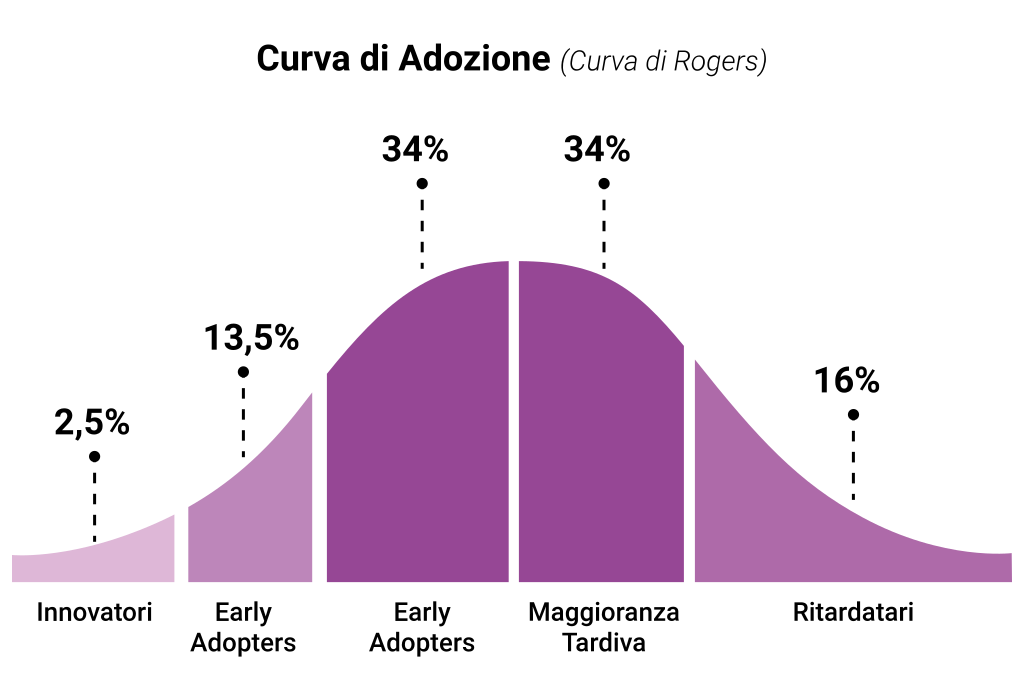
The five categories of the adoption curve
Innovators (2.5 percent)
They are early adopters of innovation, characterized by a strong desire to experiment with new niche products and services. Main features:
- Enthusiastic about new technologies and willing to take risks
- Younger, with high social status and greater financial availability
- Very active socially and in close contact with scientific sources
- Proactive, curious, and constantly looking for innovative solutions
- Often thought leaders in their field
Early Adopters (13.5%)
Willing to take some risks, but need more time to decide.
Can become influencers for the rest of the community. Main features:
- More cautious than innovators but still open to novelty
- Generally younger, with high social status and good education
- Influential and respected by their peers
- They want to form a solid opinion before openly supporting a new technology
- Careful about one’s reputation and image
Early Majority or Early Majority (34%)
Less wary of new ideas, but requires a lot of information and reviews before adopting the innovation. Main features:
- Interested in technology but require evidence of its effectiveness
- More conservative but open to new ideas
- Above-average social status and education
- Active in the community and influential on neighbors
- Pragmatic, data- and evidence-driven approach
Late Majority or Late Majority (34%)
More cautious in adopting new technologies, it tends to wait until the innovation is widely deployed. Main features:
- More cautious and skeptical about adopting new technologies
- Generally older and less educated
- Lower than average social status and financial availability
- They prefer to wait until the technology is widely deployed
- Require much testing and reassurance before adopting an innovation
Laggards or Retarders (16%)
They adopt innovation only when it has become obsolete or when new versions are available.
- Late adopters of innovations, often resistant to change
- Generally the older and less educated
- Lower social status and financial availability
- Focused on traditions and skeptical of change agents
- They adopt technology only when it becomes inevitable or obsolete
This pattern is especially true in the high tech sector but is applicable to the launch of any product or service. Therefore, to launch a new product in the market, it is appropriate to create specific marketing strategies for the different groups of people identified by Rogers.
Adoption of new technologies as influenced by socioeconomic factors
Socioeconomic factors play a key role in influencing the adoption of new technologies. Here is how these factors impact the adoption process:
Demographic factors
- Age: Generally, younger people tend to adopt new technologies more quickly than older generations.
- Gender: Gender can influence technology adoption patterns, although the specific impact may vary by context.
- Education level: A higher education level is associated with a greater propensity to adopt new technologies.
Economic factors
- Income: Higher income is positively correlated with the adoption of new technologies, as it provides more resources for purchase and use.
- Affordability: The ability to afford digital devices and services directly influences technology adoption3.
Social and cultural factors
- Access to technology: Availability of and access to technology infrastructure is crucial to adoption.
- Digital skills: Skills in the use of digital technologies facilitate the adoption of new innovations.
- Cultural norms: Cultural norms and values can influence attitudes toward new technologies and their adoption.
Environmental factors
- Government policies: Government regulations and policies can encourage or hinder the adoption of new technologies.
- Market conditions: Economic stability and market dynamics influence the propensity of organizations to adopt new technologies.
Organizational factors
- Employee collaboration: A collaborative work environment can facilitate the adoption of new technologies within organizations.
- Technological innovation: An organization’s ability to innovate technologically can moderate the impact of the socioeconomic environment on the adoption of new technologies.
In conclusion, the adoption of new technologies is a complex process influenced by a variety of interconnected socioeconomic factors.
Understanding these factors is crucial for organizations and policymakers aiming to promote technology adoption and innovation.
Adoption curve: survey
To determine which group on the adoption curve a person belongs to, you can conduct a targeted survey using specific questions.
Here are some key questions and a structured approach to setting up the survey:
Survey questions
- Attitude toward technology
- “How often do you buy the latest version of a technology device?”
- “Do you consider yourself among the first to try new apps or online services?”
- Risk appetite
- “How willing are you to invest in innovative products or services not yet established in the market?”
- “Are you comfortable using technologies or products that are not yet widely adopted?”
- Social influence
- “How often do your friends or colleagues ask you for advice on new products or technologies?”
- “Do you consider yourself an opinion leader in your social group when it comes to new trends?”
- Decision-making process
- “How long do you usually take before you decide to purchase a new product?”
- “Would you rather wait until a product is widely distributed before buying it?”
- Sources of information
- “Where do you mainly get information about new innovative products or technologies from?”
- “How often do you read reviews or seek expert opinions before making a purchase?”
Structure of the survey
- Rating Scale: Uses a 5-point Likert scale (from “Strongly disagree” to “Strongly agree”) for most questions.
- Score: Assigns a higher score to responses that indicate a greater propensity for innovation.
- Categorization: Based on the total score, classifies respondents into the five categories of the adoption curve.
- Demographic questions: Include questions on age, education, and income for a better understanding of the user’s profile.
- Open questions: Add some open-ended questions to get qualitative insights, such as “Describe the last time you adopted a new technology before your peers.”
Analysis of results
- Innovators: Higher scores, strong risk appetite, early adopters.
- Early Adopters: High scores, influential, rapid adoption but more cautious than innovators.
- Early Majority: Average scores, adoption after some diffusion, require evidence of effectiveness.
- Late Majority: Low scores, adoption only after wide dissemination, more skeptics.
- Laggards: Lower scores, resistant to change, last to adopt.
Remember that this categorization is not rigid and may vary depending on the context and the type of product or technology in question. The goal is to gain a general understanding of your target audience’s propensity for innovation.
Adoption curve: what strategies can you use to convince the early majority?
And now let’s look specifically at the early majority because the first 2 groups (Innovators and Early Adopters) accounting for 16% of the market are “easy to convince,” while the other 2 groups (Late Majority and Laggards), accounting for 50% of the market, basically adopt a new technology when it has already spread.
For this reason, the early majority, with their significant market share (34 percent) are an extremely attractive target audience.
And now let’s look at some possible strategies you can use to convince an early majority to adopt one of your new products:
Demonstrate the concrete value
- Highlight product benefits and use cases with real, concrete examples
- Provide case studies and customer testimonials to build trust
- Show how the product solves specific problems, avoiding general statements
Provide support and training
- Provide detailed onboarding and assistance to ensure a smooth user experience
- Create clear training materials that address common concerns
- Offer guides and tutorials in various formats to suit different learning styles
Using social proof
- Leveraging testimonials and success stories from early adopters
- Highlight the widespread adoption of the product in the industry
- Using influencers and opinion leaders to promote the product
Tailoring the approach
- Adapting the marketing message to emphasize practical benefits
- Provide live demonstrations to show how the product can save time and money
- Offer extended free trials or promotional packages to reduce barriers to adoption
Educate and inform
- Create high-quality educational content about the problem the product solves
- Be active in social media and industry forums to build authority
- Organize informational webinars to answer questions directly
By implementing these strategies, you can overcome the initial skepticism of the early majority and convince them of the value and reliability of the new product.
Adoption curve and marketing strategies
The adoption curve can be used to improve marketing strategies in several ways:
- Audience segmentation: Identify the different groups along the curve (innovators, early adopters, early majority, late majority, laggards) and customize marketing strategies for each segment. You can possibly conduct a dedicated survey of your customers and leads in advance to figure out which group they belong to.
- Targeted communication: Tailor marketing messages according to the characteristics and needs of each group. For example, emphasize innovation for innovators and practicality for the anticipated majority.
- Campaign Timing: Plan the launch and subsequent phases of the marketing campaign in line with the different stages of the adoption curve.
- Overcoming the “chasm”: Focus on strategies to bridge the gap between early adopters and early majority, , as highlighted by Geoffrey Moore (*).
- Targeted incentives: Offer specific incentives for each group, such as exclusive access for early adopters or discounts for the late majority.
- Building credibility: Using testimonials and case studies of early adopters to convince later groups.
- Market education: Create informational content and educational campaigns to drive adoption in the later stages of the curve.
- Product optimization: Use feedback from early users to improve the product before reaching broader segments of the market.
By implementing these strategies, companies can effectively drive their product adoption through the different stages of the curve, maximizing market success.
(*) In 1991, Geoffrey Moore introduced a key concept in his book “Crossing the Chasm,” highlighting a critical challenge in the technology adoption process.
Moore identifies a significant “chasm” between early adopters and the initial majority, representing a crucial obstacle to an innovation’s widespread success.
Crossing this chasm is essential to transforming a product from a niche into a mass phenomenon, but many innovations fail in this transition.
To bridge this gap, Moore stresses the importance of implementing targeted and robust marketing strategies capable of converting the initial enthusiasm of early adopters into large-scale adoption by the mainstream market,