



In this article we look at how to create effective corporate storytelling.
You probably typed one of these keywords into Google:
- corporate storytelling examples
- examples of corporate storytelling
- brand storytelling examples
- corporate storytelling examples
- corporate digital storytelling
Whatever your search has been, you are in the right place.
Storytelling for businesses
What is the first thing you do when you are introduced to someone you don’t know?
They generally ask questions to understand the history, such as “where are you from?”, “what do you do for a living?”, “are you married?”, “do you have children?”, “do you come here often?”
Asking a stranger questions is not simply a way to pass the time; it is an important attempt to connect.
Stories make life interesting and offer people a basis for building relationships.
People, therefore users, love stories, and this is a great opportunity for brand storytelling-an important activity that falls under the category of content marketing.
The unfortunate thing is that many companies do not think of themselves as a brand, so they do not pose the problem of whether or not they have a story to tell.
But the problem is that it is not true that the story does not exist-they simply do not understand how to find it and/or the way to share it.
Every company, no matter how big or small, has stories to tell through its Marketing Strategy.
Corporate Storytelling definition
“Brand storytelling consists of everything you are and what you do. From your company’s history to your mission, through your inspiration, goals, vision, audience and why you exist. Your story is the people, places and ideas on which your business is based. It is the foundation that keeps a brand going and growing; it is a blend of essential information about your business.”
A brand story can be told in different forms, with an evolving plot and even a cast of characters. What is important is that the content creator designated to write the story is attentive to continuity and consistency.
Your story must resonate on a level beyond what is tangible. To create a deep, emotional connection with your audience, you must overcome the barriers of the functionality, features, and benefits of your products and/or services. You need to create something that users want to be a part of.
Below are the basic questions you should ask yourself to create effective brand storytelling. Ready? Off and running!
Storytelling company: 6 questions you should ask yourself to write your brand story
To prepare your storytelling marketing strategy, it is essential to make an editorial plan to define what content to publish each day, what narrative structure to use, how to implement your Brand Identity.
And now let’s look together at the 6 key points for your corporate storytelling.
1. What is your reason for being?
To tell your story, you must know the reason your company exists and be able to articulate it clearly.
“What is your purpose? What is important to you? What features make your product different from the competition?”
Every business leader should understand theessence of their mission and analyze how realistic it is.
In addition, it is essential to have a clear positioning that identifies one’s reason for being and existing, which should be based on a deep understanding of oneself (understood as a company).
Strategy, mission, and vision are the three elements that are part of the very essence of any brand’s story and are essential to align the narrative with reality.
If you build your brand storytelling on a weak basis, know that there will always be cracks in your story.
Knowing how to answer the first basic question, which is why the company exists, means finding information about the details that make you different from your competition, as well as interesting to your audience.
Remembering where you have been will help you understand (and tell) where you are going.
Storytelling will allow you to stand out from the information overload of the Web. For this reason, some big brands such as Apple or Starbucks use stories: to win and retain their audiences.
2. What is your story?
No matter your industry, people want to know the story of your products or services.
“Has anyone else been an owner before you? Were there creative or historical events behind the birth of your company?”
If you lack inspiration consider that Moleskine has created an interesting story around its iconic products. This is when reported on their website:
“Moleskine was born as a brand in 1997, reproducing the legendary notebook of artists and intellectuals of the past two centuries, from Vincent Van Gogh to Pablo Picasso, Ernest Hemingway to Bruce Chatwin.”
Think you don’t have a business that lends itself to being told through storytelling? Take a cue from Oren International.
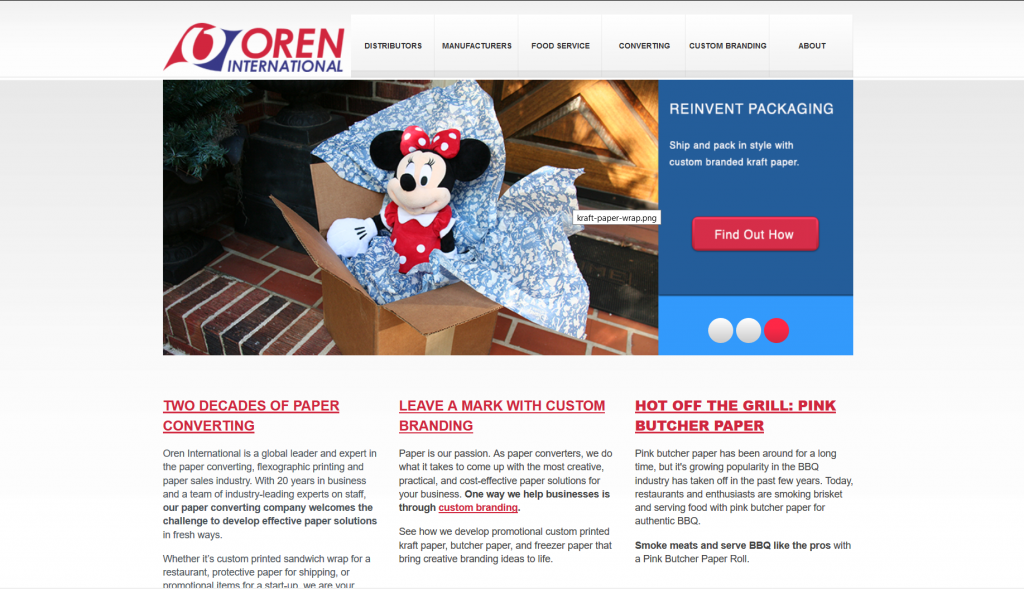
This is a company that deals with paper, more specifically the use of this material within various business sectors.
Within its website, Oren International explains how it can partner with companies to bring their visions to life and conveys a passion for the possibilities of paper.
There is a voice and a perspective, which is why Oren’s communication can be called effective.
The company describes what it can do for its customers-from developing innovative alternatives for product components to make them greener and cheaper to working with designers to implement ideas.
In the first three months since launching the new site, Oren has seen a conversion rate of 69 percent for the eBook dedicated to restaurants and 86 percent for the one dedicated to the environment.
Both results demonstrate the company’s broad expertise and commitment to providing an interesting narrative.
3, Who are the characters in your story?
Every brand story has its main characters-those who helped it take shape.
“Was your business inspired by a book or a TV series? Did the founders have a chance encounter that changed their lives? Was there a sympathetic fact that started it all?”
To find the heart of your story you must begin by identifying all those people (real or fictional) who made your business thrive. In this way you can create your “cast of characters.”
4. What is your mission statement?
This is the ultimate reason for your being in business.
“Why did you create your company? What niche are you responding to? What problems are you trying to solve?”
Method Products founders Eric Ryan and Adam Lowry set out to transform the detergent industry by creating products that “inspire a happy, healthy home revolution” with ingredients that “come from plants, not chemical plants” and will be “role models.”
The same goes for Lush, a well-known natural cosmetics company. The founders have made their products a symbol against animal testing and of full respect for the environment.
5. Have you experienced any failures?
Failure very often breeds success.
In your brand storytelling also include the problems you encountered on your way.
Showing all pitfalls transparently demonstrates humanity and will allow your users to feel more connected on a personal level.
Even Henry Ford failed in his early activities and lost his fortune five times before founding the Ford Motor Company. This makes the company’s history all the more fascinating.
6. What are your weaknesses?
As you dive into the question-and-answer session, pay attention to weaknesses as well.
It is often from the gaps that the most interesting stories are born. Blanks can be filled in by creating a timeline that summarizes your company’s story.
But don’t blame others for your problems: be honest and recognize the good and the bad.
You will find that the most interesting part of your brand storytelling will emerge from those moments you would not normally highlight.
Storytelling in business communication: Conclusion
Before you can explain it to others you have to know yourself who you are.
A brand that does not have underlying value propositions has likely internal discrepancies and will never be able to share its story with the world in an honest and engaging way.
Remember that this communication strategy is not the preserve of only large corporations.
Small business storytelling captures attention and is an effective strategy to push on one’s product and connect with a new potential customer.
And are you ready to expand corporate communication using storytelling?
Want to learn more about enterprise storytelling? Don’t miss these articles: