


In this article we discuss Inbound Marketing campaigns and why they allow us to build trust with contacts to turn them into Loyal Customers over time.
Before going into the details of the strategy, it is important to remember that a loyal customer allows us to:
- maintain our market share
- Increase sales of our products and services
- Acquire new customers, through word of mouth
- improve Brand Awareness
We called it: the Stray Cat Strategy 😂😅
Picture this scene: you are taking a walk on a quiet afternoon when, in the bushes or near a garbage can, you notice a stray cat.
His appearance is unmistakable: thin, shaggy fur, eyes full of wariness. He watches you from a safe distance, attentive to your every move.
What do you do? Do you rush up to get it? Of course you don’t. You know that a sudden gesture would scare him away, probably forever.
Instead, you slowly lower yourself onto your knees. You reach out an open hand, showing harmlessness, and begin to whisper sweet words.
Patiently, stand there, still, letting him decide to approach.
Maybe today it won’t happen, maybe not even tomorrow. But you keep coming back, showing yourself kind and trustworthy. Each meeting is a small step in building trust.
One day, the cat comes up to you, sniffs your hand, and then … lets you pet it.
From that moment, the bond is created. Not only does the cat trust you, but he begins to expect you every day, knowing that you will bring something for him, perhaps a treat or a meal that makes him feel safe and cared for.
This is the dynamic behind an inbound marketing campaign: a step-by-step process of patience, perseverance and focus that leads customers to trust you without feeling forced or insecure.
What does the Stray Cat Strategy teach an Inbound Marketing campaign?
Just as winning the trust of a stray cat requires gentleness, so does the way you approach your potential clients.
Often, clients find themselves in a similar distrustful condition as the cat.
Perhaps they have been bombarded by invasive advertising campaigns or have had negative experiences with companies that promised a lot but offered little.
That is why you cannot afford to “jump on” your potential customer.
Traditional marketing, often referred to as Outbound Marketing, is based on the idea of interrupting the customer’s journey with direct and insistent messages.
Think commercials, cold calls, or unsolicited emails-all tactics that are likely to scare the potential customer away.
With Inbound Marketing, however, the customer is at the center.
An inbound marketing campaign allows you to show up unobtrusively, offer value and build trust one step at a time, until he himself decides to approach your brand and interact with you.
The 4 phases of an inbound marketing campaign
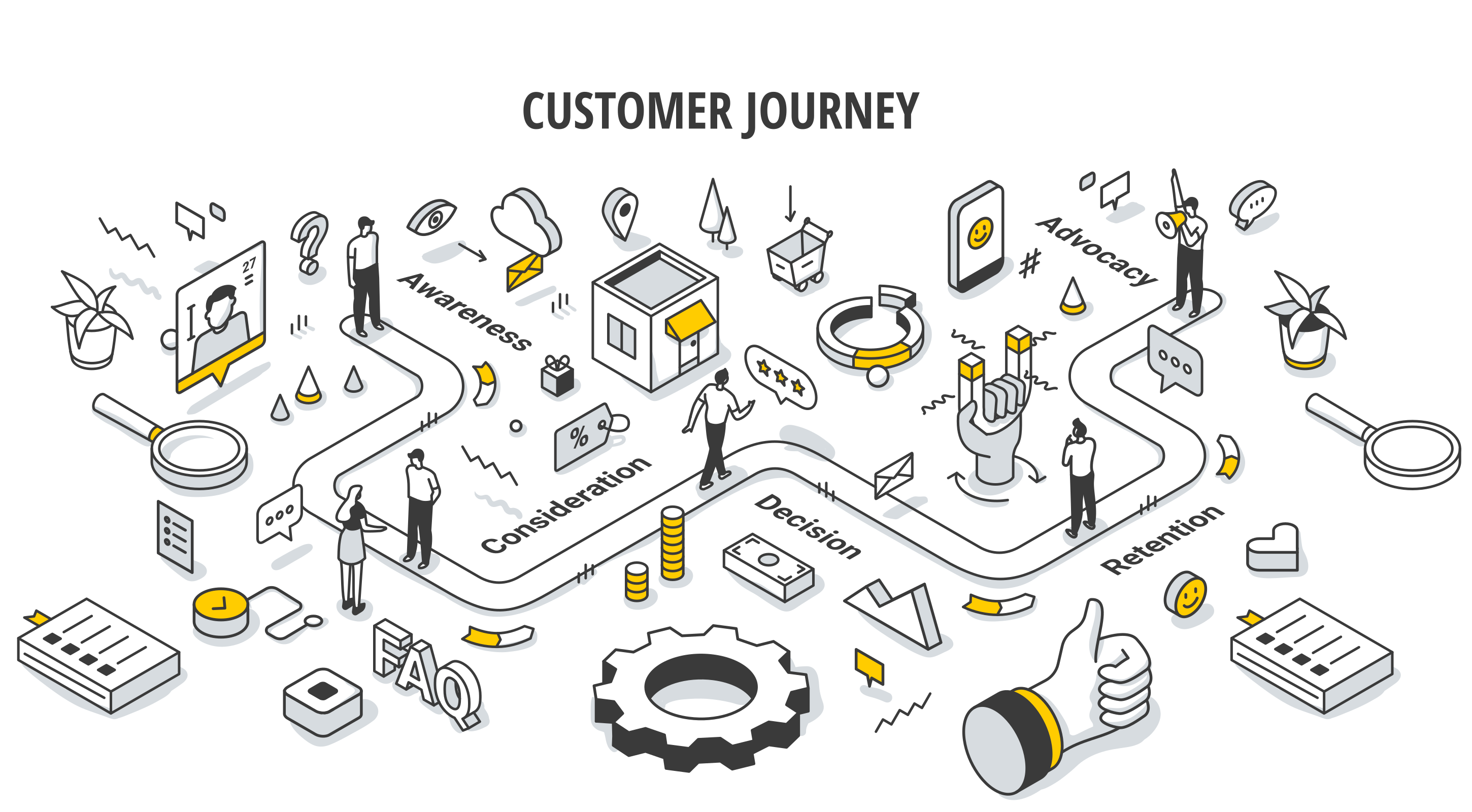
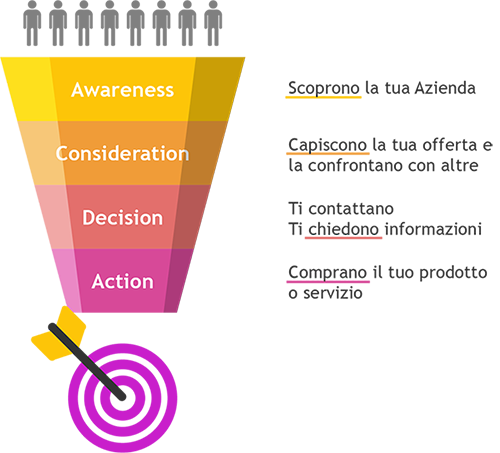
The inbound marketing campaign is based on the buyer’s journey.
The buyer’s journey is the path a potential customer takes from the moment he or she realizes he or she has a need or problem to the moment he or she chooses and purchases a product or service.
Traditionally divided into three stages (awareness, consideration, decision), it is now often considered to be divided into four stages to better reflect the complexity of modern buying behavior:
- awareness
- consideration
- decision
- retention (loyalty).
This four-step model allows companies to tailor their communication and marketing strategies to the different needs and questions that the customer manifests at each point in the process.

Step 1. Attract: how to get noticed by potential Clients
The attraction stage is when you get noticed by your potential customers, just as the cat notices your presence.
To attract the customer, you need to create content that addresses their needs and questions.
For example:
- Blog articles(content marketing) that address issues specific to your industry.
- Video tutorials showing how to solve a problem.
- Social media posts that inspire or educate.
This content must be optimized for search engines (SEO) so that customers can easily find you when they search for information online.
Step 2. Convert: turn visitors into contacts
Once the customer’s attention has been caught, it is time to turn them into a qualified contact, or lead.
This stage is comparable to the moment when the cat comes up to sniff your hand: it is a signal of interest.
To convert a visitor into a lead, an inbound campaign uses tools such as:
- Landing pages: dedicated pages that present a specific offer.
- Call-to-action (CTA): buttons or messages that prompt the customer to take an action, such as downloading an eBook or signing up for a newsletter.
- Contact forms: simple forms in which the customer leaves his or her information in exchange for valuable content.

Step 3. Closing: making the Lead an Ideal Customer.
After collecting contacts, it is time to make them customers.
This phase requires attention and care. It’s not enough to send commercial offers-you must continue to nurture the relationship with useful, personalized content.
Useful tools at this stage include:
- Email Marketing: sends targeted messages based on customer interests.
- CRM (Customer Relationship Management): manage customer data to personalize each interaction.
- Marketing automation: automates some tasks, such as sending emails, to maintain contact without being invasive.
Step 4. Build loyalty: create lasting relationships
The most important part of the process is loyalty. Just like the cat that starts waiting for you every day, the loyal customer becomes a natural promoter of your brand.
To retain a customer:
- Give them an excellent experience even after purchase.
- Keep in touch with post-purchase content, such as guides or tips: you can use articles on your website, or expand your social media marketing strategy.
- Listen to the customer and promptly solve their problems.
A successful, well-structured inbound marketing strategy does not just attract new customers, but works on their retention, turning them into ambassadors of your brand.
Conclusion: trust as the ultimate goal
Just as with the stray cat, your goal is to build an authentic bond with the customer.
If you have patience and perseverance, the customer will begin to trust you, knowing that you are there to offer them something of value.
And then, one day, it happens: the cat decides to follow you home. Maybe he sits on your couch, maybe he sleeps at your feet. And when he starts purring-it’s done! It means he only wants you.
In Inbound Marketing, those “merges” represent established trust: the customer is no longer looking for alternatives, because they have found in you the solution they were looking for.
Rely on Factory Communication for your successful Inbound Marketing campaign!
If you want to develop an inbound marketing campaign that attracts customers, builds trust and creates lasting relationships, we are here to help.