



How a Marketing strategy and CRM enable you to increase the number of Customers and sales.
With the digital transition just around the corner, Italian SMEs are increasingly being called upon to cross the threshold into the world of the Web, positioning themselves properly online to remain competitive in today’s market.
We talked about this with Donato Cremonesi, CEO and Founder of Factory Communication, a web agency specializing in online positioning of Companies.
Download the interview in PDF format
CRM: A fundamental tool
To put in place an effective strategy for online positioning and win the competition, Cremonesi explains, two factors are crucial today:
1) Collect and catalog as much information as possible about our Customers and potential Customers
2) Create the right relationship of trust with our potential Customers to turn them into Customers.
The question every Entrepreneur should answer is: why should a customer choose my company and my products or services?
Except in special cases, an Italian SME does not enjoy the visibility of large companies. It is known by a small audience.
When it decides to go online, it enters a decidedly large market, most likely already manned by its competitors.
Therefore, it is crucial to define a strategy that first captures the user’s data and then builds the right trust relationship to turn the user into a customer.
This strategy is called inbound marketing. Underlying it all is data, which must necessarily be managed with a CRM.
We at Factory Communication are HubSpot Partner Agency, the Company that brought the concepts of Sales Funnel, Inbound Marketing and Marketing Automation to the world.
Data and strategy
Over the past two years, one of the most frequently asked questions has been: why does using the HubSpot CRM enable us to significantly increase the number of Customers and sales? I try to give a concise answer.
Let’s imagine that we implement a Marketing Campaign that conveys 1,000 users to our website, or e-commerce.
Generally, conversion is represented by the number of people requesting information through forms, or making a purchase on our e-commerce.
Generally, this conversion rate is never more than 2 percent. It means we captured 20 contacts or made 20 sales. What about the other 980 users?
Thanks to HubSpot we can integrate, in a single platform, all the Company’s communication channels.
The website contact forms, the newsletter subscription form, the website chats, Facebook Messenger, the WhatsApp channel, just to say the main ones.
All channels save their data in one place: the HubSpot CRM. This makes it significantly easier and faster to profile users and get them, as they say, into the Sales Funnel.
Not only that. When a user is cataloged in the CRM, from that very moment HubSpot detects all the pages the user visits on our website or e-commerce, acquiring the precise information about the user’s real interests.
HubSpot and Inbound Marketing
Inbound marketing represents the strategy that puts the person at the center of all relationships with the company.
The goal of this innovative business strategy is to provide useful and valuable information to meet the needs and wants of the person who connects with the company, otherwise the only data the person has to make a purchase decision remains price.
Let us return to our previous example. Let’s imagine the 1,000 users coming to our site.
They do not know our Company and do not know whether we can solve their problem. Generally, filling out a form expresses a very high degree of interest. For this reason, very few people do it.
Offering the opportunity to sign up for a newsletter or chat with an operator through the site is, for the user, an easier way to request information.
For this reason, integrating these channels into CRM makes it possible to increase the number of saved users, the famous, LEADs.
Thus, we have achieved an important goal: to gather more people interested in our products and services. The next step is to send them a structured newsletter with useful information: how to make a recipe with our products, how to best use our software, how to maintain our PC.
In many cases it means “giving away our know-how,” it may sound crazy, but only in this way can we create a bond of trust and enter the minds of our potential Clients as experts in our subject matter.
In HubSpot it is also possible to activate a workflow, an automated luxury called Marketing Automation, which sends specific customized and targeted information to the user.
We can say: the right message, at the right time, to the right person. Only in this way can we score goals and increase our market share, winning over the competition.
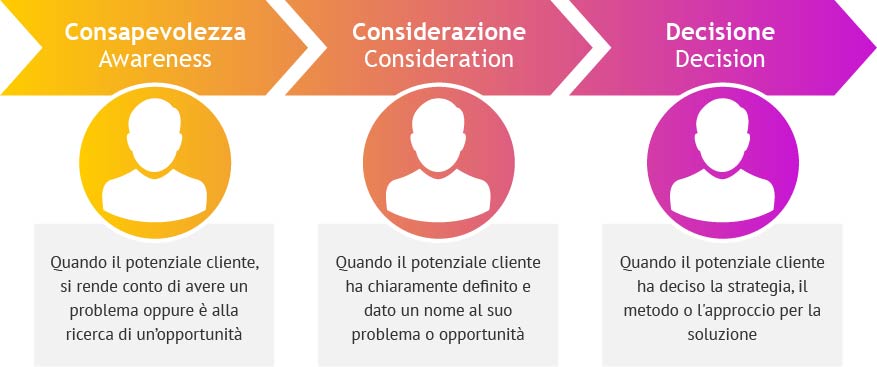
Buyer’s Journey
Increase leads and sales

Inbound is the marketing strategy for correctly positioning a company in the marketplace by distinguishing it from its competitors and establishing the right relationships with its users.
By holding this line, it is possible to acquire many new contacts and Customers, consequently increasing sales significantly and increasing Customer loyalty and membership in the company.
To implement this strategy, it is essential to define who you want to address (your target audience, called Buyer Persona) and what kind of relationship you currently have with the potential customer (Buyer’s Journey).
Identify your Buyer Persona
The “Buyer Persona” represents one’s ideal customer, those with whom one wants to relate primarily in selling one’s products or services.
Not only that, it also allows us to define those with whom we do NOT want to relate.
Identifying your Buyer Persona means knowing in depth who you are, what your needs are, what communication style to use (tone of voice), what content to send.
Basically how to intercept it and how we can be of help In Factory Communication, we consider the construction of the Buyer Persona an extremely important phase that determines the entire Marketing Strategy.
No Buyer Persona No Strategy!
Tracking needed to advise the user

Whenever a possible user is “cataloged” in HubSpot (newsletter, chat, form, e-commerce, WhatsApp, Linkedin, etc..), the latter analyzes the user’s behavior on the website, detecting the pages viewed. In this way, we can profile the user based on explicit information – such as first name, last name, email, company, city, etc. – and implicit: what pages he has viewed = what his real interests are.
HubSpot means not only Marketing Automation is, first of all a powerful Business Automation platform that integrates and automates all areas of the Company: Marketing, Sales, Technical, Customer Support.
Four business stages to grow the business
Many Companies see the sales funnel as a “squeezing” process. I feed my Marketing and Sales department 10,000 names to “process”: newsletters, emails, the many obnoxious phone calls. Goal to convert some of them into customers.
Those who do this type of activity, on average, do not convert more than 2 or 3 percent. The other contacts are thrown away. When the process is over, you start over with an additional 10,000 contacts.
Inbound marketing, on the other hand, allows us to build trust with users and generate a positive flywheel for our Business, as it is a strategy focused on the medium to long term.
The conversion rate is significantly higher.
Do you have an e-commerce business and want to find out how to increase sales? Also read these articles