


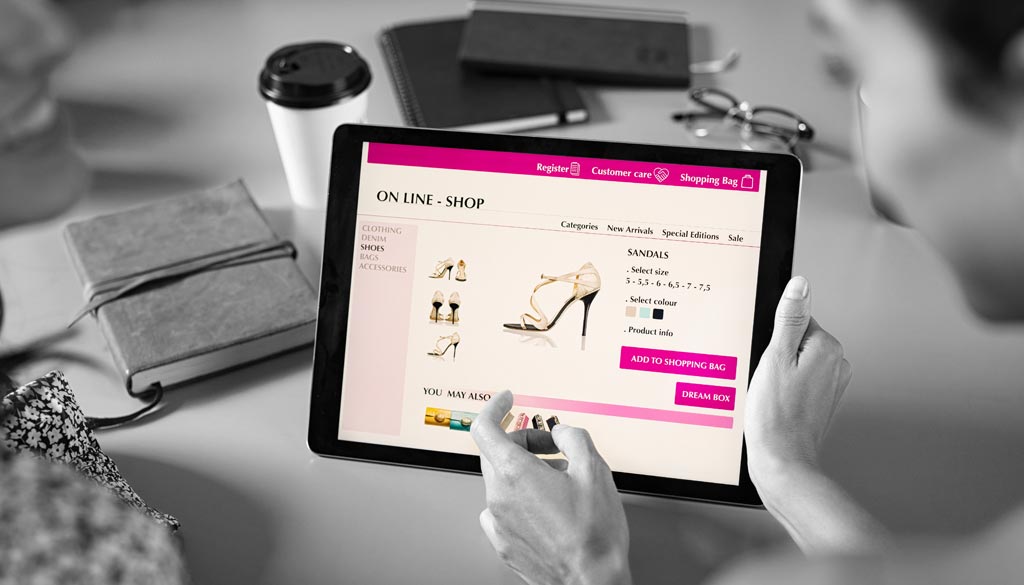
In this article we look at the activities and investments you should make to open a site to sell online versus a traditional store.
In the digital age, the business scenario is experiencing a real revolution.
On the one hand we have the warm and tangible traditional store, and on the other hand the innovative and accessible online store.
But which is the best choice for entrepreneurs and consumers? Let’s explore together the advantages and disadvantages of both options.
Want to open an online store, but don’t know the benefits of e-commerce? Read our article, but to the end.
Opening a site to sell online: why you should do it
If you own a business that sells products in a traditional way and want to expand your business, opening an online store is the solution for you.
Below we have collected four good reasons for you to jump into the e-commerce world without any fear.
1. eCommerce is a growing industry
When choosing your business model, it is always good to examine trends and migrate to markets where growth is possible.
Current statistics show that opening an online store is a good choice for all those entrepreneurs who are interested in diversifying and expanding.
In short, if you wish to enter the e-commerce world, there is no better time than now: opportunities are growing day by day.
2. You can earn money even while you sleep
For local businesses, the location and the area in which they operate is vital.
When you open an online store, on the other hand, you can get to sell all over the world, obviously only and exclusively with a solid integrated SEO and communication strategy at the base.
Working on these two aspects, you will be able to get straight to your audience, working in an inbound marketing and encouraging direct contact between the parties.
For this reason, before opening an online store you will need to turn to a communications agency that can follow you step by step or train you in web logic.
That said, opening an e-commerce will allow you to make money at any time and not just based on days and hours of operation. Paradoxically, you will be able to sell even while you sleep.
3. There are many users who buy online
Research shows that80 percent of users shop online. As you can well imagine, this number is likely to grow with time.
It is mainly members of the Millennials and Gen Z generation who make purchases in online stores, and you should know that, to date, the combination of these two generations constitutes the highest purchasing power in existence.
Meeting the needs of Millennials and Generation Z means looking to the future and adapting to and riding an absolutely growing trend.
4. Reducing costs and increasing profit
By opening an online store, you can substantially decrease the costs you might incur by opening a new physical location.
Thus, cutting down fixed and variable costs allows more profit for the entrepreneur.
In addition, being able to sell throughout the country and even around the world, rather than being limited to a single geo-localized territory, allows for a greater return on investment, which to date is critical to decreeing the success of a business.
Clearly, all that glitters is not always gold.
Let us analyze in detail problems and advantages for arising from opening a site to sell online.
Is it easy to open a site to sell online?
An e-commerce or virtual store can be a great opportunity for a new business venture or to improve the economic and business performance of your current Company.
It is important to say that creating a virtual store is not super easy, so many skills are required, basically it is like creating a real store.
First of all, it is essential to establish the sales strategy, define the target audience, understand the market, competitors, the right price etc.

Online store: Navigation and usability
Once the strategy has been defined, as in a normal store, it is important to define with the Architect the spaces(usability) of our store: how the individual section is accessed, how the products are arranged, what paths the user has to take to get to the checkout or information office etc;
Then it is the turn of the engineer. If the store is small the engineer is required to make a small effort but if it is a large e-commerce then a structural engineer is needed, as if we are building a large supermarket.
We must take into consideration that our store must be able to accommodate multiple people at the same time, who use the content in different languages and buy with different currencies.
In this case the engineer will really have a hard task and a lot of work to do.
It is also very important to design the technological resources that are essential to make our store active and fast, what we call in the jargon the iron (servers, routers etc..)
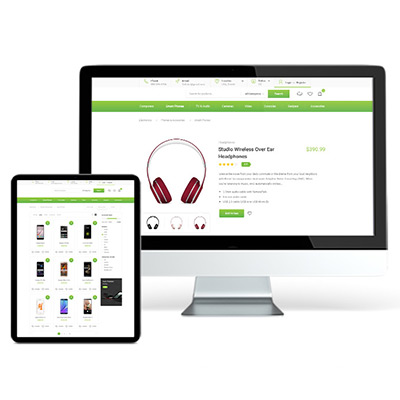
Opening an online sales site: visual and process management
At the same time Architect and engineer will talk with the Designer who is working on the visual part of our Store.
What colors to use, how big the lettering should be, how and where to place the photos etc…
At this stage, it is also very important to relate to the store manager, that is, the one who is physically responsible for running our store:
- How are the products uploaded? If they are tens of thousands it certainly cannot be done by hand.
- How are invoices issued?
- Is e-commerce connected to a management system and CRM or not?
- How are inventories managed?
- What must the user do to return a product?
- What is the purchasing and payment process?
- What up-selling and cross-selling activities can I do?
- What customer care, pre- and post-sales services can I perform?
These are just some of the activities that need to be designed, developed and managed to go in the best way our virtual store.
After this brief overview, we can only reiterate the concept that starting a web store is not an easy business and cannot be improvised.
It is also critical to budget some of the money to carry out PPC campaigns, SEO activities, good link building and SEM activities to generate a good revenue driver right away.
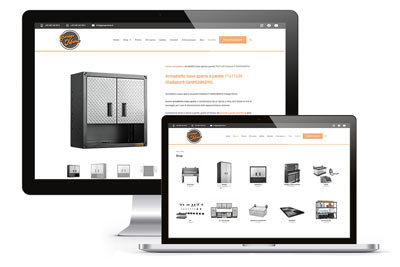
Opening an eCommerce site: success factors
With the exponential increase in online shopping, e-commerce has become the preferred shopping mode for an increasing number of users.
The convenience of being able to make purchases from anywhere, anytime, simply with a click is an irresistible attraction. But what are the real advantages?
H24 Availability
An online store never closes: open 24/7, it offers consumers the freedom to shop without time or geographical constraints.
Improved Visibility through SEO
Unlike physical stores, an e-commerce store can effectively leverage SEO techniques to improve its online visibility by attracting a steady stream of new customers.
Careful product descriptions, intelligent use of keywords and quality content become powerful tools for climbing the search engine ranks.
Ability to integrate and use all web communication channels and social networks
Opening a site to sell online allows us to use 100% all communication channels such as email, social media, WhatsApp and SMS Marketing.
In addition, if you link sales channels with a CRM (customer relationship management) you can also save all the data in one platform.
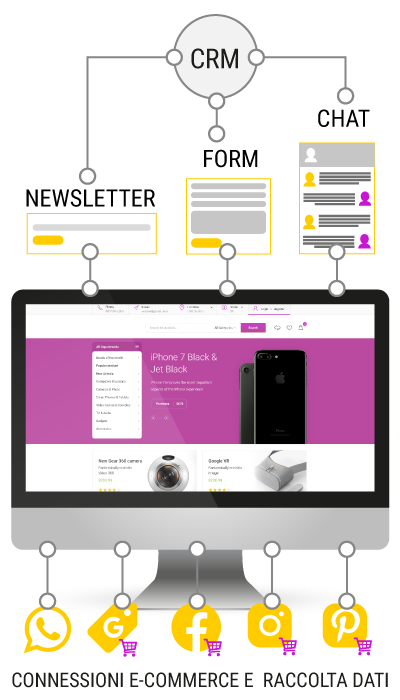
This strategy has several strengths and enables multiple activities including:
- Acquire lots of leads (potential customers)
- Send targeted information to turn leads into customers
- Establish a relationship of trust
- Increase sales per customer of their products or services
- Manage reviews
Customer Behavior Analysis
With integrated data collection, e-commerce companies can monitor customers’ shopping habits, personalizing the offer and enhancing the online shop experience, a marketing strategy that strengthens customer loyalty and brand loyalty.
Reducing Operating Costs
Unlike a physical store, an e-commerce store does not incur significant rental, furnishing or maintenance costs.
Inventory and personnel management is also more streamlined and less burdensome, thanks in part to the help of technologies such as chatbots.
The unparalleled charm of the traditional store
Despite the indisputable convenience of the online store, the physical store retains its irreplaceable appeal, offering unique experiences that the virtual world cannot replicate.
Sensory Experience
The traditional store allows customers to touch the products with their hands, to feel their quality through their senses, an aspect that for many consumers remains crucial in their purchase decision.

Human Interaction
The direct relationship with staff, who can offer personalized advice and assistance, creates significant added value by establishing an emotional bond between customer and brand.
Instant Purchase
Unlike e-commerce, which requires shipping time, the physical store allows immediate purchase and possession of the product, which is crucial for last-minute purchases or urgent needs.
Local Impact
Physical stores play a vital role in the local economy, contributing to the vibrancy of communities and providing employment opportunities in surrounding areas.
Price comparison
Price comparison is a very useful function for online users, which, however, can put our e-commerce in crisis if we have “out-of-market” prices. That is why I have included it in the advantages of traditional stores.

Open e-commerce site VS traditional point of sale: cost analysis
Opening an e-commerce online has significantly reduced costs when compared with a physical store.
It also has significantly more effective and immediate business scalability factors.
Let’s see in detail.
| Item | Open a website to sell | Traditional Point of Sale |
| Dimensions | The online store can expand indefinitely, or shrink in a short time without any problems | Space variation is always a problem. |
| Rent | The cost can gradually increase depending on the size of our online store. Initially we can start with shared hosting and then opt for dedicated servers etc. | It is a fixed cost that is difficult to scale and is directly proportional to the size and location of the store. |
| Showcases | Infinite | They depend on the structure and size of the PV |
| Utilities | Apart from electricity, which should be part of the hosting service costs, costs related to maintenance should also be considered | Utilities such as electricity, water and gas are directly proportional to the activities taking place at the store |
| Personnel (excluding Marketing and Administration) | According to the complexity of e-commerce different figures must be considered. we have to consider: store manager, web designer, developers, DB manager, content creator, SEO Specialist and SEO Strategist, help desk support, logistic manager, affiliate manager | Various figures should be considered depending on the complexity of the store: store manager, sales staff (directly proportional to floor area and hours), cleaning, |
| Commodity categories | Virtually infinite, they can also be organized into separate sections and/or mini-sites with different visuals | The greater the categories, the greater the problems related to warehouse management |
| B2B and B2C | They can coexist without any problem. They differ when logging in. | It is generally difficult to have them coexist in the same place because they have different needs. |
| Clientele | Unlimited: local, regional, national and international | Generally targets the population of the area |
| Competitor | They can be endless, because in addition to those we know there are also bloggers, influencers editorial heads etc. | Generally they are the ones immediately close to us |
| Price lists | infinite and segmentable | generally unique, the introduction of different lists require complex procedures |
| Product search | Searching can be done in multiple ways: by words, product codes, images, colors etc. | Research is almost always delegated to staff present at the point of sale |
| User Experience | Depends on the interactive of the online store. can greatly engage the user. | It depends on the skill of the staff. An excellent physical experience remains unbeatable |
| Opening Hours. | Always open 24/24 – 365 days a year | The longer the opening days and hours, the higher the costs associated with staffing |
I have listed only the main differences, but the list lengthens considerably in favor of choosing to open an online store if we talk about bureaucracy (licenses and permits) and customer support activities.
With chatbots, time and costs can be maximized, ensuring a more than positive shopping experience.
Open a traditional store, how to do it
What are the steps and activities I need to do to set up my store?
- Searching for the right Location. What if people don’t come by?
- Store rental. What is the right size of my store?
- Should I get it small or large? How many display cases?
- What kind of furnishing should I do?
- If it goes bad, how long do I have to pay the fixed charges? Generally, the termination of a lease takes at least 6 months.
- If it goes well, can I get bigger quickly? It is generally difficult, because it means: looking for new space, changing the lease etc.
Open an online store how to do
What are the steps and activities you need to do to set up an online store?
- Having no physicality is no problem. It is enough to register the domain and Hosting space (folder on which our e-commerce is saved) with an authoritative and reliable Provider. Hosting space, unlike in the past costs very little and has high performance. Do not skimp on this service. It is your store open 24/24, 365 days/year
- What is the size of my hosting space? No problem, you can increase or decrease it at any time.
- If it goes wrong, how long do I have to pay the fixed fees? Apart from the cost of e-commerce development, which depends on the complexity you require, generally hosting spaces have very low costs and it is possible to make them even with monthly fees.
- If it goes well, can I get bigger quickly? If you have developed your E-commerce using the right platform, basically your store can enlarge indefinitely.
After looking at the main differences between e-commerce and physical store, let’s see in detail what you need to do to sell online.

Open an e-commerce website: your check list
Are you deciding to open your new e-commerce business? Read our checklist of things to do and/or consider:
- Registering the right domain name: affects search engine rankings
- Purchasing hosting space: don’t skimp on this point your online store needs to be super fast
- Choice of program to use: you can have your eCommerce developed, or use one of the many solutions on the market such as WooCommerce, Magento, Shopify
- User Experience Design
- Implementation of SEO strategy, includingSEO analysis of competitors
- Design and implementation of all architecture
- Content realization, possibly SEO oriented
- Implementation of logistics and connection with different “couriers”
- Implementation of payment systems
- Definition and management of return procedures
- Online order management
- Implementation of price lists, especially if you run B2B and B2C on the same site
- Implementation of tools forcart abandonment management
- CRM Integration
- Integration of chat bots, information request systems (email, phone, WhatsApp, form) and newsletter subscriptions
Conclusion: opening a website to sell and PV, a possible synergy?
In conclusion, both opening an eCommerce and the traditional store offer unique advantages, meeting different consumer needs.
The key may lie in creating a hybrid model, integrating the efficiency and accessibility of online with the authenticity and sensory experience of offline.
We invite readers to reflect on their own shopping experiences and preferred modes, remembering that innovation and tradition are not necessarily at odds, but can coexist harmoniously, enriching the shopping experience in previously unimaginable ways.
To delve further into the world of e-commerce and retail strategies, explore other articles on our site and stay up-to-date on the latest trends and innovations in digital and traditional commerce.