



“The Purple Cow” is definitely one of Seth Godin’s best sellers.
If you have not yet had the opportunity to read this book I recommend you read this article.
Reading time: 6 minutes
The books that talk about Marketing are really many.
I must say that it is such a vast and complex discipline that, whatever books I have read, I have always gained valuable lessons from them.
At least a different point of view.
“The Purple Cow” is definitely one of the best sellers, and Seth Godin, the world’s marketing guru, certainly needs no introduction.
As for the “The 22 immutable laws of marketing: it takes courage to ignore them” this article was also written by Alessandro DePau.
The Purple Cow by Seth Godin
The old marketing paradigm included the 8 P’s: Product, Price, Promotion, Placement, Advertising, Packaging, Word of mouth, Permission.
Whereas in the past it was enough to coordinate them to make success likely, something has changed today.
The main difficulties are:
- the most obvious problems have already been solved, and consumers definitely have fewer and easily solved problems
- it is harder to reach consumers: brands and their products are ignored
- word of mouth has disappeared: satisfied consumers are less willing to talk about the products with which they are satisfied.
So, these P’s are no longer enough, a new one is needed: the Purple Cow.
Cows, observed for a time, become commonplace; a purple cow, on the other hand, aims for the extraordinary, arousing interest, at least for a while.
Today, we find ourselves in an age of advertising and product invasion, consumers do not have time to research the goods that have been made for them, it is necessary to develop marketing of the extraordinary.
Marketing is often understood as the last step after the product has already been made. But marketing is the product, and the product is marketing. The study of an extraordinary product or service, is already marketing.
The diffusion curve
Each product has a bell-shaped diffusion curve.
On the left are the early adopters (early adopters), which are those who first buy the product driven by enthusiasm or passion of a certain field. Next comes the majority of users (divided into early and late adopters).
To the right of the curve, on the other hand, are the laggards, those who buy when the product is now obsolete.
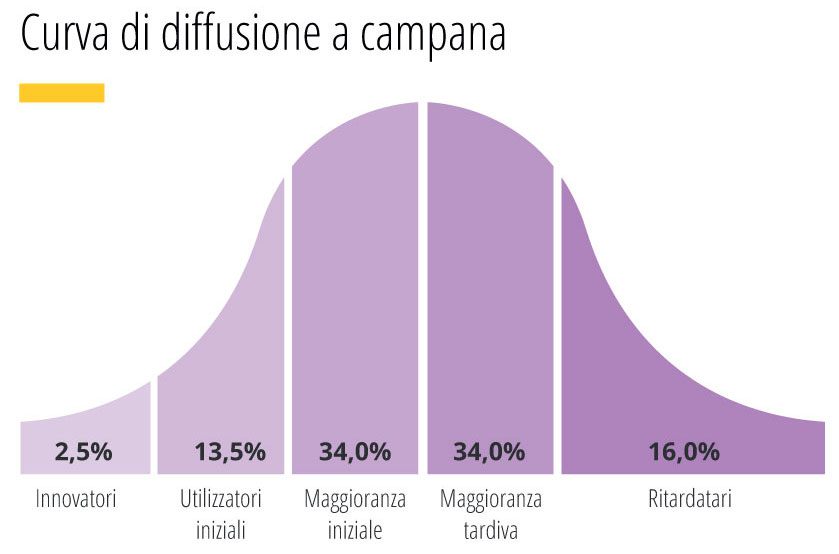
Old-fashioned marketing was geared toward the middle part of the curve, that is, the most numerous. This is what is shared by the industrial-television system, which has now always been aimed at the great masses.
The problem is that now the capital spent on TV advertising does not give an obvious economic return.
The mechanism no longer works: it certainly offers a result in the immediate (0 to 1 is always better 1) but in too short a time, that result vanishes into thin air.
Today the rule to follow is “create extraordinary products that can attract specific people.”
Who can we turn to?
So one should not target users in the center of the bell, rather early adopters. They are the ones who by word of mouth influence the rest of the curve substantially.
They are the right people to invest in. These people have the ability to take risks and spread ideas. Thanks to them, the masses feel confident in buying the new product/service.
The perfect sneezers are those who haveotaku, which means “real passion for something” in Japanese. The smartest companies target markets where otaku is already present.
You have to create a product that is extraordinary enough to attract early adopters, but flexible and appealing enough for it to be spread easily along the rest of the curve.
Ideaviruses are the idea viruses, which can be spread. And who spreads them best? Those who “sneeze,” and they are usually the early adopters. They are the ones to whom publicity should be directed.
The niche
We should not aim to reach the largest market, rather aim to win a single niche. We need to find a small slice of the market that has a positive reaction.
Here are the key questions before developing a new product/service:
- Is the idea easy to spread?
- Will friends be infected with the ideavirus?
- Is the target audience cohesive?
- Do its members have much dialogue?
- Do they trust each other?
- Do sneezers have a good reputation?
- Is the idea durable and long-lived?
In most cases, successful products are designed from the outset to be successful.
The Purple Cow is not a shortcut to saving money, but it is the best, or perhaps the only, strategy to have steady growth.
It is useful to break down not only the areas we target, but also the segments of our customer base. For example, we can identify the most profitable group, the one most ready to sneeze, and ignore the rest.
We focus only on them, both in product development and dissemination.
By addressing a niche, it is even easier to become a leader. In fact, the leading brand has a huge advantage over others, and paradoxically has a greater chance and margin for growth.
We need to find an underserved niche and dominate it. First you find the niche, then you make the extraordinary product, not the other way around.
Risk and fear
The Purple Cow is very rare because people are afraid: being extraordinary comes with the risk of not pleasing someone. But the only way to be extraordinary is precisely to expose yourself to some criticism. The real risk is to be cautious.
To overcome the fear of criticism, we need to think that criticism is aimed at the project not at us. Being criticized is normal. Those who have projects that are never criticized fail.
How can we know which ideas will fail and which will provide a return on investment and hard work? Simple: it cannot be predicted. You cannot know in advance whether an idea is extraordinary or too risky.
To launch extraordinary products, you have to be a leader, not follow leaders.
Another risk is this: the same word of mouth that can make a product an extraordinary success can also make it the object of ridicule or parody. Brands do not want to hurt the public’s susceptibility, and that is why they do not dare, making trivial products.
It is not necessary to be extravagant, brash or original. Just be irresistible to a small group of easily accessible virus spreaders who have the otaku, burning passion for our potential product. Warning. Irresistible, does not mean ridiculous, irresistible means extraordinary.
What to improve in marketing
Too often, marketing comes when the product is already finished.
This, in addition to targeting the masses, also requires much larger budgets. It is necessary to make promotional ads work very quickly.
If you do not break through and win collective attention, there will be no second chance. The product will be declared finished.
One solution may be to allocate this budget to designers, and marketing to create the product.
Better to launch 10 products at a cost of 10 million each than to invest 100 million in advertising for one product.
Obviously, the results of marketing activity must be measurable and measured. It is the only way to grow.
The magic cycle of the Cow
Here are the four steps:
- Get permission to talk to people to whom we have made a good impression from the very beginning. We must treat them well, gently, without squeezing them or spamming them.
- Work with sneezers within this group to facilitate the spread of the idea. We need to provide them with the tools (and the script) to sell the idea to the masses.
- When the overtime has already been achieved and the business is working, we hand over the task of milking the cow to another team. How? By adding new products, services or variations of the same.
- Reinvestment. It is necessary to create and launch another Purple Cow, without fear of failure.
The Purple Cow: some ideas for creating extraordinary products
- Devise a customized product tailored to the client.
- Sometimes creating an ugly, uncomfortable or irritating product can be the winning idea, as it was for the Volvo and the Hummer.
- Propose an exclusive product that can offer a unique experience. Choose a small niche, and occupy it with a simple idea that is easy to spread.
- Or, conversely, create a product that is difficult to use so that a “hard core” of loyal, cohesive people are created who are committed to the cause. Such has been the case with Linux.
- Create special or limited editions of your classic products.
- If you offer a service, be reliable and allow the customer to know as much as possible about the status of the service. This is what Federal Express has done with real-time package tracking.
- Invest in customer service, make that aspect extraordinary as well.
- Lowering the price is not always the winning strategy; you have to combine lowering prices with trendy features and good value for money. As IKEA has done.
- Propose a product that arouses strong emotions, such as kitesurfing.
- Take care of the point of sale and staff so that it is conspicuous and so that people notice and talk about it.
- Go where the competition has never gone.
- Explore the limits. You may be the fastest, the cheapest, the most expensive, the slowest, the most fashionable, the coolest, the most efficient, the easiest, the noisiest, the most hated, the most posturing, the most outsider, the oldest, the most difficult, the newest, and so on.
7 strategies to put the Purple Cow into action
If your product is not too mundane, list the 10 ways to transform it and make it attractive to even a small part of your audience.
- Always think small, it starts here.
- Outsourcing is critical. There are many outside companies that can revitalize a product if you cannot.
- Communicate with your most loyal customers.
- Take your cues from brands in other industries. In particular, it is important to find sectors that are more stagnant than yours.
- Do more than the competitor at the forefront of your industry. Or rather, do the exact opposite of him.
- Find the “missing cherry” in your industry and devote yourself to developing that.
- Be resourceful. Do not be afraid.
The job search
All of these concepts can also be applied to job seekers.
Extraordinary people have much less difficulty changing jobs, and often do not even send out a resume.
Being extraordinary is the best guarantee for both keeping one’s job and being able to change and improve it easily, without even needing to look for a new position.
What usually happens is that sneezers talk to referrals from a new company that goes after them, and may offer them an improved position.
It is important to have many positive references; this way it is much easier to get an interview.
Want to learn more about social media marketing? Don’t miss these articles: