


Native advertising, or native advertising, is a digital marketing strategy that integrates promotional ads directly within the editorial content of an online platform.
The particularity of this advertising form is its ability to blend into the context in which it is placed, both graphically and editorially, resulting in consistency with the design, tone and expectations of users.
Native advertising does not interrupt the browsing experience, but blends with the content, offering added value and relevant information, without being perceived as invasive or annoying.
In other words, native advertising is a native advertising format that adapts seamlessly to its host environment, taking on the appearance of the surrounding content.
It aims to engage the user in a natural way, overcoming so-called “banner blindness,” or the tendency of users to ignore traditional advertising.
Native advertising: what it is and how to distinguish it
Native advertising differs from classic advertising formats, such as banners and pop-ups, in its ability to integrate seamlessly into the flow of editorial content.
Native ads are often labeled as “sponsored by” or “recommended by,” but they are designed to be contextually consistent, being less invasive and more effective.
Native advertising meaning: the term denotes a form of “native” advertising, that is, advertising that is born and developed within the publishing context, without altering the user experience.
Native advertising examples: what it looks like in practice
To better understand native advertising what it is, it is useful to analyze some concrete examples:
- Sponsored articles on news portals: Editorial content created in collaboration with a brand and published on news sites, such as the New York Times’ “Brand Studio.”
- Sponsored feeds on social networks: Ads that appear in the news feed of Facebook, Instagram, LinkedIn or Twitter, with the same format as organic posts, but marked as “sponsored.”
- Recommendation widget: Suggestion box at the end of an article, offering sponsored content similar to editorial content, as is the case with Outbrain or Taboola.
- Sponsored filters on Snapchat or branded challenges on TikTok: Creative formats that integrate into the user experience of social platforms, stimulating interaction and sharing.
- Infographics or branded videos: Visual content marketing, such as those created by UPS or KitchenAid in collaboration with industry media, that tell brand stories in an engaging and informative way.
These examples of native advertising demonstrate how it is possible to promote a brand without interrupting the user’s enjoyment of the content.
Native advertising: 5 Statistics to know
Here are 5 2026 statistics (or 2025 data with 2026 outlook) specific to Native Advertising that you can cite in your content.
- In 2026, investment in native display advertising in the United States is expected to grow by 13.1 percent to $147.98 billion in spending.
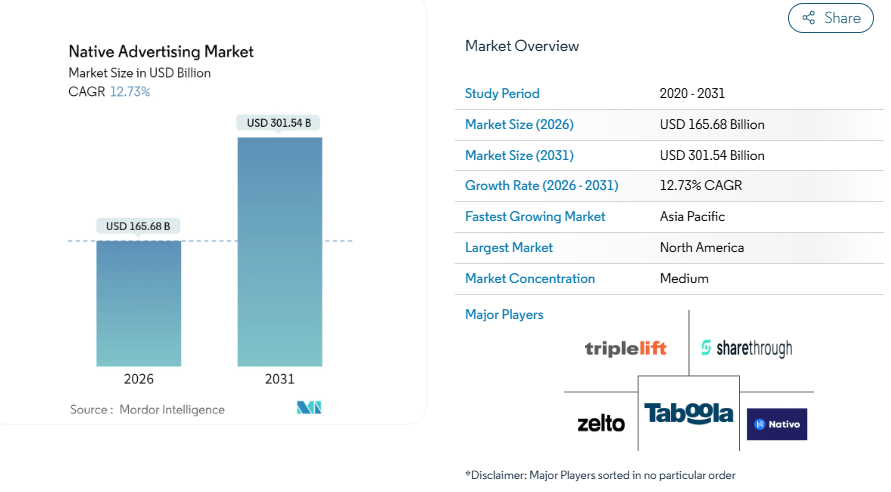
- Globally, the Native Advertising market in 2026 is estimated at $165.68 billion and is expected to grow to $301.54 billion by 2031, with a compound annual growth rate of 12.73 percent.
- According to the Native Advertising Institute, native content is viewed 53 percent more often than traditional banner ads, and exposure to native content generates an 18 percent increase in purchase intent over standard display.
- In the U.S. market, in-feed native ad units account for about 30 percent of native advertising demand due to their ability to integrate into the content feed and generate higher CTRs than intrusive display formats.
- Native video formats and content recommendation widgets continue to grow: recommendation units are expected to increase at a CAGR of 15.55 percent through 2031, reaching about a quarter of total native spending by the end of the decade.
Statistical sources Native advertising Trends
- Items 1 and 3: statistics found on the emarketer.com website.
- Items 2 and 5: statistics found on the mordorintelligence.com website
- Item 4: Statistics found on the futuremarketinsights.com website.
Native advertising: benefits for companies and brands
Native advertising campaigns offer a number of strategic advantages for business owners and sales managers, making them an increasingly chosen tool in digital marketing plans:
- Increased visibility: Native ads are viewed 53 percent more than traditional display ads, increasing brand presence with the target audience.
- Increased purchase intent: Native advertising campaigns generate an 18 percent increase in purchase intent, driving conversions and return on investment.
- Superior user experience: Integrating seamlessly into the editorial context, native ad offer a smoother and less invasive user experience than banners or pop-ups, resulting in a more pleasing user experience.
- Overcoming banner blindness: Native ads are less likely to be ignored, due to their consistency with editorial content, and record significantly higher click-through rates (CTR) and engagement rates than traditional formats.
- Increased credibility and trust: When hosted on authoritative publishing platforms, native ad boosts brand reputation: 84 percent of readers trust brands advertised on trusted news portals.
- Advanced Targeting: Enable you to reach the right audience at the right time, thanks to sophisticated personalization and targeting systems based on behavioral and demographic data.
- Added value for the reader: Native content provides useful information or entertainment, often perceived as adding real value and shared spontaneously by users on social media.
- Cross-device effectiveness: They perform particularly well on mobile devices, providing a consistent experience on desktop, mobile, and tablet.
- Tracking and optimization: Native advertising campaigns allow detailed tracking and measurement of results, facilitating ongoing optimization and personalization of messages.
- Access to established audiences: Offer the ability to tap into existing audiences on publishing platforms, without the need to build a user base from scratch.
- Improved brand awareness and lead generation: Native campaigns consolidate brand presence, fostering the building of lasting trusting relationships and generating new business opportunities.
Native advertising official definition
According to the Internet Advertising Bureau (IAB), native advertising refers to paid ads that are consistent with the context of the page and the design and behavior of the platform where they are hosted, so that the user simply perceives them as part of it.
Native advertising: why it is strategic for entrepreneurs and sales managers
For business owners and sales managers, investing in native advertising campaigns means taking an innovative, results-oriented approach. Native advertising enables:
- Reach new customers noninvasively: Native advertising intercepts the attention of potential customers when they are most receptive, without interrupting their online experience.
- Position the brand as authoritative: Presence in authoritative news outlets and industry portals increases the perception of brand reliability and authority.
- Generate direct and indirect sales: In addition to immediate conversions, the so-called “Native Effect” leads to increased organic sales due to the increased awareness generated by first contact with the brand through native ads.
- Optimize native advertising budget: The cost per click of native advertising campaigns is often lower than other formats, providing a higher return on investment.
- Strengthening omnichannel strategies: Integrating native ad with other digital marketing activities (SEO, social media marketing, email marketing) improves overall performance and synergy between channels.
Native advertising successful examples
- Forbes BrandVoice: Forbes offers companies the ability to publish sponsored content that integrates seamlessly with editorial articles, providing informational value and strengthening brand authority.
- BuzzFeed Sponsored Content: Brands such as Coca-Cola and Nike have used sponsored advertising content on BuzzFeed, leveraging the platform’s humorous and engaging tone to promote products in a natural way.
- Snapchat and TikTok: Branded filters and sponsored challenges allow brands to interact with a young, active audience, generating engagement and virality.
- Infographics and video branded content: Collaborations between brands and industry media, such as the KitchenAid x Vox documentary, tell stories of value that reinforce positive brand perceptions
Conclusions
Native advertising today represents one of the most effective strategies for companies and brands that wish to stand out in the digital landscape.
Due to its ability to integrate naturally into editorial content, it offers concrete benefits in terms of visibility, credibility, engagement and return on investment.
Business owners and sales managers who choose to invest in native advertising campaigns can count on a tool that is versatile, measurable and capable of generating value in both the short and long term.
In an increasingly competitive market, native advertising proves to be the ideal choice for those who want to communicate effectively, build trusted relationships and drive business growth.
Native advertising: FAQ
Native Advertising is a form of paid advertising that integrates consistently with the content and format of the platform in which it appears, making it less invasive and more natural for the user.
Traditional ADV campaigns (banner, display, pop-up) are clearly recognizable as ads and often interrupt the enjoyment of content.
Native Advertising, on the other hand, blends into the context (e.g., as a sponsored article or suggested content), is more contextual, and tends to generate more attention and engagement.
It is effective because it respects the user experience: it fits into the flow of reading or browsing, offers relevant content, and reduces the perception of “disruption,” which has a positive impact on dwell time, clicks, and conversions.
It can be used in online newspapers, blogs, vertical portals, social media (as “in feed” formats), content recommendation platforms, and even within editorial newsletters.
Yes, it is applicable in almost any industry, B2B and B2C, because it allows products and services to be told in an editorial, educational or informational way, adapting to the language of the audience and the medium.
It is measured through KPIs such as views, read time, CTR, interactions, leads generated and sales attributed, comparing this data to the marketing goals set.
ADV campaigns related articles
Do you want to increase your online visibility to gain new contacts and customers and increase online sales?
Also read these articles:
- How to promote a corporate event with ADVs
- PPC campaigns: trends and strategies for you Entrepreneur
- Advertising campaigns: our 8-point checklist
- Quality score why it’s important for your ADV Campaigns
- SMS advertising: why it boosts sales!
- Remarketing Campaigns: Strategies, Benefits, and Best Practices.
- Lead Generation Campaigns: The Key to Success