


There is one thing every business owner today should know:artificial intelligence applied to marketing is no longer a futuristic prospect, but a reality that is already changing the way companies communicate, sell and relate to their customers.
And in the coming months, in 2026, this transformation will reach a whole new level.
AI marketing will be the beating heart of the most effective marketing strategies, not only for large companies, but also for SMEs (Small and Medium Enterprises) that want to remain competitive in an ever-changing market.
While a good website and social presence were enough until a few years ago, today the goal is to integrate artificial intelligence and marketing into an intelligent ecosystem that can learn and improve over time.
We have already reached the end of the year – amazing how time flies! And it is just the right time to take a look at the new marketing rules that will accompany us into 2026
Let’s see together how this scenario is evolving and, more importantly, how you can leverage it in your business to gain a real competitive advantage.
Artificial intelligence that anticipates customer needs
In 2026 we will be talking about personalization beyond simple audience segmentation. AI will enable brands to know and anticipate customer desires with unprecedented precision.
With a huge amount of data collected from websites, e-commerce, social media and CRM, machine learning-based systems will be able to analyze users’ behaviors and predict their next actions.
Basically, you will be able to know what a customer wants before they even communicate it.
This is called predictive analytics, a very powerful tool for creating personalized experiences in real time based on user interactions with your digital channels.
Today, with historical data and customer relationship management systems, artificial intelligence is taking a real step forward:
- It analyzes past information, turning data into concrete insights;
- It predicts future trends, enabling companies to anticipate market needs;
- It manages market demand dynamically and accurately;
- Create hyper-customized messages and content that can adapt to each customer.
In this way, AI not only optimizes results, but also frees up valuable time and resources for more strategic and creative activities.
In this way, it frees humans from repetitive tasks, allowing them to focus on what really matters-strategy, creativity, and customer relationships.
Here are some examples:
- A visitor arrives at your site and the system immediately suggests products or services related to his or her recent interests.
- Ad campaigns automatically adapt to the time of day or the user’s purchasing preferences.
- Newsletter content changes dynamically based on the previous behavior of the recipient.
All this means being present with the right message, at the right time to the right person.
AI marketing and content creation: a new alliance
One of the fields in whichartificial intelligence applied to marketing is having the most impact is content creation.
Generative AI tools such as language models or content automation platforms are revolutionizing the way text, images and videos are designed and produced.
But beware: this is not about replacing people; it is about enhancing the creativity of your team.
With the help of AI you can more quickly generate drafts of articles, social posts or concepts for your advertising campaigns, leaving the copywriters and marketers to do the more strategic and creative work.
In fact, AI does more than just write-it can analyze large amounts of data, which content performs best, and suggest improvements based on hard data.
This means making decisions based on data, not intuition. So your company can create content that is always fresh, relevant and perfectly aligned with your audience’s preferences.
Imagine a tool that automatically optimizes titles, descriptions and keywords for SEO, adapting to current trends.
It is already possible. And in 2026 it will become the norm for those who want to remain competitive in digital marketing.
Optimizing websites and customer journey with AI
Have you ever thought of your website as an intelligent system that learns from its visitors? That is exactly what will happen in 2026.
AI marketing will make sites dynamic and able to change in real time based on user behavior data.
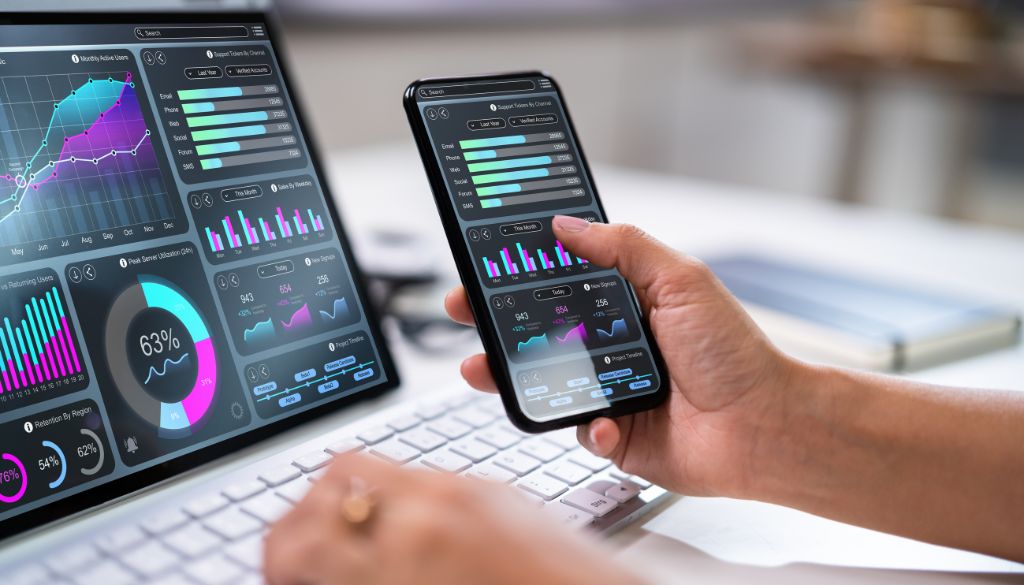
If today you use classic analytical tools to understand what works, tomorrow you will have evolved dashboards that interpret this information on their own and act accordingly.
For example, you will be able to:
- Personalize customer journey navigation paths based on user preferences and interactions.
- Optimize marketing strategies with automatic suggestions on how to improve conversions and content.
- Adapting offers and calls to action dynamically depending on the type of visitor (new, returning, repeat customer).
This approach beyond simple statistical analysis will transform the way websites support sales and customer relationships.
The visitor will no longer be a “number,” but a unique profile recognized and followed throughout his or her customer journey.
More effective advertising campaigns with data and AI
In 2026, AI-based advertising platforms will manage ad campaigns (Google increasingly autonomously), leveraging billions of variables analyzed in real time.
The combination of machine learning and predictive analytics will make it possible to identify not only the most interesting targets, but also the best time to show an ad and the most effective message to communicate.
Think about it: until now you have probably managed your advertising investments based on statistics or market insights.
Instead, with AI you can count on a system that analyzes every click, every interaction and every conversion to optimize spending and increase ROI.
A concrete example: if your company promotes B2B services, AI can automatically learn which keywords work best on certain days or times, which audience segments convert the most, and even what kind of visual creative generates the most attention.
In this way your own strategies will be more effective, becoming better and better performing with each iteration.
Data-driven digital marketing becomes predictive
The future of digital marketing is about quick, data-driven decisions.
AI not only processes huge volumes of information, but turns it into immediately actionable insights.
Companies will then be able to make real-time decisions based on customer behavior and market trends.
Imagine getting an alert telling you if a campaign is losing effectiveness or if a product begins to attract interest in a new geographic area.
All thanks topredictive analytics and automated monitoring systems.
This not only allows for faster action, but also for anticipating market developments before the competition.
The difference between a company that uses artificial intelligence and one that does not will soon be evident: the former will be able to react and adapt with agility, the latter will lag behind as trends change.
How to integrate AI into your marketing strategies
Wondering how to get started? You don’t need to overhaul everything. The key is to gradually integrate AI into your company’s existing processes.
Here are some practical examples:
- Use AI-powered automation tools to better manage emails, leads, and CRM updates.
- Leverage assisted content creation to speed the production of materials for blogs, social, and landing pages.
- Optimize your websites with analytics modules that suggest improvement actions in real time.
- Implements predictive analytics systems to anticipate trends or seasonality in sales.
Remember: the goal is not just to adopt the technology, but to make it work for you, in line with your brand’s mission and tone.
AI Writing Tools for Content Marketing: yes or no?
AI and humanity: marketing of the future will be hybrid
One of the most widely held beliefs is that artificial intelligence will eliminate the human side of marketing. In reality, the opposite will happen: companies that can combine empathy and data will succeed.
Automation and machine learning free you from repetitive work, leaving you more time to focus on what really matters-strategy, creativity and customer relationships.
In other words, the real power ofartificial intelligence applied to marketing lies not in replacing people, but in enhancing their decision-making and intuitive abilities.
The future will consist of “hybrid” teams, in which AI and professionals collaborate to generate more targeted campaigns, more effective content, and more authentic communications.
The new opportunities for entrepreneurs in 2026
For those who lead an enterprise, 2026 will be a decisive year.
Adopting marketing tools and artificial intelligence will mean being able to compete with larger, more structured brands by playing ahead.
Companies that know how to leverageAI marketing will be able to:
- Automate complex processes and save time and resources;
- Dramatically improve the effectiveness of advertising campaigns;
- Provide a smooth and personalized customer experience throughout the customer journey;
- Turn data into concrete actions and measurable profitability.
The result will be a smarter, more agile company that can adapt in real time to market dynamics.
The time for action is now
The year 2026 is not that far away.Artificial intelligence applied to marketing is already changing the game, and forward-thinking brands are reaping the benefits.
Integrating marketing and artificial intelligence into your own strategies is no longer an “extra,” but a necessity to stay competitive, grow and communicate more effectively.
AI marketing offers tremendous news for those who want to make a difference: greater precision, advanced personalization, predictive capability, and a powerful ally in making data-driven decisions.
If you want your company to grow by becoming more efficient and future-oriented, the best time to act is now.
Want to find out how artificial intelligence can grow your business? Contact us: together we will build tailored strategies for 2026.
AI marketing news and news
Read also:
- Google Deep Thinking Ratio: what changes for Italian SMEs in the next 3 years
- How AI crawlers are changing the rules of the game for online sellers
- Human-First Marketing: what is your Brand’s strategy?
- SEO and artificial intelligence: how are they connected?
- Predictive marketing: how to anticipate your customers’ needs with data
- 4 ways to use AI in your marketing strategy
- Machine Learning vs Artificial Intelligence
- Google VEO video generator: amaze your customers