



Are you the head of a company that wants to make its way in today’s market? Well, Brand positioning will help you stand out among a multitude of companies offering all kinds of products and services, including probably, those similar to what you offer.
You may be wondering: Market positioning: what is it for?
If you don’t know what I’m talking about, read on and you will soon realize how important such a positioning strategy is to be successful and increase your sales or leads.
Let’s start from the beginning and try to understand what brand positioning actually is, what the potential of a brand-centered strategy is, and how to build one tailored to you.
Brand Positioning what is it? Definition and meaning
The Academic Definition
According to Philip Kotler, the father of modern marketing, brand positioning is “the act of designing a company’s offerings and image so that it occupies a distinct position in the minds of the target audience relative to its competitors.”
From a practical perspective, it means clearly answering these questions:
- Why should the customer choose your brand specifically?
- What unique benefits do you really promise?
- What makes your brand memorable and recognizable?
Brand positioning is an indispensable step when bringing a new product to market.
It basically serves to position your brand in a specific place in the mind of the potential customer for a specific niche market.
We can use the metaphor of scale to identify how certain brands are intercepted by the mind.
The mental ladder we are talking about consists of three steps where at the first we find the leading brand, at the second the alternative and at the last, the third brand.
These three steps are a representation of how brands are remembered in the consumer’s mind; from the third onward, indifferentiation is triggered.
Through a purpose-built Brand positioning strategy, you can become the market leader for a specific segment of consumers who are interested in exactly your product.
How to build an effective brand positioning strategy
An effective Brand positioning strategy must be studied in detail, carefully evaluating all the steps in order to send an extremely detailed message to the potential customer.
First, to get into people’s heads and fix your brand as a reference, you need to ask yourself the following questions:
- What are you offering consumers?
- What category does your product or service fall into?
- Why should a consumer choose you?
- What is the differentiating factor between you and the competition?
Answering these questions accurately, truthfully and thoroughly will give you a concrete overview from which to build your Brand positioning strategy.
Once you’re clear in your mind what your target category is, all that’s left to do is to analyze the competition, trying to figure out if, among the competitors, there is already an industry leader, that is, a brand that everyone thinks of when referring to a particular product.
Examples of brand positioning in cola drinks: leader – Coke, alternative – Pepsi.
If there is already a leader in your target niche, or a viable alternative to the former, take note of all the aspects, weaknesses and shortcomings that you think these have.
You will then have a “ladder” to work on to enhance your brand. Competitors’ weaknesses will become your strengths.
In essence, the main steps to emerge through a Brand positioning strategy are:
- Finding the reason why people should choose you
- Finding a differentiating element
- Communicate both of the above aspects clearly and consistently
Let’s examine these aspects in detail to understand how to elevate your brand positioning in the marketplace.
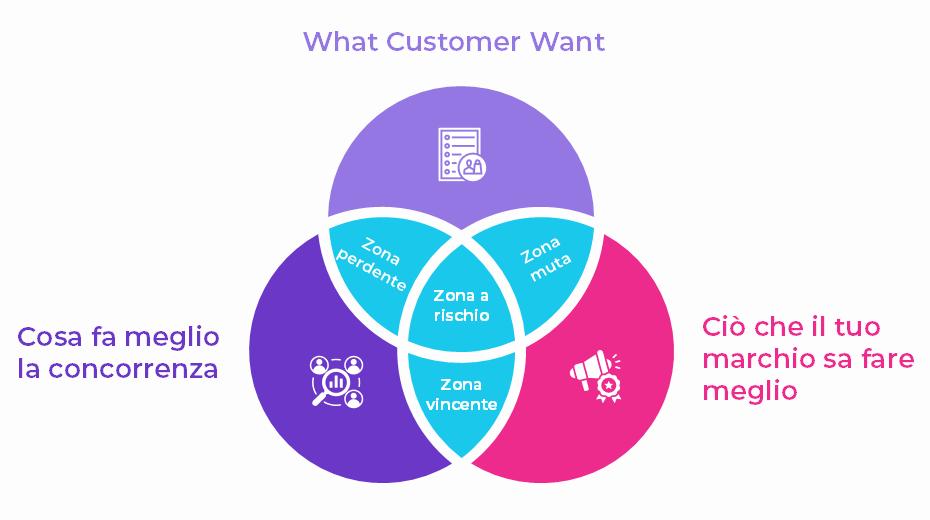
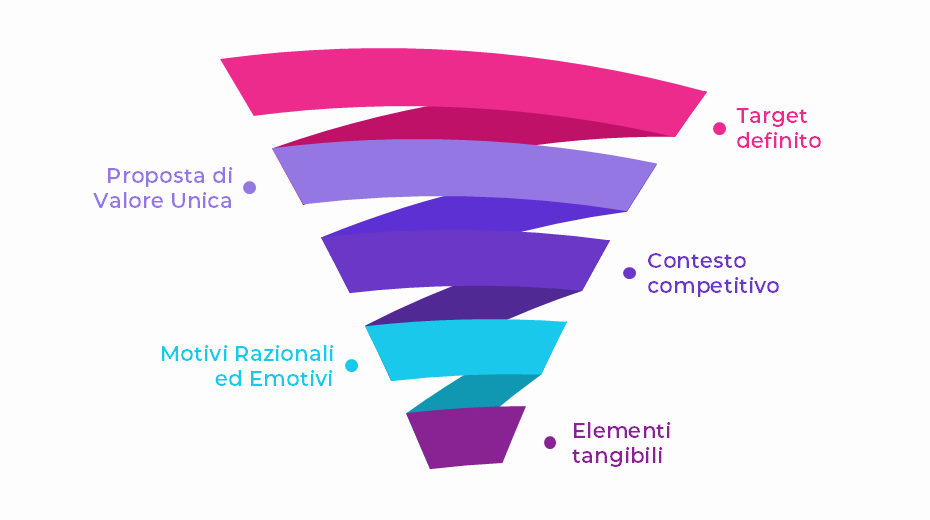
Fundamental Elements of Brand Positioning
- Unique Value Proposition
The brand must offer something distinctive, relevant and desirable compared to the competition. - Target Audience Defined
It is necessary to identify who the brand is targeting: defining a clear audience is essential for effective communication. - Category Frame of Reference
Establish the competitive environment: in which market category does the brand operate? - Rational and Emotional Motives
Effective positioning combines rational (functional characteristics) and emotional (values, lifestyle, identity) motives in brand perception. - Proof Points
Tangible elements, data, testimonials and benefits that make the stated positioning credible.
1. Finding the reason why people should choose you
The first step in building an effective positioning is to understand why consumers should choose your brand over others. This reason must address a real need or deep desire of your audience.
How to identify the main reason
- Know your audience: Study the needs, problems and desires of your target audience or buyer persona. Interview customers, analyze feedback, and observe market trends.
- Focus on value: What tangible or intangible benefit do you offer? Example:
- Innovative product.
- Better user experience.
- Corporate values in line with the public (e.g., sustainability, inclusiveness).
- Look beyond price: Don’t compete on cost alone. Look for something that adds value (superior quality, exclusivity, ancillary services).
Practical example
Imagine you are selling sports shoes. Your motive might be:
- Comfort and technology: Shoes designed to reduce fatigue during long running sessions.
- Social value: Every purchase helps fund environmental projects.
2. Brand positioning: finding a differentiator
Your differentiator is what makes you unique from your competitors. Without clear differentiation, your brand risks being perceived as “one of many.”
How to identify your differentiator
- Analyze competitors:
- What are they doing?
- What aspects do they neglect or fail to communicate adequately?
- Identify your uniqueness:
- Do you have a patented or exclusive technology?
- Do you offer superior quality or unique design?
- Are you the first to propose a solution in a specific niche?
- Leverage your strengths:
- Tradition and corporate history.
- Innovation or creativity.
- Distinctive values (e.g., ethicality, respect for the environment).
Helpful questions to find your differentiator
- What do you do better than others?
- How can you improve the customer experience?
- What is your “why” (the mission that sets you apart)?
3. Communicate both aspects clearly and consistently
Even the best positioning is useless if it is not communicated transparently, consistently and repetitively. Communication is the bridge between your brand and consumers, and it is what solidifies your position in their minds.
How to communicate effectively
- Create a key message:
- Short, clear and memorable.
- It must emphasize the main benefit and differentiator.
- Example: “The shoe that goes the farthest with you, respecting the planet.”
- Uniformity across all channels:
- Use the same tone of voice and values in advertising, social media, website, and point of sale.
- Maintain visual consistency (colors, fonts, logo).
- Tailor the message to the audience:
- Tailor communication to the interests and behaviors of your target audience.
Useful tools to reinforce the message
- Storytelling: Tell your brand story to create emotional connection.
- Testimonials and reviews: Social proof for confidence building.
- Creative advertising campaigns: Innovative ideas that grab attention and stick.
4. Brand Positioning examples
Here are 5 examples of successful brand positioning specific to the Italian market, each associated with a strategy that made them recognizable and leaders in their field:
Coca-Cola
Positioned as the drink of happiness, sharing and positive emotions, Coca-Cola has managed to become the most recognizable soft drink on the Italian (and world) market, thanks to constant and emotional communication, always centered on the concept of happy moments to be experienced together.
Barilla
In Italy, Barilla is synonymous with pasta and with “home,” family, Italian-ness and culinary tradition.
Its positioning focuses on the feeling of “family cooking” and the emotional value the brand represents in the daily lives of Italians, becoming the reference point in consumers’ minds for the pasta product.
Olive Grove and Rocchetta
These two Italian mineral water brands have been able to differentiate themselves in a crowded market by positioning themselves as “health waters,” specifically targeting sportsmen and wellness enthusiasts, emphasizing specific benefits on the body.
Zalando
In the Italian online fashion industry, Zalando has built a clear positioning as a leader and innovator in digital shopping, focusing on ease of purchase, free returns, wide choice, convenience, and attention to sustainability and second hand-features highly valued during and after the pandemic.
McDonald’s
In the Italian imagination, McDonald’s has represented fast food par excellence for decades, synonymous with speed, recognizable quality standards and adaptation to local tastes, thanks to a continuous balancing act between globality and national food traditions.
These brands have managed to become deeply rooted in the Italian market precisely because of their distinctive positioning and consistent communication over time.
Brand Positioning Agency: position your brand with the help of Factory Communication!
Integrating these three aspects into your Brand Positioning strategy will enable you to win a clear and relevant place in the minds of your audience.
Summary of steps:
- We will find the main reason why consumers should choose you.
- We will identify your differentiator from the competition.
- We will communicate these issues clearly and consistently through all channels.
By working on these areas, your brand will not only emerge in the marketplace, but build a lasting relationship with consumers, turning them into ambassadors of your brand.