


In this article we will see together how to do Inbound Marketing to seek new customers and increase sales. In marketing, this process is called lead generation.
A lead is a user who has shown interest in the company. Thus, it is a user who is on the road to conversion and final purchase, who is in an early stage of evaluation.
How to recognize it?
The lead explicitly and voluntarily leaves personal data to the company in exchange for material, content, information.
Personal data includes master information, contact information, contact details, etc.
The lead should not be confused with the prospect, which is instead a lead that has shown interest in a specific product or service.
The prospect is at the stage of considering the item for purchase, so it is a later development than the lead.
Lead generation: what it is and why it is important
The meaning of lead generation is “to generate interest in the brand from users.”
Lead generation is the set of tactics that marketers use to approach new potential customers.
This process is not only important if there is a new product launch or a new brand launch, but is also strictly necessary for well-established product lines.
In fact, lead generation has always been a foundational aspect of corporate marketing strategies to increase sales. With the preponderance of the Web as a marketplace, digital marketing strategy has assumed primary importance.
A functional strategy must therefore consider all the different platforms that allow the brand to connect with its potential customers: social, email, podcasts, website, blog, etc.
There are two ways to generate leads:
- Going after new customers with push actions;
- Making sure that users find us.
The first strategy is called outbound marketing and includes for example:
- Advertising and paid campaigns;
- Email marketing, DEM and the like;
- Trade shows and industry events, in-person or virtual.
The second strategy is inbound marketing, which is based on giving users useful content according to his or her needs.
Inbound marketing actions include:
- blog
- e-books, guides, infographics and downloadable content;
- SEO strategies;
- website.
Today, more than ever, to generate leads you need to create relationships with users, through content: this explains the rapid growth of Inbound Marketing. We think it requires a little further study.

Doing Inbound Marketing: 10 good reasons
Although no specific data are available for Italy, global statistics for 2023 show that:
- 83% of companies prefer inbound marketing to acquire customers
- 62% of companies report an increase in leads through inbound marketing
- 75% of companies improve their online visibility through inbound marketing strategies
These data suggest a positive trend in the adoption and effectiveness of inbound marketing in Italy as well.
And now let’s see 10 good reasons to use inbound marketing strategy to do lead generation
- Attract qualified customers
Inbound marketing attracts people already interested in your products or services.
By creating content targeted to the needs of your audience, you attract high-quality leads more likely to convert. - Increase brand visibility
Through search engine optimized content and the use of social media, inbound marketing improves your online presence and increases brand awareness. - It’s cheaper than traditional marketing
Inbound marketing has lower costs and a higher ROI. Inbound leads cost on average 62% less than outbound leads. - Generate qualified traffic
SEO and content marketing tactics attract qualified visitors to your website, increasing the chances of conversion. - Builds long-term relationships
Inbound marketing focuses on building lasting relationships with customers through valuable content and personalized interactions. - Educate prospects
By providing educational and informative content, inbound marketing helps prospects better understand your products/services. - Strengthens corporate reputation
By offering useful, quality content, you position yourself as an authoritative expert in your field. - It scales over time
Content created continues to attract leads long after publication, making inbound marketing a sustainable long-term strategy. - Provides detailed analytical data
Unlike traditional marketing, inbound marketing offers precise metrics to measure the results of your campaigns. - Align marketing and sales
Inbound marketing fosters collaboration between marketing and sales teams, creating a unified business approach
How to do Inbound Marketing: the basics
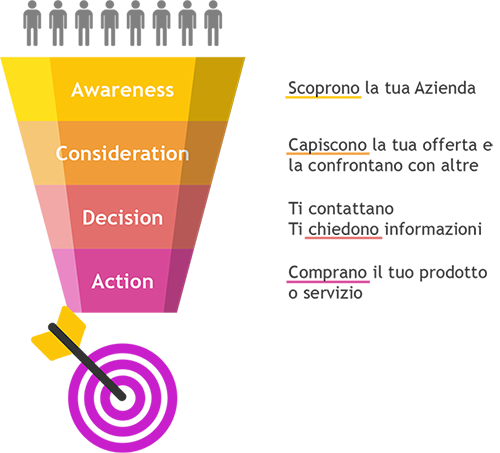
Before defining what Inbound Marketing is, we need to make a premise. Every user who becomes a paying customer faces an evolving journey in his or her relationship with the brand.
This path is accomplished within a marketing funnel (the funnel). Not all users will become customers, but only those who are truly interested and convinced.
As a textbook, in funnel has 5 stages, which change as the user becomes aware of their needs and how your brand can help them.
The 5 stages are:
- Awareness: the user understands that he or she has a need or problem;
- Interest: he gets in touch with your brand, and he senses that you can help him. Now it’s a lead;
- Consideration: consider the pros and cons of buying from you, and perhaps even from competitors, evolving into prospects;
- Decision: he finally chose your product and company;
- Action or purchase.
In Inbound Marketing, three different types of content are associated with these phases;
- Content to attract new users;
- Content to engage them and generate increasing interest (lead generation);
- Content to convince them to buy.
Which sectors in Italy are showing the most interest in inbound marketing
We can identify some sectors in Italy that are showing particular interest in investing their resources in inbound marketing strategies:
Automotive
The automotive industry emerges as one of the most active in adopting inbound marketing strategies.
With an email open rate of 58.87 percent and a click-to-open rate of 7.18 percent, automotive demonstrates strong engagement with inbound content.
Nonprofit
Nonprofit organizations are embracing inbound marketing with significant results.
This sector records an email open rate of 51.98 percent and a click-to-open rate of 8.96 percent, indicating a high level of interest and interaction from the public.
Real estate
Real estate stands out for the effectiveness of its inbound strategies, with an email open rate of 51.39 percent and an impressive click-to-open rate of 15.46 percent.
These numbers suggest that inbound content is resonating particularly well with audiences interested in real estate.
In fact, several industry players have implemented valuable content on their sites to solve various problems related to managing or buying/selling a property.
Financial Services
Although not at the top in click-through rates, the financial services sector shows strong initial interest in inbound content, with an email open rate of 58.49 percent.
Retail
The retail sector is showing a growing interest in inbound marketing, particularly as it relates to landing page conversion.
With a conversion rate of 17.6 percent, retail ranks among the most effective sectors in turning initial interest into concrete action.
Technology and High Tech
With an email open rate of 46.32 percent and a click-to-open rate of 9.88 percent, the technology sector shows solid interest in inbound strategies, probably due to the innovative nature of the sector itself.
It is important to note that while these areas show special interest, inbound marketing is gaining ground in various areas of the Italian market.
The overall growth of the digital market and the increased investment in content marketing suggest an increasing adoption of these strategies in different sectors of the Italian economy.
Doing inbound marketing to acquire new Customers and contacts
You may have already guessed that Inbound Marketing is perfectly suited for lead generation (and subsequent steps up to purchase).
We have also already mentioned that it is based on the content of websites, blogs, ebooks, guides, etc. that are offered for free to users.
But how is it possible to generate giving away content, which takes time and resources to prepare?
The key is to produce content that has value to your audience. They can be helpful in solving a problem, or they can simply be entertaining, engaging, interesting.
To have value, they must be designed for your audience. Usually therefore the Inbound Marketing strategy starts with the study of Buyer Personas. On the technological side, marketing automation platforms such as HubSpot, for example, are very useful.
If you read on, we will tell you why it is worth investing in content production.
Start with Buyer Personas
These are fictitious users, to whom you must attribute all the psycho-socio-demographic, behavioral and attitudinal characteristics of your ideal client.
As you collect data on your audience (through Google Analytics, social network Insights, sign-ups for your events, open rates for your newsletters, etc.) you can refine Buyer Personas.

Create content to attract new users online
Now that you know who to target, you can publish the first content dedicated to users in the very first stage of the funnel. These customers are meant to attract them to your brand, as we mentioned.
At this stage then you should help them discover that they have a need or problem, or communicate that there is a possible solution.
Interesting content that engages the user
At this point, you have attracted users who are aware of a need. The real lead generation phase begins.
The content you offer now must be engaging and generate interest in your brand. It can be guides, downloadable e-books, infographics.
For example, you could add them at the end of a blog post and ask for an email address or registration to your newsletter in return.
And why would he agree to provide you with personal information?
People are more likely to provide personal information if they receive a “gift,” such as in this case a guidebook or e-book. For this to work, however, you have to come up with content that is truly valuable to your audience.
Lead generation through Inbound strategies are therefore only effective if you distribute quality content that is in line with the expectations of Buyer Personas.
When this happens, it pays back the investment required to create such content.
That is why it is often best to rely on inbound marketing experts.

Prospects, customers and aficionados
In this article we focused on lead generation, but the next steps in an inbound strategy are to generate prospects, sell and increase customers.
The most useful content at the end of the funnel is that which prompts the lead first to consider buying and then to buy. For example? case studies, success stories, free trials, demonstration webinars, etc.
Finally, remember that Inbound Marketing is also effective in post-sales to maintain relationships with and retain existing customers.
Why doing inbound marketing can contribute to the digital innovation of Italian companies
Inbound marketing can contribute significantly to the digital innovation of Italian companies in several ways:
Transformation of corporate culture
Adopting inbound marketing requires a change in mindset, pushing companies to:
- Focus on creating value for the customer rather than simply promoting products
- Develop a data-driven culture, based on data analysis to make informed decisions
- Promote collaboration among marketing, sales and customer service departments
This innovative approach can catalyze a broader digital transformation of the organization.
Adoption of new technologies
Doing inbound marketing involves the use of advanced digital tools:
- Marketing automation platforms to manage and optimize campaigns
- Integrated CRM (customer relationship management) systems to track the entire customer journey
- Data analysis tools to measure performance and gain insights
The integration of these technologies can accelerate the digitization of business processes.
Improving online presence
Through inbound marketing, Italian companies can:
- Optimize your websites and content for search engines (SEO)
- Creating an effective social media presence
- Develop content marketing strategies to attract and engage target audiences
This leads to increased online visibility and improved digital brand reputation.
Personalization of the customer experience
Inbound marketing is all about creating personalized experiences:
- Advanced audience segmentation
- Creating targeted content for specific buyer personas
- Automation of personalized communications throughout the customer journey
These innovative practices improve customer engagement and satisfaction.
Integration of Artificial Intelligence.
The most recent developments in inbound marketing include the use of AI to:
- Automating repetitive tasks
- Analyze large amounts of data in real time
- Delivering highly personalized experiences
- Optimizing marketing campaigns
The adoption of these AI technologies can give a significant competitive advantage to Italian companies.
Overcoming cultural barriers
Despite its potential, Italy still invests little in digital marketing compared to other advanced countries. Inbound marketing can help overcome some cultural barriers:
- Educating managers on the importance of digital
- Demonstrating the ROI of online marketing activities
- Promoting a culture of innovation and continuous learning
By implementing inbound marketing strategies, Italian companies can therefore not only improve their marketing performance, but also catalyze a broader digital transformation, better positioning themselves to compete in the global marketplace.
Why doing inbound marketing can personalize the user experience
Inbound marketing offers several opportunities to personalize the user experience, improving engagement and conversion of potential customers.
Here are some key ways in which inbound marketing can personalize the experience:
Audience segmentation
Inbound marketing is based on the creation of detailed buyer personas and audience segmentation. This allows for:
- Create targeted content for specific user segments
- Send communications tailored to the interests and needs of each group
- Offer more relevant product or service recommendations
Content customization
Through data analysis and user behavior, it is possible:
- Display dynamic content on the website based on user preferences
- Suggest articles or resources related to demonstrated interests
- Adapt the tone and style of content to the specific target audience
Marketing automation
The use of marketing automation platforms enables:
- Send personalized emails based on user actions
- Create automated and tailored nurturing flows
- Provide relevant content at different stages of the customer journey
Personalized interactions
Inbound marketing enables:
- Use intelligent chatbots to provide personalized assistance
- Offer consultations or demos tailored to specific needs
- Customize call-to-actions based on user behavior
Continuous analysis and optimization
Thanks to data analysis, it is possible:
- Monitor campaign performance for each segment
- Constantly optimize content and strategies based on results
- Progressively improve the personalization of the user experience
By implementing these personalization strategies, companies can achieve significant results.
For example, Plastic Printers was able to convert 64 percent of leads into customers through the use of customized workflows and lead nurturing.
Similarly, Bell Performance increased site traffic by 700% and lead generation by 1400% in two years through SEO optimization and customized email campaigns.
Personalization in inbound marketing not only improves the user experience, but can lead to a substantial increase in ROI.
According to McKinsey, personalization can generate a 5- to 8-fold return on marketing investment and increase sales by more than 10 percent3.
Want to learn more about how to do Inbound Marketing to attract new customers?
Read these articles: