



In this article we look at what the EAA or European Accessibility Act is and what changes for Companies with the new rules regarding products and services made available online.
Digital accessibility is no longer just a matter of ethics or social responsibility-it is now a regulatory obligation for a broad category of businesses in Europe.
As of June 28, 2025, Italy’s digital landscape will change dramatically due to the enactment of theEuropean Accessibility Act (EAA).
Those who lead a company must be aware of these changes to avoid penalties, ensure compliance, increase competitiveness and reach new market segments.
What is the European Accessibility Act
In this guide, you will find a detailed overview of the European Accessibility Act, what it provides and what types of companies will have to comply with this directive, with a practical and useful approach for decision makers in the enterprise.
Before June 28, 2025: origin and goals
The European Accessibility Act (EAA) is Directive 2019/882 of the European Parliament, passed on April 17, 2019, with the goal of ensuring that all citizens, including people with disabilities, have barrier-free access to a wide range of digital products and services in the European Union.
The directive stems from the need to harmonize member states’ accessibility laws, overcoming regulatory fragmentation that has so far led to confusion among both manufacturers and service providers.
What changes from previous standards
Prior to the EAA, regulations focused mainly on government sites, leaving the private sector in the background.
From 2025, however, the concept of digital accessibility requirements is extended to private companies offering products and services in certain sectors, imposing specific technical and design requirements that must be met from the development stage (“accessibility by design”).
EAA application areas: products and services involved
The standard focuses on a precise list of products and services that must be made accessible according to WCAG 2.1, Level AA guidelines.
Here is an overview of the areas involved:
- Websites and mobile applications
- Electronic commerce platforms (e-commerce)
- Electronic devices: smartphones, computers, smart TVs
- Banking services: ATM, home banking, online financial services
- Electronic ticketing and check-in systems (air, rail, bus, sea)
- Audiovisual media services: video streaming, TV broadcasting and connected devices
- Electronic books (e-books) and related reading devices
Recipients of the European Accessibility Act
The directive applies in Articles 7 to 13 to the following categories of economic operators:
- Manufacturers: those who produce and market products for the European market
- Authorized representatives: individuals acting on behalf of manufacturers within the European Union
- Importers: companies introducing products from third countries into Europe
- Distributors: entities that sell products and services, both online and physically
- Service providers: those who deliver digital services to the public (e.g., home banking, e-commerce, streaming, booking platforms)
Each of these figures has precise compliance and reporting obligations: from declaring accessibility to managing accessible customer support, from technical assistance to setting up barrier reporting channels.
Subject companies: which companies must comply?
The legislation, as clarified by both the European directive and the Italian transposing legislative decree (Legislative Decree 82/2022), calls all companies with more than 10 employees or a turnover of more than 2 million euros per year to comply, if they offer to the public the products and services listed among the “scopes of application.”
Here are the main categories:
- E-commerce and marketplaces (B2C): online shops, vertical or generalist marketplaces
- Banking and fintech: banking services, digital wallets, payment apps
- Travel & booking portals: flight, hotel, train, restaurant, digital ticketing booking services
- Streaming services, online training, VOD platforms
- Self-service systems: ATMs, ticketing kiosks, electric vehicle charging stations
Excluded are microenterprises, i.e., companies with fewer than 10 employees and turnover of less than 2 million euros, unless they choose to comply voluntarily.
Similarly, personal sites, amateur blogs or purely informational sites without interaction (so-called “showcase sites” without digital services) do not fall under the EAA.
Table: Examples of companies involved
| Sector | Obligated to EAA | Examples |
|---|---|---|
| E-commerce | Yes (if >10 dip. or >2M€ invoice). | Online shop, B2C marketplace |
| Banking Services | Yes | Home banking, fintech app |
| Transportation & booking | Yes | Portals of flights, trains, hotels |
| Media & streaming | Yes | VOD platforms, e-learning |
| Microenterprises | No (excluded, unless chosen) | Small workshops, local stores |
| Showcase sites | No (excluding if informative only) | Portfolio site, contact page |
Technical requirements and practical requirements
To be EAA-compliant, certain products and services must meet the principles of the international guidelines WCAG 2.1, Level AA. It means that each platform, site or app will have to be designed to:
- Be navigable via keyboard
- Support screen readers and assistive technologies
- Manage alternative text for images
- Have adequate color contrast
- Offer accessible documentation and customer support
Each company involved must also prepare and publish an Accessibility Statement according to the template provided by AgID (Agenzia per l’Italia Digitale), with constant updates of compliance status and contact methods, including how to report any barriers.
What risks are faced by companies that do not comply
Administrative penalties for noncompliance can be up to 5 percent of annual turnover, in addition to reputational penalties and possible compensation actions by users.
It is therefore critical not only to ensure compliance to avoid fines, but to seize the opportunity to position oneself as an inclusive and modern enterprise in the eyes of customers and stakeholders.
Why it pays to adapt: strategic benefits for the enterprise
- Market expansion: 101 million European citizens with disabilities represent an often “invisible” but highly loyal target audience when they find accessible solutions
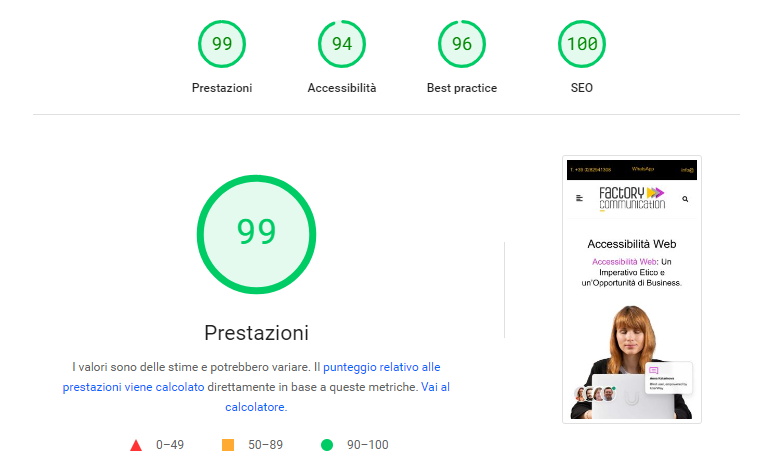
- Competitive advantage: accessible sites improve usability for all, increase conversion rate, reduce bounce rate and improve SEO ranking
- Brand reputation: an accessible company conveys attention to inclusion, innovation and social responsibility
- Compliance: reduced risk of penalties, lawsuits and image damage
How to get started: the recommended roadmap
- Analysis and audit of its services: uses professional tools to assess current site/app compliance, identifying areas of risk
- Implement an “accessibility by design” strategy: involve designers, developers, and content managers at all stages of the process
- Internal training: raises staff awareness of regulatory aspects and best practices
- Drafting and publishing the Accessibility Statement
- Constant monitoring and updating: accessibility is an ongoing process, not a “one-off” action
The European Accessibility Act represents one of the most important challenges for European digital business in the coming years.
For the entrepreneur or business owner, complying with the EAA is not just a regulatory requirement, but an opportunity to innovate, include and position oneself distinctively in the marketplace.
Investing in accessibility today is a successful strategy that goes far beyond compliance: it is a choice that enhances corporate identity, stimulates growth and promotes a truly modern vision of the enterprise.