


Have you included email marketing newsletters in your communications activities? In this article discover 9 important metrics you should always use.
Definition of email marketing
E-mail marketing is a tool used to market products and services and cultivate relationships in a humane and useful way through the use of the e-mail channel
The email marketing newsletters
They are an important component of digital marketing that positively impacts business growth
In Marketing, but we could say in business in a general sense, the basic element is “measurement” that is, the ability to collect, analyze and verify data.
Only by analyzing by verifying and modifying our strategies can we make progress.
Otherwise, without analysis, we risk trial and error without knowing which path to pursue.
“Doing Email Marketing and Newsletters “, might sound like a simple task, but it is not. There are many parameters we need to pay attention to and, more importantly, many common mistakes we need to avoid.
We may create brilliantly optimized e-mails, but we may have no results if, first, we do not ask ourselves two questions:
- What are my goals.
- In what “position of the journey” is the person we are addressing.
Before we look specifically at how to set up our own campaign, it is important for us to see the difference between Email Marketing and DEM Direct Email Marketing.
Direct email marketing is the Web marketing strategy of sending mass emails to people we do not know.
Generally, sending DEMs, as they are known, is a service provided by companies specializing in direct marketing or Direct Marketing that have built over time, their own Data Base (contact archive).
In order to send marketing emails and DEMs, it is essential to have the recipient’s authorization to avoid being flagged as a SPAMMER, i.e., those who carry out mass SPAM email sending.
Goals of our email marketing newsletter
Before we press “Send,” always ask ourselves, “What is the purpose of this e-mail?”
What is referred to in branding jargon as Call to Action (CTA). Of course, the purpose of our Email Marketing operation may not be just one.
The goals are as varied as:
- Generate new contacts
- Turning potential clients into customers
- Increase sales of a product or service through our website
- Propose a subscription
- Invite your clients, or leads to a presentation, webinar, or corporate event
In any case, whatever our goal is, we need to understand what metrics to take into account to see if we are going in the right direction to achieve our goal.
The user’s journey
User journey means what kind of relationship we have with that person.
In marketing it is also referred to as “customer journey“:
- Is this your first time contacting us (you just signed up for our newsletter)?
- You have already asked about our products
- He has asked for an estimate and is deciding whether to buy or not
- He is already one of our customers
- He has been a customer of ours for quite some time, but in the recent period he has not been purchasing
- You called our customer service department because you had a problem with our services
- He is so happy with our services that he has introduced us to other clients
It is easy to see how the needs are totally different based on where the user is in the “journey” relationship with our company (lead nurturing).
The customer journey together with the goal of our “communication” are two fundamental elements of carrying out an efficient email marketing activity.
At Factory Communication, we use the platform HubSpot of which we are Certified Partner.
HubSpot is a very powerful CRM (customer relationship management) and one of the most widely used Marketing Automation and Email Marketing platforms in the world.
If you are about to launch your startup in the market, take advantage of the special promotion that provides super-discounted Hubspot prices for startups.
To plan our campaign Hubspot is very helpful and makes the Email Marketing Planning Template available to us free of charge.
And now we come to the point.
Newsletter email marketing: the importance of profiling
Email Marketing generally relies on the creation of a content marketing activity. It aims to create a lasting relationship with its target audience.
Starting a relationship the right way and keeping it alive, interesting and valuable is one of the most important challenges in marketing.
Email, in this, is of great help because unlike the many tools available it is still the most personal and effective one, capable of engaging the recipient on multiple levels.
In the article “Marketing Automation: the core of the strategy” I delved into the topic related to Marketing Automation.
It is an extremely important and effective activity that is based on the content marketing, that is, the creation of valuable content for our users.
Newsletter web marketing and profiling
Do you know who you turn to? Profiling tells you!
Profiling our target audiences well means breaking them down based on so much information:
- Geographical
- Age
- Sex
- Preferences
- Job
- Hobbies …etc.
The quality of a database depends on the amount of information we have.
Especially that which qualifies users with respect to the field in which we work.
Basically to the target market and target audience.
Profiling one’s contacts should be a preliminary step to any marketing and communication consulting, but not only.
It should accompany every moment of the relationship with our Customer, helping us to create communications that are always centered, relevant and judged interesting.
So well “profiled” that our emails are not only opened with pleasure, but also expected.
The 9 metrics I must use to plan marketing email newsletters
Let’s analyze email marketing newsletters together
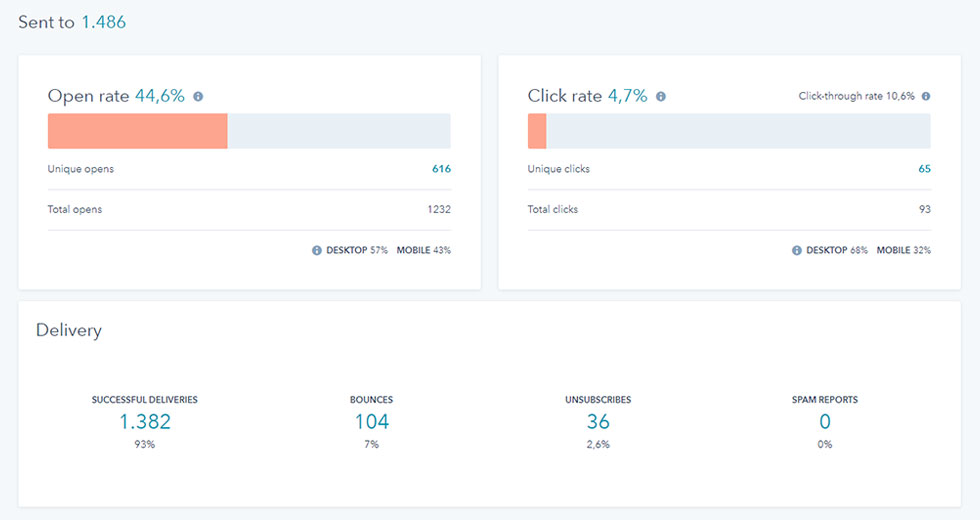
1. Percentage of clicks
- What it is: Click-through rate corresponds to the percentage of recipients who “clicked,” precisely, on one or more links within the email.
- Calculation: (Total clicks/unique clicks ÷ Number of emails sent) x 100
- Example: (500 total clicks ÷ 10,000 emails sent) x 100 = 5% click-through rate
Click-through rate (CTR) is something of an “everyday” metric, precisely because it is the value that email operators value most.
This data allows us to check the performance of all the emails we send, and it is critical to monitor its variation over time.
As we said, click-through rate is a very important figure to take into account for our planning.
In fact, it allows us to understand how many people on our list interact with our content, but more importantly whether they are interested in receiving updates, or more information.
2. Conversion rate
What it is: The conversion rate is the percentage of recipients who clicked on the link within the email and completed the predetermined action.
This is the case with filling out a registration form, or purchasing a product.
- Calculation: (Number of people who completed the desired action ÷ Number of emails delivered) x 100
- Example: (400 people booked a room in our hotel ÷ 10,000 emails delivered) x 100 = 4% conversion rate
Of course, the conversion rate also depends on our initial goal.
Whether the purpose of our email is to get users to enroll in our online course, or to purchase a particular product or book a hotel room, it doesn’t change.
In short, whatever our goal is, we will consider as conversion anyone who has performed the action we desired.
In conclusion, conversion rate is a key element of our email marketing analysis. Precisely because with this data we will be able to measure the effectiveness of our strategy.
3. Bounce rate
- What it is: Bounce rate corresponds to the percentage of emails that were sent but were not delivered correctly to the recipient.
- Calculation: (Number of emails bounced ÷ Number of emails sent) x 100
- Example: (75 undelivered emails ÷ 10,000 sent emails) x 100 = 0.75% bounce rate
We can distinguish two types of rebound: “Hard” and “Soft”
Hard bounces
They occur because of an invalid email address, which may be non-existent, closed, or deleted. As a result, our emails will never be delivered correctly.
In the case of a Hard bounce, we will need to remove the invalid email address from our list immediately so that we do not use it again in the future.
In fact, Internet service providers use precisely bounce rates to assess a sender’s reputation. Our advice is not to remove re malicious contacts but to mark them as such.
If we remove them we risk entering them back into our email delivery system. If they are present and “marked” as invalid emails we are sure not to use them again!
Soft Rebounds
As for Soft bounces, we have no particular reputation problems.
A Soft bounce may be due to less serious factors, such as a full mailbox, or issues related to the recipient’s server.
In any case, with this type of bounce we are dealing with a temporary problem, on a valid e-mail address.
So we can keep our contact, without “marking” it, and try again by sending a new e-mail later.
Bounce rate has nothing to do with our goals, but it helps our analysis by monitoring the functionality of the tools we have available.
Let’s always make sure there are no glitches, or malfunctions, in our Email Marketing Strategies. Let’s always check everything, perhaps testing on ourselves, before pressing “Send.”
4. Growth rate
- What it is: The growth rate corresponds to the speed of growth of your mailing list
- Calculation: [(Number of new subscribers – Number of unsubscribes/complaints/spams) ÷ Total number of email addresses in our list] x 100
- Example: [(500 new subscribers – 100 unsubscribes/complaints/spam) ÷ 10,000 email addresses in our list] x 100 = 4% growth rate
Obviously, the goal is to grow our mailing list. Keeping track of the growth rate is important because we have the ability to measure its progress, both positive and negative, and act accordingly.
Let us not be discouraged if our list shows a decrease. In fact, it is completely normal.
According to a statistic surveyed by “HubSpot,” a decay of about 22.5 percent of mailing lists is measured each year.
This is one of the reasons why we make sure that our list is always full of new contacts.
5. Email sharing/forwarding rate.
- What it is: The sharing rate corresponds to the percentage of recipients who clicked the “Share” button, for posting on a social network, or forwarded the message to a friend.
- Calculation: (Number of clicks on “Share” or “Forward” button ÷ Number of emails delivered) x 100
- Example: (100 clicks on “Forward” ÷ 10,000 emails delivered) x 100 = 1% sharing rate
Sharing rate is probably among the most important metrics to consider. Sharing, or forwarding our email, generates a kind of email word-of-mouth. And word of mouth is still one of the best marketing tools. (Find out what WOM is)
By encouraging our email recipients to share our content, we will increase the likelihood of growing our contact database.
In fact, those who receive our emails have already shown interest in our business, so we are delivering valuable content, curating the customer experience.
And this is really good! Because we are perfectly following theInbound Marketing Philosophy.
But the sharing/mail forwarding rate will give us the ability to monitor how many new users we can reach with this method.
So we always encourage our recipients to share our content with their friends and colleagues. It certainly doesn’t hurt!
Also, always remember to keep track of the content with the highest sharing rate.
This data will allow us to design effective newsletters, and it will also help us understand what content is most interesting to users.
6. Overall ROI.
- What it is: Overall ROI (Return of Investment) is the return on our email campaigns. That is, revenue, divided by total expenses.
- Calculation: [(€ received for sales – € invested in campaigns) ÷ € invested in campaigns] x 100
- Example: [(€ 1000 in sales – € 100 invested in campaigns) ÷ € 100 invested in campaigns] x 100 = a 900% return on investment
Calculating the overall ROI should be a fixed rule.
For every Marketing and Communication Activity we implement, it is important to monitor the economic return on each of our strategic moves.
Only then will we be able to evaluate its effectiveness, but more importantly, correct the mistakes so that we can get better every day.
7. Opening rate
- What it is: The open rate corresponds to the percentage of recipients who open our email
This metric is actually somewhat misleading. In fact, it is good that the open rate is high, but the measurement of it depends on some external factors, also independent of us.
For example, an email is classified as “open” when the recipient also views the images within it.
But many users, on their e-mail client, often use image blocking.
As a result, even though the user will have opened, and perhaps even read our email, it will still appear “closed.”
For these reasons, open rate is often an unreliable metric in terms of precise calculation. However, at Factory Communication, we use this figure comparatively. In what sense?
For example, by measuring the open rate of two separate emails, both sent to a given list of contacts, we might have a more accurate figure by comparing the results of the two mailings.
8. Enrollment cancellation rate
- What it is: The unsubscribe rate is the percentage of recipients who unsubscribe from the list after opening an email
In reality, even this metric is often unreliable. In fact, subscribers who no longer wish to receive our updates very often do not complete the classic unsubscribe procedure, but simply stop opening our emails.
So they do not open, click, or interact in any way with our content. However, they will still turn out to be active members, subscribed to our mailing list.
Of course, this metric also needs to be monitored, precisely because there is a percentage of users who instead follow the formal procedure of unsubscribing.
Most importantly, it will help us monitor the decay of our database over time.
9. Spam Identification
- What it is: Reporting as Spam email is one of the most dangerous metrics. It corresponds to the percentage of recipients who have reported us as senders of unwanted or unsolicited email.
This is a metric to be kept strictly under control because a significant number (greater than 1%) can express several factors:
- Our communication was not requested by the user. Basically, we found/purchased lists of names and sent the email without their consent;
- Communication is “too harsh,” unclear, out of context etc.
- The user is angry with our company. For example, he reported a problem after-sales department and had no support.
Whatever the reason, it is essential to take prompt action.
Newsletter and marketing
We evaluate the effectiveness of our email marketing campaigns based on goals.
As we pointed out at the beginning of the article, every self-respecting Marketing Activity needs a specific goal and precise knowledge of the position the user has in the experience with our company (customer journey).
And just based on our goals, we will have to assess which data attracts our attention the most, but more importantly which we need to know the most.
Whether our goal is to build leads or sell a product, the process is always the same.
We learn to determine what our goals are. Only then will we be able to properly measure the effectiveness of our Strategy.
It is important to be able to measure the performance of our campaigns, the status of our mailing list, open, click and conversion rates.
But the most important measurement is the progress toward our ultimate goal, and without a specific purpose we will never be able to achieve this data.
Did you find this article interesting? You can explore further by reading these articles.