



In this article I discuss two beautiful books by Paolo Ruggeri “The 10 Rules of Success” and “The Ethics of Excellence.”
Paolo Ruggeri is the co-founder of OSM Open Source Management, a consulting firm specializing in the personal and professional growth of the Entrepreneur.
Paul Ruggeri has a simple writing style.
Simple not trite.
He has the ability to convey messages, sometimes complicated, in an extremely clear and simple way.
In his book “The 10 Rules of Success,” he states that “a successful person is recognized by the success of those around them.”
Paul really has a lot of success. He is surrounded by so many successful people who do what they do, first and foremost for the pleasure of doing it.
If you want to experience this feeling. If you want to project yourself into a new world where the human being is center stage, I recommend attending OSM’s Mind Business School.
A school where business, management, ethics, dreams and desires constantly go hand in hand.
Where the focus is “how can I go about achieving my personal goals.”
Where understanding takes the place of judgment. Where sharing and inclusion, just to mention two terms very much in vogue, take the place of exclusion and competition for its own sake.
Ruggeri Paolo “The Ethics of Excellence.”
To win in the market and in life requires ethics.
Ethics is not only an important principle that is based on fairness.
It allows us to stand out. To make a difference, at work and in our personal lives.
In this blog, I have written several reviews of books I have been fortunate enough to read and, in many cases, described specifically what had struck me.
In this case, I decided to convey only some elements, some feelings.
For the simple reason that the book is as beautiful as it is revolutionary.
It changed my life.
To fully understand the benefits we can gain from ethical behavior, it must be read.
To try to convey its value, in a brief review, would be to distort it.
I could not convey the value of the concepts except by transcribing them step by step.
Why read The Ethics of Excellence
It is a book I recommend to everyone. Regardless of one’s job or role in the company.
It is a book that touches deep inside. Which explains, simply, how living unethically leads us to live badly.
To make continuous compromises, bigger and bigger.
To abandon our dreams. To move away from our deepest self.
I consider it strategic for everyone and especially for Entrepreneurs.
Those who are responsible for running a business.
Many see entrepreneurs as those in charge.
Who take advantage of people to make money.
It is not like that, believe me.
To be an entrepreneur is to accept the mission of changing the world.
Because no matter how large or small the business we run, we have a responsibility to our employees and the community of which we are a part.
By conducting business on the basis of ethics, we enrich ourselves and the people with whom we relate.
In our own small way, we can change the world.
It is a principle that I think is, extraordinarily, important.
For the avoidance of doubt, I do not aim for sainthood 😅😘 I am far from saintly.
I simply try to change the world by changing, first of all, myself.
This is the only way.
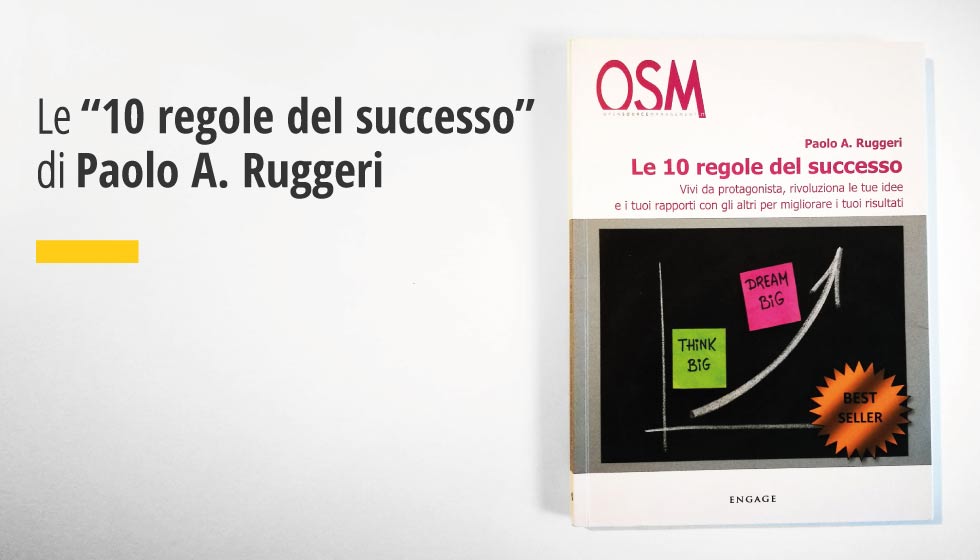
Paolo Ruggeri “The Ten Rules of Success”
I have read this book several times because it is simply fantastic.
Success? Moving from a state of enough to a state of abundance.
Basically it divides Entrepreneurs, but we could say people in general, into two groups.
Those who accept the state they are living in, where “success appears as a feeling of fulfillment for what they have been able to achieve in life,” and thus live in the concept of ENOUGH.
Others, that is, those who respond to a second definition of success as “The knowledge that you are materializing your dreams” and thus live their lives in the concept of ABUNDANCE and not enough.
He goes on to express the concept of abundance as “abundance doesn’t mean a delicate balance on which your survival rests, it means that things are going really well. “
“It means having many more customers interested in your products or services than you can satisfy.”
But if you look more closely you find that a great many entrepreneurs who now live in enough, when they founded their companies they lived in the concept of abundance.
They saw success as abundance
They had a dream, a goal, a purpose in life and “saw success as abundance.”
Little by little, for a thousand reasons, they have forgotten their dream and transformed their lives:
“People who used to be idealists, pursuing the materialization of their dreams, have turned into extremely realistic people, with their feet firmly planted on the ground, who think ‘it’s not that simple, “between saying and doing there’s a sea in the middle,” “it’s easy to say, but not easy to do.”….
The culture of enough is becoming so entrenched in society that it is taking away something that has always belonged to us: our dreams.
And so it was that as I eagerly read the pages of this book, emotions were reborn in me.
The desire to change my life broke through the soporific state into which I had now descended.
My dreams, the ones I had always had but had now sealed in a box, stowed away in a nightstand drawer, came back, more and more intensely, awakening the ardor I had not felt for quite some time.
I think one of the most beautiful passages in the book, regarding abundance, is the definition Paul gives in the Introduction
Abundance is not just a matter of wealth and property. It is primarily a matter of contentment and happiness: a man dies when the last of his dreams dies.
We become what we do
Ralph Waldo Emerson, as early as the late 19th century, argued in his “Essay on Compensation”:
“You will be paid exactly for what you have done, no more, no less. In work and in life you cannot cheat. The thief steals from himself. The cheater cheats himself.”
“To be successful you have to improve the quality of your exchange.”
It is only fair for me to tell you that in this article I address a decidedly tough topic.
I believe it is critical to analyze our actions and those of our collaborators to understand how to improve our business and, in some cases, even our social relationships.
We live in a world that is based on exchange, and at this time in history, the production freeze has made this phenomenon even more evident.
Human relationships, as well as business relationships, rest on the pillar of exchange.
By analyzing the “exchanges” in which a person is involved, we can understand much about why his or her life is going well or badly.
And that is how there are people who try to have 10 offering 5 or even less.
Who try to take advantage of every opportunity to “bring home business.”
Who do not care about what they do to others, but exclusively about what they achieve.
These people live by unequal exchanges. The scales, according to them, must always weigh in their favor.
But one of the certainties we can have, even if it is sometimes hard to believe, is that it all adds up.
For this reason, I try to always keep in mind the Buddhist Law of Cause and Effect
“We reap what we sow. What we put into the universe is what comes back to us.”
Ralph Waldo Emerson, as early as the late 1800s, argued in his “Essay on Compensation“
“You will be paid exactly for what you have done, no more, no less. In work and in life you cannot cheat. The thief steals from himself. The cheater cheats himself.”
In life as in work, it is crucial to exchange results and not actions.
I quote a practical example that Paolo Ruggeri writes in his book “The 10 Rules of Success.”
A farmer every morning gets up at five o’clock and starts plowing, hoeing, sowing etc.
A few months later he shows up at the market with his basket of tomatoes.
He exchanges the tomatoes for money or other goods that will enable him to survive.
Rightly we are willing to pay, only if we have tomatoes in return.
We would all consider it bizarre if he showed up at the market, without tomatoes and demanded money just for plowing, hoeing, sowing etc.
Unfortunately, this happens every day in business and in relationships with people.
Often times they want to exchange not the result of their action but the action itself.
There are employees who think that their salary is due to them only because of the hours they spend at work, because of their commitment, because of their degree, because of their position on the organizational chart, but where are the tomatoes?
Let’s try to explore this thought by taking a concrete look at what happens in our companies, every day.
Sometimes our employees or suppliers perform several actions, that is, work, producing few concrete results.
This exchange becomes negative for the enterprise that needs concrete, tangible results, not actions.
Let’s take a practical example of what might take place in my agency.
If I assign a collaborate to make a new Client’s website what do I expect in return?
That after analyzing all the client’s needs and clearing all doubts, the collaborator will realize the agreed website in the agreed time.
If there are problems during the implementation phase, the collaborator must proceed independently to solve the problems, even if he or she does not have the total expertise (e.g., by turning to one of his or her colleagues).
If the problem is really big, you can turn to me for advice, or to find a solution together.
In this way he produced a useful “good” for the agency and the client.
Different is the case if the contributor, on the agreed delivery date, shows up telling me that he installed wordpress, that he did the layout, that…that…that…but the site is not ready.
Basically, he is giving me a list of actions taken, some of them probably complicated or difficult, but which did not produce the agreed-upon result.
Where are the tomatoes?
Not only that. The exchange must also produce a great result for the one who receives it. It must produce a great bargain.
Basically, the Client must receive something more.
For example, the agreed-upon website but with a little extra unanticipated functionality.
This allows me to make the Client even happier, who thus feels that he or she got a very good deal.
And so he will still approach my agency.
It is important to keep in mind that there is always a customer.
For the Entrepreneur, the customer is the market and the one who buys his product or service.
For the collaborator, the Client is both the entrepreneur and, in many cases, also the end customer.
Because a collaborator is his or her own Entrepreneur.
To win and thus achieve our personal goals, it is essential that both, entrepreneur and employee, listen to their respective Clients.
Dear Entrepreneur awakens the dream in you
If you are an Entrepreneur, if you have a Business, whether small or large, try to think back to that day when you decided to try, to put yourself out there.
What led you to create your business? What was your dream?
Our dream is the vital energy that we must carry within us every day, which gives us the strength, determination and awareness to constantly put ourselves out there.
Doing what we set out to do, that is, the hard work of the Entrepreneur.
Rediscover your dreams and goals. If you no longer remember what they were.
If you feel lonely and feel like you are constantly running every day, like a hamster on a wheel, then it’s time to stop.
Take some time and if you take advice, contact an OSM Partner.
If you want to find out why, I invite you to read this article OSM a great opportunity for all Entrepreneurs.
To them I owe everything, because they awakened the dream that was now buried inside me. They restored my energy, vision and mission.
My life has totally changed because of them, both personally and professionally.
Give yourself this chance.
If you want to learn more about my thinking, I invite you to read this page “Spiritual Business“.
It is on this principle I am building the Agency.
Happy reading.
donato cremonesi
Did you find this article interesting? You can explore further by reading these articles.
- When motivational drive turns a dream into an attainable goal
- Support the nonprofit Entrepreneur You Are Not Alone
- Howard Schultz. A history of success
- Spiritual Business by Anna Marras
- Ethical marketing: how it can make a difference for companies
- Do you want to acquire customers? Attract the right people
- Strategy and business planning to build the future
- Palm Oil discovers marketing
- Passing from father to son, in a Company, is a difficult bet to win