


In this article we look at what quality score is and how it affects the ADV Campaigns you make on Google ADS, or Social Media channels.
What is the quality score
Quality Score is an indicator used by search engines and advertising platforms to assess the quality and relevance of ads, keywords and landing pages.
It is measured on a scale of 1 to 10, where a higher score indicates higher quality and relevance to users.
Quality Score is critical because it directly influences the performance of advertising campaigns.
This classification affects both the cost and position of the pay-per-click ads published on the SERP (search engine results page).
A higher score can lead to:
- Better ad placements
- Lower cost per click(CPC)
- Increased visibility of listings
Higher quality scores tend to reduce cost per click (CPC), which translates into lower costs for conversions and higher ROI.
Before looking in detail at what the quality score is and how it is calculated, it is appropriate to see what campaigns made with Google ADS are.
Quality score Google ADS
Ad campaigns created with Google ADS are a type of online advertising in which advertisers can create ads and promote their products or services on Google’s search engines and Google’s partner network.
These campaigns allow advertisers to reach specific audiences based on keywords searched by users and show ads in search engine results pages.
Advertisers can set a daily budget and pay only when users click on ads.
Google ADS offers a number of tools and metrics to monitor ad performance and optimize ad campaigns. Quality Score is one of these very important factors.
Here are some reasons why you might consider using Google Ads to promote your products or services:
- Wide visibility: Google is the most widely used search engine in the world, with millions of searches performed every day.
- Precise targeting: allows you to select keywords relevant to your business and show ads only to users who perform searches related to those keywords.
- Budget control: you can set a daily budget and pay only when users click on ads (pay-per-click).
- Measurability and analytics: you can precisely monitor the performance of your advertising campaigns. You can get detailed information on the number of clicks, conversions, cost per click, and more.
Google ADS quality score: how it is calculated
In Google Ads, Quality Score is calculated based on three main factors:
- Expected CTR: estimate of how likely the ad is to receive clicks
- Relevance of the ad: how relevant the ad is to the search terms
- Landing page experience: quality and relevance of landing pages
Google provides ratings for each component (“Above Average,” “Average,” or “Below Average”) by comparing performance with other advertisers.
How to improve Quality Score Ads
Here are some tips for optimizing Quality Score:
- Improve relevance between keywords and search queries
- Create relevant and engaging ads
- Optimizing landing pages for a better user experience
- Monitor and improve the historical CTR of the account
- Avoid overuse of irrelevant keywords
How to check Quality Score Ads
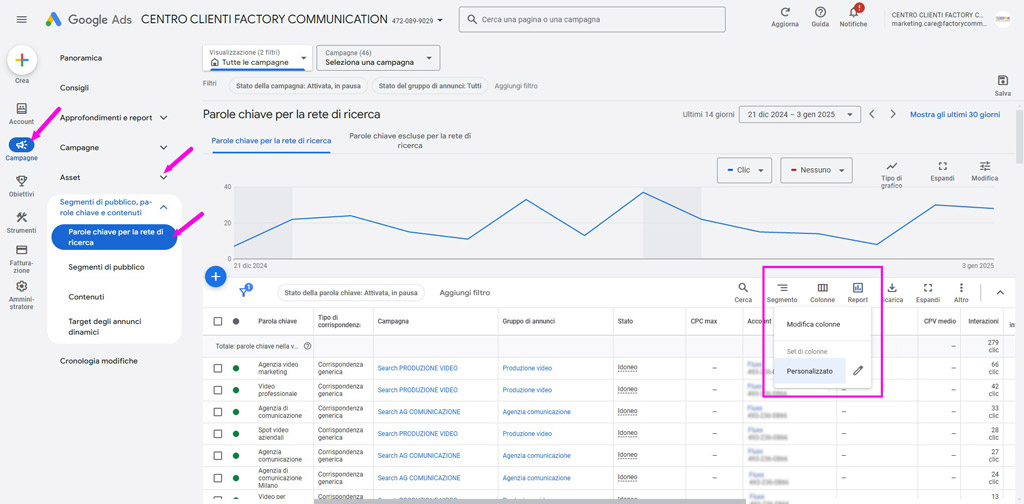
You can view the Quality Score in your Google Ads account. Each keyword you are targeting receives a Quality Score.
Simply go to the “Campaigns” tab. Click on “Assets” and select “Keywords for Search Network” (purple arrows).
Then you must select the option that allows you to change the columns displayed (purple box).
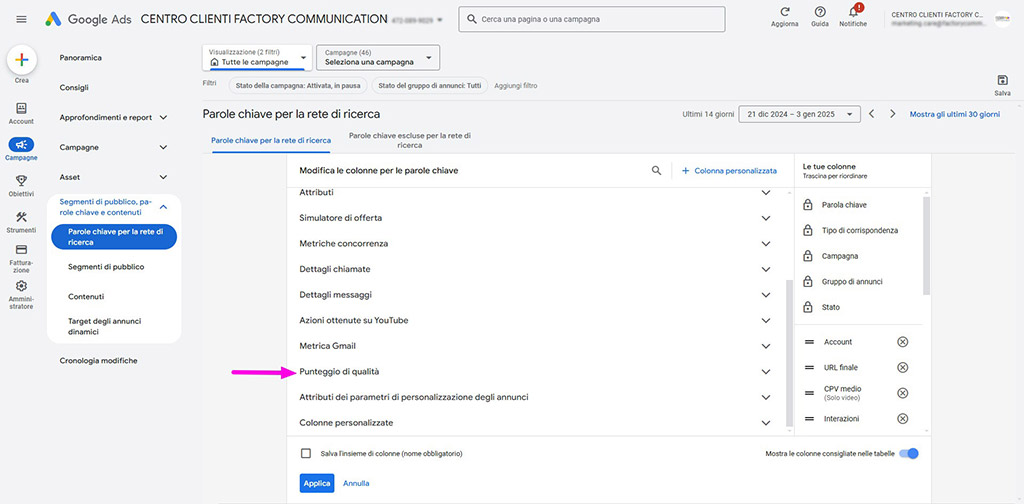
At this point you must select the “Quality Score” option (purple arrow).
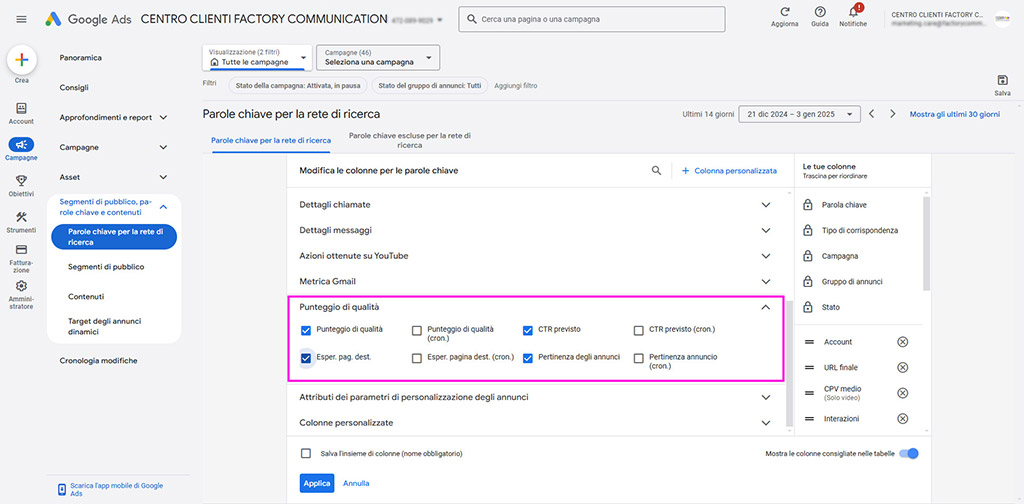
Choose which columns you want to display in your report (purple box).
Quality score Facebook
Facebook uses a system called“Ad Relevance Diagnostics” that evaluates ads on three dimensions:
- Quality Ranking: perceived quality of the ad compared to the competition
- Engagement Rate Ranking: expected engagement rate
- Conversion Rate Ranking: expected conversion rate
Quality score Facebook: Key factors
- Relevance of the ad: How well the ad content aligns with the selected target audience.
- Engagement rate: Measures how often people interact with the ad, including likes, comments and shares.
- Conversion rate: Evaluates the effectiveness of the ad in generating desired actions, such as purchases or sign-ups.
- Perceived quality: How the quality of your ad compares with that of other ads competing for the same audience.
- Campaign goal: How effectively the ad supports the specific goal you have chosen for your campaign.
- Freshness of content: Facebook penalizes outdated or repetitive ads.
- User feedback: How users react to the ad, including positive and negative interactions.
Other influencing factors
- Low-quality attributes: Facebook negatively considers some elements such as:
- Withholding information
- Sensationalist language
- Engagement bait (content that solicits interactions in an inauthentic way)
- Ad frequency: Too high a frequency can lead to ad fatigue and negatively affect the score.
- Quality of creative content: High-quality, high-resolution images that connect well with the ad text.
To improve the Quality Score on Facebook, it is critical to focus on these factors, creating relevant, engaging, and high-quality ad groups that resonate with target audiences and effectively support campaign goals.
Quality Score Instagram
On Instagram, which is part of Facebook’s advertising ecosystem, a similar concept called“Audience Quality Score” (AQS) is used.
The AQS is a score from 1 to 100 that is based on several key factors:
- Engagement Rate (Engagement Rate): Percentage of followers who interact with the influencer’s content.
- Audience quality: Percentage of real followers versus bots or inactive accounts.
- Growth patterns of followers and followings: Detection of anomalous activity in growth graphs.
- Authenticity of comments: Percentage of recent comments from real accounts, not involved in “engagement pods.”
Quality Score Instagram: Key Factors
The AQS score is the result of 15 different metrics, divided into the four main categories mentioned above.
Some analytical tools, such as HypeAuditor, use up to 28 different metrics to evaluate an Instagram profile.
Additional factors considered:
- Follower Reachability: Number of followers who follow fewer than 1,500 accounts, indicating a greater likelihood of seeing the influencer’s content.
- Quality of engagement: Assessing the authenticity of likes and comments.
- Comparison with similar accounts: Comparison of influencer engagement with the average of accounts with a similar number of followers.
Interpretation of the score
- An AQS of 100 indicates an audience of the highest quality
- Scores between 40 and 70 deserve further analysis
- Scores below 40 generally indicate a low-quality audience.
Quality score: why is it important?
In order to improve ad group placement, advertisers are faced with a choice: increase the maximum cost per click (CPC) or improve the quality score.
Assuming that CPCs will continue to rise due to the increased number of advertisers using these tools, ad optimization is no longer an option but a compulsory choice to maintain optimal rankings.
For this reason, quality score is a crucial factor.
Quality Score Tool
Several tools exist to monitor and improve Quality Score:
- Google Ads: offers built-in functionality to view and analyze Quality Score
- Third-party platforms: tools such as SEMrush or Optmyzr provide in-depth analysis and content optimization suggestions for websites and eCommerce
- Facebook Ads Manager: allows you to view metrics from Ad Relevance Diagnostics
- Analytics tools for influencers: for Instagram, platforms such as Phyllo offer insights on Audience Quality Score.
Quality score: conclusions
In conclusion, Quality Score is a crucial element in the success of digital advertising campaigns.
Constantly monitoring and optimizing it can lead to better performance and more efficient use of the advertising budget.
In conclusion, improving the quality score is essential for optimal results from ADV campaigns.
If you are an advertiser, you need to do everything you can to increase the relevance of your ads, improve the user experience, and score high.
This is the only way you can compete in your target market, increasing the number of users coming to your landing page (site/eCommerce, App etc) without having to increase your offer prices.
In conclusion, improving the quality score on Google requires a strategic and constant approach.
Optimizing your keywords, landing page and monitoring the performance of your ad groups are just some of the actions you need to take on a daily basis for optimal results.
Investing time and energy in improving your quality score can lead to greater visibility and success in your ADV campaigns.
ADV campaign implementation: related articles
What are the elements that we need to take into consideration when carrying out lead generation activities? Read these articles