



Twitter can also become an integral part of your marketing strategy, allowing you to increase sales, thanks to its e-commerce
Do you want to sell your products online? Surely Twitter is not the first social network that comes to mind for your online shopping.
However, with sales through e-commerce continuing to increase, partly due to the COVID-19 pandemic, social platforms are increasingly getting in on the action.
Facebook with its Facebook Shop, Instagram with its Online Shop feature, TikTok is taking its first steps to implement a new e-commerce within its platform. Thus, Twitter certainly does not waste time either.
Social e-commerce is definitely a great idea to boost sales of your products and services.
We live in an age where we are always connected and “on the hunt” for the quick, convenient and…online purchase!
In short, Twitter, too, wants to ride the trends of the moment…testing e-commerce functionality.
Perhaps not everyone remembers that a few years ago, Twitter had already included its “Buy Now” call-to-action button, only to withdraw it in 2017, deciding to abandon the idea momentarily and focus on other avenues.
Today, the social network, reevaluates this idea, offering business account holders the chance to test new tools for online sales.
By providing, therefore, a social space where shoppers can discover new products while conversing with brands and communities.
Twitter social: E-commerce a test to boost online sales
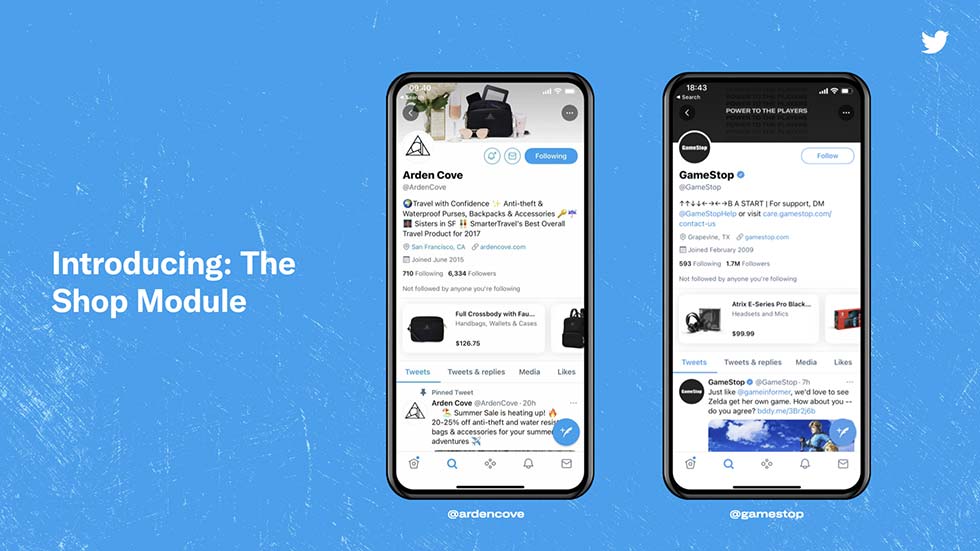
How can your Brand use Twitter ecommerce to increase sales of products and services?
As anticipated,Twitter e-commerce is still in the testing phase, but even if your business profile does not yet have access to these features.
We report 3 points to consider if you want to implement in your Inbound Marketing strategy, online selling through Twitter.
Step 1: Create and propose valuable content…the right content, at the right time, to the right person
Now is the right time to start coming up with valuable content that can generate enough interest to keep your target audience’s attention and, why not, also attract new users by motivating them to join your community.
This strategy is known as Inbound Marketing.
Let us never forget that, an old or new user who is interested today, has all the prerequisites to become a very good buyer tomorrow.
Let’s take a practical example.
Suppose your brand is a skin care product company.
In this case, you can start a conversation with your community by offering interesting informative and educational tweets.
You thus have the opportunity to:
- Illustrate each essential step in creating an effective skin care routine
- Explain why it is important to follow each proposed advice and step.
Your audience will thus be motivated and inclined to share the steps of their beauty routine, to show how they take care of their skin and their person, and to ask for information and useful tips about the products you offer.
By continuing to stimulate your audience, through these kinds of interactions, once your Brand Twitter profile, gets access to the e-commerce business features, you can start offering the products discussed in your online shop.
Then you can measure your users’ responses (in terms of clicks and purchases).
Step 2: Select a variety of products to feature in your Twitter e-commerce
When The Shop Module is available on your Twitter profile, start testing the products that appeal and are most interesting to your audience.
How?
For example, try offering a variety of products for sale, at different prices, and regularly evaluate which of these products get the most clicks and purchases.
This is definitely a great way to refine your e-commerce strategy.
Step 3: Take an experimental approach
In the early stages, do not rely too heavily on using these new features to increase sales.
Instead, take a more experimental approach to assess your audience’s responses, then refine your strategy when you have a more robust set of data and statistics.
While implementing these new features, Twitter made it clear that it is testing its e-commerce to better understand user behavior.
And so should you.
Study, analyze, do lots of tests and increasingly refine your strategy to increase online sales of your e-commerce products.
Social platforms that offer brands more and more sales opportunities, therefore, allow us to experiment and implement in our marketing strategy, innovative methods to connect more and more consumers to products and services.
Why use Twitter to carry out Communication and Marketing activities
How and why to use Twitter for your business!
Referred to as an “Information Network” by many, it has inherent qualities that make it highly valued for both personal branding as well as for corporate communication management.
Right now it has exceeded 500 Million users worldwide and 200 Million active/monthly users.
It is certainly a very strong social network in some areas and a little less so in others. But one cannot shy away from using it, even for just creating Links to one’s own site.
The mode is different from that of Facebook. Basically, the user does not ask for friendship, but simply decides who he wants to follow. He in turn will be followed, if deemed interesting, by other users.
The distinguishing feature of Twitter is that messages must be 140 characters long, like early SMS. A feature that will soon be dropped, as it is considered by some to be limiting.
A momentous change is planned for March 2016: it will be possible to post longer articles, complete with Links, images and videos.
We consider it strategic especially to understand the general sentiment, which themes, topics and keywords are most used at that specific moment.
If you know what people are interested in, you can plan activities and communication strategies to “exploit” those interests.
Why is it useful to your Company?
It allows you to:
- Listening: it is not as important to open an account to say how good we are as it is to be present to listen to what they are saying about US.
What perceptions others have of us and our market, and to understand what the competition is doing. - Telling (and promoting): taking advantage of the great opportunity to communicate oneself and one’s company to improve one’s image.
Also through a studied editorial plan that allows us to convey a service/product we offer on a daily basis. - Dialog: tool for dialogue with individual users.
Everyone who participates with a question or remark only increases word of mouth and the virality of our communication.
An opportunity for businesses to invest in visibility, communication and listening.
There are so many Channels and Tools available to structure one’s Social Strategy.
You can decide to do everything yourself, or you can rely on Agencies, such as Factory Communication, to do it for you.
Did you find this article interesting? You can explore further by reading these articles.