



Are you a Web Copywriter and looking for a recipe for your SEO Strategy?
Don’t worry, you are in the right place!
You probably typed one of these keywords into Google:
- copywriter consulting
- copywriter for websites
- copywriter consultant
- copywriter sites
Whether you are a freelance copywriter, or you work in an Agency like us, we onsider you to read our 5 tips to implement your SEO Strategy.
Web Copywriter what it does
SEO writing means creating content optimized for search engines.
Imagine you do a Google search, for example, “Pizza recipe.”
On the results page (SERP) you will see many sites and articles appear where you can find your recipe. Most likely, you will click on one of the first ones.
Being in the top search engine results is the goal of everyone involved in SEO-driven content creation.
Being first on Google means we can intercept new potential customers, increase traffic to our site, increase sales of our e-commerce. Not bad, right?
How does Google decide which web page deserves the top positions?
Although the algorithm is not 100% known, we know for a fact that the search engine cannot taste pizzas (poor!). So it is not certain that the first recipes you find are also the best ones.
Certainly (except for paid content, which you easily recognize in the SERP) Google rewards optimized content and sites by giving them a good score in its ranking.
To optimize a piece of content, you must use a number of technical tricks that allow Google’s bots to locate, read and evaluate the text.
It will only offer it to its users if it seems to them to be in line with what they are looking for.

Copywriter for websites
There are many other aspects related to SEO, but today we mainly talk about SEO blog article writing.
SEO blogging appeals to companies because it allows them to intercept the searches of sincerely interested users for free.
Every great dish requires technique, research and the chef’s touch. But a 5-ingredient recipe for writing SEO is a good place to start. Strap on your apron and hat. In a few minutes, the SEO blog will be on the pass.
You are a web copywriter and you need to do persuasive writing for a landing page or a website. Don’t worry now we reveal 5 key ingredients you can use all the time.
1. Web copywriting valuable content for your users
The main ingredient in any SEO (or non-SEO) content is the Value it brings to users. Pour it copiously into the bowl and sift through it, for it is never too much.
Added Value is the nourishing part of content marketing, in fact it “feeds” a desire and “satiates” those who read your SEO blog articles.
How do you recognize if a piece of content brings Value?
- It solves a problem;
- It teaches something;
- Amusement;
- Inspire big or small change, etc.
If your content does none of these things, then run to the mill and fill a bag-it’s like making pizza without flour.
2. SEO copywriting: Keywords q.b.
We have the basic ingredient. But what makes Google read our very SEO article?
Keywords. These are the keywords that “intercept” user search.
If the Value Added is the flour, the Keywords give the taste.
Some people ask for Capricciosa, some for Diavola, and some for Quattro Formaggi. (Alert: This is marketing. You may have to write SEO even using the keyword “pineapple pizza.”)
What keywords do users like?
These are the most frequently used keywords to perform a search on a particular topic.
You can identify them with special tools, which also provide data on search volume, competition for that keyword, related keywords, etc.
Alternatively, you can use free tools such as Google Trends, which is useful for figuring out whether a topic is potentially interesting.
How many keywords to use in an SEO text?
If you’ve recently started as an SEO copywriter, you should know that it’s crucial not to overdo it. Not a few, but not too many.
Just like you would with the toppings on a pizza. If you want a hand with this and your site is built in WordPress, I recommend using the Yoast SEO plugin.
If your site is used with another CMS for writing your articles and a thorough SEO audit you can use Semrush.

3. A dash of meta tags
Working as a copywriter also means using know several technical aspects such as meta tags. You can’t see them, but they are there.
Meta tags are portions of html code that you need to optimize to give flavor to your SEO recipe. They can help you rank your content in the top search engine positions because the Google bot is fond of them.
The main ones are:
Meta Title
The unique title of the page (often matches the title of the article on your SEO blog). Ideal length 55/60 characters and include the main keyword: kissing!
Heading Tags (h1, h2, h3…)
That is, the headings that help you to subdivide the text hierarchically. A real treat for Google, but also a boon for humans who read;
Meta Description
That is, the description that then appears as a preview in Google. I mean here you play the description of the dish in the menu.
The ideal length of an SEO meta description should be between 150 and 160 characters, including spaces.
Alt Text
It is the text that accompanies images and is useful if an image does not load or if it is read by a screen reader for blind users.
4. Reduction of snippets
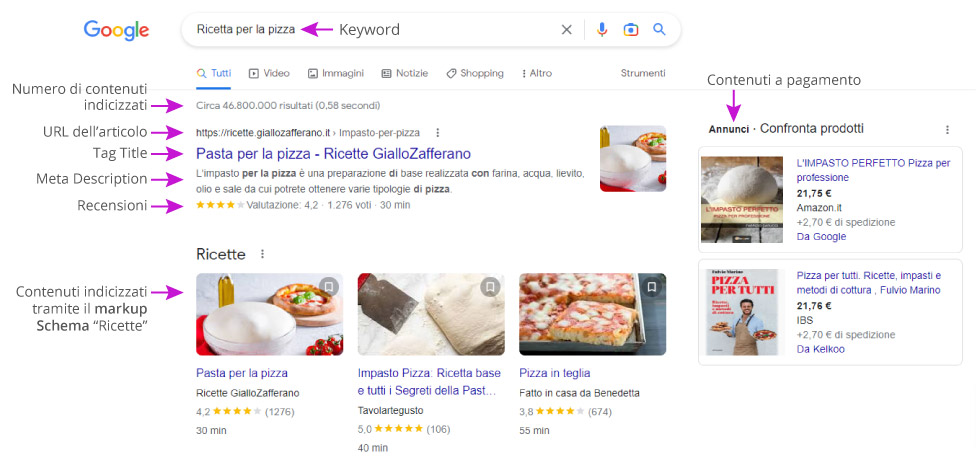
One of the secrets of old grandmothers’ SEO recipes is snippet reduction. Reduction in the true sense of the word: the snippet is what you see as a preview among the results on Google.
Includes:
- Tag Title
- Meta Description
- Article URL
The presence of keywords in these three elements allows Google to say, “Okay. This content is SEO optimized. Then I can read it and figure out if I should suggest it to my users.”
But it’s not like we are cooking for Google. The snippet must also make the user exclaim, “Wow, I really want to taste this SEO article.”
Web copywriter: A sprinkling of readability to spice it up
If you have followed the various editions of Masterchef Italia, you will know that the “mappazzone” has been rejected a thousand times by Chef Barbieri. We also fail him on our recipe for SEO writing.
The mapping on the blog is the wall of text. It has no spaces, no paragraphs, no subheadings, no boldface. You would do anything but read it.
Readability is order and hierarchical structure.
It gives the item so many textures: feel the creamy, the crispy, the crumbly. Just by looking at the dish you already know where to go for the taste and texture you like best.
Google wants its users to eat well and also rewards content with a good user experience, including readability.
Regardless of whether you need to talk about products or services, your creative writing must also be neat and organized.
Headings, subheadings, images. Prepare a detailed editorial plan and organize the spaces of your text content so that it is pleasant to look at and easy to read.

Web copywriter: Now you have all the useful info
Now that you know the 5 main ingredients you can start trying your hand at SEO writing to grow your business. Put it all in your PC and churn out a mouthwatering article.
In order to get better results with SEO writing, there are professionals whose job it is to spaddle between words and Google rankings: content writers.
But to position yourself on Google through SEO, you need a broader strategy and a detailed plan of the content to be published.
Why don’t you consider hiring an agency experienced in SEO strategy?