


Imagine opening your own restaurant in the heart of Milan: the place is beautiful, the dishes are excellent, the service is impeccable. Yet, outside the door, no one walks by. The sidewalk is deserted.
This is the situation in which many Italian SMEs find themselves on the web: quality products and services, yet zero digital visibility. The problem is not the offer, it is the absence of a strategy to be found.
Until a few years ago, there was only one tool to solve this problem: SEO (Search Engine Optimization). Today, the landscape has changed dramatically.
Two new approaches have emerged-Generative Engine Optimization ( GEO ) and Answer Engine Optimization ( AEO )-that respond to a world in which people search for information in a completely different way than in the past.
In this article you will find out what these three acronyms mean, how they differ, and what concrete tools you can use for each. All explained in a simple way, without unnecessary technicalities.
1. SEO: the foundation of online visibility
SEO, Search Engine Optimization, is the set of activities that allow your website to appear among the top Google results when someone searches for something relevant to your business.
How it works
Think of Google as a giant library. SEO is the work you do to make sure your books (your web pages) are properly cataloged, have a clear title, are well written, and that other libraries (authoritative sites) cite them as reliable sources.
In practice, SEO works on three pillars:
- Technique: the site is fast, secure, search engine readable
- Content: pages answer questions users ask Google
- Authoritativeness: other quality sites link to your pages, certifying your expertise
What it’s good for your business
SEO generates organic traffic, that is, visitors who come to your site for free, without you paying for each click.
It is a medium- to long-term investment: results come in 6-12 months, yet they last much more stably over time than paid advertising.
| Practical example: a Chianti winery optimizes its pages for keywords such as “organic wine Tuscany” or “visit Chianti winery.” After 8 months, it receives 400 organic visitors per month without spending a euro on advertising. |
Key SEO tools
Here are the tools that professionals and agencies use for SEO:
- Google Search Console (free): monitors how Google sees your site, what keywords bring you traffic, any technical errors
- Google Analytics 4 (free): analyzes user behavior on the site
- Semrush / Ahrefs (paid): keyword research, competitor analysis, position monitoring
- Screaming Frog (freemium): technical site scan
- Surfer SEO (paid): content optimization with an SEO perspective
2. GEO: optimize for generative engines.
GEO, Generative Engine Optimization, is a discipline that has emerged in the past two years with the spread of generative artificial intelligence.
This is the optimization of content to be cited and recommended by tools such as ChatGPT, Google Gemini, Perplexity, and Google AI Overviews.
The change that generated the GEO
Until yesterday, when someone searched for “best hotel in Florence,” Google would show a list of links. The user would click and visit the sites.
Today, increasingly, ChatGPT or Google’s AI Overviews answer directly, “Here are the three most recommended hotels in Florence, with their top features.”
In this scenario, if your company is not among the sources that artificial intelligence considers authoritative, it simply does not exist in the response.
GEO works on exactly that: making your content understandable, structured and credible in the eyes of AI models.
How it works in practice
Unlike classical SEO, which optimizes by keywords, GEO optimizes by concepts and contexts. AIs prefer:
- Content that directly and completely answers a question
- Structured texts with verifiable data, cited sources, statistics
- Brand with a consistent presence across multiple platforms (website, social, industry directory)
- Up-to-date content relevant to the relevant field
| Practical example: a law firm in Milan that publishes in-depth articles on labor law, with up-to-date data and precise normative references, is more likely to be quoted by ChatGPT when a user asks “what are the worker’s rights in case of dismissal in Italy.” |
Main GEO tools
- Perplexity AI (freemium): useful for understanding how AIs answer questions in your industry
- ChatGPT (freemium): check if your brand is mentioned in replies on relevant topics
- Brandwatch / Mention (paid): monitoring of brand mentions on the web and AI
- Schema.org optimization (free): structured markup that helps AI understand your content
- AlsoAsked.com (freemium): identifies related questions people ask about AI engines
3. AEO: optimize for direct responses.
AEO, Answer Engine Optimization, is answer engine optimization.
While SEO aims to rank in Google’s list of results, AEO aims to get the “featured snippet”: that box that appears at the top of the Google page with the direct answer to the user’s question, even before the links.
The difference between GEO and AEO
These two terms are often confused. The distinction is this:
- GEO is about optimization for generative artificial intelligences (ChatGPT, Gemini, Perplexity)
- AEO is about optimization for direct response features within Google itself (featured snippet, People Also Ask, Knowledge Panel)
In practice, AEO was born before GEO and is more established as a discipline. However, today the boundaries overlap as Google increasingly uses AI to generate its direct responses.
How it works
To get a featured snippet on Google, your content must accurately, concisely and authoritatively answer a specific question. AEO best practices include:
- Structure the content with explicit questions as headings (H2, H3) and answer them in the following paragraphs
- Use clear lists, tables, and definitions
- Implement structured data (FAQ Schema, HowTo Schema) in the site code
- Aim for questions such as “what is it,” “how does it work,” “what is the difference between”
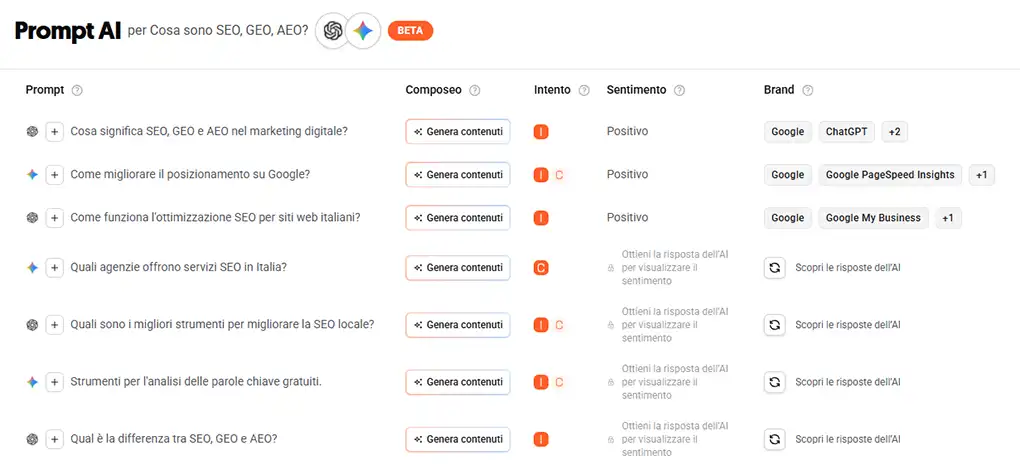
As you can see the title of this article is “What are SEO, GEO, AEO? What are the differences and what tools do they use?” which includes as its main keyword “What are SEO, GEO, AEO”
| Practical example: a hotel in Venice creates a FAQ page on its site with questions such as “what is the best time to visit Venice?” and well-structured answers. Google selects that answer as a featured snippet: the hotel appears at the top of the results without paying advertising, resulting in a significant increase in organic visits. |
Main AEO tools
- Google Search Console (free): identifies queries for which your site already gets rich results
- AnswerThePublic (freemium): find out what questions people are asking about a topic
- SEMrush Position Tracking (paid): monitor featured snippets for your keywords
- Google’s Schema Markup Validator (free): checks that structured data is implemented correctly
- Phrase.io (paid): optimizes content to answer users’ questions
4. SEO, GEO and AEO compared: the summary table
Here is a visual scheme to navigate the three disciplines:
| SEO | GEO | AEO | |
| Target | Positioning on Google | Being quoted by AI | Getting direct answers |
| Channel | Google (results list) | ChatGPT, Gemini, Perplexity | Google (snippet, FAQ box) |
| Focus | Keywords and links | Concepts and authority | Questions and Answers |
| Horizon | 6-18 months | 3-12 months | 3-9 months |
| Difficulty | Medium-High | High | Media |
| Investment | Medium-High | Medium | Medium-Low |
| Results | Constant traffic | Brand awareness AI | Vertical visibility |
5. Comparing tools: the practical guide for the entrepreneur
This section brings together in one table the main tools for each discipline, with an indication of cost and practical use. A concrete starting point for navigating the world of digital tools.
| Discipline | Tool | What is it for | Cost |
| SEO | Google Search Console | Monitor visibility and keywords on Google | Free |
| SEO | Google Analytics 4 | Analyze user behavior on the site | Free |
| SEO | Semrush | Keyword research and competitor analysis | From €120/month |
| SEO | Ahrefs | Backlink analysis and keyword research | From €99/month |
| SEO | Screaming Frog | Technical site scan | Free up to 500 URLs |
| GEO | ChatGPT | Checking brand citations in AI responses | Free / €20 month |
| GEO | Perplexity AI | Monitoring AI responses on industry questions | Free / €20 month |
| GEO | AlsoAsked.com | Related questions in AI engines | Freemium |
| GEO | Schema.org Markup | Structured data for AI understanding | Free |
| AEO | AnswerThePublic | Questions that users ask online | Freemium |
| AEO | Schema Markup Validator | Structured data implementation verification | Free |
| AEO | Phrase.I | Optimize content to answer questions | From €14/month |
| AEO | SEMrush Position Tracking | Monitor featured snippet and rich result | Included in Semrush |
6. What strategy to adopt? The starting point for an SME
The most frequent question we receive from entrepreneurs is, “Where do I start?”
The answer depends on what stage your company is in digitally:
If your site doesn’t show up on Google
SEO is the essential starting point. Before thinking about AI, you need your site to be technically sound, have quality content, and receive authoritative links.
Without this foundation, GEO and AEO have little to work with.
If you already have a good SEO
Now is the right time to integrate GEO and AEO into your strategy.
Start structuring your content in a question-answer format, put structured data on your site, and periodically check how your company is being described by ChatGPT and Perplexity.
If you are a startup or a brand new
Investing from the beginning in all three disciplines is the most efficient choice.
The advantage of starting from scratch is that you can build a site that is already optimized for classic search engines and artificial intelligence, without having to “fix” already established structures.
| Factory Communication’s advice The three disciplines are not alternatives: they complement each other. SEO, GEO and AEO are three different ways of answering the same question: how do I get the right people to find my company when they need it? Building an integrated strategy, with clear priorities and a realistic budget, is the most effective way to achieve lasting results. |
7. Checklist: are you ready for SEO, GEO and AEO?
Use this checklist to figure out what stage your company is in:
SEO Checklist
- Your site is indexed correctly on Google Search Console
- You have identified the main keywords for your industry and your pages contain them
- Site loads in less than 3 seconds on mobile
- You have a content strategy (blogs, guides, FAQs) that is updated regularly
- Do you have at least some links from authoritative sites in your field
GEO Checklist
- Have you checked whether ChatGPT or Perplexity mention your company or products
- Your content includes verifiable data, sources, and up-to-date industry information
- You have implemented structured data (Schema.org) in your site
- Your online presence is consistent across multiple platforms (website, Google Business, LinkedIn)
AEO Checklist
- You have a FAQ section on the site with real questions from your customers
- Blog article titles are structured as questions
- You have implemented the FAQ Schema or HowTo Schema on the relevant pages.
- Monitor queries for which Google already shows direct answers (featured snippets) related to your brand
Conclusion
SEO, GEO and AEO are not acronyms to be left to the techies. They are three strategic levers that, used with awareness, determine whether your company is visible or invisible in the digital world of today and tomorrow.
The starting point is always the same: understand where your business is today, define where you want to get to and build a realistic path to get there.
Without miraculous promises, without blind investment: with method, data and a clear vision.
If you want to understand where your company stands with respect to these three disciplines, the first step is to make an honest assessment of your current situation.