


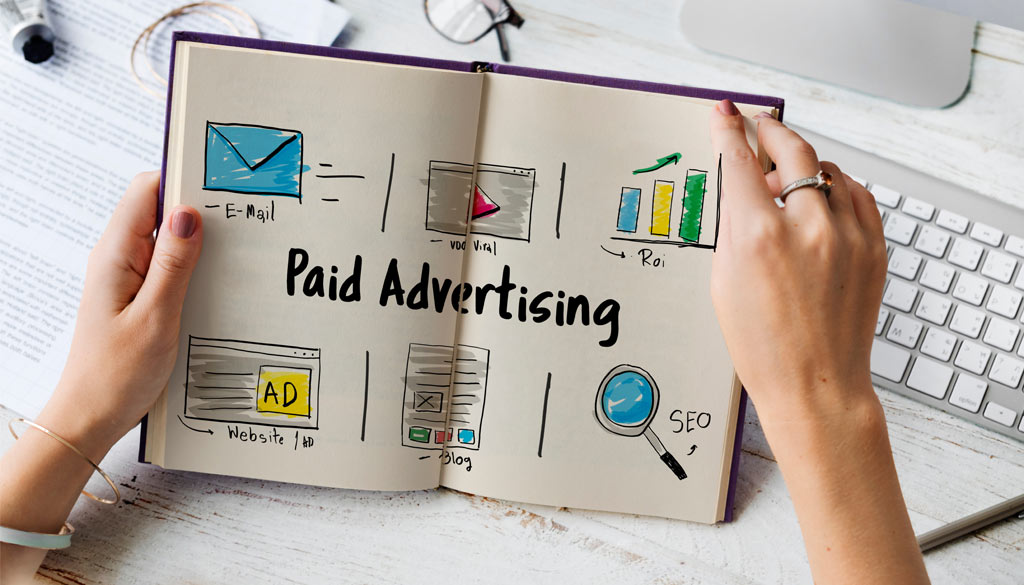
Advertising campaigns are one of the most powerful tools for promoting products, services or brands in a targeted and effective way.
Through well-structured marketing strategies and the use of various channels, both digital and traditional, companies can reach specific audience segments, increase visibility and stimulate interest in their offerings.
A well-planned digital advertising strategy enables :
- intercept the rightperson (buyer persona)
- optimize the invested budget
- acquire new customers and potential customers
- increase sales
- improve brand awareness
- monitor results in real time
Basically through a Digital Marketing campaign you can achieve your business and marketing goals.
In this article we will delve into how to design, manage, and improve advertising campaigns for maximum return on investment.
And now, let’s look at the elements to consider when planning a pay-per-click campaign:
1. Advertising campaigns: Objectives
Like all Marketing activities, objectives determine all the elements that make up a Campaign strategy.
We report below the main goals we can achieve:
- Online branding: Increasing brand awareness
- Brand monitoring: Monitoring sentiment (what people think) in search engine results
- Database building: Building a database of contacts to be used for subsequent marketing activities
- Lead generation: Creating lists of profiled contacts motivated to purchase
- Direct sales: through e-commerce and/or price comparators
Depending on the objective, the campaign may have a more or less complex structure.
2. Budget and ROI
Cross and delight of Google Ads is the cost.
In fact, what is considered an advantage can turn into a critical element.
Finally, it should be noted that CPC is not the only parameter taken into consideration by Google during the auction. The text of the ad must also be judged as relevant, just as the quality of the landing page carries its own weight.
So when you incorporate Ads campaigns into your marketing strategy, you should try to do so by taking a broader view of your entire online presence.
The benefits of the opportunity to do push with advertising and showcase yourself by paying for ad space are obvious.
However, this does not detract from the need to build a strong brand and put in place a multichannel digital marketing strategy.
Your website, your social, your blog should always be up-to-date, shiny and ready for a new user to visit.
3. Advertising campaigns: keywords
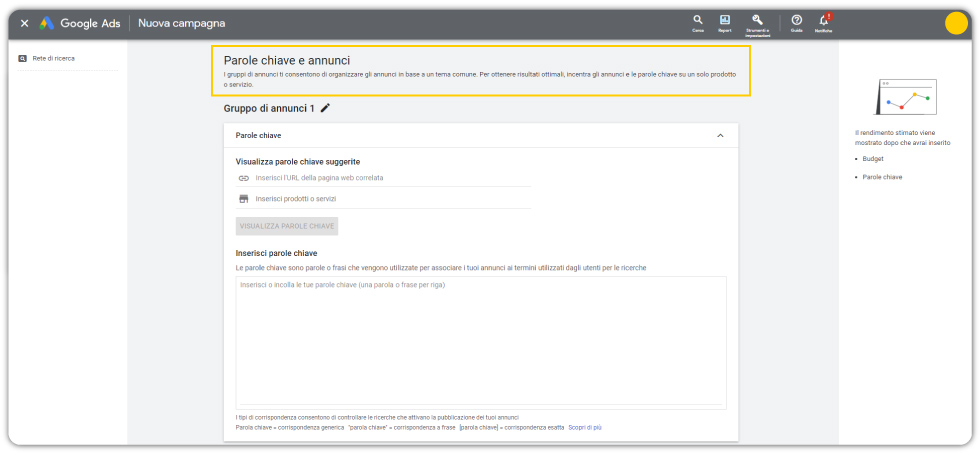
As you may have guessed in the section on costs, the most important thing in the ad are the keywords, which Google Ads asks you to include.
The purpose of keywords is to intercept the search that users will do and propose your ad in a way that is relevant to the topic.
Depending on the type of business you run and your goals you can choose keywords that are not very specific but have a high search volume, or keywords that are more specific even if the search volume is lower.
Or you can activate multiple campaigns, on different keywords, themes and products.
- A high-traffic but generic keyword might be, for example, “women’s handbag.”
- If you have an artisanal leather goods business, you might consider instead also setting your ad to more specific keywords such as, “women’s leather bag,” “leather bucket bag,” “women’s leather bag made in italy,” and so on.
The choice depends on your strategy, but data on search volume is obtained with ad hoc tools such as for example SemRush.
4. Land your users on landing pages
Landing pages, or landing pages, are web pages, more or less complex, that are specially created with the goal of collecting leads (contacts).
Landing pages can be placed on the website, or they can be published on a specially registered Internet domain.
They are a useful tool, but not indispensable. As mentioned at the beginning, it depends on the goals of the pay-per-click campaign.
If our strategy involves the creation of a landing page, it is crucial to take the right amount of time. Because it can determine the success, or failure of our campaign.
There are many factors to consider in developing an effective and efficient landing page.
Copywriting must be able to effectively and immediately reproduce brand values and the end user’s call to action: purchasing products/services, signing up for a newsletter, downloading a catalog, etc…
In addition, never underestimate thegraphic aspect, which must be able to faithfully reproduce brand values and motivate the user to discover more and more through subsequent clicks.
- The user needs to understand right away what we are offering.
- What are its advantages
- What are the differentiators from competitors, or our strengths.
- Basically: why do you have to leave us your contact information?
In addition, it is critical to verify the landing page on mobile devices as well.
5. Advertising campaigns: the Call to Action
What is the action to be taken by the user?
The call to action (CTA) must be clear, effective and direct.
The user must immediately understand what action he or she must take to achieve the goal:
- Click here to book
- Order now
- Send us your resume
- Download the coupon
These are just a few examples of calls to action.
Haven’t you ever seen advertisements and wondered,
“Okay I’m interested, but what do I have to do?” But what the heck do I have to do to order ‘this product?”
Here, these are unfortunately real examples of PPC campaigns where the user doesn’t understand what to do.
6. Study your Ads carefully
Apparently advertisements are the most important element, they are the ones that capture the user.
True but, as we have seen, they are only one part of the process:
- The user sees the ad >
- Do you find it interesting >
- Click on the ad >
- Get to the landing page >
- Must perform an action: buy, leave contact information, make a phone call, make a reservation, etc.
As we can see, each element of the campaign can determine its success, or failure.
A few key elements should be taken into consideration:
Consistency of the advertising message
The advertising message must be consistent throughout the entire supply chain. Starting from the ad, all the way to the landing page.
Clarity of message
If we convey a promotion of products or services, we need to be clear. Deadline, discounts, constraints, purchase and payment methods, etc.
The user must have all this information available immediately. He should not be forced to look for it.
Respect for the user
Unfortunately, many campaigns convey crazy discounts, with the goal of intercepting the user, or selling immediately online.
Then really these discounts do not exist, or they are only related to stock.
Respect for the client is the first step in creating a long-lasting relationship of trust.
More simply, you only fool him once, but that will be enough to turn him into your worst enemy.
It is important to always keep in mind the importance of Ethical Business.
7. How to measure the performance of your Online Advertising Campaigns.
There are several metrics to be able to evaluate the effectiveness of your online advertising campaign, let’s look at some of them together:
- impressions(impressions): represent the number of users to whom the ad is shown, regardless of the number of clicks made;
- customer engagement: this is the ultimate metric, the so-called CTR (click through rate), which is the number of actual users who clicked on the ad;
- reach and frequency: coverage and frequency, that is, how many users were reached by the ad and how many times an individual user was exposed to the ad.
8. Final considerations.
For all these reasons, although the wizard and the simplicity of the interface make Google Ads a usable tool for everyone, you should have a solid digital strategy behind you to ensure a return on investment.
It is built from the goals, and the use of Ads campaigns must integrate within the strategy, improving the results.
Unfortunately, without an underlying strategy, or without the right skills to choose the keywords to compete on and set the budget, you risk being disappointed with the ROI.
Instead, in the right hands and with a goal-oriented action plan, however, Google Ads is an irreplaceable tool for outbound marketing, to boost sales and increase revenue.