


In this article we look at why the Buyer Journey is critical to your strategy.
What is the Buyer’s Journey?
Buyer Journeyliterally means “Buyer’s Journey.” It corresponds to that process that potential customers go through before making a final decision, regarding the purchase of a product or service.
If you are reading this article you have probably performed a search with one of these keywords:
- b2b buyer journey
- buyer journey marketing
- buyer journey funnel
We all embark on this “journey,” whether we like it or not. Whether it is buying a house, or choosing the perfect restaurant for our anniversary, we cannot avoid going through this process.
This “journey,” undertaken by the buyer, is divided into 3 stages:
- Awareness: at this stage the buyer realizes he or she has a problem.
- Consideration: at this stage the buyer becomes aware of the problem, defines it, and begins to research various options for solving it.
- Decision: at this stage the buyer makes a final decision.
Why is it critical to know the Buyer Journey?
Because if we don’t know the real needs of the potential client, we can’t be of any help to them.
It is essential to know what stage of the “journey” he is in in order to provide the most correct response to his needs.
In most cases, with the exception of impulse purchases, an individual begins his or her journey at an “unconscious stage.”
This individual probably corresponds to our target buyer person, our ideal potential customer. But he is not yet aware of our product, or he simply does not need it at the moment.
However, a triggering event might occur, which changes his situation. And this event could be the need to solve a problem, or to achieve a goal.
Here, this kicks off the Buyer Journey.






Word of mouth: understanding the buyer’s journey
If we do not have a full understanding of our audience, it creates a disconnect between our business and our potential customers.
Simply put, we might publish content that is not interesting to our audience, or rather, that is not useful at that precise moment in their journey. The consequence might just be losing that slice of the audience.
As in all marketing disciplines, it is critical to understand our audience: how they think, the answers they seek, and the path they take when they need to find a solution.
From this research, we can begin to create a content marketing strategy, with content that travels in unison with the buyer at the various stages they will go through in their Buyer Journey.
Developing the buyer’s journey for our business, is the first step in creating content that aligns with our ideal potential customer.
Buyer Journey Marketing: example
You are probably still not convinced. Maybe you’re thinking it’s all marketeering pippe.
Well every day we implement our own journey, our own “Buyer Journey.”
AWARENESS: Awareness = Need.
You’re at the beach. You are single. You have just met someone you think is very interesting.
Talking you find out that she is a vegetarian…. like you.
You want to invite her to dinner. But you don’t want to take her to just any place.
You don’t know the local restaurants because it’s your first time in that location.
CONSIDERATION: Consideration = You evaluate, you inquire
Then you try asking a couple of locals.
They recommend some restaurants.
You’re still not convinced.
Then you try doing some online research
DECISION: Decision = You know what you want
You look at the sites of the various restaurants, location, location, etc.
You read the menus. You make sure there are vegetarian dishes.
You check the cost and to be even more sure read the various reviews.
You decide which restaurant best meets your needs.
How to define our company’s Buyer Journey
One of the key elements in defining our company’s Buyer Journey is to imagine our ideal potential customer. In short, our target Buyer Persona.
La Buyer Persona is nothing more than a semi-fictional representation of our potential typical customer.
Having a clear idea about our buyer persona helps us define his journey to his final choice. That is, us.
Funnel Marketing and Buyer Journey
A Marketing Funnel, is most commonly known as a Sales Funnel, since its ultimate goal is to obtain revenue.
This “funnel,” describes the different stages a customer goes through before his or her purchase. So from the first time they visit our website, to the purchase of one of our products or services.
The operation of the funnel is very simple.
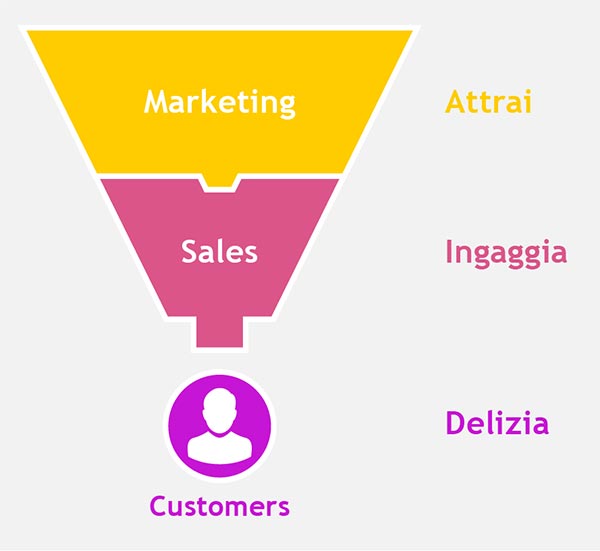
At its top, all potential customers who are still far from making a decision, regarding the purchase of one of our products or services, are placed.
While in its lower part, those who are closest to the final purchase decision are placed.
Often, it is marketing’s job to attract the buyer early in the Buyer Journey. Then to “hand them off” to the sales team to engage them more.
Then, once he becomes a customer, our service team delights him so that he can buy from us again, and again, and tell all his friends and acquaintances.
Funnel Marketing does not mean Aggressive Marketing
We at Factory Communication have never liked the representation of the funnel.
It makes the process very clear but, in our opinion, expresses a “squeezing” concept.
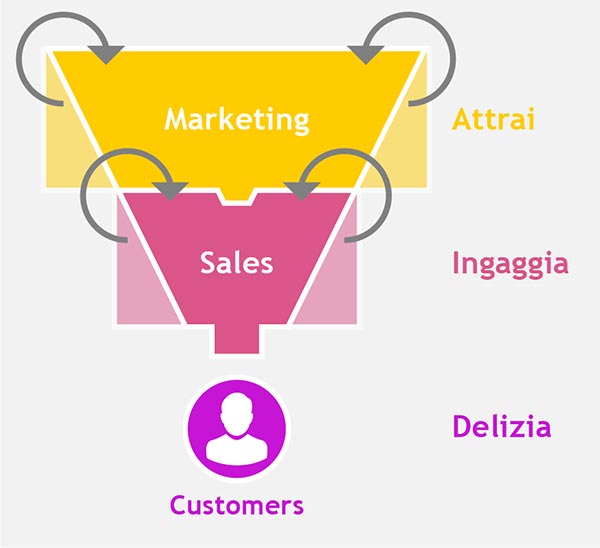
So much so that many companies apply the Funnel Marketing concept, activating campaigns for Lead Acquisition (contacts), without applying the Buyer’s Journey concept.
More simply: if they sell immediately good, otherwise the Lead is discarded.
This approach is totally destructive, because most of the people we come in contact with are potentially interested in our products or services.
And there are many reasons why they do not decide to buy right away.
We report only a few of them:
- They do not know our Company
- The need is not immediate. At the time we contacted them, they are still in the research stage
- They do not have the budget to buy our product or service, but they may have it after a short time
- They are interested in our product, but before buying they want to inquire further
The “Inbound” Approach
People cannot simply be considered numbers or Business opportunities.
For this reason, it is strategic to implement a strategy that speaks the language of the potential customer according to the type of relationship they have with our company at that precise moment.
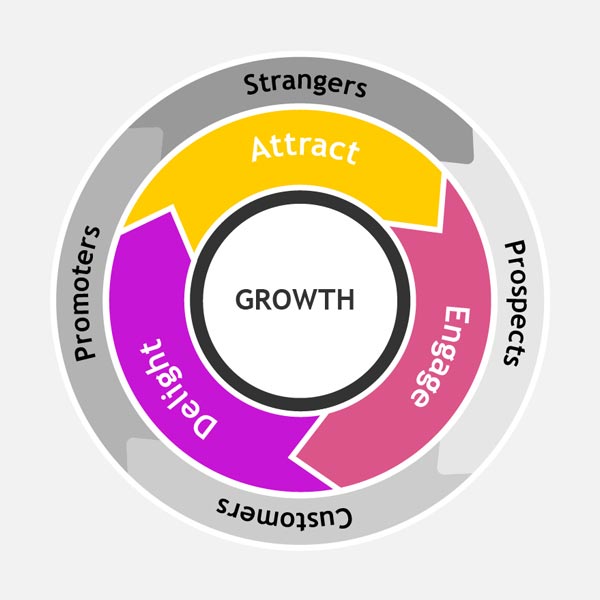
The image reports our understanding of Funnel Marketing.
If we have an “Inbound” approach with our potential customers, the opportunities to build the right relationship of trust and, consequently, a sale, multiply over time.
As we said, the funnel is a useful tool when used in the context of the buyer’s journey.
However, it has one major flaw: customers are considered “a consequence,” and not an asset.
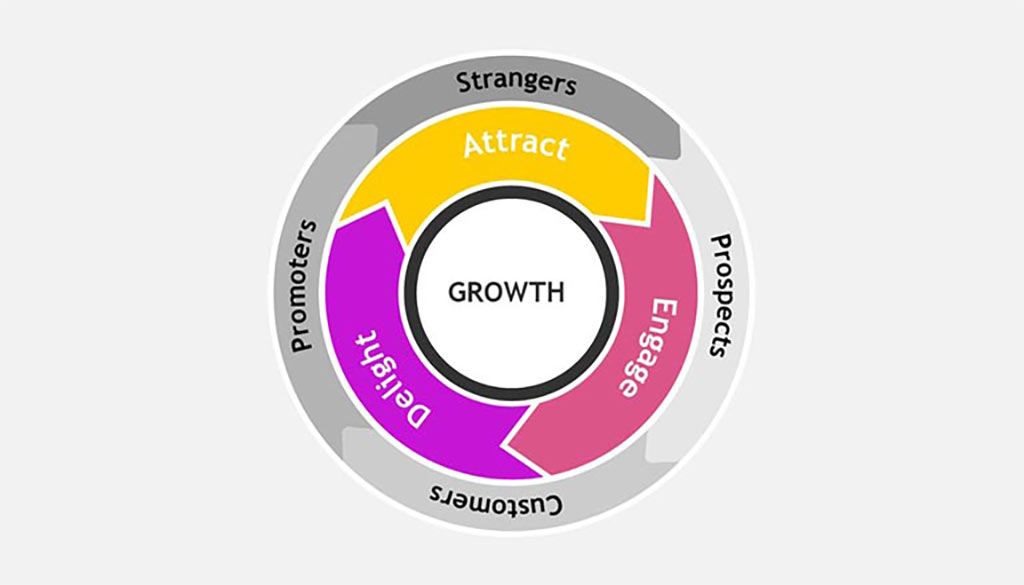
Thus, the funnel turned into a flywheel: the Flywheel.
The Flywheel puts customers at the center, which creates a more unified and less linear approach to all marketing, sales, and service activities.
We explained the potential, and differences, of the two approaches here: From Funnel to Flywheel
The Stages of the Buyer’s Journey
To understand how best to use the buyer’s journey, let’s ask this question, “How can we attract and engage people so that they become customers?”
We can use the Funnel or Flywheel technique, but the goal will always be the same: to increase our business. And to do that, we need to consider 3 steps in particular:
- Attract
- Involve
- Delight
As we create targeted content that performs these functions, we consider each of the stages the buyer is at in his or her journey. And the best channels to use to connect with him.
The Internet has certainly made it easier to engage consumers at various stages of the Buyer Journey, using content marketing.
This is one of the main reasons why 60 percent of experts, consider content “very important” or “extremely important,” for their Communication and Marketing strategy.
However, it can be difficult to create the right content, for the right person, at the right time.
So let’s see together how to proceed.
Let’s analyze together the 3 phases of the Buyer Journey
1) Awareness: Awareness Phase.
In the Awareness stage, the buyer realizes that he or she has a problem, or a goal to achieve, a purpose to pursue.
To better understand this stage, let us ask ourselves:
- How does the buyer describe his need?
- How do you prepare to deal with the problem?
- What consequences does the buyer’s action bring?
- Are there common thoughts in buyers who have the same need?
- How do you determine whether your goal is a priority?
The answers to these questions can help us develop our marketing and communication strategy.
2) Consideration: Consideration Stage
At the Consideration stage, the buyer is clear about what his problem is, and he is determined to find a solution.
At this stage, it is useful to ask ourselves:
- What solutions do buyers consider?
- How do they inform themselves about their problem?
- What criteria do they use to choose the best solution for them?
It is always useful to put ourselves in our potential customer’s shoes. To play ahead and anticipate his moves, right from the initial stages of his journey.
3) Decision: Decision Stage
At the decision-making stage, the buyer has already decided how to deal with his problem. And in this case, the buyer’s general behavior results in a comparison of offers, prices, products and services. Looking for which of these will best meet his need.
To best define this stage, let us ask ourselves:
- What criteria does the buyer use to determine the best offer?
- What distinguishes our offerings from those of our competitors? And what doubts might it raise?
- Might the buyer want to test the offer, before buying it?
- Before making the purchase, should buyers prepare themselves in any way? Such as taking a training course?
The answers to these questions will help us make an effective action plan to improve our business.
Marketing channels for each stage of channeling
Once we have determined who our ideal potential customer is, and which channels will work best for our business, we can start creating content for the different stages of the Buyer Journey. And tailor that content to each channel we’ve decided to use.
This will make it easier for us to map all the content, and associate it with the various stages of the buyer’s journey.
We can analyze both the Funnel and the Flywheel. Although, as we said, the Flywheel performs better, especially in the long run.
But both strategies have the same steps in common, consequently we can analyze both tools together.
Creating a Content Strategy, begins with identifying the channels we want to use to reach our audience.
Marketing channels for the Attraction Phase.
Some potential customers, may already be in the awareness stage of their journey, when we start to attract them.
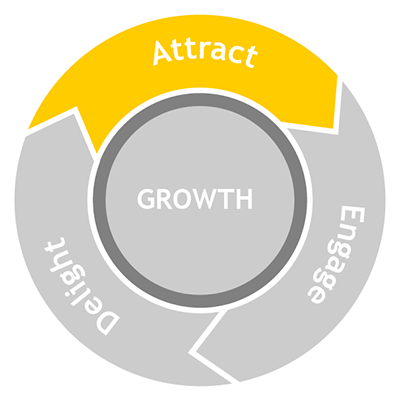
This means that our focus should be on solving their problems, creating content that they can easily find and use.
In the Attraction phase, a buyer wants to solve a problem, get an answer, or satisfy a need.
So he is looking for high-level educational content that will help him find a solution that satisfies him.
A blog article, social media content, e-book, etc.
His value as a lead is low because there is no guarantee that he will buy our products or services, leaving out our competitors. But if he finds our content useful and interesting, he will have taken the first step toward proceeding to the next stages of the Flywheel.
Ideal channels for the Attraction Phase may include:
Marketing channels for the Engagement Phase.
When a user moves to the next step, it means that we have caught his or her attention.
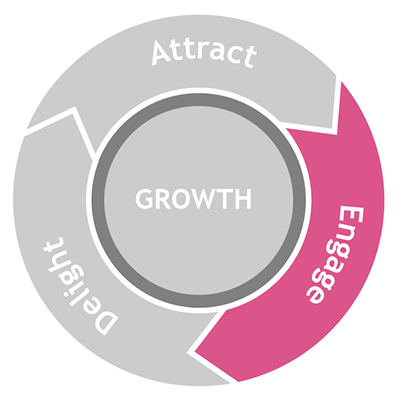
He is aware that he has a problem that needs to be solved, and now he is trying to discover the solution that best suits his needs.
While the first phase is designed to educate a potential customer, this is the phase where we need to show why our solutions are better than those offered by our competitors.
The Engagement Phase is crucial to begin cultivating a relationship, based on trust.
Ideal channels for the Engagement Phase may include:
Of course, potential customer engagement should not be overlooked, especially when we are getting closer to turning a lead into a customer.
Involvement also means Awareness
In the Funnel, the lower part groups those who have decided to buy. But beware, we are not yet certain that they will buy from us!
In fact, at this stage, users have only decided to proceed in buying a product or service, which could solve their problems, but they do not yet know from whom to buy.
In most cases, leads at the bottom of the channel, need that “final push,” to be incentivized to make a purchase decision.
So the right offer and content at this stage can be really crucial.
Marketing channels for the Delight Phase.
Marketing should not stop once we get a new customer.
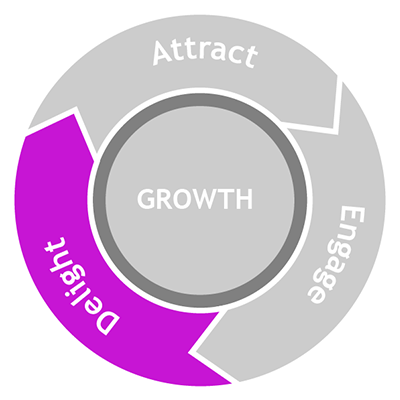
Continuing to cultivate a relationship with him, even after the sale, can lead to greater customer satisfaction.
And in this way, we could generate word of mouth, and thus new potential customers.
This is the real power of the Flywheel.
The flywheel effect comes from this very element.
A satisfied Customer will tell other people about our Company, Products and Services.
If your friend recommends a restaurant where he or she had a great time, you try it too. Right?
This generates visibility, new contacts and customers in a “natural” way and totally free of charge.
The goal in the Delight Phase is to go beyond customer expectations and provide a good customer experience to generate new business.
Ideal channels for the Delight Phase may include:
- Email Marketing
- Remarketing (Retargeting)
- Live chat and chatbots
- Loyalty programs
The Buyer Journey in Inbound Methodology
From the perspective of Inbound Marketing, we use the Buyer Journey as the basic framework to connect with the buyer. And thus to achieve the fundamental purpose of Inbound: to build strong and lasting relationships with our customers.
Of course, we will always have to demonstrate the values of our company, emphasizing our Ethical Business.
This is a very important but too often overlooked factor, even by large companies.
Our customers, or potential customers, must trust us in order to become promoters of our Brand. And only by showing respect to them, and keeping our promises to them, can we achieve our goal, which is to make them Ambassadors of our Company.
The ladder of knowledge
The ladder of knowledge, which we might also call the ladder of the evolution of the relationship between Potential Customer and Company, is often represented, for convenience, in steps.
In reality, it is a curve that can take on different aspects, depending on the activities the Company carries out towards potential Customers.
For example, if the Company prepares Inbound Marketing activities, the probability of the user turning into a happy customer are extremely higher, for the same service and product sold.
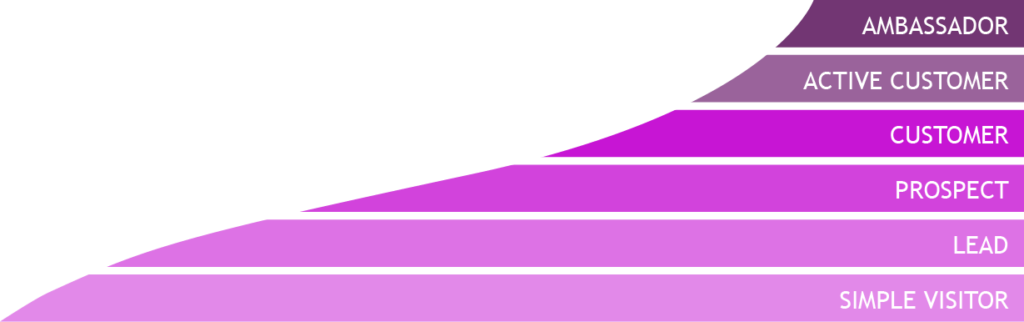
- SIMPLE VISITOR Visited the Company’s website and/or social channels.
- LEAD Has expressed interest in a product or service
- PROSPECT Interest turned into an offer or business negotiation
- CUSTOMER The user has purchased a product or service
- ACTIVE CUSTOMER Customer liaison with the Company (after sales, sales or technical support etc.).
- AMBASSADOR The customer is happy and feels pampered. They talk positively about the Company and its products or services with their contacts. GOAL
Not surprisingly, Inbound Marketing is currently the most effective Marketing technique to increase and improve our business.
Solid Relationships mean positive reviews on our Social Media, positive word of mouth (WOM), continuity of purchase, error tolerance, etc.
A happy customer is worth 1000 advertisements
Let’s think about it. A happy and satisfied customer tells his friends, relatives, acquaintances … about us, and about our products and services.
Practically free advertising!
Because if we can also meet the needs of others, he will turn out to be an excellent “counselor,” and he will feel gratified in having contributed to the happiness of others.
He trusts us, so he will have no doubts about buying one of our novelties, just released on the market.
Think of the phenomenon of smartphones, and the mile-long lines of people in front of phone stores, to grab the latest model (despite the fact that the one they own still works perfectly).
He forgives us, and justifies us. If the customer trusts us, and we have always met his expectations, if we make a mistake he will forgive us. Because “It‘sokay, everyone can make a mistake.”
Of course, it’s different if the mistakes start outweighing the successes.
As we can easily guess, all of us are possible happy and satisfied customers (if we are not already, vis-à-vis certain Brands).
So our goal will always be to create solid and lasting relationships, which will allow us to increase our business in a healthy and organic way.
And studying our Buyer Journey, is definitely a good first step to start our path to success.
Did you find this article related to the Buyer’s Journey interesting? You can learn more by reading these articles.