



Offer value to your content, and remember that good corporate content marketing is forever.
Most companies and entrepreneurs focus on short-term gains.
Nothing wrong with that eh! Especially if there is a positive return.
Let’s think about a DEM campaign (Direct Email Marketing) that can convert a handful of recipients into new customers.
The following year new message and layout will have to be thought of.
So also for billboard posters, they may be fine for a few months, then they will have to innovate, and think of a new copy or pay off.
Nothing wrong with that, but if you want to have long-term success you will have to think of another strategy.
There is no better long-term strategy than corporate content marketing
It is critical to understand that content can be employed as a complementary strategy to almost any online marketing strategy.
Think about it, content supports SEO as well as earning you inbound links.
It is useful as a basis for a social media marketing. It can be used for a DEM campaign.
It can help you build relationships with users and other brands.
In 1996 Bill Gates wrote a short article titled precisely “Contentisking.”
And if Bill Gates says so, you can believe it.
Want to know what’s the beauty of doing enterprise content marketing? Read the article and find out more.

Corporate content marketing: 3 important factors
#1 Evergreen content lasts forever
Let’s start right away with the so-called evergreen content.
Evergreen content never dies, and it never goes out of style.
They are a perfect long-term investment because they will always prove useful and valuable to the user.
The secret to evergreen content? Analysis, study, analysis.
Take advantage of the long tail strategy technique, that is, focus on very specific keywords with high conversion rates and minimal competition.
Take a forward-looking approach, always.
And, be sure to broaden your horizons and get to the heart of your target audience!
#2 Corporate content marketing helps your reputation
By publishing content that shows people that you understand their problems and how you can solve them, you build credibility, says Ardath Albee.
Reputation on the Web runs at the speed of a clik, and it is not always easy to keep tabs on the rumors that swirl through the jungle of the Web.
The more people who see your content, the more popular your brand will be, the greater your reputation and authority.
Therefore, offer users content that is relevant, original, useful, and meets their information needs.
Tell stories that manage to enthuse the reader. Offer something more, in one word: value.
#3 Content marketing for businesses influences conversions
Sometimes pretty and grammatically correct content is not enough.
Add a Call To Action, with an original and catchy message, this way you will encourage direct conversions, with growth in average revenue per visitor to your site.
Users just want to be guided and pampered.
Remember, there is no inbound marketing strategy without content marketing, and vice versa.
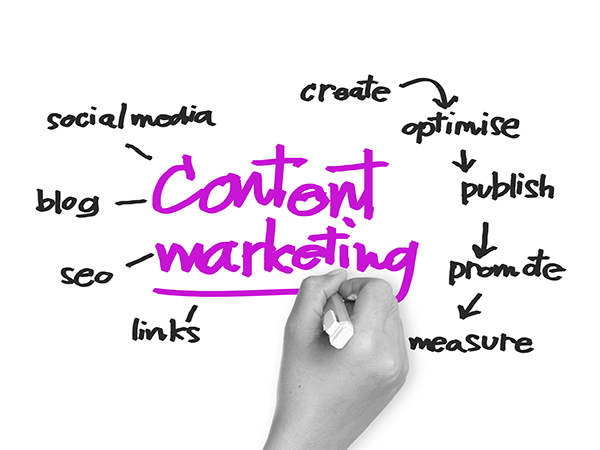
Content Strategy what is
Content strategy is to produce content (text, images, video, multimedia, etc.) to promote your products or services to potential customers, or increase the brand awareness.
To be effective, content must be personalized and valuable, specific to your target audience. As we often advise, you can target using the buyer personas method.
At each stage of the sales process, the user needs a different kind of content, ranging from discovering your brand or service, to learning more about it, evaluating the pros and cons of buying, your competitors’ offers, and finally buying your product.
For this, you should always use an editorial plan. All you have to do is plan the topics to be covered on the various platforms in your marketing strategy.
A now well-known refrain in the marketing world says that “Content is the King.” And indeed, content marketing is indispensable at every stage of the marketing funnel: from lead generation, to prospecting, to customer retention.

Why measure the results of corporate content marketing strategy
Creating content is not enough-you need to make sure it is effective. That’s why it’s important that your content marketing strategy can be measurable with meaningful metrics or KPIs.
You should identify these baseline metrics already when you build your marketing plan and monitor them periodically (e.g., every 3, 4 or 6 months).
Have measurable goals to achieve over time (we talk about the SMART approach) allows you to know exactly whether you are working well, correcting your aim, optimizing ROI.
ROI is return on investment: it only makes sense to spend content marketing if you have results.
If the return is not satisfactory, then you need to change something in your strategy.
Not all benefits of content marketing can be measured in numbers. Brand growth and customer loyalty , for example, are qualitative metrics that are very important but difficult to translate into numbers.
For other aspects more related to data, statistics and insights, you can turn to a number of meaningful metrics when it comes to content.
What KPIs in enterprise content marketing
Marketing KPIs are the metrics used to monitor the results of a digital marketing strategy, in this case on content.
Since a content marketing strategy can be developed on several channels, you need to have a set of metrics for each of them.
For example, on social media, it can be useful to monitor engagement rate, which gives you info on users’ interactions with your brand and thus of their engagement.
Still it is useful to calculate conversions, clicks on ppc campaigns, etc.
Less significant, however, is the number of followers, since in terms of business growth it is preferable to have a few motivated followers than a large but off-target fan base. We are talking in this case about Vanity Metrics.
Enterprise Content Marketing for SEO
Content marketing can also serve to attract traffic to the website from search engines, through SEO.
This happens, for example, when you curate a blog. In this case to monitor the results you can use keyword research tools such as for example SemRush, which allow you to analyze your keyword rankings, including against competitors and reporting changes over time.
Another very useful tool is Google Analytics, which allows you to take a view of many important KPIs on your website: traffic origin, conversions, time spent on a page, number of users, number of visits, etc.
The KPIs you can see with Google Analytics are many and cut across a bit of all the content you use to drive traffic to your site, including performance of campaigns, landing pages, etc.
About theemail marketing, the most widely used and most useful KPIs are the newsletter open rate and the percentage of clicks on the call to action. However, in this field it is very important that the email addresses are reliable, so as not to distort the metrics.
Of course, you can choose the KPIs that best suit the goals of your content marketing strategy. Let the results guide you to constantly improve the way you engage with your potential or acquired customers.
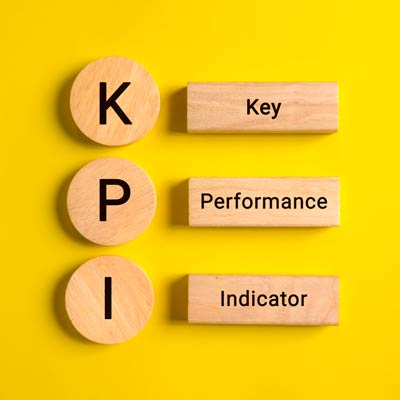
KPIs: are you measuring your content correctly?
Simply creating content is not enough: content marketing is more than just automated: create, publish and repeat.
Instead, ask yourself, why are you creating content? Measuring content marketing is useful for achieving more results, plus it allows you to see what works and what doesn’t, helping you to improve your pitch.
When you measure KPIs (key performance indicators), you can see not only how many people look at your content, but also where they come from and how long they stay. This gives you a good idea of which distribution methods work best.
It also gives you a good idea of whether or not the content you are producing has value to readers. If people click on the content and then leave almost immediately, you can see that you’re not engaging them.
Before you start with your content strategy , define your specific goals.
Here are some goals you might focus on:
- Increase brand awareness
- Increase traffic to your website
- Generate sales leads
- Convert more leads into customers
- Improve customer loyalty
Each goal should, then, be linked to KPIs and content metrics.
Here is a roundup of questions and some of the most commonly used KPIs to measure the effectiveness of your content marketing strategy:
Consumption KPIs:
- What content has been most successful in
- What content generated the most sessions?
- How many unique users did they generate?
- What is the bounce rate?
- What is the length of the average session?
Sharing KPIs:
- Did my content spark interest?
- Has it been shared on social media?
- How many likes and comments did it receive?
Lead generation:
- Did my content convert a user into leads?
KPI Sales:
- Did my content generate economic value?
Think of content marketing as an ongoing optimization strategy: small steps and small adjustments each day will lead you to achieve great results.
Now you’re ready! Choose the ones most relevant to you and start measuring your content marketing today.
Content Marketing for Companies by Factory Communication
How about building an effective and SMART content marketing strategy, with Factory Communication?
The agency is an expert in content marketing, inbound marketing and marketing automation with HubSpot.
From planning, to production, to content distribution, to monitoring the most significant KPIs, Factory’s team works with you to achieve your business goals.
Enterprise Content Marketing FAQ
This FAQ is designed to answer the main concerns of entrepreneurs who want to approach enterprise content marketing and want to understand its benefits and how it can be applied to grow their business.
Enterprise content marketing is a strategy that involves the creation and distribution of relevant, useful and valuable content to attract, engage and retain a well-defined audience, with the ultimate goal of driving customers toward profitable actions for the company, such as the purchase of products or services.
This approach allows you to increase brand awareness, improve your online reputation and position yourself as an authoritative reference point in your industry, generating new business opportunities and strengthening customer relationships.
The benefits of content marketing for businesses are many:
– Increases visibility and brand recognition (brand awareness)
– Improves the company’s reputation and authority
– Allows generating qualified leads and business opportunities
– Builds customer loyalty, stimulating customer participation and return to the website or social channels
– Supports SEO positioning, making it easier for search engines to find content
The choice of content types depends on the industry, target audience and business goals. The most effective formats include:
– Blog articles and insights
– Video tutorials and case studies
– Infographics and white papers
– Newsletters and email marketing content
– Social media posts and campaigns
– Webinars and podcasts.
It is crucial to choose the most suitable format for your message and distribution channel, taking into account the preferences of your audience.
An effective content marketing strategy starts with analyzing the target audience (buyer personas), defining business objectives and choosing the most suitable channels to reach the desired audience. The main steps include:
– Market and competitor analysis
– Editorial planning and choice of relevant topics
– Production of original and quality content
– Distribution and promotion through the most suitable channels
– Performance monitoring and ongoing optimization.
A well-structured strategy enables measurable results and optimizes investments over time
Content marketing is a medium- to long-term strategy: the results are not immediate, but grow exponentially over time due to the consistency and quality of the content produced.
Typically, you can begin to see the first positive effects (such as increased traffic, leads, and engagement) after a few months of continuous activity.
However, the real value of content marketing manifests itself over time, with the building of a solid reputation and customer loyalty.