


Topic cluster and pillar page are two sides of the same coin: the model is the topic cluster, the page that holds it up is the pillar page.
The first is about the overall content architecture, the second is the pillar content that presides over the main topic and links to related insights.
This article is designed for all entrepreneurs who want to understand how to use topic clusters and pillar pages in their SEO strategy to grow traffic, leads and authority for their company.
Pillar page: What is it?
The pillar page is the page that presides over a main topic in a broad, orderly, and strategic manner, serving as the central hub of the topic cluster.
It is usually a comprehensive “A to Z” guide that touches on all the key subtopics, without going into too much detail, referring to the cluster articles for more in-depth discussions.
The essential features for creating an effective pillar page are:
- Broad coverage of the subject: covers all major aspects of the topic, maintaining a clear overview and teaching logic.
- Hierarchical and navigable structure: table of contents, well-organized heading, logical sections that guide the user and intelligently distribute links to clusters.
- Strong internal interconnection: natural links to in-depth articles and backlinks from clusters to the pillar, reinforcing its central role.
- Focus on high-volume generic keywords and informational intent: the page aims to intercept broader searches, while clusters preside over more specific and transactional queries.
For your company, a good pillar page can become the “flag page” on a business-critical topic (e.g., “B2B marketing for manufacturing companies”), from which to then lead the user to more operational content, lead magnets, product sheets or business contact.
What are topic clusters
A topic cluster is a content organization model based on topics, not individual keywords, designed to help Google recognize your site as an authority on a specific topic.
It is, in fact, a group of closely related web pages that delve into a single topic from different angles and support each other through internal links.
Basically, a topic cluster consists of:
- A central page (the future pillar page) that covers the main theme in a broad, orderly, and well-structured manner.
- A set of “satellite” articles (cluster content) that go in depth on individual subtopics, each focused on a specific research intent.
- A coherent network of internal links, connecting pillars and clusters in both directions, building a strong semantic relationship.
For a company, this means to stop publishing isolated articles and start building information ecosystems: no more “random content,” but a system designed to let Google know that your company really dominates a certain topic.
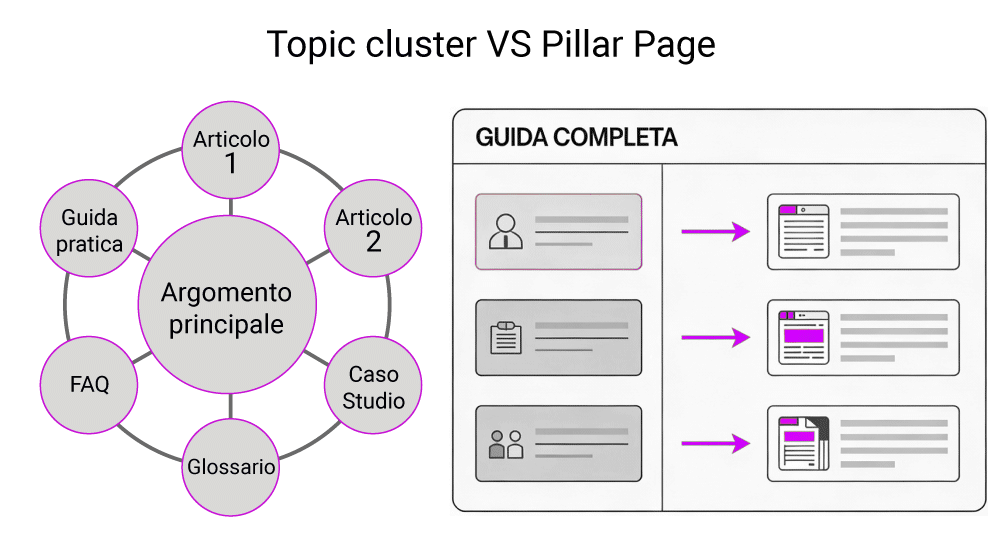
Difference between topic cluster and pillar page SEO
The difference between topic cluster and pillar page SEO lies in the level at which they operate: the topic cluster is the strategic architecture, the pillar page is one of the (key) elements of this architecture.
In other words, the pillar page is the center of the topic cluster model, but the cluster also includes satellite pages and the internal links that join them.
Here are the main operational differences relevant to an entrepreneur:
- Function:
- The topic cluster defines the overall structure of content on a topic, like a thematic “master plan” for the site.
- The pillar page is the single page that presides over the main theme and “governs” the sub-themes, serving as a navigation hub and high-value content.
- Scope:
- The topic cluster is about an entire set of content (pillar + cluster), with its network of internal links.
- The pillar page is a single, albeit very extensive, piece of content that summarizes and connects this content.
- SEO Objective:
- The topic cluster aims to build thematic authority and improve the overall coverage of a topic by increasing organic visibility in a structural way.
- The pillar page aims to rank for the main keyword and retain the user, offering a complete answer and guiding them to more vertical content and conversions.
- Measurement:
- The topic cluster is evaluated overall (aggregate traffic, visibility on the topic, number of keywords manned, conversions generated by the entire “hub”).
- The pillar page is measured as a single information landing page: ranking, traffic, dwell time, scroll, CTR of calls to action, direct conversions.
To summarize: the difference between topic clusters and SEO pillar pages is similar to the difference between an entire corporate department (cluster) and its manager (pillar). One does not really exist without the other, but each has a specific role.
Summary table: topic cluster SEO vs pillar pages
| Appearance | Cluster Topic | Pillar pages |
|---|---|---|
| Nature | Content model/architecture | Single page pillar |
| Role | Organize more content around a topic | Being the central hub of an argument |
| Composition | Pillar + cluster content + internal links | Long, structured content introducing all subtopics |
| SEO Focus | Overall authority on the topic | Broad and high volume main keyword |
| Key Marketing KPIs | Aggregate traffic, visibility shares, conversions of the entire hub | Page ranking, page traffic, time on page, CTA clicked |
| Advantage to the company | Systematic organic presidium of a strategic area | Flag page that positions brand and drives to leads and business opportunities |
Why Google likes topic clusters and pillar pages
In recent years, search engines have shifted their focus from individual keywords to understanding topics and semantic relationships between related content.
The topic cluster model, supported by solid pillar pages, helps Google understand that your site is not a haphazard collection of web pages, but a coherent system that covers specific topics in depth.
The main advantages from an SEO perspective are:
- Better interpretation of search intent: organizing content by topics and subtopics (content strategy) makes it possible to respond to all stages of the user’s search path, from general to purchase questions.
- More organic gateways: pilar pages intercept generic searches, while cluster pages preside over long tail keywords and very specific queries, exponentially increasing the ranking surface.
- Strategic distribution of internal authority: the link system between pillars and clusters helps to transfer “strength” to the web pages you are most interested in (e.g., more commercial articles, categories, products).
Looking forward, this approach makes your site more resilient to algorithm changes and more compatible with new artificial intelligence-based systems that value quality content creation and thematic authority.
How to set up an SEO topic cluster strategy in the enterprise
For an entrepreneur or business owner, the point is not so much to know the theory as to turn it into an operational plan that generates measurable results. A simple model to get started:
- Define strategic business topics
- Start with the areas where you want to be recognized as a reference: core solutions, vertical markets, key customer problems.
- Assesses search volumes, level of competition, and business value of the topic (leads, opportunity, potential revenue).
- Draw the topic cluster map
- For each topic, design a pilar pages and a list of subtopics that will become the cluster content (FAQs, use cases, comparisons, operational guides).
- Ensure that each cluster meets a specific research intent (informative, comparative, transactional).
- Design the pillar page as a “reasoned index”
- Structure the page as a complete guide: introduction, main sections, examples, operational elements, FAQ.
- Insert natural links to cluster content, which the reader can use to delve deeper without getting lost.
- Produce and link cluster content
- For each subtopic, create a vertical, comprehensive, operational article with a clear CTA (contact, demo, product sheet, download).
- Always link the cluster page to the pillar page with contextual links and consistent semantic anchors.
- Integrates lead generation and sales objectives
- Use the pillar page as a “gateway” high in the funnel, from which to lead the user to related content closer to conversion (case studies, offers, plans, advice).
- Within clusters, insert more direct CTAs related to the specific problem being addressed (e.g., request for quote, configurator, free trial).
Mistakes to avoid (which cost time and budget)
Many companies try to work with pillar pages and SEO topic clusters but do not see results, often due to rather common strategic mistakes. Some of the most relevant ones:
- Overly generic or promotional pillar pages: if the page only talks about the company and does not respond with depth to the topic, it will not be perceived as an authoritative guide by either users or Google.
- Disconnected or duplicate cluster content: articles that do not link to the pillar page, repeat the same concepts, or lack a clear focus weaken the entire cluster.
- Absence of business logic: lots of informational related content that leads nowhere, no call to action, no link to the company’s actual services.
- Failure to update over time: creating an effective pillar page is evergreen content, but it needs to be revised periodically with updates, new clusters, recent data, current examples.
Articoli che potrebbero essere di tuo interesse: