


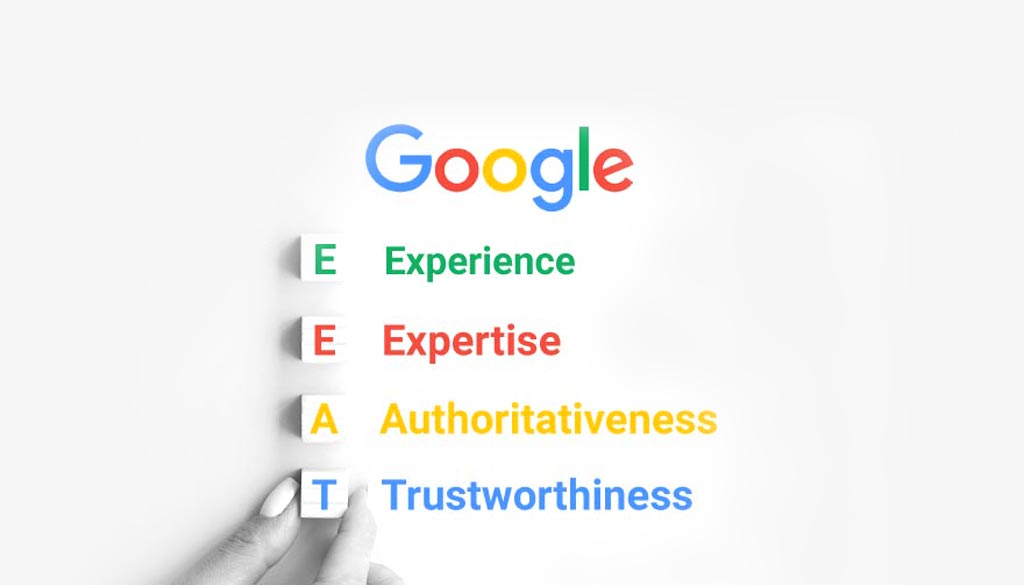
In this article we look at what Google EEAT means and how it can impact your Company’s Search Engine Ranking Strategy.
If you are reading this article, it probably means that you are interested in understanding how SEO Strategy can increase the visibility of your Company and Business.
SEO is a key component of marketing strategy.
It consists of making the content of a website so that it is identified and indexed by the search engine.
Since the most widely used search engine globally is Google, the sacred text of SEO is big G’s guidelines.
The goal of Search Engine Optimization is to reward your pages among the search results, leading to a top ranking in Google’sSERP.
This dramatically increases your company’s visibility and is therefore an important tool for finding new potential customers.
It is not about Ads or Pay per Click advertising. SEO is based on organic traffic.
The goal is to make sure that when a user performs a Google search, he or she finds your content among the first results on target.
To do this, you have to:
- Perform an SEO Analysis of your current site and relative ranking to understand strengths and weaknesses
- Know your target audience well, your Buyer Persona
- What keywords it uses to conduct searches
- How are your competitors positioned on those keywords.
Yes … it is true … doing SEO is an extremely difficult and complicated job. If you have decided to carry out the activities in-house, you can ask for an SEO consulting from our experts.
If you want to outsource all activities, our team realize the SEO Strategy that meets your needs, goals and budget.
a your Strategy internally used by users to search for information, products and services.
How to use SEO strategy to attract new customers
As we mentioned, SEO improves the ranking of your site among Google search results, organically. This allows you to attract new potential target customers, who actively come and search for what you have to offer.
- On the one hand, you have to take care of technical SEO, working on metadata, site performance, loading times, etc.
- On the other hand, there isSEO content: producing content with the keywords your users use when searching, to intercept their needs.
Various keyword research tools are used to search for keywords, such as Google Trends, AskThePublic, Google ADS or SEMRush.
Tools like SEMRush also give you news about search volume for each dry keyword (a single word) or for the long tail keywords (phrases or queries).
Depending on your industry and your SEO strategy, you can decide whether to use high-volume keywords, where competition with competitors may be fiercer, or low-volume keywords but geared toward reaching a very specific niche of users.
Link building is also important: Ideally, you should obtain backlinks from authoritative sites and portals in your field. The use of internal links between various pages and resources on your website is also rewarding for link building.
But for this to be successful, you have to put the user at the center. Google’s guidelines make that very clear.
Google EEAT: what does it mean?
Google EEAT guidelines, also written E-E-A-T are a paradigm for evaluating the quality of content published by websites. The acronym stands for:
- Experience
- Expertise
- Authoritativeness
- Trustworthiness
Therefore, content published on Google ‘s SERP must be useful, verified, published by authoritative sites, and competently written.
Until December 2022, the guidelines consisted of only 3 points (EAT): Expertise, Authoritativeness, Trustworthiness.
Then Google decided to include the 4th point“Experience” as well.
As stated on the official page, “In some situations, what matters most is content produced by someone with firsthand experience on the topic.”
Let’s give some examples: How do I use a specific tool? What do I need to do to implement a proper SEO Strategy? How do I maintain the lawn mower?
Content made by people who have the right skills and experience is definitely more valuable.
EEAT Google Impact on SEO:
- They are not a direct ranking factor, but they indirectly influence ranking.
- They help the content creator improve the quality of what they publish, so content tends to perform better in search results.
- They are especially important for YMYL (Your Money Your Life) pages such as those of health and finance.
- They guide content optimization efforts toward authority and reliability.
Google EEAT Impact on Business:
- They encourage the creation of useful and valuable content for target audiences.
- They can increase users’ trust in the brand and the website.
- They push companies to demonstrate their experience and expertise in the field.
- They can lead to improved online visibility and thus organic traffic.
- Incentivize the use of experts and professionals to create content
How to implement E-E-A-T:
- Create content based on direct experience and expertise in the field.
- Show author and company credentials.
- Getting mentions and links from authoritative sources.
- Keep content current and accurate.
- Provide clear contact information and transparent policies.
- Carefully moderate user-generated content.
In summary, Google’s E-E-A-T guidelines push companies to focus on the quality, authority and reliability of their online content, with potential benefits for both SEO and brand reputation.
Google’s E-E-A-T A paradigm that mainly concerns YLYM content.
YLYM stands for Your Life, Your Money.
An acronym for sensitive content that can have a major impact on people’s lives: in fact, Google’s guidelines for quality raters are especially important for sites dealing with medicine, finance, banking, etc. In this case, it is even more important to provide useful, verified, reliable and authoritative content.
The EEAT paradigm is not considered a direct SEO ranking factor (capable of directly influencing a site’s ranking among search results and rewarding, or penalizing, organic traffic). Yet it is considered an element with non-negligible weight in SEO.
It is not as measurable as other factors inherent in the user experience, for example, the loading times of a site, how well forms and buttons work cc.
It is not even an algorithm, but requires the work of evaluation by a group of professionals: quality raters, in fact.
Google EEAT Guidelines and SEO Copywriting
This concept is also the basis of writing the SEO Copywriting.
In fact, it is crucial to make SEO content that is useful to users, i.e., that solves a problem they have: reason that led them to perform a Google search.
Google has lots of tools and methods for figuring out which content is appreciated and which is not. We report only a few of them:
- User dwell time on the page
- Bounce coefficient: did the user leave without visiting further content?
- Page scrolling: did you read the entire content, or did you leave the page after a few lines?
- Sharing content on other channels
- Content cited from other sources: links placed in other sites (backlinks) that lead to that specific content
Evaluating the quality of content are Google Quality Raters, i.e., live Google contributors.
Compliance with EEAT guidelines helps to improve SEO.
FAQ Google E-E-A-T
E-E-A-T stands for Experience, Expertise, Authoritativeness and Trustworthiness. These are the criteria Google uses to evaluate the quality and credibility of web content.
No, E-E-A-T is not a direct ranking factor. Rather, it is a set of guidelines that Google uses to evaluate the quality of content. However, optimizing for E-E-A-T can indirectly improve a site’s performance in search results over time.
You can improve the E-E-A-T of your website by creating high-quality content, showing author credentials, citing authoritative sources, building your authority in the field, and maintaining transparency. It is also important to update content regularly and provide clear contact information.
The main difference is the addition of an “E” for “Experience.” Google added this element in December 2022 to emphasize the importance of direct, hands-on experience in the subject matter.
For AI-generated content, it is important that human experts review and improve the content to maintain a high level of E-E-A-T. The use of AI should not compromise the accuracy, expertise, or reliability of the content.
Articles dedicated to Google services
Are you interested in staying up-to-date on the different services offered by Google? Also read these articles
- Google destinations: the Google solution for tourism
- Google Domains: a guide for Entrepreneurs and Marketers
- Google PhotoSphere: get your Company off the ground.
- Google update 2024: how can they affect your website?
- What impact can Google Multisearch have on your Business?
- Google Data Gif Maker creates animated graphics
- Google SGE: if you have a site you need to know what it is!
- Google Discover: what’s new from Big G
- How does Google For Job impact Recruitment Companies?