



In this article we look at why to use Groups on LinkedIn to implement your Social Media Marketing Strategy.
LinkedIn is a professional networking platform founded in 2003, connecting professionals from around the world.
With over 700 million users, it provides a unique environment for individuals(personal branding) and businesses to build connections, share experiences, and promote skills and services.
Groups on LinkedIn: find out why they can help you increase visibility, contacts, customers and sales!
Having a company page on LinkedIn is a strategic move for any business aiming to strengthen its online presence and cultivate meaningful professional relationships.
LinkedIn, being the world’s largest professional network, provides a unique platform for companies to showcase their expertise, products or services, and to build a strong brand.
Linkedin marketing: functionality of groups!
Linkedin enhances and simplifies the functionality of “groups,” the ideal places where professionals with similar interests can meet and talk to each other as in a real community.
We have written many times how important it is for a Brand to carry out social media marketing activities that strengthen the appeal and dialogue towards its Potential (Lead) and Effective (Customers) “Target” defined according to the positioning strategy.
Communities and Groups are certainly two fundamental and useful tools for achieving these goals.
But it should also be said that no matter which Social Network and/or online service you use, both require a lot of resources to manage.
In fact, creation takes virtually only a few minutes. Page setup, definition of Administrators and/or Editor etc..
Social Groups: doing Marketing and Communication is definitely challenging
It is the immediate next step that makes you realize how, these activities, are highly Time Expensive:
- Creating an Editorial Plan that is attractive to members and any potential
- creation of relevant content
- user management
- quick and relevant answers to questions, interaction, etc…….
Our advice? Entrust the creation and management of Groups and Communities to an external Agency, with whom you can define objectives, activities and budget, only then you will have a better chance (certainties are not of this area) of creating an interesting, effervescent “place” that allows you to generate real and concrete returns for your Business.
And now we come to the technicalities and news related to Groups on LinkedIn
The new changes will ensure a simpler and more intuitive Linkedin experience for all users.
In addition, the new groups will become the increasingly trusted place to gather with professionals with similar interests and exchange advice and useful information.
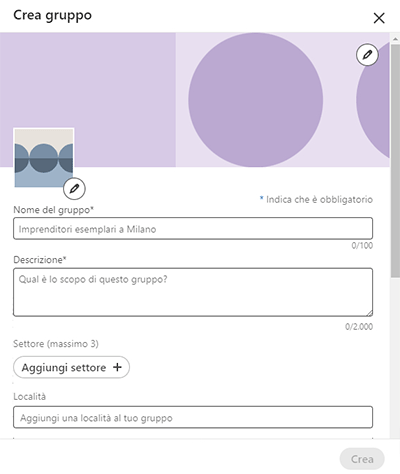
And now let’s look at how to create a group on LinkedIn that reflects your company’s Business goals.
Standard Groups and Unlisted Groups will be the only two types of existing groups, both of which are recognized as reliable discussion forums.
The main differences between these two groups are the ability to be found and the ability of group members to invite first-degree connections to join.
In detail, standard groups appear in your search results, can be found by any member who can apply for membership directly or by invitation from other members.
Unlisted groups, on the other hand, differ in that they do not appear in your searches, and in order to join, an invitation from an administrator is required.
And now we see the two different types of groups.
In standard groups:
- You must be a LinkedIn member to sign up;
- Conversations are not displayed in search engine results;
- Only group members can post conversations;
- Group members can invite their first-degree connections to join;
- Conversations and comments are visible only to group members;
- The group owner has the option of changing the group to unlisted only when the group has been created;
- All group members can approve applications for membership.
In Unlisted Groups:
- There is a padlock icon next to the group name;
- You must be a LinkedIn member to sign up;
- Members of a group cannot show the group on their profile to members who do not belong to that group;
- The group cannot be searched by any search engine;
- Members can join an unlisted group only by invitation from the group owner or administrator or by requesting membership from an invitation link that has been sent to them.
If your group currently has public conversations or membership is free it will become a standard group and thus acquire the characteristics listed above.
New features that will allow your group to register five times more interest than other groups.
Once you have created your Standard Group, you will also have the option of converting it to an Unlisted Group.
LinkedIn groups: features
If you are interested in the topic and want to explore it further, you can check out the main features of current groups on Linkedin, below:
- All groups are private: professional conversations are most effective in a trusted private space. Therefore, conversations in groups will not be visible until you have joined the group.
- All groups are for members only: joining a Linkedin group now requires either an invitation or approval of your request.
Open groups have always attracted a higher percentage of low-quality conversations.
Whereas members-only groups have always generated higher participation and more conversations than other groups. This is because members feel safer within a “closed” group. - Content Moderation: given the importance of timeliness, conversations will now be posted immediately within a group to ensure their effectiveness.
Owners, administrators or moderators will be able to take action to remove off-topic conversations, and all group members will, in turn, have the opportunity to report any inappropriate postings. - Improved content filtering: Linkedin has improved filtering of spam-like and low-quality content.
Within groups there will be a focus on more relevant conversations and topics, which is why promotional content and job offers will go into the moderation queue for approval by owners, administrators and moderators. - Removal of subgroups: in order to improve the organization of groups, it will no longer be possible to create subgroups, and existing ones will have to be renamed and treated as independent groups.
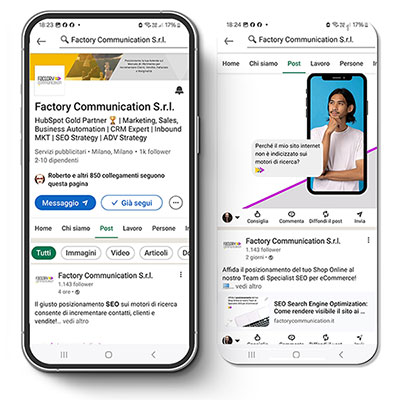
Linkedin marketing: now you can use videos
B2B videos will be allowed to be native, that is, uploaded directly to the platform and not uploaded as an external element from other sources e.g. YouTube and Vimeo.
Offering the user the ability to upload videos directly to the platform and thus view them without leaving social, which would happen using an embed, proves to be a winning strategic choice.
It will allow the social to keep users within the social and at the same time combined with the core of the social, which is the development of professionally oriented contacts.
As with most of the browsing, which today turns out to be predominantly is mobile, more than half of the access to Linkedin is counted done via App, and so the main changes will be introduced starting with uploading files directly from the mobile device.
What could be the areas of application ? We expose the main ones:
- Are you looking for a new job opening? Given the big change, why not make your presentation directly on video? We believe that in the short term Companies looking for specific figures, such as sales, marketing, customer care etc… will increasingly require video resumes, to skim potentially interesting candidates from the start.
- The introduction of video uploading will also allow the social to be used for training purposes, with webinars and professional video lectures being uploaded.
- Presentation of Company Products and/or Services via a video, reel or demo. YouTube and Vimeo first, Facebook now, have built the core of their business around video. If you want to discover some tricks on how to make them viral we recommend this article: Viral marketing 10 useful tips for making a viral video.
Video dominates, depopulates, engages, attracts, makes communication easy and direct, makes you deliver, engages the main senses, so we should certainly not be surprised if the growth strategy of this important Social Network now includes this type of media.
Actually, we have always wondered why this transition was not accomplished so many years ago. Probably the acquisition of Microsoft to the tune of Billions made it easier.
And it is clear, however, that videos have to be produced. And it is not really true that a video camera (or a Smartphone) is enough to create something good.
At the base of it all, before technique (which can be acquired) you need ideas and a clear Communication strategy. Otherwise it will turn out to be like throwing crumbs from the ship, while with the ship you cross the ocean.

Groups on LinkedIn: 6 good reasons
This is why a company should consider LinkedIn as an integral part of its marketing and business strategies:
1. Professional Networking.
Marketing Linkedin makes it easy to connect with potential customers, partners, and talent in your industry. Companies can expand their professional network, making it a valuable resource for business development.
2. Brand Awareness and Credibility
By regularly publishing valuable content, companies can increase their visibility and establish their authority in the industry. This helps build trust and credibility among professionals and potential clients.
3. Lead Generation and Business Opportunities.
LinkedIn offers advanced targeting and advertising tools, making it ideal for targeted lead generation strategies. Companies can use LinkedIn to reach decision makers and influencers in their industry.
4. Recruiting
LinkedIn is an invaluable resource for recruiting, giving companies access to a vast talent pool. Platform features make it easy to find and connect with qualified candidates.
5. Industry Insights and Trends
As a professionalism-centric platform, LinkedIn is a valuable source of industry insights and updates. Companies can stay informed about the latest trends, innovations and best practices.
6. Engagement and Community Building.
By creating a company page and actively participating, companies can build a community around their brand. This not only improves engagement but also builds customer loyalty and promotes brand loyalty.
In summary, LinkedIn offers an exceptional platform for companies to promote their brand, generate leads, recruit talent and make meaningful connections in the professional world.
Its business-oriented nature makes it an indispensable channel for B2B marketing and business strategies.
Groups on LinkedIn: FQA
Groups on LinkedIn are online communities where professionals with similar interests can connect, share ideas and discuss industry-specific topics. These groups provide a dedicated space to interact with other members, share relevant content and participate in meaningful discussions.
Joining a group on LinkedIn offers many benefits, including the ability to expand your professional network, gain new knowledge and skills, and increase your visibility in the industry. Groups can also provide access to job opportunities and resources for professional development.
To find a group on LinkedIn, you can use the search bar on your homepage by entering keywords related to your interests or industry. Once you find a group that interests you, you can request to join by clicking the “Request to Join” button on the group’s page.
To get the most out of groups on LinkedIn, it is important to contribute valuable content, actively participate in discussions, and abide by group rules. It is advisable to avoid self-promotion and focus on providing support and useful resources to other group members.
Groups on LinkedIn can be a valuable resource for professional growth, offering networking opportunities, access to exclusive job postings, and the chance to learn from industry experts. Actively participating can help you position yourself as a thought leader and enhance your professional credibility.
Want to learn more about and Linkedin Groups and Social Media strategy? Also read these articles:
- Creating a company page on LinkedIn for your Business
- 7 good reasons to use Linkedin in your social media strategy
- Social network algorithm: main differences!
- Social media can help you increase customers, leads and sales
- Linkedin Stories: why to use them
- Linkedin 2026: strategies for building a personal brand that generates leads