


Influencer marketing today represents one of the most strategic components of any company’s digital marketing mix.
Partnerships with creators and influencers are evolving toward increasingly data-driven logics geared not only toward notoriety but also performance, brand equity, and loyalty.
The goal is no longer to preside over social media platforms, but to integrate them into a communication strategy capable of connecting corporate messages with the right people, at the right times and in the most relevant contexts.
In this scenario, Influencer Marketing emerges as a communication and business lever, capable of supporting diverse objectives-from product or service launches to brand positioning, from reputation building to conversion generation-within an increasingly fragmented and competitive digital ecosystem.

Influencer marketing: between credibility crisis and new strategic maturity
In recent years, influencer marketing has gone through alternating phases going through great moments of strong criticism and disillusionment; episodes such as the so-called “Pandoro Gate” have ignited the debate on the authenticity of this channel, questioning the credibility of creators, the transparency of numbers and the sustainability of the costs of an industry sometimes perceived as unprofessional.
Regardless of whether we were talking about nano influencers, micro influencers or macro influencers, many analysts had speculated that the influencer marketing “bubble” was set to burst. Yet, the data tell a different story.
The centrality of the creator economy
Despite the controversies, the robustness of the model has been reconfirmed. Major platforms-from TikTok to Instagram-have continued to focus on the centrality of creators, introducing dedicated tools and features: subscription programs, TikTok Shop, advanced editing and monetization tools.
This evolution has not only solidified the role of the creator as a key player in the digital ecosystem, but has also spurred steady growth in investment by brands.
According to data from Influencer Marketing Hub, global spending on influencer marketing activities increased +4% year-on-year (YoY), confirming that companies consider creators a stable and measurable channel in their marketing mix.
In parallel, the introduction of a new Code of Conduct for influencers – geared to ensure transparency, fairness and accountability – testifies not only to the maturation of the sector, but also to the need for a regulatory framework capable of accompanying its growth.

Toward a new integrated paradigm
These closely related factors have fostered the emergence of a new paradigm of influencer marketing management: a model based onstrategic integration with corporate digital marketing structures.
The era of “spot” influencer collaborations is long gone.
Today, activities with influencers and content creators are planned, measured and optimized throughout the marketing funnel, with the goal of increasing tracking, content longevity and conversion of generated traffic flows.
Influencer Marketing is thus positioned as a performance driver that accompanies the consumer on his or her journey-from Awareness and Consideration, where creators prove particularly effective (typical stages of the Top of the Funnel), to the “hottest” goals of Conversion and Retention, traversing the entire Customer Journey.
A more mature, integrated and responsible ecosystem
The industry is therefore entering a phase of greater strategic maturity. The most advanced brands are no longer just “doing influencer marketing campaigns,” but are building long-term partnerships and integrated measurement systems capable of connecting the visibility generated by creators with business results.
In this context, influencer marketing is no longer just a communication lever, but a structural component of the digital ecosystem, able to combine storytelling, performance and data into one coherent strategy.

UGC and Influencer Marketing: the synergy that multiplies effectiveness
The most advanced marketing strategies do not pit Influencer Marketing and User Generated Content (UGC) against each other: they combine them, creating an integrated, high-performance communication ecosystem.
Influencers are the engine of awareness and inspiration: with their ability to storytell and connect emotionally, they amplify brand visibility and build brand value positioning.
The UGC Creators, on the other hand, act as a lever of trust and conversion, producing authentic and spontaneous content and storytelling that influence purchasing decisions at the hottest stages of the funnel.
The result is a complementary influencer marketing strategy where content, authenticity and performance coexist in balance:
- influencers make people discover the brand, generate curiosity and aspiration;
- UGC Creators make the audience trust, turning interest into action.
In an increasingly crowded digital environment, the synergy between Influencer and UGC Marketing enables brands to combine the power of visibility with the strength of credibility, optimizing every stage of the customer journey-from inspiration to purchase to loyalty. How?
UGCs are a strategic lever because:
- show the brand from the consumer’s point of view, generating empathy and credibility;
- They combine authenticity and performance, turning emotional connection into concrete results
- improve the efficiency of ADV campaigns, with higher CTRs and purchase rates.
UGC marketing is now a data-driven strategy that strengthens the entire communications ecosystem and shifts some of the budget from influencers to UGCs for four main reasons:
- Authenticity: spontaneous narratives that enhance trust and reputation.
- Performance: formats that outperform traditional ADVs on TikTok and Meta.
- Efficiency: fast, scalable and easily reusable productions.
- Engagement: content that activates the community and turns prospects into customers and later into ambassadors.
From creation to amplification: advanced content repurposing strategies
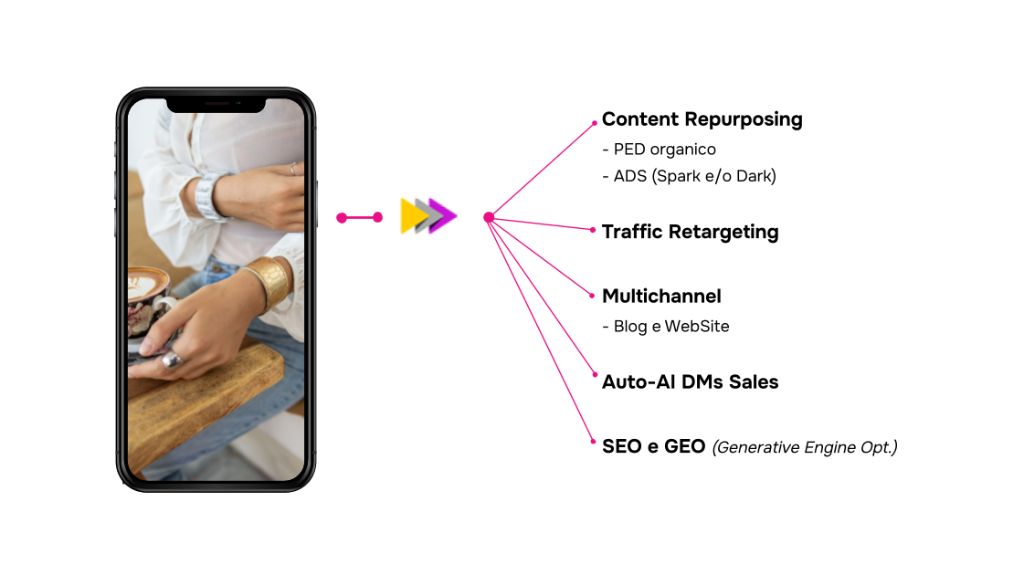
Once produced, content does not end its life cycle: the amplification phase is crucial to transforming creative work into concrete results.
UGC or influencer-generated content becomes proprietary assets that can be used both organically on brand channels and as creative for paid campaigns.
This synergy takes shape in content repurposing and remarketing, key levers for maximizing message impact and campaign performance.
Content repurposing
In content repurposing we distinguish a few main modes:
- Organic PED: Organic inclusion within the brand’s social editorial plan
- Dark Ads: the brand reuses the original content, publishing it organically or as a creative asset in its ADV campaigns.
- Spark Ads: more advanced mode that requires permission from the creator; content is sponsored directly from the influencer’s profile, appearing on both feeds and in the company’s Business Manager. This approach combines the credibility of the creator with the power of media strategy, optimizing reach, engagement and conversions.
Funnelization and qualified traffic
To maximize effectiveness, the amplification phase must be preceded by a clear and structured strategy:
Following a clear and structured strategy, and when built around objectives, target audience and tone of voice analysis, and careful selection of the most brand-consistent creators, creator-generated content can produce qualified, interested traffic ready to travel the entire marketing funnel, fromawareness to conversion through consideration.
SEO and AI Optimization: enhancing every piece of content
Today, in addition to UGC and funnelization, the strategic evolution goes through the enhancement of Reel and Post caption and copy, designed from the beginning with SEO and AI-driven logic.
Social content no longer just lives on platforms, but is indexed by Google and can appear in traditional and AI search results, as it does on Google SGE or Gemini.
Caption optimized with strategic keywords, contextual descriptions, and relevant hashtags increase the discoverability of content, amplifying its visibility and enabling full integration between the social media, web, and AI ecosystem, extending the content lifecycle and increasing its impact on business.
Toward an integrated, full-funnel approach
Specialized agencies such as Factory Communication take a tout-court approach: Influencer Marketing is no longer an isolated activity, but an integrated and optimized component within broader digital strategies.
Content creation, performance, SEO and AI work together, enhancing each piece of content throughout the customer journey, from initial inspiration to final conversion and retention.
Influencer marketing and its surroundings: also read these articles
- The 10 (+3) new features for the Influencer and Creator Economy 2026
- Become an Influencer from scratch and earn
- UGC Creator: the future of influencer marketing is real, authentic and performing
- YouTube AI: what changes for users, creators and companies
- Social TV what it is and how it can be used by Companies
- Influencer Marketing ROI: how to calculate it?
- Influencer Marketing: strategies to increase the visibility of your brand