



In this article, we analyze the possible activities and strategies to be adopted for Website Optimization after a search engine upgrade.
Google has announced the March 2023 Google Core Update, active starting mid-month.
This change of pace can have an impact on your SEO strategy and search engine rankings.
Depending on changes in Google’s algorithm, in fact, your page could be rewarded with a more relevant position in SERP (search engine results page), or it might lose a few positions.
This does not mean that Google will penalize content that it had hitherto deemed relevant and functional for users, but a change in evaluation parameters could also bring out pages and websites that had lagged a bit behind in the ranking.
Site optimization: What are Google Core Updates
Google Core Updates are important algorithm updates that have a decisive impact on the operation of the search engine.
They could affect ranking factors, which, as we know, are many and quite varied.
The Google Core Update March 2023 was long overdue. In fact, these updates are performed periodically, after careful evaluation and collection of feedback from Google on the content of web pages and websites.
The previous update was six months earlier, that is, September 2022.
However, taking a look at the ‘ list of Google updates over time we realize the fact that the search engine is constantly evolving.
In fact, the goal of Core Updates is to give users increasingly useful and reliable search results. What is certain today is that Google rewards your website more and more if you have taken care of the SEO Strategy, but also if you are authoritative and reliable.
User experience and the value of content are increasingly central factors, as we also learn from the guidelines Google has given to Quality Raters (teams of human evaluators, who analyze content to see if it is useful and relevant to users).
Optimizing site for Google: what changes with the March update
As we have already mentioned, with the March update there may be some SEO news. In the sense that a web page that has remained in the shadows could be rewarded, to the detriment of those who until now had occupied the very first positions.
If you lose a few positions, don’t despair: by optimizing text, images and web pages for the search engine, you can always climb the SERPs.
In fact, SEO strategy is made up of many small ongoing adjustments, keyword research, and content production.
What is increasingly important, however, is curating the user experience-Google specifically calls for this when it specifies its Web Core Vitals.
These are the most important parameters for performance evaluation, which have also become indispensable for being rewarded in the ranking.
Sites that publish content of value to users will be rewarded more and more.
From this point of view, it is also worth mentioning that the search engine has finally spoken out about AI-generated content: if original, if useful, if valuable, it will not be penalized in SERPs.
As always, then, regardless of the tools used, SEO requires a thorough understanding of Google and also of the people on target, who become the central pivot around which to revolve the entire strategy.
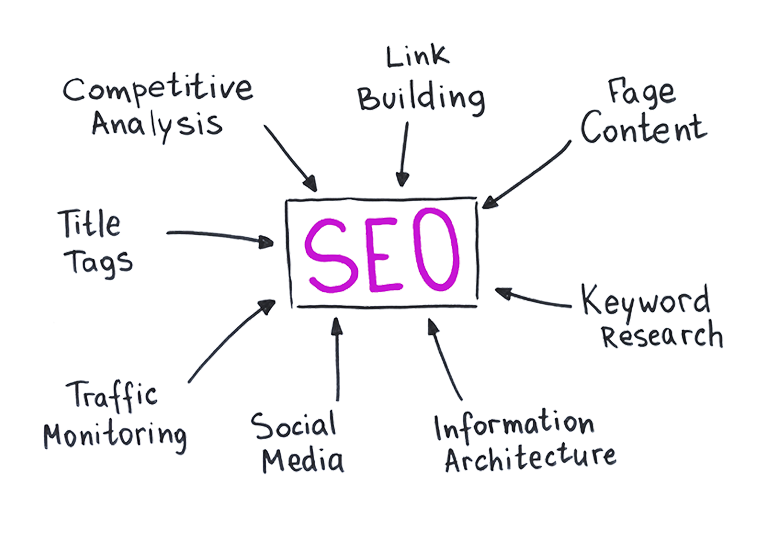
Optimizing a website: what should never be missed
To build a winning SEO Strategy, there are always some indispensable elements. Below, I list the main ones:
The SEO audit
The SEO Audit consists of the assessment on the state of your website’s or content’s SEO, both from the point of view of on-page and off-page SEO, as well as Technical SEO and content optimization.
Conducting this initial assessment allows you to identify weaknesses and strengths and improve your strategies to gain more relevant positions in the SERP.
The technical SEO
Optimizing a website requires more than just using keywords. You also need technical tricks that help Google’scrawler decipher your content, index the site and give it a ranking position.
On the one hand, you should optimize the metadata, especially the metadata that then goes to form the snippet (the page preview in SERPs).
On the other, there are user experience factors, such as page loading speed, which are evaluated by Google.
The SEO content
SEO content is based on target keywords and that is, keywords that allow us to intercept the searches performed by users.
There are tools specifically for keyword research to help you identify keywords to use.

You can rely on several parameters to choose them, such as search volume or the probability of placing on a specific keyword, depending on the competition.
The tools return insights based on big data, but the choice of keywords to use must be made within the SEO strategy.
Speaking of SEO copywriting finally, I must remind you that one of the best tools to carry out this type of activity is the blog post.
Writing optimized and authoritative articles allows you to climb the SERP and get more organic (not paid) traffic to your site.
Social media, and especially LinkedIn, can also help you with SEO.
LinkedIn for example has introduced a new feature with Pulse that allows you to better optimize articles, which are also visible from Google search.
If you’d like to delve deeper into SEO writing, also read, “The 5 Ingredients for a Mouthwatering SEO Writing.”
Optimizing a site: Product SEO
When we talk about SEO content, we do it in the broadest way possible.
For example, if you have made an e-commerce, it is extremely important to make the ‘ seo optimization of your products.
Optimizing the content of a product means greatly increasing the search engine ranking opportunities of your online shop.
Every product can become a position on search engine SERPs, thus an opportunity to intercept new customers and increase online sales.
Some basic elements to achieve SEO of your product pages:
- Clearly and comprehensively organize your product category tree
- Realize the SEO of the categories and any TAGs
- Choose a simple and clear URL
- Use high-quality, well-optimized images: they help the sale of your products
- Check the opening speed of your eCommerce: users don’t like to waste time
- Use Breadcrumbs: they help the user navigate your e-commerce
- Uses structured data from Schema.org

Web site optimization: Link building
En passant, a few paragraphs ago I also mentioned off-page SEO.
This is a whole series of optimization actions that you can do “outside” your web page. For example, getting external links (or referral links) from authoritative domains. This action is a bit complex to accomplish because it also requires Digital PR work, but it helps Google understand that your site is authoritative.
In general, if you cannot carry out an external link building strategy, I remind you to always take care of ‘ internal linking, that is, to include internal links to your site (e.g., to in-depth articles, products, services, etc.) in your content.
Another useful thing is to link to external, reliable and authoritative pages. You can do this, for example, when citing research, official documents, public utility sites, etc.

Website optimization: Where to start?
Your SEO strategy should always be a part of your marketing strategy.
The first thing then is identity: always start with your market positioning and your target audience niche.
Based on this field choice, you can target keywords and intercept the queries that potential customers type into Google. You can target highly searched keywords (where it is often harder to compete, however) or niche keywords.
It depends on your industry, your products and services, and your “firepower”-this is a really strategic choice because it marks the path to achieving your goals with SEO.
Finally, I would like to reiterate that every piece of content you publish must be of value to users. Content must be original and meet the needs of searchers-this is the most important thing in content marketing, but also in SEO since users are increasingly the focus for Google.

Want to check and improve the indexing of your content? Use Google TAG Manager
Easy, free and reliable solution for managing useful tags to improve the indexing of a website
Tags are small portions of website code that allow you to analyze traffic and visitor behavior, check the effectiveness of online advertising and social channels, test the website and optimize it, and more.
Tagging without efficient management leads to serious problems.
Abundance of code can affect the smooth operation of the site.
Redundant or incorrectly applied tags can cause data loss and generate measurement errors.
In addition, adding new tags can be time-consuming for the IT department or webmaster team.
This can lead to delays in the activation of important measurement and marketing programs.
Why use Google Tag Manager
Google Tag Manager was created precisely to address tag management problems by speeding up and simplifying the upload process.
It is essentially a real “container” of scripts and tags, to be installed like any tracking code (such as those from Analytics or AdWords, to understand) on one’s site.
It generates cleaner code and the site therefore gains in speed and readability (by search engines).
To configure the Google Tag Manager, you need to:
- Open the tagmanager page
- Create a Google Tag Manager account by making a simple registration
- Creating a container for the site
- Add code to your own site
- Add tags to your container
- Post the new Google Tag Manager code by removing all other tracking codes and tags from your page.
If used correctly, Google’s service could provide companies with SEO-side benefits and significant time savings.
This is another big step in the direction of the 360-degree marketing platform we have been longing for.
These are not new features of one product or another, evolutions or unifications of existing products.
We are talking about a new product that encapsulates all the others, which makes operations much easier for agencies.
It offloads customers from some tasks and almost eliminates the work of IT departments and web developers.
Optimize site for Google: we can help you improve ranking
Juggling algorithms, SEO techniques, keywords and content can be tricky because it requires a specific skill set.
But SEO gives you the opportunity to bring more qualified traffic to your website and be found by really interested potential customers, without investing in advertising.
Factory guides you through the maze of search engine optimization, building SEO strategies in line with your marketing goals and your company’s market positioning.
If you would like to learn more about these topics, or would like a customized SEO Consultation, book a Free Meeting on my calendar.