



Over the past few years, I’ve met countless entrepreneurs, and one of the requests that came up most often was always the same: “We want to rank first on Google.”
If you’ve made it this far, you’ve probably been searching for something like “how to rank first on Google,” “how to be among the top results,” or “how to appear among the top results on Google.”
It’s a legitimate desire, and the good news is that it can be achieved. However, it’s best to start by making a distinction that makes all the difference: understanding what “being first” really means.
It is precisely this misunderstanding that gives rise to the most common disappointments.
In this guide, we’ll explore what it actually means to appear at the top of search results, why it’s worth investing in, how to assess your starting point, the four steps to climbing the rankings, and what’s changing now that search results are increasingly generated by artificial intelligence.
What does it really mean to rank first on Google?
Ranking first on Google means appearing at the top of the results for a specific keyword, not for the entire site. Every site ranks first for a specific set of search queries—whether there are many or few depends on the work that’s been done: even the pages where Google explains itself appear in second or third place for some searches.
So the right question becomes: first, for which searches?
First of what, based on what words, and for how long?
When I read an ad that promises “guaranteed first place on Google,” the first question that comes to mind is: first in what? For the entire website, a single page, or a single product? For how many keywords—one or a hundred? And for how long—one day or forever?
The honest answer is that you rank first on Google for specific content related to specific search queries. Let me show you with a concrete example.
A concrete example: from the catalog to the front page
Imagine a company that manufactures and sells office furniture, with a catalog of 500 products. Getting all 500 products to rank at the top of Google is out of the question.
During one of our meetings, we therefore decided to focus our efforts on the 50 products with the highest profit margins, which fall into two categories: office desks and conference tables.
Then let’s narrow it down even further: let’s choose to feature just one product—the conference table.
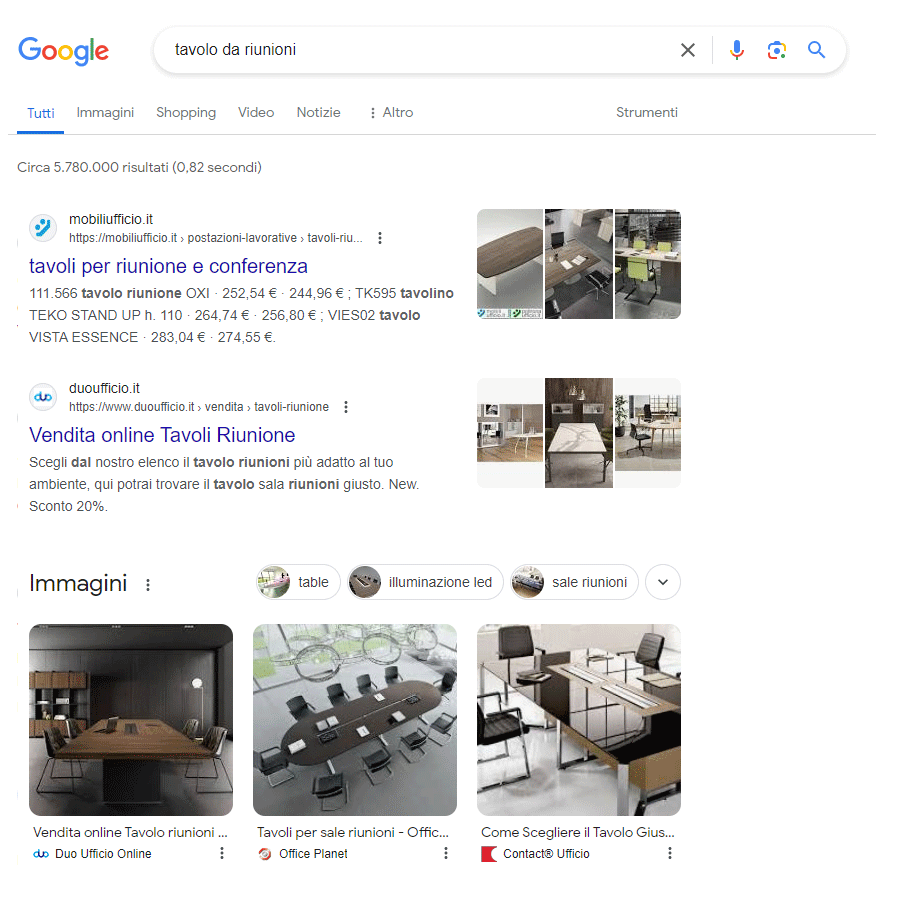
A search for “meeting table” on Google returns about 5,780,000 results.
To understand how many competitors are targeting that search term, let’s use the free Google Ads Keyword Planner, which provides three valuable pieces of information: the average number of monthly searches, the trend over time (is it rising or falling?), and the level of competition.
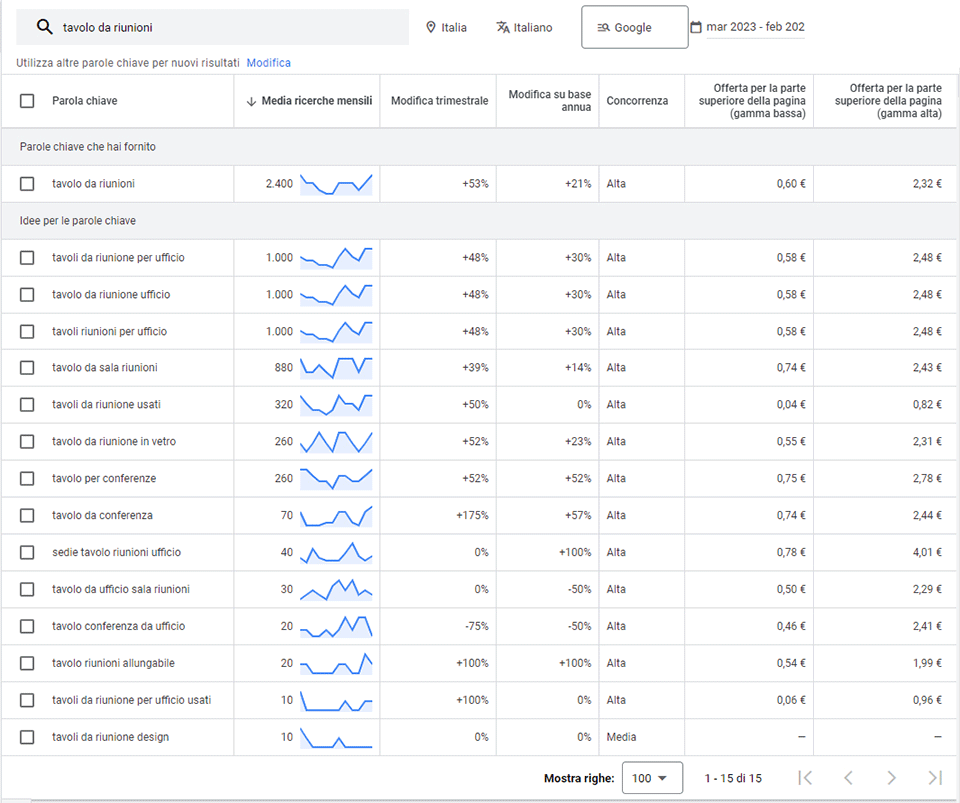
Let’s say we choose “conference room table.” We’ll tailor the product description around this main keyword and carefully add a few secondary keywords.
In moderation, because filling a text with keywords has the opposite effect—what’s known as keyword stuffing. Little by little, the product climbs to the first page.
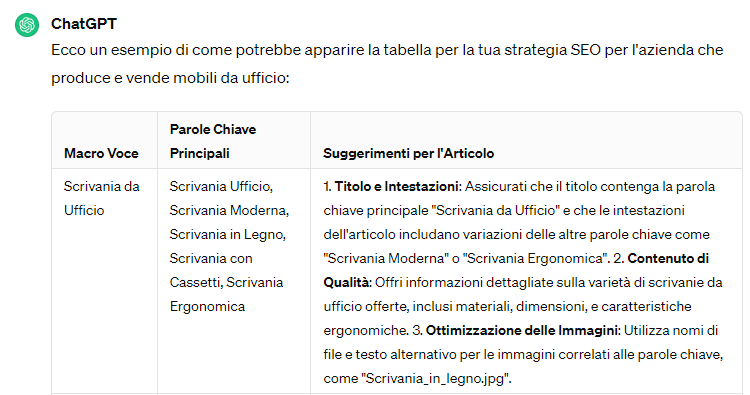
Then we search for “office meeting tables” and discover that our product ranks lower: it had been optimized for a different keyword. That’s why “ranking first on Google” only makes sense when it refers to specific searches.
Why It’s Worth Investing in Google Search Engine Optimization
Before getting into the “how,” it’s worth clarifying the “why.” Appearing among the top results offers three concrete benefits for your business.
Consistent visibility builds a reputation
Think about your purchasing behavior: How many Google searches do you do before choosing a restaurant for a special occasion, a supplier for your company, or a consultant you can trust?
Your customers do exactly the same thing.
When your website consistently appears in search results for a wide range of questions related to your industry, you gain a foothold in the minds of potential customers even before they add anything to their shopping carts.
Each appearance on the front page is a building block of your reputation: it communicates reliability, competence and market presence.
The customer finds you exactly when they need you
Traditional advertising interrupts people while they are doing something else. Google search works the other way around: it is the customer who independently expresses a need and searches for those who can solve it.
Being there at that moment means tapping into a demand that’s already fully formed, with a willingness to listen that any other form of promotion can only hope to achieve.
For an SME, this is a huge competitive advantage: organic visibility puts your company on the same shelf as the big players—right in front of people who are already looking for what you offer.
Over time, SEO costs less than paid advertising
Pay-per-click campaigns deliver immediate results and remain useful during specific phases, such as a launch or a promotion.
However, they work like a faucet: as long as you pay, the water flows; when you stop, the flow stops instantly. Organic search works like a well: it requires an initial investment of time and expertise, then continues to bring in visits, leads, and customers month after month, with increasingly lower marginal costs.
In the medium to long term—the natural time horizon for any entrepreneur who builds value—this remains the most efficient investment in visibility that exists.
How to figure out where you are today: the starting photograph
Every strategy starts with an assessment. Before deciding where to go, you need to know exactly where you are. The right tool is free and is called Google Search Console.
The Four Numbers That Tell the Story of Your Visibility
Google Search Console is the dashboard through which Google informs website owners how their sites are viewed by the search engine. Once you’ve connected your site, you’ll find four key metrics in the “Performance” section:
- Impressions: How many times has your site appeared in search results?
- Clicks: How many people actually clicked
- CTR: the ratio of clicks to impressions—in other words, how persuasive your headlines are
- Average position: On average, where do you appear on the results page?
Taken together, these four numbers tell a specific story. Thousands of impressions with zero clicks, for example, almost always point to one thing: Google considers you relevant, but it shows your ad too far down the page for anyone to actually see it.
Queries on the second page are your best opportunities
The most valuable piece of information is the “Query” tab: the list of keywords for which each page appears on Google, along with its ranking.
This is where the gold lies. Queries ranked 11–20—that is, at the top of the second page—are the best opportunities: Google already considers them relevant, and all it takes is some targeted optimization to bring them to the first page, where the clicks are.
Queries ranked 30th or lower for highly competitive keywords, on the other hand, require strategic decisions: it’s best to focus your efforts where the return is within reach.
Four Steps to Improve Your Google Search Rankings
Let us now look at the heart of the method: four sequential steps that apply to every industry and business size.
Step 1: Write content that’s useful to people who are searching
Google rewards those who best answer people’s questions. The first step, therefore, is to create content that’s truly useful to your audience: clear, concise, and organized so it’s easy to read even on a smartphone.
The guiding principle is simple: value first, sales second.
When you provide a thorough answer to a specific question from a potential customer, you come across as an expert in the field.
Little by little, a relationship of trust is built, and it is on that trust that, when the time is right, your products and services proposal is grafted.
Step 2: Study your competitors, even the ones you don’t expect
To develop a strategy, you need to know who currently holds the positions you want to reach: which keywords they rank for, how much traffic they drive, where their strengths lie, and where they have room for improvement.
And here comes the most useful surprise: your SEO competitors may be different from your business competitors.
If I asked you to name five of your competitors, you’d list the companies that sell the same product as you. However, for certain keywords, your biggest competitor might be a blogger who doesn’t sell anything and makes a living from advertising. Recognizing this changes your strategy.
At Factory Communication, we use SEMrush for this analysis, integrating it into the initial phase of our Factory System: first we analyze, then we define the strategy, and finally we implement and scale it.
Competitor analysis often reveals the most valuable insight: related keywords with high search volume and low competition, where an SME can rank on the first page within a reasonable amount of time.
Step 3: Find out how your customers find you
Every Google search hides an intent. Understanding that intent means speaking your customer’s language. Search intents fall into three categories:
- Informational: The user wants to understand, find out more, and learn (“how to rank first on Google”)
- Transazionali: l’utente è pronto ad agire o acquistare («consulenza SEO per aziende»)
- Navigation: The user searches for a specific website or brand (“Factory Communication”)
An effective strategy addresses all three types with dedicated content: blog posts for informational searches, service pages for transactional searches, and a well-curated brand presence for navigational searches.
Step 4: Build Your Keyword Tree
The final step brings everything together. The keyword tree is the hierarchical map of the search terms you want people to find you by. It’s built by cross-referencing actual user searches, competitors’ rankings, and your company’s strategy, and it defines the weight of each keyword:
- The main keyword—the heart of your search engine ranking
- 5–6 keywords of moderate importance, covering related topics
- 10–15 related keywords, listed in descending order of priority
Once the tree is defined, each piece of content on the site is born with a specific purpose and contributes to the overall design. It is the difference between publishing articles and building a positioning.
What to Expect from a Professional SEO Service
Let’s go back for a moment to the promises of a “guaranteed top ranking.” A reliable SEO partner works transparently and helps you distinguish between what’s realistic and what’s just a marketing gimmick. Three signs point to a sound approach.
The first is content quality. Google consistently emphasizes that the key factor in indexing is the value of what you publish.
In recent months, the search engine has also stepped up its scrutiny of automatically generated, low-quality content: entire websites have been removed from search results. Serious work, therefore, begins with substance rather than technique.
The second is choosing keywords. It’s not about ranking first on Google in general, but rather about ranking first for keywords relevant to your business.
This requires understanding your audience’s search behavior and creating content that answers their actual questions.
The third is an ethical and sustainable approach. Practices such as keyword stuffing or buying links provide only short-lived benefits and risk damaging the site’s reputation in the eyes of Google and users.
It’s worth noting that today the acronym SEO has expanded in meaning, from Search Engine Optimization to Search Experience Optimization: the focus is on the searcher’s experience.
Ranking First on Google When the Answer Is Provided by Artificial Intelligence
Let’s get to the chapter that distinguishes a 2026 strategy from one stopped three years ago. The way people search is changing, and with it the rules of visibility.
What Are AI Overviews and Conversational Search?
Google has introduced AI Overviews: AI-generated answers that appear at the top of search results, even before traditional links. At the same time, millions of people have started asking questions directly to ChatGPT, Perplexity, and other assistants, using increasingly natural and conversational language.
A metaphor helps us understand this change: whereas Google used to be like a library that pointed you to the right shelves, today it’s increasingly like a librarian who reads the books for you and summarizes the answer.
The strategic question for every company becomes: What books is the librarian reading? And is mine among them?
The Three Signals That AI Rewards
The approach that makes a company visible in the generated responses is called GEO (Generative Engine Optimization), and it is based on three signals:
- Clarity: content that answers real questions in a direct and structured way, with clear headings and explicit answers
- Reliability: structured data, cited sources, and consistent company information across the web, including indexing on Bing, which ChatGPT and Copilot draw from
- Authority: concrete examples, demonstrable experience, content authored by real people with verifiable expertise
The best news is that SEO and GEO reinforce each other: the four steps outlined above lay exactly the foundation that AI is looking for.
What changes for an SME
Searches are becoming longer and more specific: “I have a store in the Navigli area of Milan; how can I improve my Google ranking?” is an actual search query entered today, and in this case, techniques known as“local SEO” are applied.
For an SME, this is a tremendous opportunity: specific questions reward those who offer specific answers, and on this ground a focused and knowledgeable company starts at par, and often at an advantage, over the large generalist portals.
Where to Start This Week
Let’s wrap up with the most practical part: what to fix right away and a checklist to get started.
The issues to address first
Many small and medium-sized businesses face the same challenges. Recognizing them is half the battle:
- Showcase website: Focus solely on products and services. Add content that answers customers’ actual questions.
- Overly ambitious keywords: Go after the most-searched term in the industry, where the giants dominate. Also focus on related terms that are within reach.
- Content to be updated: Articles that haven’t been updated in years lose value. Google rewards fresh content
- No Monitoring: Publishing Without Tracking Means You’ll Miss Valuable Signals from Search Console
- Snippets to Optimize: Consistent and Unique Titles and Descriptions Increase Clicks Even at the Same Ranking Position
The Six-Point Operational Checklist
- Link your site to Google Search Console and enable the “Average Position” and “CTR” panels
- Export the queries ranked 11–20: these are the ones closest to the first page
- Choose the 3 pages with the most impressions and update their content, titles, and meta descriptions
- Verify that the site is also indexed in Bing Webmaster Tools, a prerequisite for visibility on ChatGPT and Copilot
- Add a Q&A section to each key page, written in the same tone your customers use
- Plan a quarterly update of your key content: consistency beats intensity
Visibility on Google is a strategic choice
Ranking first on Google is a goal within reach for every small and medium-sized business: it requires a systematic approach, consistency, and the right questions—rather than a large budget. The four steps you’ve read about—useful content, competitor analysis, search intent, and keyword tree—build visibility that works for your business every day, and that’s now twice as valuable: in traditional search results and in AI-generated answers.
The best time to start was yesterday. The second best time is this week, starting with Search Console photography.
Frequently Asked Questions About How to Rank First on Google
Google scans web pages, indexes them in a large database, and ranks them based on three factors: relevance to the search query, content quality, and website authority. The pages that provide the most useful and reliable answers to the user’s query appear at the top.
It depends on where you start. A page that’s already ranked between 11 and 20 can reach the first page in 4–8 weeks with targeted optimization. For a new and competitive keyword, it generally takes a few months of consistent work. Search engine rankings reward consistency over time.
Google Ads delivers immediate visibility, which lasts as long as the campaign remains active. Organic search rankings are built over time and continue to drive traffic and leads even afterward, with increasingly lower marginal costs. The two approaches complement each other well: ads cover the short term, while organic search builds long-term assets.
No one can seriously guarantee the top spot, because results depend on content quality, keyword competition, and changes in algorithms. A reliable partner works transparently toward realistic and measurable goals, one search at a time.
Answers are increasingly generated by artificial intelligence, either directly at the top of Google search results or within assistants like ChatGPT. To be cited, what matters is content clarity, reliability (including indexing on Bing), and demonstrable authority. SEO and GEO—the discipline that optimizes for AI—reinforce each other.
Yes, when you have the time and in-house expertise, because this work requires ongoing attention: periodic analysis, content creation, technical maintenance, and keeping up with algorithm updates. Many small and medium-sized businesses choose to outsource it precisely so they can have their staff focus on higher-value activities.
Find out how visible your business is on Google and in AI-powered answers
The first step is to figure out where you stand today: which search queries are already generating visibility, which keywords are within reach of the first page, and which actions yield the fastest results.
Withour SEO Audit, we assess your website’s current search engine rankings and provide you with a concrete action plan, integrated with our GEO Method for visibility in AI-generated responses.
Being first on Google: insights
If you would like to explore these issues further, you can also read these articles
- Cosa sono SEO, GEO, AEO? Perché sono importanti per le PMIù
- Ultimate SEO checklist for Your E-commerce!
- SEO for Lawyers: the complete guide 2026
- SEO & AI Awareness Course for Entrepreneurs
- Do you have a site? You need to know what Google SGE is
- Do you sell on the Internet? Product descriptions are critical!
- SEO optimization: what to do when Google changes the algorithm?
- Google Discover: what’s new from Big G