


Imagine opening your store every morning, but instead of waiting for customers to come in, someone would allow you to knock directly on their doors with a personalized message.
Without them having to know their email. Without them having to open an app. All it takes is two clicks on the browser to reach them, in real time, wherever they are.
This is what push notifications do for your website or eCommerce.
Yet, many Italian SMEs still do not use them.
Either because they do not know that there are tools that are accessible even without a dedicated IT team, or because they think they are a technology reserved for large companies.
In this article you will find out how they work, what platforms exist, how much they cost, and-most importantly-what concrete results you can expect.
1. What are push notifications for websites.
Sending web push notifications are short messages that appear directly on the user’s device screen-desktop or mobile device-even when the browser is not open on your site.
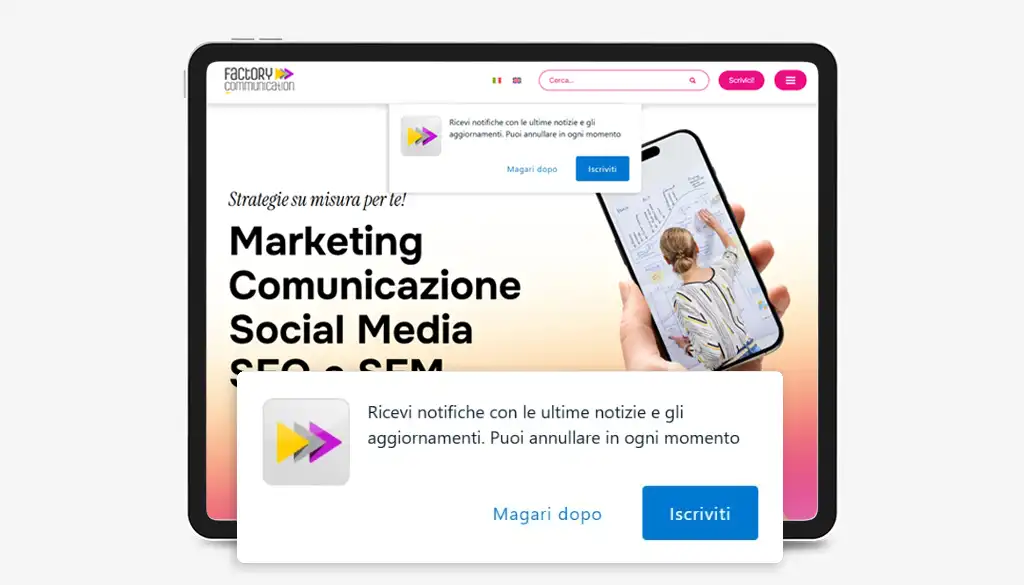
They are those little windows that appear in the corner of the screen with text, an image, and a clickable button.
They work through a technology called Web Push Protocol. When a visitor arrives at your site for the first time, the browser asks them for permission to send notifications.
If he agrees, his device is registered and from then on you can reach him with targeted messages, without needing to know his email or phone number.
Think of push notifications as a digital doorbell: the customer has given you the keys to his screen. Each time you ring, he decides whether to open the door – but at least the message comes through.
1.1 How they are activated: the opt-in mechanism
The process is simple and takes place in three automatic steps:
- The user visits your site for the first time
- The browser shows a native dialog box, “Do you want to receive notifications from [site name]?”
- If the user clicks “Allow,” he/she is subscribed to the push channel. If he clicks “Block”, he will not receive anything.
The good news is that no personal information is needed: no email, no phone number.
The system works through anonymous browser-managed tokens, which greatly simplifies the management of privacy and GDPR compliance.
2. The statistics that every entrepreneur should know
Before evaluating a tool, it is useful to understand whether it really works. Let’s look at the data.
| Metrics | Push Notifications | Email Marketing | SMS Marketing |
| Average opt-in rate | ~12-15% | ~25-35% | ~5-8% |
| Opening rate (CTR) | ~20-30% | ~20-25% | ~98% |
| Click-through rate | ~10-15% | ~2-5% | ~19-35% |
| Delivery time | Instant | 1-5 minutes | Instant |
| Cost per message | Very low | Low | Medium-high |
| Personal data required | None | Phone number |
These numbers deserve reflection.
Push notifications have a click-through rate that can be three times that of email, with significantly lower sending costs.
They do not require personal data, which lowers the barrier to enrollment and simplifies regulatory compliance.
2.1 Opt-in rates: what to expect
The average opt-in rate is between 12% and 15% of unique visitors.
This means that out of 1,000 people who visit your site, about 120-150 may become subscribers.
In the eCommerce sector, where purchase intent is already present, rates of even more than 20 percent are reported.
For an ecommerce that receives 5,000 monthly visits, we are talking about 600-750 potential subscribers each month-a direct communication channel that grows organically without additional advertising investment.
3. Major push notification platforms compared
The market offers different solutions, with widely varying levels of complexity and cost. Here is a comparative overview of the most popular platforms, designed to help you get your bearings without having to test everything yourself.
| Platform | Free plan | Strengths | Ideal for | Base price |
| OneSignal | Yes (up to 10,000 subs) | Quick setup, intuitive UI, great doc | SMEs starting with push | €0 → €9/month |
| PushEngage | Yes (up to 200 subs) | Advanced segmentation, A/B testing | Ecommerce with extensive catalog | €9/month |
| Pushwoosh | Yes (up to 1,000 subs) | Multi-channel (push + email + in-app) | Companies with mobile app + web | €49/month |
| VWO Engage | No (30-day trial) | Integration with CRO platform | Companies already on VWO | €99/month |
| WebPushr | Yes (up to 10,000 subs) | Competitive price, RSS automation | Blogs and media with a lot of content | €0 → €29/month |
3.1 OneSignal: the starting point for beginners
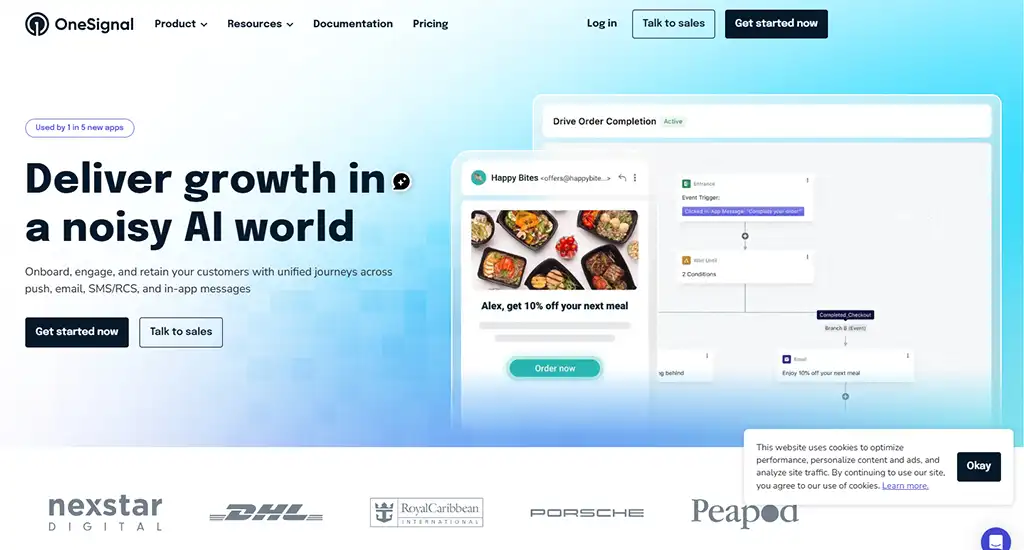
OneSignal is probably the best known and most widely used platform worldwide.
Its popularity is due to a generous free plan (up to 10,000 subscribers), a very intuitive interface, and excellent documentation.
Integration with WordPress, Shopify and most CMSs is via plugins or a few lines of code.
It is an ideal choice for an SME that wants to get started without initial investment and without the need for a dedicated technical team. The main limitation is in advanced segmentation, which is available only in paid plans.
3.2 PushEngage: the choice for advanced eCommerce
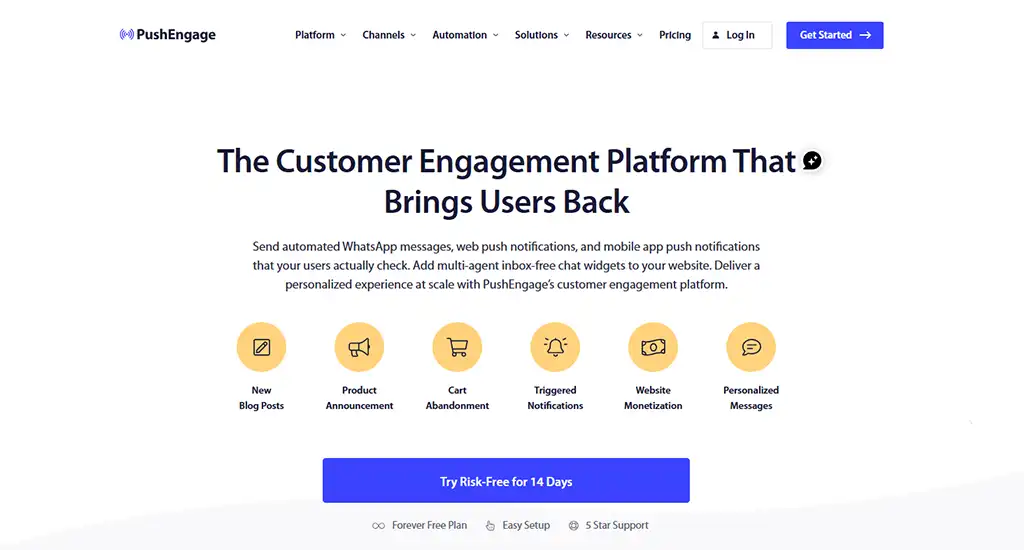
PushEngage was born with eCommerce specifically in mind.
It offers features such as retrieving abandoned carts, activating automatic shipping notifications, and reminders for products that are back in stock.
Segmentation is more refined than OneSignal already in the basic plans, making it more performant for those with a large product catalog and frequent purchase cycles.
The cost starts at about 9 euros per month, making it affordable even for smaller realities.
3.3 Pushwoosh: for those who also have a mobile app
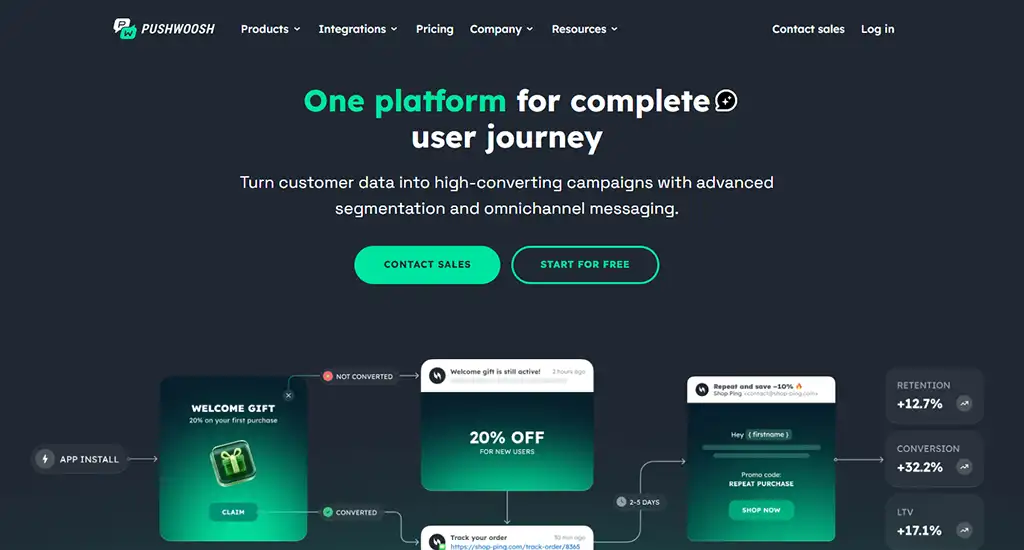
Pushwoosh is the platform to consider when the goal is to centrally manage push notifications for both the website and an iOS/Android app.
Supports multi-channel campaigns (push + email + in-app messaging) from a single dashboard, which reduces operational complexity for small teams.
The price starts at about 49 euros per month, making it more suitable for structured entities.
3.4 VWO Engage (formerly PushCrew): for those already using the VWO platform.
VWO Engage makes sense primarily if you are already using the VWO suite for conversion optimization.
Native integration with A/B testing and heatmapping tools enables the creation of push campaigns linked to behavioral data collected on the site.
The higher cost is justified only if the full ecosystem is exploited.
3.5 WebPushr: value for money for frequent content
WebPushr is less well known but offers excellent value for money, with a competitive free plan and RSS automation features particularly useful for those who publish content frequently (blogs, news, product updates).
It is a solid solution for those who want to automate the sending of notifications without manual management.
4. What concrete benefits can an SME gain
Talking about tools without linking the benefits to actual business is a theoretical exercise. So let’s see what would change in your business with an active push notification system.
4.1 Recovery of customers who abandon the site
About 97 percent of visitors to an eCommerce site leave without purchasing.
Push notifications allow you to reach them again with a personalized message-a reminder, a temporary discount, an update on the product displayed.
This mechanism, called push retargeting, has higher conversion rates on average than remarketing email campaigns, precisely because the message arrives in real time, while the user is still “warm.”
4.1 Increased recurring traffic without advertising costs
For an SME in the food or fashion industry, recurring traffic is vital.
Whenever you launch a new product, promotion or event, you can instantly reach all your push subscribers without spending on advertising. You’re basically building a proprietary communication channel that no social media algorithm can penalize and that requires no cost per send.
An ecommerce with 5,000 push subscribers sending a weekly notification can generate hundreds of extra visits per month at almost no cost.
4.2 Real-time communication for the B2B manufacturing sector.
In B2B manufacturing, push notifications can be used differently than in consumer eCommerce: order status updates, availability alerts for critical components, urgent communications to regular customers.
In this context, message delivery speed and certainty of reception are more important than volume.
4.3 Loyalty and brand awareness over time
Every notification sent is a contact with your brand. Even when the user doesn’t click, they see your company name on the screen. This helps keep the relationship alive over time in a non-invasive way. The ideal frequency varies by industry: for food ecommerce you can go up to 3-4 notifications per week, for B2B manufacturing it is advisable not to exceed 1-2 per week so as not to be intrusive.
5. Push notification and AI: the next step
Push notifications become even more powerful when integrated with artificial intelligence systems. Some more advanced platforms already allow predictive algorithms to be used to:
- Determine the optimal sending time for each individual user (based on their interaction history)
- Personalize content based on past browsing behavior
- Automatically segment the subscriber list into behavioral clusters
- Optimize notification text through automated A/B testing
This does not mean you have to adopt complex solutions right away. The starting point is to install a basic platform, collect subscribers for a few months, and only then evaluate whether and when to integrate predictive logic.
The rule we apply in Factory Communication with our clients is always the same: first build the channel, then optimize it.
AI does not replace strategy: it amplifies it. First you have to know what you want to say to your customers, then AI helps you say it at the right time, to the right person, in the most effective way.
6. How to get started: a practical path in 5 steps
You don’t need a technical team to get started. Here’s how to proceed in an orderly fashion.
- Define the main goal: Do you want to increase recurring visits? Recover abandoned carts? Communicate promotions? The answer determines your choice of platform.
- Choose the platform based on your goal and budget: for no-cost starters, OneSignal or WebPushr are the most straightforward options. For structured ecommerce, PushEngage is the best performing choice.
- Install the code or plugin on your site: most platforms offer plugins for WordPress and Shopify push notifications. On average, the integration takes 30-60 minutes.
- Configure the opt-in window in a way that is consistent with your brand: customize text, icon, and time of appearance (e.g., 30 seconds after visit or on the second page visited).
- Plan a sustainable sending schedule: better 2 quality notifications per week than 5 generic messages that increase unsubscribing.
7. Ethical considerations: how to use push notifications respectfully
Any marketing tool can be used well or misused. Push notifications are no exception.
An ethical approach-the one we at Factory Communication strive to promote-means abiding by some simple but basic rules.
- Send only when you have something useful to say: avoid generic or purely promotional notifications with no value to the user.
- Respect frequency: saturating the user with messages leads to unsubscribing and damages brand reputation.
- Make it easy to unsubscribe: don’t hide the unsubscribe button. Those who stay must do so by choice.
- Segment by relevance: a customer who has purchased vegan products does not want to receive push notifications about meat products. Personalization is respect.
- Monitor the unsubscribe rate: if it exceeds 5% per individual campaign, it is a signal that you are sending irrelevant messages.
Ethical communication is not only a matter of values: it is also a matter of effectiveness.
A push channel curated with respect for the user gets higher click-through rates, lower unsubscribes, and a real impact on business in the long run.
Conclusion: enabling push notifications is not a fad, it is infrastructure
In a world where users’ attention is contested by thousands of channels simultaneously, having a way to reach them directly–without depending on algorithms, without cost per single message, without needing their email–is a real competitive advantage.
Web push notifications are not a technology of the future.
They are available today, work even with limited budgets, and integrate with any type of site or ecommerce.
The difference between those who use them well and those who use them poorly is not technical: it is strategic.
If you want to understand whether your company is ready for this step-and more generally whether it is ready to integrate digital tools effectively and sustainably-the starting point is to assess its current level of digital maturity.
Related articles: