


In this article, we will discuss just Google’s SERP Features: these are search results with additional information that you can use to get new potential customers to find you.
If you arrived at this article you probably typed “serp what is” “serp meaning” or “google serp” into the search bar.
Seeking customers is an activity that no business can escape.
Whether you are a global company, an SME, a local business or a freelancer, your goal must always be the same: to acquire paying customers, to sell your product or service.
By now we all know that digital marketing strategies to find customers can be so many: Ads, SEO, social, email marketing, etc.
Almost every business owner today has become familiar with these worlds. But knowing more about the amazing world of Google can help you achieve much more because it enables you to be in the top positions of search results.
What is Google’s SERP?
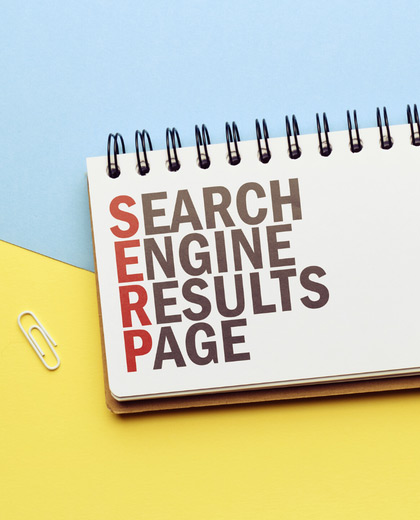
If you are wondering SERP Google what it is, let’s start by telling you that SERP stands for Search Engine Results Page. It looks like a Web page with a list of results returned by a search engine based on a particular query typed in by a user.
Search engine results pages are Web pages offered to users when they search for something online using a search engine, such as Google.
The user enters his or her search query (often using specific terms and phrases known as keywords) and the algorithm returns results with a SERP.
This is usually the first page of organic results that appear as a list of the most relevant web pages for the search query. It usually includes 10 results, with links at the bottom to go to the next page.
Google SERPs generally contain two types of content: “organic” results and paid results, via sponsored search engine ads or PPC campaigns.
Organic results are “natural rankings” that, determined by the search algorithm, depend on the SEO search engine optimization strategy of the keywords.
If a page ranks organically, it means that it has a very strong search engine optimization strategy behind it.
Whereas, sponsored ads will be ranked and placed according to a bid and their overall quality score.
What is the difference between the two? Simple, a Seo strategy will take longer to implement, whereas a sponsored ad, once paid for, will be immediately visible.
Google Serp and SEO: why is it so important?
The motive behind Google’s creation of the search engine result page functionality is about improving User Experience (UX). In fact, this feature enables users to have a simpler and more direct search experience.
Google’s SERP offers in-page content that provides users with the answers to their questions, even before they click on an organic result.
Who does SEO consulting know very well how important it is to increase keyword rankings and climb to the top of the Google SERP to get to the top.
The more authoritative and credible a company is to search engines, the greater its visibility and exposure in the rankings returned by the algorithm.
SEO and organic results
We have said it very often on the Factory blog: SEO is the optimization of a web page for the search engine. By antonomasia we refer to Google.
Textual content plays the lion’s share of an SEO optimization strategy. For example, valuable content that is interesting to your l’utente and optimized for Google can help you intercept new potential customers.
SEO does not involve Ads or sponsored on Social: it is organic growth, which is why it takes time.
The advantage of playing on organic search results is that you will run into really interested potential customers.
Organic results also populate the Google SERP. Their form and functionality may vary depending on the SERP Features and the additional information they give the user.
Let’s do a brief overview to learn about Google SERP and the main features. Then, we will understand which ones are most useful for a brand that wants to search for customers online.
What is the Google SERP and what are the SERP Features
SERP stands precisely for Search Engine Results Page: it is nothing more than the results page on a search engine. The results vary according to the search query the user performs.
For example, if you searched for “Finding Customers,” you might come across this very article.
Telling you how important it is to be among the top results in Google SERPs is redundant, isn’t it?
As we mentioned, the very first results you see on the page are paid ads.
Just below that, organic results begin. To rank among the top organic results, you need to build a solid SEO strategy: the more you optimize your site and content, the more Google will reward you in its rankings.
Climbing the SERP is the goal of SEO. Making the most of SERP Features, on the other hand, is a way to get users to click right on your content.
SERP Features are additional elements on the results page that go beyond the title and short description (meta description). Instead, they give extra information that is easy to interpret and useful to the user, who is thus more likely to click.
Key Google SERP Features
SERP Features are many. Each industry can use some features to its advantage and discard others. Here are the main ones:
Featured Snippets
Features Snippets are small portions of text that appear in so-called “position zero,” before all other organic results. It is text that Google extracts from an authoritative domain, also bringing up the link and an image. It often provides an answer to the user without even the need to click to go deeper.
Images or Videos
Image Packs are results in image and GIF format, which the user arrives at simply by performing the search and without going to Google Images.
This is a very useful feature for brands, which can rank by curating the SEO of images: descriptive and keyworded alt text, for images that make sense of the content. The same goes for videos, a format that is always popular with Google users.
2. Paid outcomes:
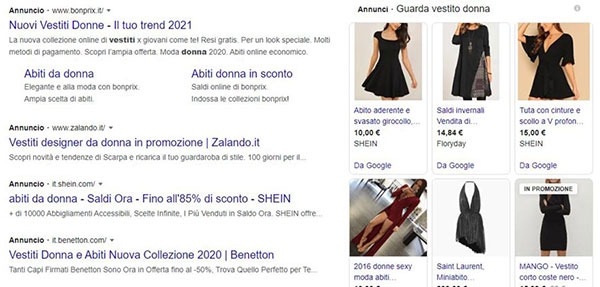
Paid results are the ads and sponsored posts that appear at the top of the SERP.
Google differentiates paid content from organic content by providing a sponsored or advertising label (Ad or Ann. or Ad.) .
Or by boxing it in a separate area of the page, as we can see from the image.
Knowledge Panels or Knowledge Graphs
I knowledge graphs or knowledge panels are boxes where the user finds a series of questions and answers about a person, fact or thing.
They are particularly useful because they immediately give the brand authority on a particular topic. Very often, users delve deeper into the answers contained in the Knowledge Graph by clicking the link.
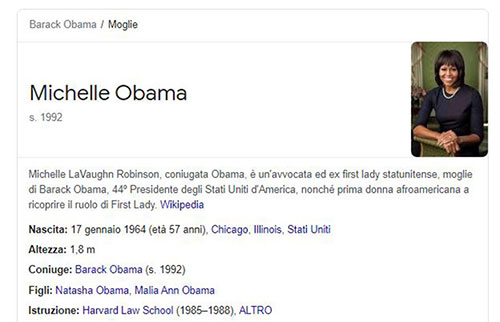
When your search probably has only one answer, Google will show a Knowledge Graph.
This is the case with searches such as “Today’s predictions” or “Who is Barack Obama’s wife.”
In fact searches of this type, will produce a Knowledge Graph, and it will show this result in a highly visible box at the top of the page.
Local Packs
These Features show information about local businesses, based on the search and the geographical area in which it is performed.
If you have a local business, for finding customers they are amazing, since they immediately show the name of the business, reviews, location on the map, website, etc.
The “People also asked for” boxes.
These boxes show the user additional questions related to the query. Suggestions are obviously based on the most frequent searches made by large numbers of users.
Rich Snippets
I Rich Snippets are additional information in the preview (snippet) of the page you find on the results.
They very effectively show salient elements for a potential customer, e.g., reviews, products, etc. This is a particularly useful feature for acquiring customers or leads.
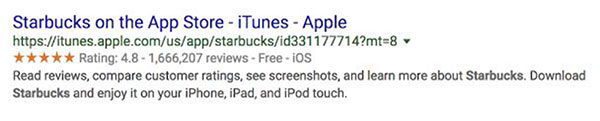
A rich snippet contains more information than a normal snippet,. Including images, reviews or customer ratings.
You can recognize a rich snippet as any organic search result that provides more information than the page title, URL, and meta description.
Site operators can add structured data markup to their HTML to help search engines understand their Web site and optimize it for a rich snippet.
The Starbucks app, for example, also includes prices and customer reviews in its description.
Sitelinks
Sitelinks show internal links within the domain, related to specific products or categories, for example.
Again, we are dealing with an important feature for finding customers, since it allows you to immediately direct them to the products they are interested in.
Top and Bottom Ads
Google Ads results can also be considered SERP Features. They are usually placed before all organic results, but if there are many competing advertisers you may find other ads at the bottom of the SERP.
Top News
The Main News feature brings up Google News content related to the search performed by the user. This feature can be very useful for companies in the publishing industry, news outlets, etc.
Twitter Cards
Among the features of Google SERPs, you may have also seen Twitter Cards: they often provide a very quick overview of news and trending topics.
They can be exploited well by companies doing real time marketing, as well as of course by journalists and influencers.

Google SERP Features to Acquire Customers
Some SERP Features are undoubtedly more expendable than others for acquiring customers or bringing traffic to your site, regardless of your industry. Among these features we must mention:
- The knowledge graph;
- Local packs;
- Rich Snippets;
- Images and videos (e.g., of products or services).
Added to these, of course, are Google Ads, which, as we have seen, are an integral part of the SERP.
How to figure out which SERP Feature is right for you? One thing you can do is to use specific tools to find out what competitors in your industry are doing, and which SERP features they use most often.
One such tool for example is SEM Rush, which Factory Communication uses to implement its clients’ SEO Strategies.
Remember, however, that to attract new target customers, you should always integrate SERP features into a broader digital marketing strategy.
To do this, it is imperative to have a thorough knowledge of the web and the marketplace…or seek the help of an experienced consultant.
Factory Communication has been helping companies of all sizes and in all industries build their marketing strategy for years, targeting the goals that grow business.
Improve your online positioning
Do you have a little clearer idea of what the Google SERP is?
In our SEO BLOG you can find several articles, which will help you and your Company climb the Google rankings.
Write to us in the comments about your progress and… happy SERPs to all!
Articles dedicated to Google services
Are you interested in staying up-to-date on the different services offered by Google? Also read these articles
- How does Google For Job impact Recruitment Companies?
- Google destinations: the Google solution for tourism
- Google Domains: a guide for Entrepreneurs and Marketers
- Google PhotoSphere: get your Company off the ground.
- Google update 2024: how can they affect your website?
- What impact can Google Multisearch have on your Business?
- Google Data Gif Maker creates animated graphics
- Google SGE: if you have a site you need to know what it is!
- Google Discover: what’s new from Big G
- Google EEAT (E-E-A-T) What they are and why they are critical for SEO