



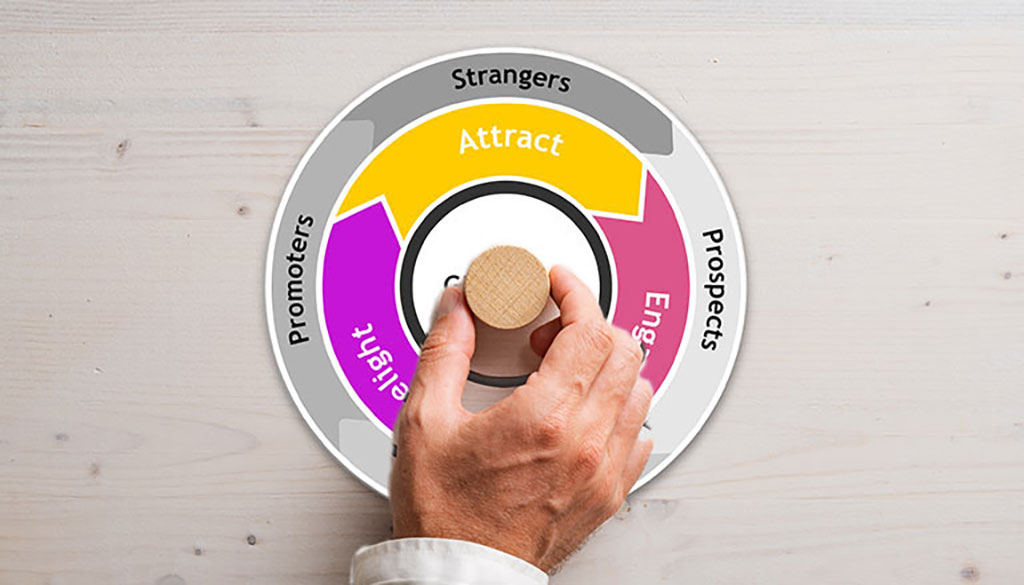
Perhaps we will go a bit against the grain by talking about Flywheel Marketing instead of Funnel Marketing.
But as Darwin teaches us, in order to survive, we need to evolve, to find the solutions best suited to the needs of the moment. And flywheel marketing corresponds to the exact evolution of the Funnel.
In short, the perfect Inbound Marketing strategy.
How to turn the Sales Funnel into a Marketing Flywheel and grow with customers
But why the Flywheel? What’s wrong with our beloved Funnel Marketing?
For a long time in marketing we have been hearing about Sales Funnel, and how effective it is to use this strategy to increase our business.
Today we decided to explain how inbound marketing flywheel, instead, has almost completely replaced this technique. Bringing significant improvements to our marketing and communication strategy.
Until a few years ago, decision-making power was completely in the hands of companies.
Customers, or potential customers, did not play a primary role, so no one paid too much attention to the Customer Experience, to the User Experience, the quality of one’s customer service, etc.
Today everything has changed.
Currently, we have all kinds of tools at our disposal, enabling us to connect with the whole world.
So every day we have the opportunity to discover new companies, re-evaluate “the old ones,” express our thoughts–and most importantly, we can choose the product or service that reflects our needs.
In fact, today the central role in the Company-Customer relationship is played by the Customer.
He decides what to buy, and from whom. He decides whether to trust one Company, rather than another. He is the one who compares offers, catalogs, prices, quality of products, etc.
The Customer now has full decision-making power in the purchasing process.
Therefore, it is necessary to study a strategy that aims to make the customer or Lead choose us. And generate in him the knowledge that we will be the perfect solution to his problem.
Funnel vs Flywheel Marketing
Literally Flywheel means “flywheel.”
As with Funnel, here too we can see the similarity to the object of comparison through its graphical representation.
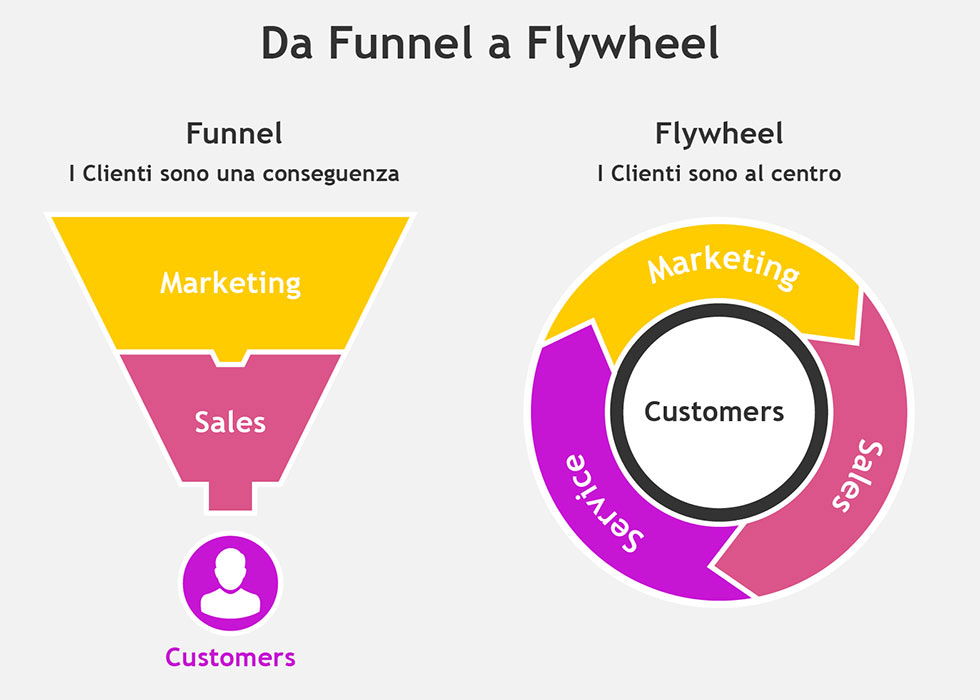
Invented by James Watt (yes, the very guy we find on all our light bulbs) over 200 years ago, the flywheel is actually a very simple invention. In fact, it is a disc, which rotates on an axis.
This tool is incredibly energy efficient.
In fact, the amount of energy it stores, depends on how fast we spin it.
But also the amount of friction present, and what makes it up.
Here is the main reason for the advancement of the Flywheel, compared with the Funnel.
Customers, in fact, are the real engine of our business.
So it is counterproductive to consider them “a consequence.”
As we have already explained in the article related to The Importance of Reviews, our customers play a key role, as far as the credibility of our Company is concerned.
In fact, the word of mouth has always been a key tool, to make our Marketing and Communication Strategy work properly.
Losing that energy, that momentum that Customers can give to our business, is a waste.
In addition to being a major obstacle in the long run.
While Funnels have a conclusion, ending in the “Customers” phase, Flywheels take advantage of this position to recharge themselves with energy, and keep turning.
In addition, because they retain their stored energy so well, everything you add (energy, new components, heavy cc.) allows them to run faster and faster.
In short, without ever stopping.
Although, so far, Funnel has been a great tool for increasing our business, we are forced to follow Darwin’s law: “It is not the strongest or the smartest species that survives, but the one that adapts best to change.”
Therefore, we must decide to change. Or rather, evolve.
Concepts behind Flywheel Inbound Marketing
There are three basic factors, which determine the movement in our Flywheel:
- The speed at which we turn it
- Friction
- Its components (how big it is, and how much it weighs)
And the best teams implement strategies for all three factors.
- The speed at which we turn it.
The speed of our flywheel increases, if we apply more force in the areas where it can have the greatest impact.
In a funnel model, all force is applied to attract and acquire customers.
In contrast, in a flywheel model, force is also applied to delight existing customers, to make them loyal customers.
- Friction.
Since we are applying all sorts of forces in our flywheel, let’s make sure there are no contrasts in its path.
In fact, a lack of alignment among our team members for example, can slow down the speed of our flywheel. And it may even stop!
So we always place a focus on aligning our resources. All team members must travel on the same track, and be clear about the business goals.
This, we discussed in the article related to Integrated Marketing.
- Its components (how big it is, and how much it weighs).
As we increase the speed of our flywheel, and reduce its friction, we correspondingly increase happy and satisfied customers.
And happy and satisfied customers means having a flywheel that is “heavier,” and therefore produces more energy when spun.
In other words, our flywheel produces more growth as the number of customers increases.
And if we add “body” to those customers, thus keeping our business ethical, with proper focus on their needs and requirements, etc., we will get more and more energy.
And thus more growth for our business.
How to maximize the results of our Flywheel Marketing Strategy
First, we need to study an ad hoc strategy that will enable us to leverage the Flywheel in our favor to improve our business. So let’s proceed with one step at a time:
1) Measurement of the flywheel:
Let’s find out the key metrics of our flywheel.
2) Maximizing pleasure:
We identify our Company’s strengths, based on the flywheel stage. We reframe and leverage those strengths, to maximize satisfaction and word of mouth
3) Reduce friction:
We find the points of friction and crossing points between our team and our clients
- We need to study these points in order to better assist our customers, and to be able to use our Marketing Automation strategy in a performant way.
Measurement of flywheel
Our first task is to understand the status quo of our flywheel.
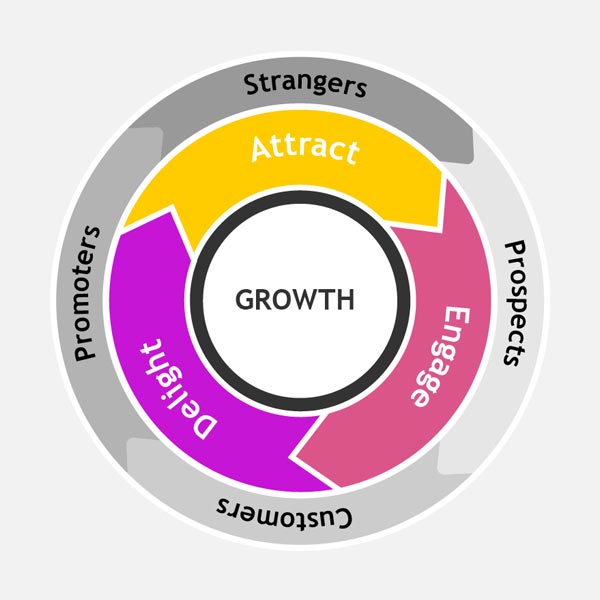
For each stage illustrated below (attract, engage and delight) we need to think that:
Attract: In this phase we use our expertise to create content, which with good positioning will lead to conversations.
These elements will serve as the basis for building healthy and meaningful relationships, with our target buyer personas.
Involve: at this stage we need to give body and substance to our relationships, providing solutions focused on people’s specific problems.
Delight: at this stage we must provide an exceptional experience for our customer. In this way we will truly offer value, helping them find the answers to their questions and making them promoters of our Company.
However, to determine the health of our flywheel, two questions must be asked:
- What investments are we making for each stage of our flywheel?
- How do we measure the success or failure of these investments?
Step one: strategy mapping
In this step, we identify the main activity, or program, in which our company has invested to address each phase of the Flywheel.
In fact, we may find that one flywheel is not enough to encompass everything our company does. For example, we may have multiple Flywheels running simultaneously. And that is perfectly fine.
Below we see an example about our agency. Factory Communication’s “First Step:
Attract: at Factory Communication, we use the principles of Inbound Marketing to turn our flywheel. To offer value before receiving value, we invested heavily in free content through our website, blog, social media, etc.
Engage: to facilitate potential clients to interact with our services, we offer free consultations to Companies. In this way, users can understand our modus operandi before they consider purchasing our services.
Delight: we help our clients improve their business by implementing Marketing and Communication strategies tailored to them. We also offer guided training in key Marketing tools and support clients’ internal growth.
Second Step: measuring success
In this step, we identify the most important metric for each activity. We also note the conversion rates for each step. In this way, we have the ability to measure attrition in our Flywheel.
So, we take note (month by month, or year by year) of the goals we have achieved, and what we have lost.
As before, let’s look at an example of the “Second Step” of Factory Communication:
Attract: In this section, our main metric is monthly website traffic. So we measure month by month the amount of traffic we gain, or lose.
Engage: at this stage, we focus on how many new users enter our flywheel each month. And we also measure the churn rate, so how many users leave our flywheel.
We also monitor users to see if they can become qualified leads. We monitor how many of those qualified leads come close to becoming customers, and again, we track how many of those leave the flywheel process.
Delight: We monitor the number of clients who are promoters of our agency, that is, how many clients say they would recommend Factory Communication to a friend, or relative.
Maximizing pleasure
When we begin the journey of growing our business, based on the Flywheel, most of our resources will definitely be focused on the Attraction and Engagement phase.
All this is normal, because our flywheel has to start somewhere! And it is no coincidence that these two phases coincide with those of the Inbound philosophy.
But once our flywheel has begun to accumulate energy, and turn independently, we should consider the option of focusing primarily on the Delight phase.
Why?
Because when our flywheel starts turning steadily, the most powerful momentum will come from the retention of our customers.
In fact, the goal is to turn them into promoters, who will support our Brand and help us generate new contacts (new possible customers).
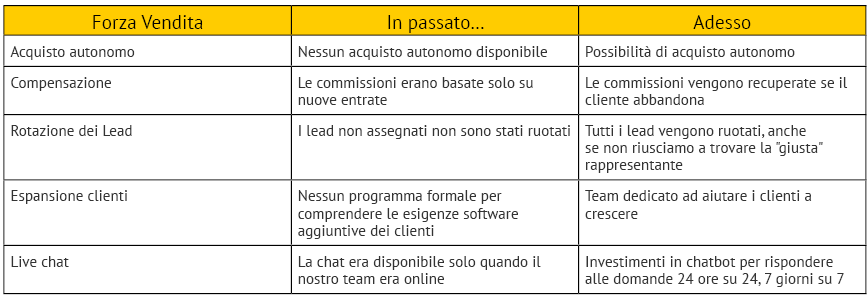
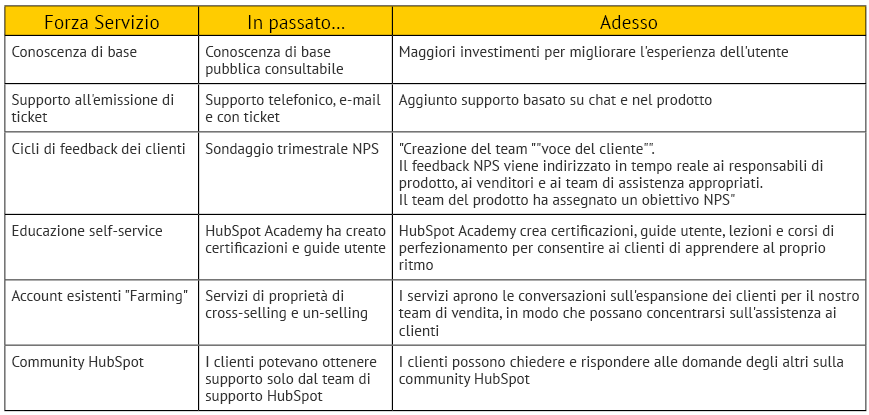
At this stage, it is necessary to examine the “forces” (i.e., activities and programs) that currently move customers through our flywheel.
And we consider whether these forces are meant to help our process, or the needs of our customers.
In this way, we can list the problems we experience, and highlight the changes we should make, to maximize customer delight.
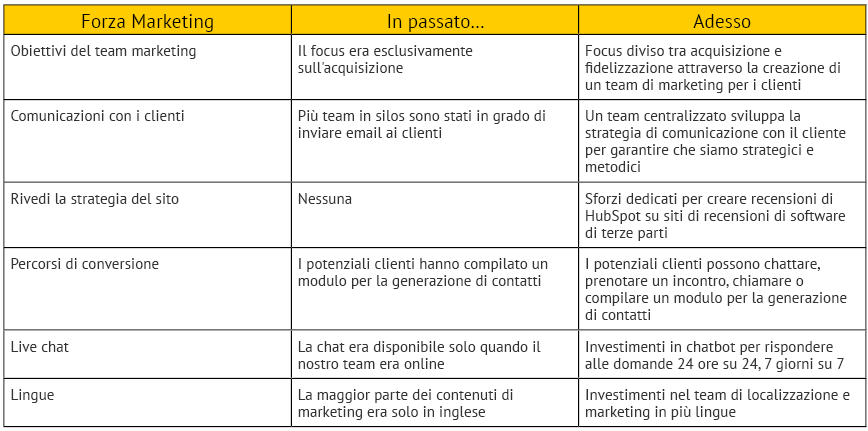
Below, HubSpot offers us an excellent outline from which to take a cue, to carry out such an analysis.
And this diagram is really about HubSpot’s strategy in 2018, compared with the current strategy.
Reduce friction
There are many ways to reduce friction in our flywheel.
One of these, is to smooth out common friction points, such as conversion rates between stages, the number of satisfied customers, and the number of dropouts.
It is not difficult to identify this kind of weakness because we are dealing with metrics that are largely isolated from each other.
So, for this assignment, we will focus on one of the most significant sources of friction in our company: the organizational chart.
Poor communication between various teams in the Company is a major cause of friction, in most flywheels.
We can divide this analysis into three steps:
- Where are the friction points?
- What can be automated?
- What can be addressed through team reorganization?
So let’s look at these steps one by one.
Step 1: Where are the friction points?
Let’s put ourselves in the shoes of our customers, or potential customers. Let’s think about their complaints, and ask ourselves: where do they have difficulty interacting with the company?
Internally, we consider what metrics we struggle to move, despite our efforts.
Processes that take longer than they should be activated, and common sources of problems.
Step 2: What can be automated?
First, let’s consider the activities that our customers, and potential customers, want to do. And let’s assess their complexity.
Can we “streamline” the process, making it easier for customers to conduct business?
We also identify the mechanical and repetitive activities of our team.
Can we help them gain valuable time by automating these tasks, and making room for building customer relationships?
These are just a few examples, of how automation can help us streamline our flywheel processes.
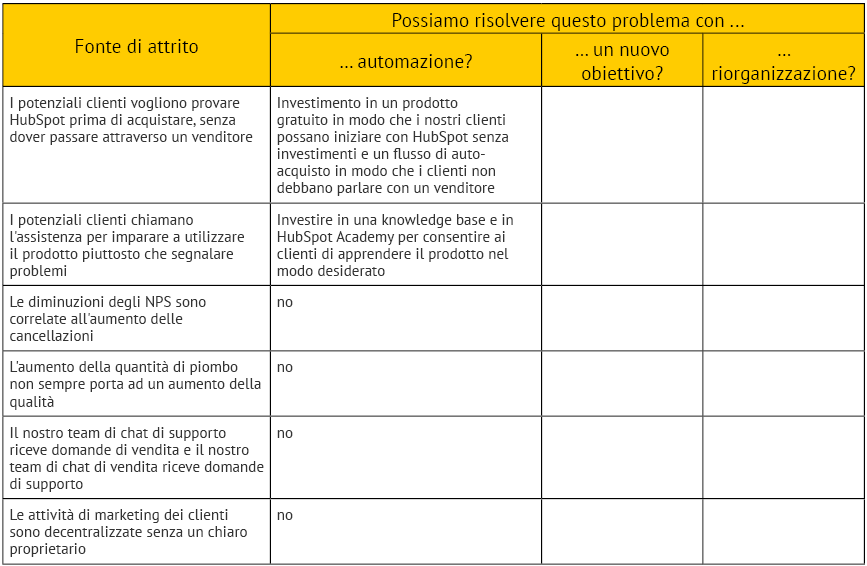
Here, for example, are the friction points that HubSpot solved with automation:
Step 3: What can be addressed through team reorganization?
Within every organization, there are problems that cannot be solved by automation or realignment of objectives. In these cases, reorganization may be necessary.
We can conduct a self-assessment, asking ourselves:
- Do employees working in the same functions sit in different departments?
- Are the teams too specialized?
- If my organization has a blind spot, do I have a dedicated team to fix it?
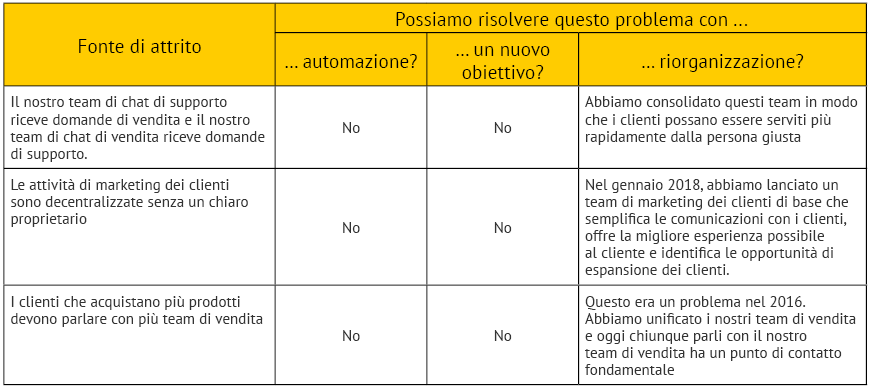
Here is how Hubspot solved this kind of friction:
How to Create a Marketing Flywheel
Putting the customer first.
The biggest change introduced by the flywheel, is the role customers play in our growth model.
When we put the customer at the center of our business, we are preparing for the best possible growth of our Company. In the long term to boot.
Currently there are many companies that claim to “put the customer first.” But then the facts prove otherwise.
In fact, it was recently shown that only 12 percent of consumers believe companies that use this phrase.
And probably the cause is precisely trust, which failed when this statement was not proven to be true.
Build a system around customers, not vice versa.
Most companies, implement a growth system that works more smoothly and scalably, and not necessarily great for customers.
These two visions should not conflict with each other. On the contrary, customers should always come before operational efficiency.
Let’s not make the mistake of compromising the Customer Experience, just to solve our internal issues.
Eliminates friction from the customer experience.
We analyze our customers’ experience, and try to identify, and resolve, points of friction.
For example, we may find that our Customer Service section is difficult to find on the site, or unintuitive.
One solution, could be to implement a live-chat. To help customers right from their first access on our site, and to have the possibility to receive assistance right from the start.
Building a 360-degree view of the customer.
The entire team must have access to customer contacts and data. In this way, each team member can focus on helping customers by focusing on the specific buyer person of interest.
By empowering everyone to get to know and understand the customer, each team member will be able to provide a functional and targeted approach, with the goal of customer retention.
Eliminates friction between marketing, sales, and customer service.
As we have already pointed out extensively, attrition slows down our flywheel. And consequently, the growth of our business.
That is why it is important to constantly evaluate the customer journey (customer journey), identify points of friction and resolve them.
A very common point of friction for many flywheelers is customer service. And an effective way to eliminate this friction is to help customers help themselves.
But how to do it? Let’s see it together.
We help clients at every opportunity.
When a customer asks a simple question, his first move is not to call us, or come to our store. But he Googles the answer to his question.
To help it, we need to implement a ranking strategy to help us index our content (content marketing) on the search engine.
In this way, customers, or potential customers, will be able to find the answers they are looking for more easily and quickly. And we will be the ones to provide them with them.
We consolidate and codify knowledge.
The first step to creating incredible self-service solutions, starts from the inside. In fact, many companies have such a vast knowledge of their industry that they could really help their customers.
But unfortunately, many have not yet realized the potential of sharing their know-how.
So cues, reflections and notes, remain in a desk drawer, or written on a post-it note.
What a waste!
So let’s reorganize all our knowledge and make it usable. As of today, for example, ebooks turn out to be very popular. This could be a great tool for our company as well, so let’s think about it.
We make our knowledge public.
After collecting and codifying our knowledge, we need to find a way for customers to access it easily.
So we can use our blog, specific landing pages, a community, etc.
Let us remember to make this process simple and smooth. A bad user experience could undermine the dissemination of our domain knowledge.
Delight your customers.
Delighting customers is easier said than done. However, recent studies have shown that loyal customers have higher expectations, and are more likely to share their experiences online, and in person.
Simply put, customer happiness is the most important factor in the growth of our business, and it is the key to differentiating ourselves from our competitors.
Making the customer happy is easier when we are a small company because we have the time to personalize each interaction.
But as our company grows, customization obviously becomes more difficult.
So how can we maintain a high level of customer satisfaction?
Let’s see it together.
We keep detailed records of clients.
CRMs are great support tools because they track customer lifecycle stages and service requests.
At Factory Communication, we have chosen the services offered by HubSpot, which we would like to recommend.
In fact, HubSpot provides information on how users interact with our business. In this way, we have the ability to “know the customer” in advance, and offer a much more targeted solution to their problem.
Let’s make sure our entire team has access to customer information.
Customer service is a team game, so every employee in our company must be cohesive toward one goal: customer satisfaction.
And team members collaborate better if they have the ability to access the same data. In fact, this way they will all have an overview of the strategy to be adopted.
Develop word of mouth
By eliminating friction and providing our industry knowledge, we have definitely improved our customer’s experience.
Now, having obtained happy and satisfied customers, we can grow word of mouth WOM or word of mouth.
Word-of-mouth marketing is effective because users have more incentive to listen to the opinions of “ordinary people” who are similar to them, rather than companies.
In fact, a company will never want to point out its flaws, and flaunt them to the web audience. A customer (or former customer), on the other hand, may well do so.
We provide a delightful customer experience.
A delightful customer experience is critical to turning our flywheel faster. By providing customers with an excellent experience, we have a better chance that they will become advocates for our Brand.
Considering the enormous potential of word of mouth, we can turn our best customers, into our best marketers!
Identifying happy and unhappy customers.
We can identify happy and unhappy customers by collecting feedback on their experience.
We always respond to customer reviews, both positive and negative. Most importantly, we give customers a way to provide us with their feedback, quickly and easily.
Making the review process complicated benefits no one. Least of all to our business.
We help unhappy clients and make the happy ones visible.
An optimal solution for our company, would be to devise a system that reaches unhappy customers, and solves their problems.
This operation, can improve the customer’s perception of our Brand, especially when they are deciding whether to abandon us, or not.
Similarly, a good strategy is to highlight our satisfied customers. And for this we can use many tools. First and foremost, social media marketing.
Why turn Funnel into Flywheel Marketing?
We now understand the difference between Funnel and Flywheel model. So let’s do a brief summary to recap what benefits following “Flywheel Marketing” brings.
And how this new way of thinking about our business can be adapted to any company.
- We always aim for the customer, not our system.
When customers see that we have designed a strategy that revolves around them, and not our business system, they will know that our company really does put the customer first.
- Shared knowledge has immense power.
If we want to eliminate friction in our client’s journey, we can make this practice more effective by sharing our knowledge. Knowledge is an immense power when it is available to those who need it.
- We delight customers.
Let’s not delight customers just because Factory Communication, or Pinco Pallino, tells us to. Let’s do it because it’s the right thing to do. For clients, but more importantly for our business.
- People trust people, not companies.
We are human beings, consequently we tend to trust people. And not in companies.
We make sure that our customers are so satisfied with us that they cannot help but start positive word of mouth.
Let us always remember, that in order to implement an effective strategy, and one suitable for increasing our business, it must follow one simple rule: the customer at the center.
N.B. if you introduce the HubSpot Platform into your strategy, in addition to contact information, you will also have information about user behavior on your site. This way you will know, in advance, what they are interested in.
Did you find this article interesting? You can explore further by reading these articles.