


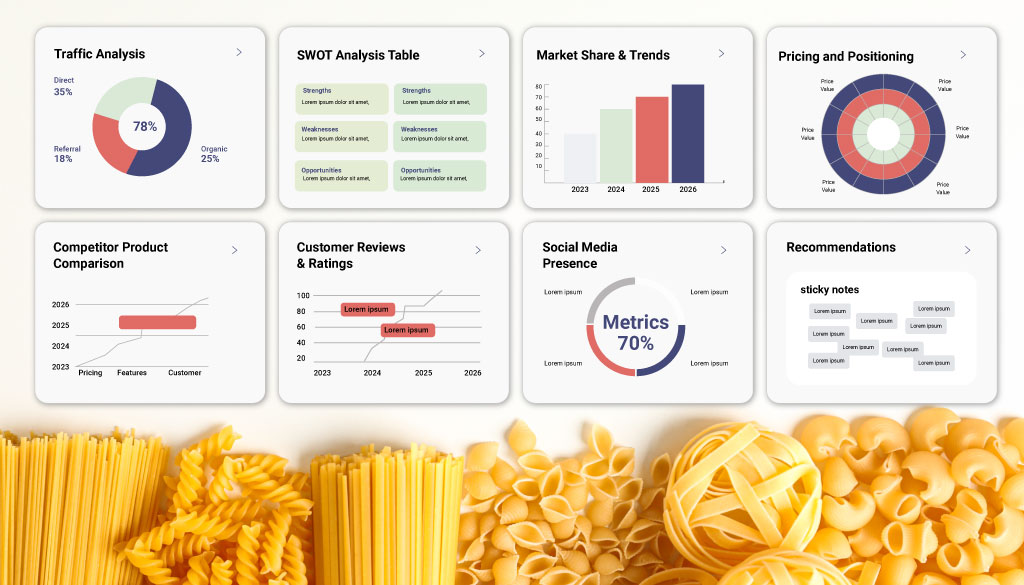
In the Food & Beverage industry, competition never sleeps. New brands are constantly emerging, consumer trends are changing rapidly, and margins are thinning. In this scenario, understanding what your competitors are doing is not a luxury-it’s a strategic necessity.
Food & beverage competitor analysis is the tool that allows a business owner to look beyond his or her counter, understand the market as a whole and make decisions based on real data-not hunches.
Whether you run a food production company, a restaurant chain, or a craft beverage brand, this analysis helps you identify opportunities, prevent threats, and build a solid positioning.
In this guide we explain how to conduct an effective competitor analysis in the Food & Beverage sector in 5 concrete steps, with practical tools and tips designed for Italian SMEs.
What is competitor analysis in Food & Beverage and why it is critical
Practical guide for F&B entrepreneurs and SME owners.
Competitor analysis is a systematic process of gathering, processing, and interpreting information about key competitors in your target market.
It is not simply a matter of “spying” on rivals: it is a strategic activity that allows you to compare your offerings with those of the market, identify gaps to be filled, and understand where the real opportunities for growth lie.
In the Food & Beverage sector, this analysis takes on even greater relevance for at least three reasons:
- The market is highly fragmented, with a multiplicity of players ranging from large multinational corporations to small local artisans.
- Consumers are increasingly informed and unfaithful to brands, ready to change preferences based on trends, prices, and ethical values.
- Product innovations and changes in distribution channels follow one another rapidly, making any static strategy obsolete.
According to the most recent market research, companies that conduct structured competitive analysis at least once a year perform better in terms of revenue growth and customer retention than those that do not. Investing in this activity is therefore not a cost, but a return.
💡 Insight: many F&B SMEs stop at informal observation of competitors-“I saw they changed the packaging” or “they told me they are opening a new store.” This reactive mode is not enough: a structured and repeatable process is needed.

How to perform a food & beverage competitor analysis in 5 steps
Step 1 – Identify your competitors: who are really your rivals?
The first mistake many companies make is analyzing the wrong competitors-or analyzing too many of them, scattering resources and attention.
The starting point is to build a clear map of the competition, divided into three levels:
Direct competitors:
Companies that offer products or services identical or very similar to yours, to the same target audience and in the same geographic market. If you produce artisanal mozzarella from Campania, your direct competitors are the other dairies in the same area.
Indirect competitors:
Companies that meet the same consumer need, but with a different product. A vegan cheese producer is an indirect competitor to a traditional dairy.
Potential competitors:
Brands or companies that today operate in an adjacent segment but could enter your market. A large retail retailer launching a private label, for example.
What tools you can use to identify your competitors
To build this map you can use tools such as:
- Google Maps (for local players), the GDO and distributor catalogs
- Trade fairs (Cibus, Tuttofood, Vinitaly)
- Industry databases such as Nielsen or IRI, and social media.
- Searches made online: you can use tools such as AnswerThePublic, Google Trends, Google Keyword Planner, Semrush, to analyze the searches made by users. What they search for and how they search.
- Research done with AI: You might understand how your competitors are doing based on questions asked on platforms such as ChatGPT, Claude, Perplexity: “Analysis of the main competitors in the food & beverage sector in Italy” or “What are the most competitive market segments in the Italian food & beverage sector?” – are an accurate thermometer of what people are looking for and therefore who competes for their attention.

Step 2-Collect the data: what information to analyze
Once the competitors to be monitored have been identified, it is time to collect relevant information. What data to collect to study competitors in food? There are two main categories:
Quantitative data:
- Turnover and market share (where available)
- List prices and active promotions
- Number of outlets and distribution coverage
- Volume of content published online
- Social channels manned with number of followers and engagement
- ADV campaigns carried out online and offline
- Campaigns made with UGC Creator 4eo/o Influencer
- SEO positioning: what keywords they are positioned for, how much traffic they intercept etc.
- Positioning on AI platforms
Qualitative data:
- Brand positioning and communicated values
- Quality and variety of product offerings
- Communication strategies
- Tone of voice and Value Proposition
- Customer reviews and feedback
- Sustainability policies and certifications.
There are many sources to draw from:
- Competitors’ websites and e-commerce
- Social profiles (Instagram and TikTok are key in F&B)
- Reviews on Google My Business and TripAdvisor for the restaurant industry
- Press releases, trade shows and industry events
- Product labels in large-scale retail trade
- Industry reports
- Specialized publications such as Food, Beverage & Confectionery News, Italia a Tavola and Largo Consumo.
A practical recommendation: create a standardized form for each competitor so that information is collected in a uniform and comparable way over time.
💡 Useful tools for data collection: SEMrush or Ahrefs for web traffic and competitor SEO; SimilarWeb for digital traffic analysis; Mention or Brand24 for monitoring online conversations; Google Alerts for receiving real-time notifications about your competitors’ news.

Step 3 – Analyze prices and distribution channels.
Two of the most critical aspects to analyze in the Food & Beverage industry are the pricing strategy and sales channels used by competitors.
How to analyze the prices of competing products in the food & beverage industry? And how to understand which sales channels competitors use?
For price analysis, the most effective methodology is mystery shopping: buying or simulating the purchase of competing products, whether in physical channels (large-scale retail, wholesale, markets, catering) or digital channels (proprietary e-commerce, Amazon, marketplace).
Among various projects in the Food & Beverage field, we carried out one for a restaurant chain GiroPizza.
Through “mystery shopping” analysis, we were able to map:
- The retail price (and its variation in different channels)
- Promotions and discount mechanics (3×2, percentage discounts, bundles)
- Consumer’s perceived value for money
- Dynamic and seasonal pricing policies
In terms of distribution channels, the F&B sector offers great variety:
- Retail and supermarkets
- Ho.Re.Ca. (hotels, restaurants, catering)
- Direct E-commerce (DTC)
- Online marketplace
- Markets and fairs
- Direct sales on the farm (farmhouse, winery, dairy).
Analyzing which channels your competitors are manning-and with what intensity-allows you to identify under-presidized channels where you could position yourself with less competition.
Step 4 – Assess online presence and digital marketing strategies
How to evaluate the online presence of competitors in the food & beverage industry?
This is one of the most relevant steps today because digital has become a central battleground even for traditional F&B companies.
The areas to be analyzed are:
SEO and organic visibility:
What keywords do they preside over on search engines? What is their ranking for the most relevant terms in the industry? Using tools such as SEMrush or Ahrefs allows you to see exactly for which searches your competitors appear on the first page of Google.
Social media:
Instagram is the social media par excellence in F&B. It analyzes posting frequency, formats (Reels, Stories, carousels), engagement rate, and best performing content. TikTok is becoming increasingly relevant, especially for reaching younger consumers.
Google Business Profile:
For businesses with physical stores, the Google tab is a key asset. Analyze competitor reviews: what do customers love? What do they criticize? These are gold mines of competitive insights.
Digital Advertising:
Tools like Meta Ad Library allow you to see what ads competitors are running on Facebook and Instagram. It’s a free way to understand the key messages and offers they are investing in.
Key performance indicators to monitor for rivals in beverage and food include:
- Growth of followers over time
- Engagement rate
- Publication frequency
- Type of sponsored content
- SEO positioning for strategic keywords
- Number of mentions present in AI platforms
Step 5 – Synthesize the results with a competitive SWOT analysis.
The fifth and final step is to turn all the information gathered into actionable strategic insights. The most effective tool for doing this is competitive SWOT analysis: not a generic SWOT on your company, but a systematic comparison of your strengths and weaknesses against those of your competitors.
How to identify the strengths and weaknesses of competitors in food & beverage? The answer lies in the data collected in the previous steps:
Competitors’ strengths:
widespread distribution in large-scale retail, strong brand recognition, wide product range, strong social presence, quality or organic certifications.
Competitor weaknesses:
poor digital presence, products with low perceived quality, high prices not justified, poor customer service (emerges from reviews), poor product innovation.
By cross-referencing these with your strengths and weaknesses, you can identify concrete opportunities: an uncovered price segment, an overlooked distribution channel, a value (e.g., sustainability, craftsmanship, local origin) not effectively communicated by competitors but sought after by consumers.
The end result of the analysis should not be a document to be filed away-it should become direct input for your marketing and business plan. Define concrete actions, assign responsibilities, and establish KPIs to measure results over time.
💡 Practical tip: Repeat the competitor analysis at least twice a year. The Food & Beverage industry is dynamic: brands that don’t exist today could be your main competitors tomorrow.
Trends 2026 in Food & Beverage: what to monitor in competitors
Effective competitor analysis not only looks at the present, but anticipates the future.
What are the new culinary and F&B market trends that you also need to keep an eye on as far as your competitors are concerned?
- Sustainability and traceability: consumers are increasingly demanding transparency about the supply chain. Competitors that effectively communicate product origin and sustainability are gaining market share.
- Plant-based and protein alternatives: the segment is growing in double digits. Traditional companies are also launching vegan or vegetarian lines.
- Hybrid food+entertainment experiences: catering is transformed, with immersive experiences, pop-ups and innovative formats.
- Supply chain digitization and delivery: the most advanced competitors are investing in technologies to optimize logistics and distribution.
- Personalization and niches: products for intolerances, specific diets (keto, gluten-free, sugar-free), and cultural identities are fast-growing trends.
Monitoring how your competitors are positioning themselves against these trends allows you to understand where the market is shifting and decide whether to follow, anticipate or differentiate.
From analysis to action
Competitor analysis in the Food & Beverage industry is not an activity reserved for large multinational corporations.
Even an SME, with the right resources and a structured method, can gain valuable insights that make the difference between a winning strategy and one that chases the market instead of leading it.
The 5 steps we have outlined-identifying competitors, data collection, price and distribution analysis, digital presence assessment, and SWOT summary-form a replicable process that you can apply to your business, regardless of size.
The food & beverage market is constantly evolving: new trends, new competitors, new channels.
Those who stop to analyze their competitive environment on a regular basis have a huge advantage over those who only move by reaction.
And in an industry where the difference between growing and losing share can be a matter of months, having a strategic compass is not an option.
Want a competitor analysis tailored to your company?
Do you want to conduct a competitor analysis tailored to your company in the Food & Beverage industry?
Contact our consulting team-we analyze your market and help you build a concrete and measurable competitive strategy.
Food and Beverage Marketing: related articles
- Proximity marketing: what it is and what it can do for your business
- Brand Positioning: an important requirement for every company
- Ideas for attracting customers to a restaurant
- SEO consulting for restaurants: Increase your online visibility
- Description of menu dishes: you have to give value to your Product
- Local SEO: comprehensive guide for Local Businesses and Activities
- Local SEO for Restaurants. Grow your business!
- Product positioning in the market
FAQ – Competitor Analysis Beverage & Food Sector
Competitor analysis is carried out in 5 main steps: identification of direct, indirect and potential competitors; data collection on products, prices, channels and communication; analysis of digital presence; comparison of marketing strategies; and synthesis with a competitive SWOT analysis.
It is important to use structured tools and repeat the analysis periodically.
Among the most useful tools: SEMrush and Ahrefs for SEO and competitor web traffic; SimilarWeb for visit analysis; Mention and Brand24 for monitoring online mentions; Meta Ad Library to see Facebook and Instagram ad campaigns; Google Alerts for real-time notifications. For more structured market data, Nielsen, IRI and Nomisma or Censis reports are used.
The most important data include: prices and promotions, product range and quality, distribution channels manned, brand positioning, digital communication strategies, customer reviews and feedback, market share, and distribution coverage. It is advisable to create a standardized form for each competitor to collect information in a uniform manner.
To assess competitor innovation, it is useful to monitor: new product launches (press releases, trade shows, GDO shelves), patents filed, partnerships with other brands or chefs, R&D activity communicated in company reports, and reports in trade magazines. Consumer reviews also often reveal how the market perceives competitor innovation.
In the Food & Beverage sector, where trends change rapidly, it is advisable to conduct an in-depth analysis at least twice a year and integrate continuous monitoring (via Google Alerts, social listening and direct market observation) on a monthly basis. When launching a new product or entering a new market, analysis should be conducted in a more timely manner.
Market analysis photographs the industry as a whole: size, trends, segments, consumer preferences. Competitor analysis, on the other hand, focuses on individual competitive players. The two analyses are complementary: market analysis provides the macro context, while competitor analysis goes into detail about the strategies of individual players. For the restaurant industry, it is also important to analyze geographic location, format (fast casual, fine dining, delivery-only), and online reputation.