


Email marketing campaign is an effective digital marketing strategy to directly reach your purchased or potential customers.
This is not to be confused with the mass emailing that goes by the name of DEM marketing (direct email marketing).
Over the years, many companies have indiscriminately used e-mail to promote and advertise products and services, often engaging in outright spamming.
Email is also often associated with fraudulent phishing messages , and this has led users to distrust communications from real or supposed companies in their inbox.
Further damaging the category is the unscrupulous use of personal data and mail addresses of so many users who have received DEM without consent over the past decades.
Email marketing campaign
With the advent of GDPR to protect privacy, the situation has changed.
Companies that do e-mail marketing in a virtuous way achieve important results for:
- Building relationships with potential customers and accompanying them through the funnel
- Convert contacts acquired through lead generation activities into new customers
- Talk about your new products or services
- Retaining existing customers
- Increasing online sales
- Increase visits to your website
Not surprisingly, the latest Content Marketing Trends 2023 research conducted by the Content Marketing Institute teaches us that most marketers (69%) use Email Marketing Campaigns for B2B.
With increasingly savvy users, however, to be successful you need to write a great newsletter that converts. In this article, I give you some tips on how to do that.
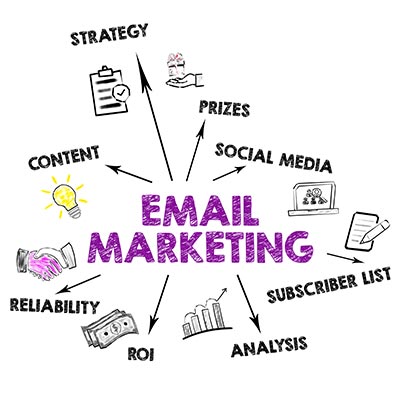
Email marketing what is it?
Emails sent by companies directly to a user’s inbox (who has given consent for the use of personal data) may promote products or services, or even simply talk about the brand.
Regardless of purpose, these activities fall under email marketing. There are differences in content and design, depending on the company and industry.
News and articles from the company blog (newsletter), promos, catalogs, initiatives, invitations, etc. can be shared through this channel.
The Email Marketing Campaign
The Email Marketing Campaign must have clear objectives. You can use email for branding or for selling: calibrate the content according to the purpose.
You also must always remember that you are addressing a live recipient: always, whether B2B or B2C.
So, my advice is to thoroughly understand your target audience. A great tool, for this, are the buyer personas.
Is looking at what and how other companies and your competitors are doing it helpful? Yes, but limit yourself to looking at the pros and cons.
Your reality is unique, the people you target are your niche and they have their own unique and specific characteristics.
If you keep your goals and target audience in mind, then you can write a good newsletter that converts (i.e., prompts the recipient to take an action, such as reading more content, buying a product, or attending an event).
Email marketing campaign: our 12 tips for writing a newsletter that converts
Below, I tell you about some best practices for making a user-attractive newsletter.
Point 1. The subject: a few lines to be read or spammed
The subject line is a short sentence, very few characters to catch the recipient’s attention immediately and convince him or her to open the e-mail… or discard it in the trash. This is probably why it is the most difficult aspect to manage.
The subject line should be short, but clearly frame the focus of the email and its objective. Gmail for example reads, in preview, a subject line of about 77 characters. With Outlook we go down to 60. Mobile devices give us a preview of 5 or 6 words in the subject line.
So better to be brief, especially if we expect recipients to read from smartphones.
Some research cited or conducted by the email marketing platform Mail Up reveals that emails that have dynamic field objects, bearing the recipient’s name or company name, are more likely to be opened.
To do this, it is very useful to use marketing automation, for example, with HubSpot.
Power words and spam words
Regarding the subject line of e-mails, finally, it must be said that there are real power words that can facilitate opening because of their persuasive power. For example:
- free
- offer
- immediately
- discount
- free delivery
- extra etc.
On the opposite side, some words may destine your e-mail directly to the spam box:
- congratulations
- you won
- your credit card
- earns etc.
Step 2. Email marketing campaign: use marketing levers to persuade
The power words we mentioned refer to some marketing levers that are widely used in copywriting in general and thus also in marketing email texts.
They allow the conversion rate to be greatly increased.
Such levers are:
- Scarcity (“offer valid for the first 20 customers”; or “last available seats”):
- Theurgency (“Sign up now to get the early bird rate,” or “Free until June 10”);
- Social proof (this is a very effective lever, reassuring the user for example through positive reviews from your customers, or making them feel part of a community).
Other persuasive mechanisms include:
- Exclusivity (“free guidance only for our clients”);
- Reciprocity (“discount for you if you bring a friend”);
- Theauthority of the sender company.
Step 3. Write incisive Call to Action
To push the user to make a “conversion” you should always include a call to action (CTA) in your email.
The actions to be taken can be different, depending on the goal you want to achieve:
- Buy
- Signing up for a corporate event
- Joining the community
- Writing a review
- Responding to a survey;
- Landing on a specially constructed landing page on your website (e.g., to present a product, service, project).
The entire body of the e-mail must point to the Call to Action, which for its part must be short, clear, and punchy. You can play fancy, as long as you are performative and explicit, or use expressions that we now easily recognize as a Call to Action. For example:
- Read the article
- Visit the shop
- Use the code and get 20% off
- Sign up for webinar
- Attend the event, etc.
Advice? Use only one CTA per email.
Step 4. Email marketing campaign: The body of the email: how much to write?
So many say that the email must be brief so as not to bore. Some have the courage to write real articulate letters.
My opinion is that interesting content is read even when it takes a few extra minutes. Content that is boring or gives no added value to the recipient has its fate sealed.
The length of the email is also affected by the recipient: who is he? what is he expecting? what does he love?
It also affects your company’s positioning and your identity: if your people love the stories you tell, you can take some space. If they love that you get straight to the point, shorten the body of the email.
In any case, include all key information clearly and comprehensively (even when you decide to write concise content).
Find your style and make it a recognizable figure in all subsequent e-mails.
Step 5. Plan ahead
By planning our email marketing activity in advance, we can check the consistency of our message and correct any errors.
In fact, all too often it happens to notice graphic, typographical, display, etc. errors. But always too late.
The advice of Christopher Donald, president of operations and managing partner of InboxArmy: “Start your vacation email marketing strategy early.
Create planning, creative, production and distribution calendars to best execute your campaigns. Don’t wait until the last minute to decide what to do.”

Step 6. Focus on the customer
During the holidays, especially at Christmas, we notice a general increase in email marketing activity by Companies.
However, it is important to remember that our stakeholders are people, not email addresses. Don’t just think of them when you want to send a promotional email, or want to manage an abandoned shopping cart.
The advice then, is to study our buyer persona in depth, so that we can implement a targeted communication strategy, and with focus on their needs and requirements.
Kara Trivunovic, VP / GM Client Services, Global Industry Evangelist at Epsilon, believes that it is necessary to find out what the client expects from us, instead of spending our energy on a “poor” sales pitch.
For example, we could help users choose the perfect Christmas gift for someone they love. Or alert them to the current super promotion on their favorite product.
In this case, HubSpot offers us great support. Because it allows us to check what our web visitors are interested in.

Step 7. Focus on interactivity
In recent times, interactivity has become an indispensable feature to attract users.
Making a newsletter + playful makes it more interesting, fun and certainly less boring.
Of course, we do not have to include a demo of a latest video game in our emails. Even small touches in our messages will make our communication interactive and less “passive.”
Leading the user to take the action we want, generating loyalty and positive sentiment.
The first step toward interactive communication? Calls to action.
According to Uplers director Jaymin Bhuptani, “Interactivity in emails is an engagement tactic that will help attract attention and generate excitement during the holiday season.”
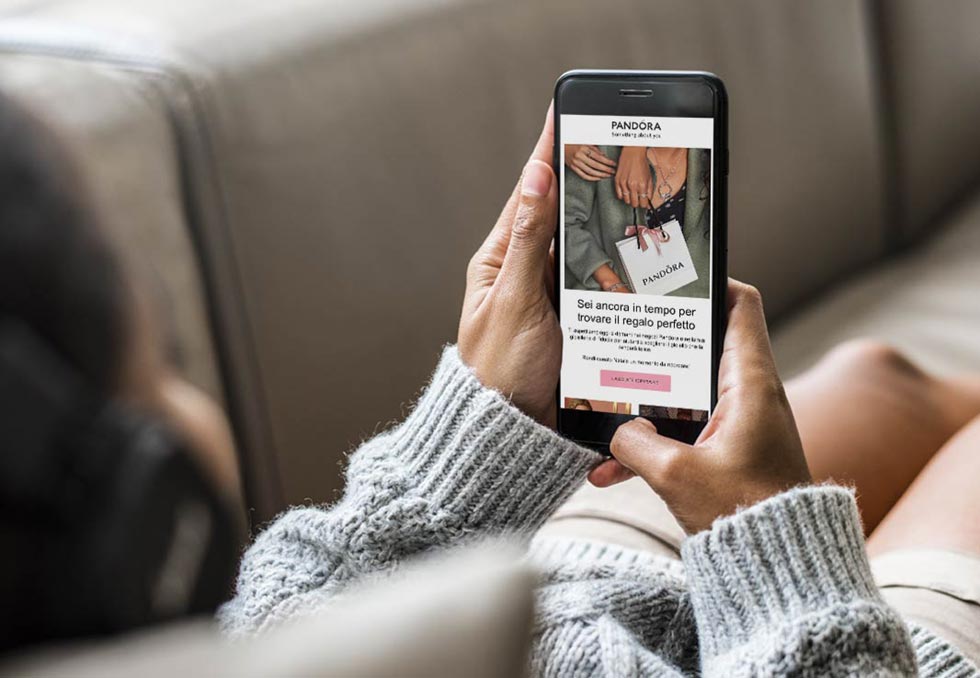
Step 8. Segmentation of contact lists.
One of the fundamental activities for a proper email marketing strategy, is the segmentation of contact lists.
If we have kept track of user behavior on our website during the year, it will be easy to figure out which of our products or services they are interested in.
Directly related to point 6. Focus on the customer, list segmentation reasons the same way.
By making diversified mailing lists, based on the interests of your customers or potential customers, you can send targeted and personalized messages to each individual person (or list, in this case).
Obviously, emails must be designed and implemented following the user’s interests, otherwise the open rate will still be low.
“Data is obviously critical all year round, but when it comes to the holiday season, focusing your efforts on key customer groups could be more fruitful and a better use of resources.”
Tink Taylor, founder and president of Dotmailer
Step 9. Watchword: Customization
“Personalization will play a key role in the success of your email campaign.”
Shanon Strahl, senior digital marketing leader at Shaw + Scott
Personalizing one’s email marketing campaigns is certainly strategic, for example, it is very effective to create personalized welcome emails for all users who decide to subscribe to our newsletters.
In fact, communicating in a personalized way allows us to make our company recognizable to users. Thus, improving our web reputation, attracting new users to our site (or to other channels, such as social), getting new newsletter subscribers, etc.
So it is important to emphasize how much our communication should reflect our Brand, our business and our values.
Most importantly, it is crucial to make users feel how important they are to us.
Therefore, an email that appears in one’s inbox beginning with “Hi Marco!” will definitely be more likely to be opened, read and considered.
Conversely, if our email marketing strategy is based on sending generic emails to an infinite database of contacts, we will have very little chance of success.

Point 10. User experience matters!
Let’s say that an ideal potential customer of ours, reading our email through a smartphone, comes across a disjointed graphic, a blurred image, or unreadable text.
User experience is critical.
This is why our email marketing strategy must be perfectly planned (see point 5. Plan ahead) and controlled. Including the responsive aspect.
In fact, it is not certain that a message perfectly designed for desktop will work the same way for mobile devices.
Therefore, before we go ahead and send our emails, it is critical to make sure that the User Experience is positive for users. Regardless of the device they will use to get in touch with us.
Dennis Dayman, chief privacy officer at ReturnPath, says that 46 percent of e-mail is currently opened on mobile devices.
From this data, it is essential to make our emails with a responsive design.
Step 11. Use the “Urgency Factor”
Currently, among the best performing content in web marketing, we find real-time updates.
It is important to remember that our customer, or potential customer, needs to understand right away what we are talking about in our email.
So the duration of an event or promotion, the news of the season, the rules of a sweepstakes (read the article Giveaway on social to learn more), etc.
Our communication must be clear, easy to understand, but most importantly, current.
In fact, for most marketing campaigns, it is strategic to leverage the “Urgency Factor.”
The user in this case has a sense of having to perform specific actions, within and no later than a specific time period.
Obviously to get something. For example, a special discount, a free gift, etc.
So why not include a timer in our email communications? Let it signal the remaining time of a promotion, or an ongoing event.
“Real-time content can allow your emails to reflect changes in the advertising space, which is a major concern for holiday shopping. We can make email a more realistic experience, instead of the momentary experience it is now.”
Ryan Phelan, vice president, Marketing Insights at Adestra
We can think about putting a countdown on our custom landing page as well.
In this way, the Urgency Factor in our email will also be called out on the reference page of our sales or promotions.

Step 12. Don’t forget social
The best way to stay in touch with our customers, or potential customers, is to be present at all stages of their Buyer’s Journey.
And what better tool than social media?
It is important to remember to include all of our social references in our email communications.
In this way, users will have the opportunity to stay connected with our Brand, even outside of the e-mail context.
Sam Hurley, founder of OPTIM-EYEZ, advises:
“Combine social media withemail marketing and you will be a winner! However, don’t hijack trending hashtags without solid pre-planning and results analysis”
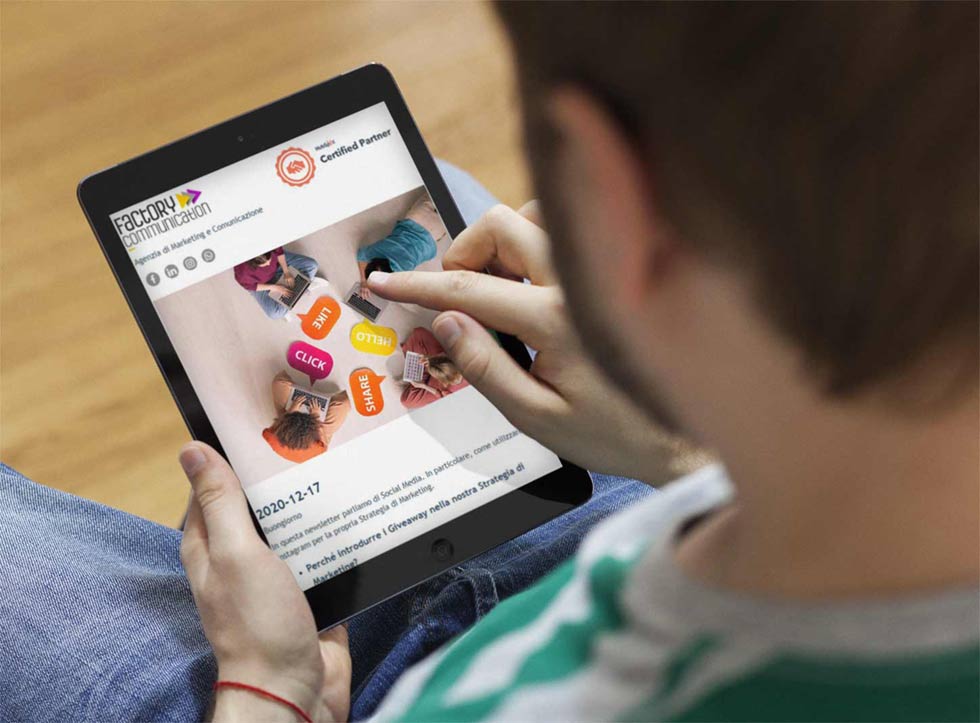
Other things you need to know to best manage your email marketing campaign
Email marketing campaigns work if the newsletter is well written but also if you have taken care of other details of the email marketing strategy.
First of all, the GDPR requires that the user receiving the email has filled out newsletter subscription forms, giving explicit consent to the processing of his or her personal data.
This is important not only from the legal point of view, but also from the strategic side.
If the user agrees to be contacted directly by mail, they probably feel that you will give them something of value, and this dramatically increases your chances of success.
The mailing list should therefore contain only users who have explicitly said yes to your marketing communications.
Again on the subject of mailing lists, I suggest that you keep it clean: no outdated addresses and delete users who request to opt out or unsubscribe (again, this is necessary both legally and strategically).
Having a clean list also allows you to better track the results of your newsletters.
Without outdated addresses and bouncing emails, you will have a clearer and more reliable picture of the marketing KPIs that matter: open rate and clicks, for example.
Marketing automation: email like a pro
It is also important to choose the right time to send the newsletter, to create a campaign to deliver the right content to each user. This can be helped by marketing automation.
There are no times or days of the week that are universally considered perfect for sending your newsletter-it depends on the target audience.
The content also depends on the target audience, but even more so on where the recipient is in the funnel: has just met you/is already a lead/is a customer to be retained, etc.
Through marketing automation you can schedule the sending of differentiated communications, at differentiated times, to different target segments that have common characteristics.
This allows you to improve the open rate and give each recipient useful and valuable content based on their needs.
One of the best marketing automation tools is the aforementioned HubSpot, a CRM known globally for its effectiveness and inbound marketing approach (if you’ve never heard of it, you can learn more about it on the dedicated page on Factory’s site).
Now it’s your turn!
These 12 tips will help you implement a successful email marketing strategy.
However, don’t forget to deliver valuable content to your audience!
It is the only way to attract new customers, increase sales and gain loyal customers for your Brand.
Through this tool you can deploy a truly effective e-mail marketing strategy to acquire new customers and retain existing ones.
Factory Communication is a HubSpot partner.
Build your e-mail marketing strategy with Factory.
Want to improve your email marketing campaign?
Learn more: