


In this article, we analyze the connection between SEO and artificial intelligence and more specifically how technical SEO factors affect artificial intelligence-based search.
The article is dedicated to all Entrepreneurs who want to understand how SEO & AI can help their companies’ business.
So let me ask you a direct question: do your potential customers find you when they search online for what you offer?
If the answer is“I don’t know” or“maybe,” then this article is for you.
You don’t have to become an SEO expert. You don’t have to understand how an algorithm works. What you do need to know, however, is that the rules of the game are changing – and fast.
Today when someone types a question into Google, increasingly they do not get a list of links.
It gets a direct response, generated by artificial intelligence. And that response cites some sites as authoritative sources.
Guess which site is never mentioned?
That which has no content, is not structured properly, is not optimized for search engines.
Think of SEO as your storefront window.
The AI is the passerby walking down the street and deciding whether or not to enter. If the storefront is empty or poorly maintained, the passerby will not stop-and will never know that inside you have exactly what they were looking for.
The good news: it’s not too late to start.
The bad: Every day without an integrated SEO + AI strategy is a day when your competitors get found instead of you.
Factory Communication has been a Semrush Partner for several years and we use this suite to perform Search Engine Optimization and AI analysis.
The article was developed from the case study published on the Semrush blog.
SEO and artificial intelligence are together redefining the way your potential customers discover your brand online.
This means that the logic of classical SEO does not disappear, but extends to a new ecosystem dominated by LLM-based response engines such as ChatGPT and Google AI Mode.
From “classical” research to AI discovery
Digital search is no longer just a Google SERP full of blue links: today, a growing share of searches come through conversational interfaces such as ChatGPT, Perplexity, and Microsoft Copilot.
In this scenario, the user does not scroll through results, but converses with an assistant who selects and synthesizes for him the content deemed most reliable.
Google remains the dominant player with over 90 percent market share in traditional search, but the growth of LLM use is creating a “second channel” of discovery that you cannot ignore as an entrepreneur.
This implies that some of the potential traffic no longer comes through organic positions alone, but through citations in artificial intelligence-based search engines.
SEO and artificial intelligence: the myth of automatic transfer
The idea is gaining momentum that technical SEO factors that help rank on Google are also automatically transferred to the citation logic of large language models (LLMs).
In other words: if a page is strong from a traditional SEO perspective, then “by definition” it will also be cited by ChatGPT or Google AI Mode.
However, the data show a more nuanced situation: some technical components transfer rather directly, others only indirectly, and still others function more as minimal prerequisites than as true ranking levers within AI responses.
For those doing business, this means that it is not enough to replicate the classic SEO checklist, but it is necessary to understand what elements really create favorable conditions for visibility in response engines.
In the last period I have read several article headlines like “SEO is dead” or something similar.
I think nothing more wrong has ever been written, for the simple reason that LLMs draw information online.
If your site or eCommerce is not content-rich it has not been developed in compliance with both technical and semantic SEO requirements, it is essentially not seen by search engines, let alone AI.
Many people say: but now Google overview already shows the answer to your question and then points to some links. That’s exactly the point, if you don’t post content online (on sites and social) you will never show up in search engine results.
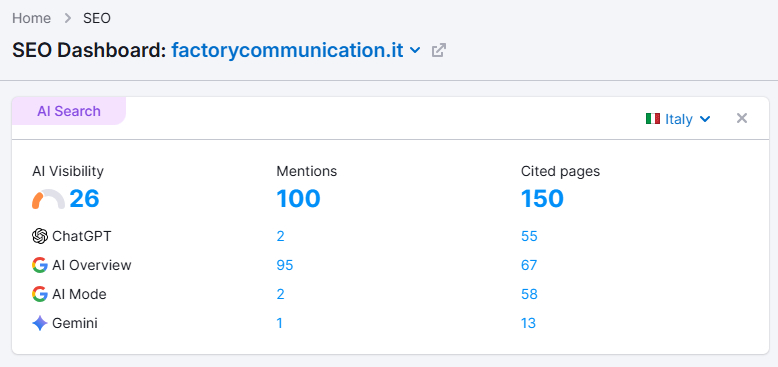
Example of AI Analysis
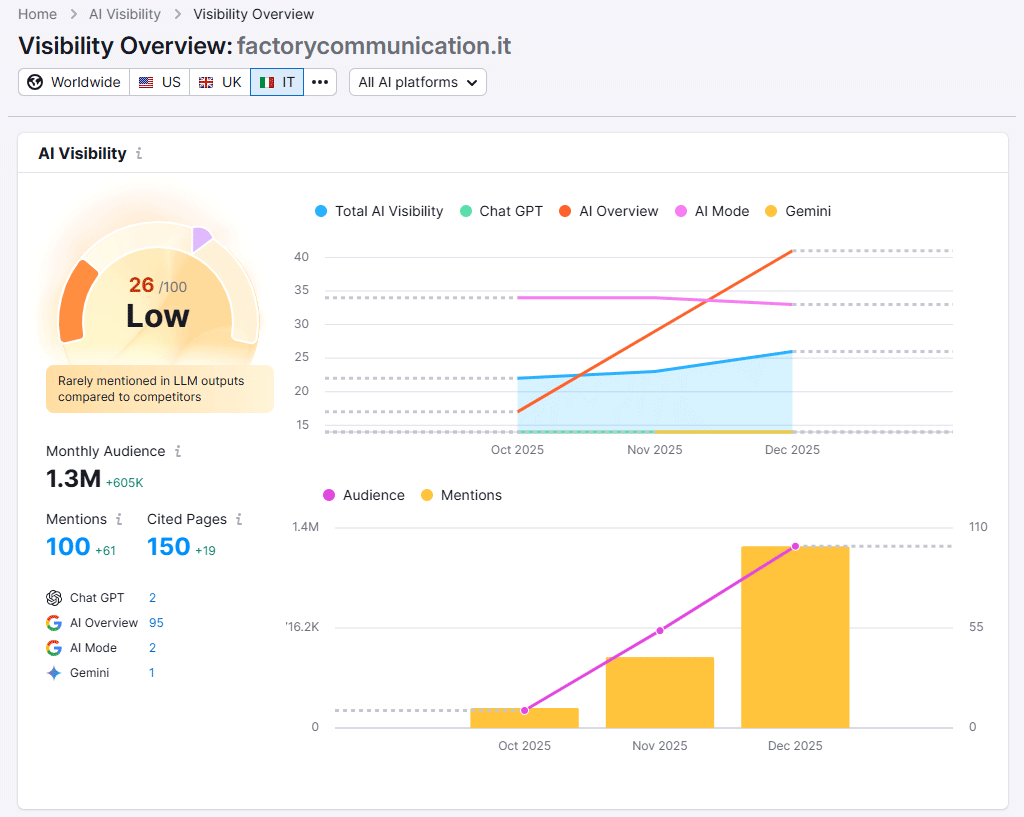
Below you can see a brief analysis of the AI positioning of Factory Communication’s site.
The analysis was conducted on 2026-01-17
Report visibility and research:
- AI Visibility: parameter defined by Semrush
- Mentions: How many times the Brand has been mentioned.
- Cited Pages: how many pages are cited
In this screenshot you will find the graph showing the growth progression of indexing generated with AI over the past 3 months.
This screen is extremely useful as it shows the best performing content.
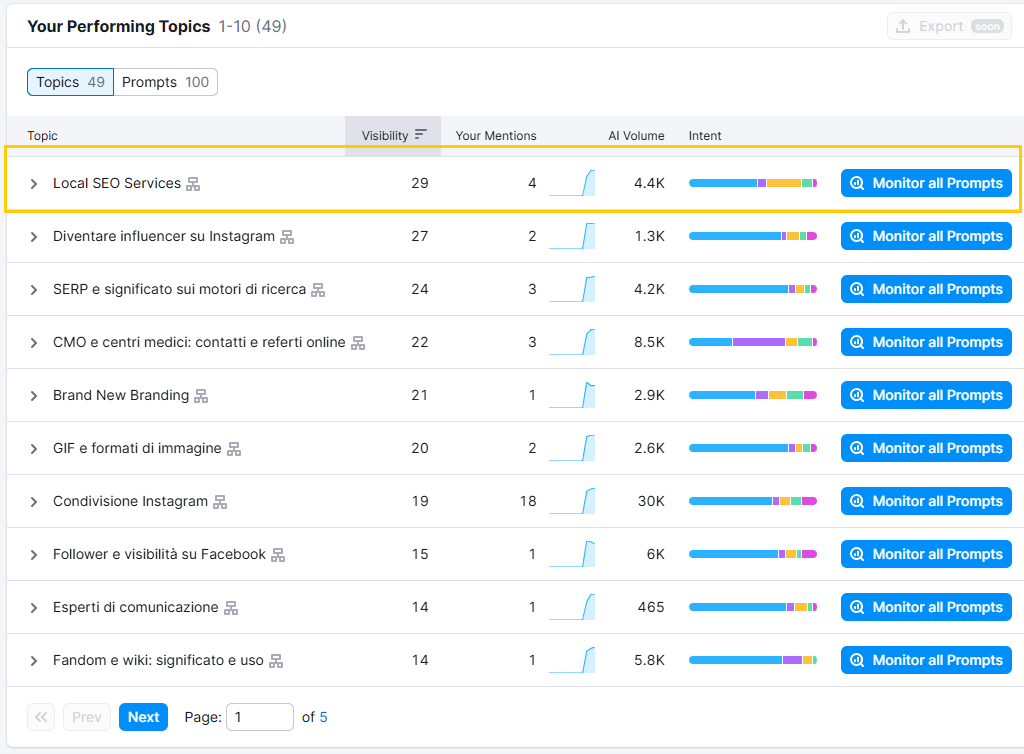
I analyzed the 4 contents related to Local SEO
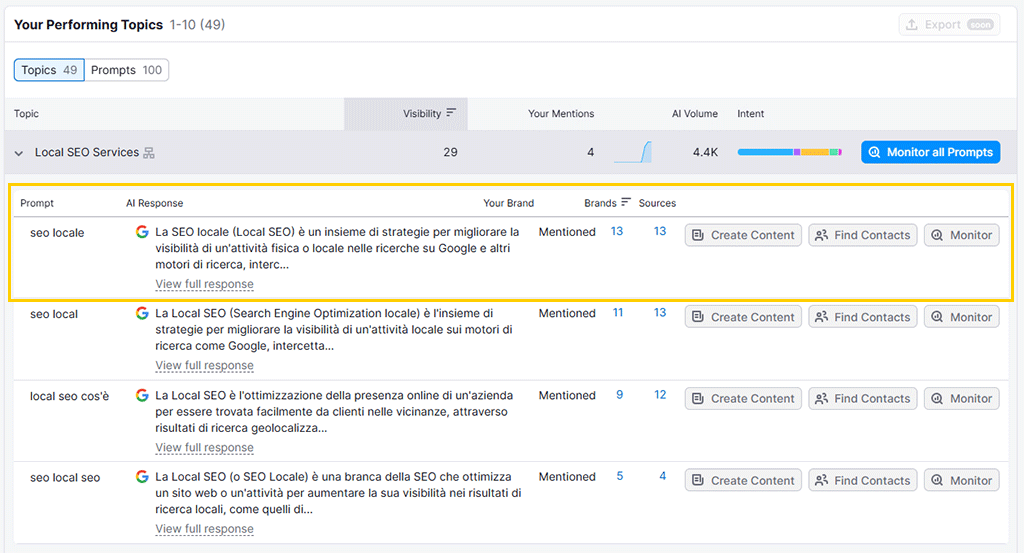
In this last image you see the analysis of the “Local SEO” prompt.
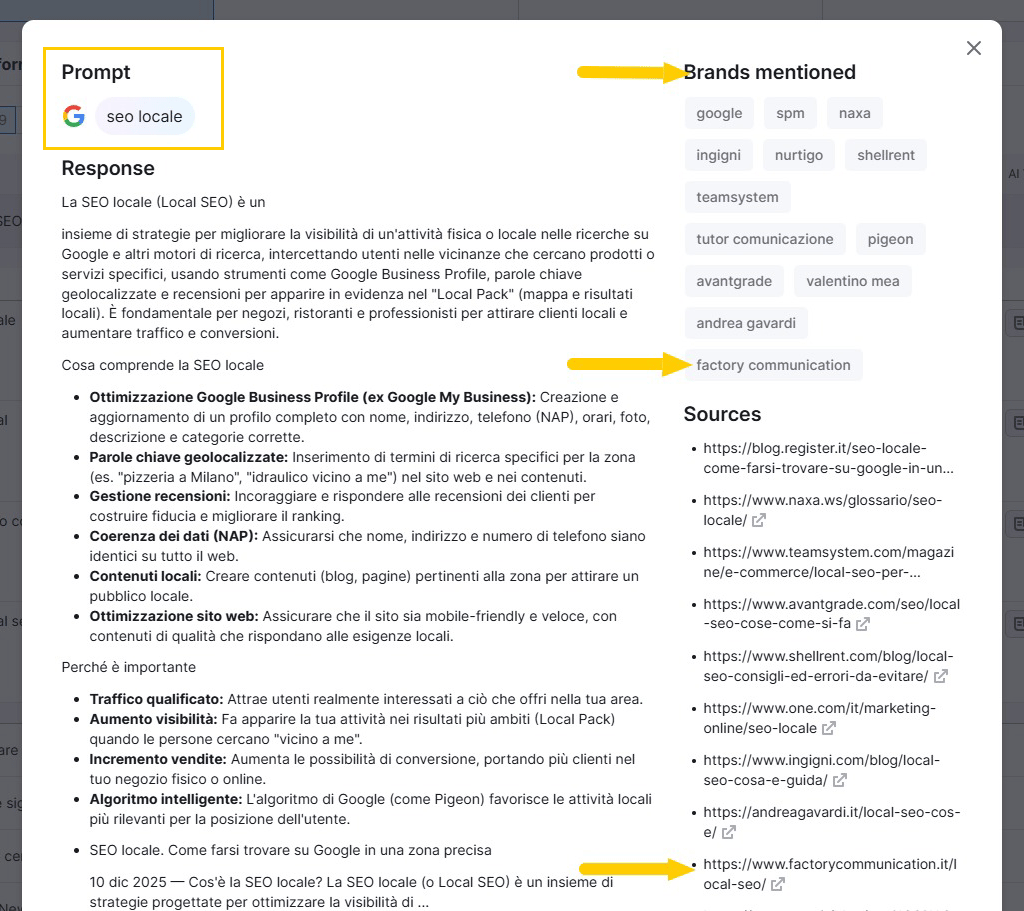
The new KPI: the visibility of AI.
To measure the effectiveness between SEO and artificial intelligence, a new indicator emerges: brand AI visibility.
This metric assesses how often and how accurately your brand is mentioned or cited as a source within the responses generated by artificial intelligence systems.
Basically, the questions an entrepreneur should start asking himself are:
- “Does my brand get mentioned when someone asks AI for solutions in my product or service category?”
- “Do artificial intelligence platforms actually cite my content as an authoritative source?”
- “Does traffic from AI citations bring longer sessions, more page views, and better conversions than traditional search?”
These questions are quickly becoming central to digital strategy as AI visibility becomes as important a performance metric as impressions, clicks, and organic rankings
How Semrush performed the analysis
They analyzed 5 million URLs cited by ChatGPT Search and Google AI Mode to identify technical SEO patterns related to AI visibility.
The study collected the following data:
- 5 million URLs cited in ChatGPT search and Google AI mode
- 378,000 URL citations analyzed by structure pattern bots
- Engagement metrics extracted from Semrush’s Traffic Analytics database
- Schema markup analysis extracted from Semrush Site Audit
With this data they analyzed:
- Ranking position: how prominently cited URLs appeared in the list of sources for an AI response (positions 1-20)
- Signs of user engagement: visit duration, bounce rate, pages per visit, and traffic conversion rates to URLs in the sample
- Schema markup: presence and types of structured data in URLs in the sample (organization, article, FAQ, etc.).
- URL structure – Slug length of URLs cited
Note: This study identifies correlations, not causation. However, consistency across 5 million URLs and multiple platforms suggests that these technical factors create favorable conditions for AI visibility.
The effect of the “educated click”
A very interesting phenomenon for those running a business is what can be called “educated clicks”-the user who comes to your site after having already been informed by AI about your brand, why it is being mentioned and the value it offers.
These users do not simply discover your site, they come to it with a clearer context and motivation.
In practice, traffic from AI citations tends to:
- Show deeper sessions, with more page views and more time spent on the site.
- Express higher conversion rates because the user has already passed part of their information path before they even click.
This type of traffic is often more qualified than a share of traditional organic traffic, and is a strategic lever for sales goals and lead generation.
SEO and artificial intelligence: the role of engagement
By analyzing the most frequently cited URLs in the top positions (1-5) within the AI responses, common patterns emerge in terms of user performance.
The most visible pages for AI tend to register.
- Higher volume of visits and unique users.
- Longer sessions and more pages per visit.
- Higher conversion rates than the site average.
Crucially, these metrics are measured after the click, whereas AI citations occur before: thus, it is unlikely that ‘ engagement is a direct input signal for ranking within artificial intelligence systems.
More realistically, high engagement reflects solid content, clear structure, and strong overall reliability, elements that help AI platforms identify pages as useful sources.
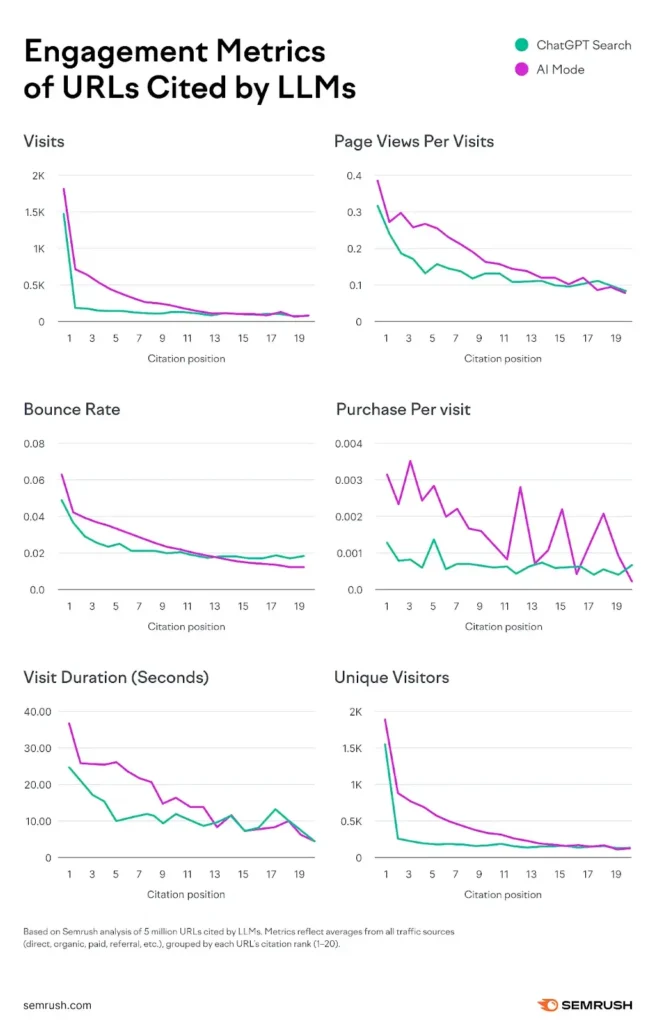
Main results:
The highest citations (in cited positions 1 to 5) are URLs with:
- Higher volume of visits and unique visitors
- Sessions of longer duration
- More pages per visit
- higher conversion rates
Comparing the two LLMs, Google AI Mode tended to cite pages with higher engagement than ChatGPT Search, particularly for page views and purchases per visit.
URL structure and AI citations
The relationship between SEO and artificial intelligence also comes through URL design.
Analysis of hundreds of thousands of cited URLs reveals that slugs with moderate length perform better in terms of citation frequency.
The data show in particular that:
- Slugs between 21 and 25 characters appear to be the most cited, with significantly higher volumes than very short or excessively long slugs.
- In general, URLs with slugs between 17 and 40 characters perform better than those under 6 characters or over 56 characters.
For an entrepreneur, the operative reading is clear: designing descriptive but concise URLs that tell the page content without overloading them with unnecessary parameters or keywords increases readability for both the user and AI systems.
Extremely short slugs (typical of homepages or macro-categories) or excessively long slugs (filled with filters, queries or nested slugs) appear less often among the cited URLs.
When I first got into SEO, one of the first things I was told was: the URL has to make it absolutely clear what you are talking about.
Structured data: when schema meets AI
Another crucial point in the connection between SEO and artificial intelligence is the adoption of structured data.
If you’ve read any of my articles, you may have noticed that when I talk about SEO, I often refer to structured data.
We should not forget that artificial intelligence basically relies on the analysis and schematization of information.
Structured data, H1, H2, H3, permalinks, breadcrumbs are all logical signals for search engines and LLMs to understand content and context.
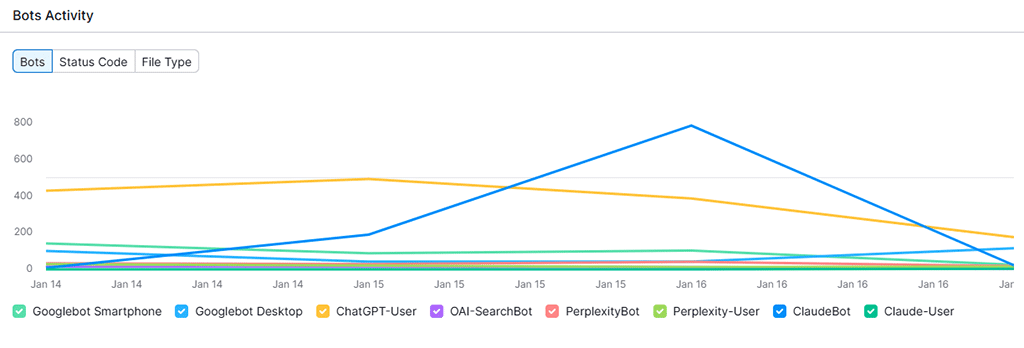
The logs of many websites show increasing activity by AI crawlers, such as OpenAI’s OAI-SearchBot, that scan pages to extract information useful for generating responses. In this context, how you present and structure the data can make a difference.
Studies show that the pages most frequently cited by AI platforms have specific types of schema markup more frequently.
- Organization, often associated with clear brand identification.
- Article, used to produce well-structured editorial content and blog posts.
- BreadcrumbList, useful for expressing navigation hierarchy and page position in the site.
Other frequent items include SiteLinks SearchBox, FAQ, LocalBusiness, Product, Review snippet and Video, with generally higher deployment rates on pages mentioned by Google AI Mode than ChatGPT Search.
This suggests that a well-designed structured data strategy helps make your natural language content more easily interpretable by AI systems, without the need to chase total coverage of every possible schema type.
If you are interested in understanding what structured data are and how many types of Markup you can use I encourage you to read this article:
Schema.org what it is and why it is critical for SEO
Social metadata and structured formats
In addition to schema.org, pages often cited in AI responses exhibit strong adoption of other structured data formats and social metadata.
In particular, high implementation rates of Open Graph, Twitter Cards and JSON-LD are noted, with slightly higher rates on Google AI Mode than on ChatGPT.
It should be remembered that Open Graph and Twitter Cards are now widespread on established websites, so part of the high rates also depends on this widespread adoption.
If you lead a business, the operative message is that you do not need to implement everything indiscriminately, but it is useful to test which combinations of formats actually improve the AI visibility of your website or eCommerce domain.
How to manage crawlers and AI scan budgets.
Increased visits by AI bots introduce new challenges related to scanning budget and server resources.
Log files and analysis tools show that bots such as OAI-SearchBot can generate significant volumes of requests, especially on sites with many pages or complex architectures.
To avoid waste and optimize discovery, it makes sense:
- Carefully monitor the log files to understand which AI crawlers visit the site, how often, and which sections they favor.
- Use robots.txt and crawl-delay directives to prioritize strategic areas of the site and reduce the load on resources that are less useful from a business perspective.
This management makes it possible to guide bots to high-value natural language content, improving the likelihood that they will be selected as authoritative sources in AI responses.
Technical tips to increase AI visibility
In the relationship between SEO and generative artificial intelligence, some technical interventions emerge as particularly useful in improving the ability of AI systems to scan, interpret and cite content.
Among the priority actions:
- Server-side rendering (SSR): JavaScript-heavy websites can create difficulties for AI crawlers; making content available server-side ensures that what the user sees is also what the bots can index and evaluate.
- Conversational formatting: creating structured content in the form of questions and answers, with clear summaries and readable sections, tend to be more easily “reusable” within model-generated responses.
- Evolved structured data: going beyond the simple FAQ schema and introducing a broader spectrum of schemas for entities, authors, products, and editorial content facilitates semantic recognition by AI.
- URL structure: keep slugs between 17 and 40 characters, descriptive and clean, avoiding unnecessary parameters and excessive nesting.
- AI scannability: make sure that AI spiders can access clean HTML content supported by a logical heading hierarchy and an easy-to-explore site structure.
These interventions should not be read as tactical tricks, but as components of a solid technical foundation on which you can build a stable presence of your website in the response engines.
A new perspective on technical SEO
The emergence of AI-based search forces a rethinking of the role of technical SEO: no longer just a list of optimizations, but a foundation for artificial intelligence systems to find, understand, and reuse your content when other signals-authority, relevance, engagement-align.
For digital visibility teams, the priority is not to chase the latest AI SEO “trick,” but to invest in a robust foundation, measure AI visibility, and experiment systematically to understand where competitive advantage is really being created.
In a landscape where AI-driven discovery is still evolving but already influencing the perception of brands, those who start now working on SEO Strategies and AI as one integrated system will be better positioned when these channels become the new search standard.
As always, if you need more information, or want to find out how Factory Communication can help your Company as well, all you have to do is request a free in-depth appointment.
SEO and artificial intelligence: also read these articles
- What are SEO, GEO, AEO? Why they are important for SMEs
- AI consulting for businesses
- Google Deep Thinking Ratio: what changes for Italian SMEs in the next 3 years
- How AI crawlers are changing the rules of the game for online sellers
- Human-First Marketing: what is your Brand’s strategy?
- Google AI Mode: make the most of it for your Business
- Artificial intelligence applied to marketing in 2026
- 4 ways to use AI in your marketing strategy
- Google VEO video generator: amaze your customers