



The SEO copywriter combines good writing with techniques useful for indexing content on search engines (SEO).
It allows to improve a website’s ranking, visibility and online notoriety.
As a result we increase opportunities for our company, to acquire new potential customers and sell our products and services.
seo copywriter what is
The SEO Copywriter is a professional digital marketing copywriter with a great understanding of search engine ranking dynamics.
It deals with the creation of content for a website or blog post with the goal of ranking it on Google for one or more keywords.
If you want to become a seo copywriter, in addition to being good at writing content, you need to acquire the right knowledge inherent in search engine optimization.
The tough job of the SEO Copywriter
To be first on Google, content must “please” both the search engine and the user.
Google’s algorithm uses more than 200 parameters to decide how to rank a page.
The user decides within seconds whether that page is valuable or not. How do I find out?
By reading, for example, Google Analytics statistics, where you can check the average time users spend on your site’s pages.
If it turns out to be 7/10 seconds the content is probably unclear and/or uninteresting.
It is important to take into account the evolution of Google’s algorithms over time.
Google is increasingly aiming to offer the best user experience.
Today it integrates artificial intelligence and semantic analysis, which enable the engine to understand the user’s search intent. Lots of stuff some would say.
Back in 1996, Bill Gates wrote an article, published on Microsoft ‘s website entitled Content is King.
This, over time, has become a real mantra for all those who, by job, are seo copywriters.
SEO copywriter job: 12 Tips by Factory!
We have prepared this guide for the seo website copywriter, with the aim of providing useful insights, ideas and techniques that can be put into practice immediately.
Whether you are a freelancer or an inexperienced copywriter, don’t worry.
With our guide you can make your content seo friendly and thus improve its search engine rankings and generate traffic to your site.
And now let’s see together what the seo copywriter does.
1. Original and valuable content
Writing original content means avoiding copy-pasting around the web. This is to provide the right experience for our users and avoid Google penalizing us for “duplicate content.”
Users are looking for valuable content, they are looking for answers. The greater our ability and desire to describe a topic in depth, the greater our user’s interest will be.
Always remember that one of the goals of the SEO consultant and copywriter is to create a valuable link between the brand and the user.
Those who visit our site should regard us as knowledgeable in our subject. We must not be afraid to “give away information and tricks of the trade.” Trivial and incomplete answers are of no value.
Texts should be written with the user in mind, not the search engine.
2. Long-form content
Lately there has been a lot of talk about long form, that is, a text-rich article structured in several paragraphs, so much so that it is considered a mini-guide.
This article is an example of a long form, in fact it has over 3,000 words.
Advantages in making long form articles:
- A complete guide is available to the user without having to go from page to page with “forward” “back” buttons.
- Due to the “amount of content” it is possible to include multiple keywords, both main and related. This allows you to build web pages that rank for multiple keywords on search engines.
- The division into paragraphs allows the user to provide targeted answers to specific needs. Overall, they allow for in-depth and comprehensive development of the main topic.
3. Use h1, h2 and h3 tags.
Tags, on the web, are codes that identify the value of a “thing”. For example what are called H1, H2, H3 etc. tags communicate to Google, the importance of a content.
This important aspect for SEO optimization.
Think of a newspaper article, the main headline is written large. Then generally there is a subtitle and often times, we also find an introduction paragraph.
On the Web, the same logic operates. In fact, the web designer, that is, the person who is in charge of creating the layout of a website, creates the different TAGs so that, the one who is in charge of content insertion, has the various pre-set styles available.
Somewhat like what happens in Word, where you can choose which style to use.
In this image we have shown the TAGs h1, h2 and h3 of this article.
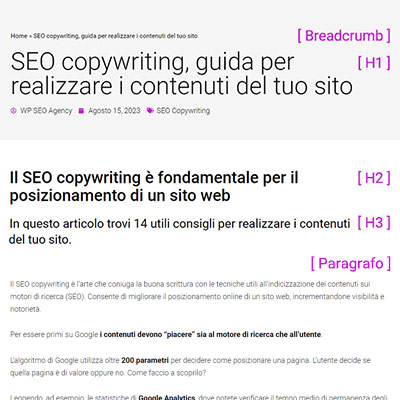
The element that we must always keep in mind is that if we use an H1 title, not only is it great, but we are communicating to Google that that is an important element of our page.
Some technical tips:
The Page Title (H1 Tag):
- It should be no longer than 55/60 keystrokes.
- Must contain the keyword
- We do not recommend continuously repeating the name of the company
The subtitle (Tag H2):
- Must not exceed 80 characters in length
- Must contain the keyword
Last aspect. Tags h1, h2, h3 are useful to divide the article into paragraphs making the article easy for the user to read, especially when it is very long.
4. Don’t abuse keywords
Before including keywords in our article, it is essential to define which ones to use, in what logic and scale of importance.
To explore this topic in detail, we recommend reading this article: Keyword Research, where we explain in detail what it is and how to build a keyword tree.
If you are looking for the right keywords we recommend Google’s free keyword planner tool.
Once you have defined which keywords to include in the article, it is essential to take these elements into consideration:
- The main keyword, should be placed at the beginning of some paragraphs (not necessarily in all of them) and at the end of the article.
- When writing your content, depending on your topic, it is also important to include some secondary keywords.
For example, if your keyword is “sterile cat kibble,” you can also use related keywords such as “sterile cat food,” “sterile cat nutrition,” etc. - Do not abuse keywords. If you exceed in quantity (keyword stuffing), you risk making the content unpalatable to users.
Also, if you use the same keywords repeated over and over again, search engines may not like the article or, even, you risk being penalized by search engines for keyword abuse, a technique called keyword stuffing. - It is good to use a broad vocabulary relevant to the topic. Users and search engines want to read authoritative, comprehensive and useful articles.
It is important to take into account Google’s ability to determine the true value of a piece of content, not only by considering keywords but also by examining its semantics.
This parameter is called Latent Semantic Indexing. - If your content is pleasing, interesting, relevant and useful you will have a greater chance that the same will be shared by users on the web and social channels. This is the big goal.
- If you still have little experience in creating seo-oriented content, we recommend using suites such as Semrush, which guide you step by step through the writing process.
5. Use bold, italics, underlined
As is the case every day when we write content, reports, articles, and reports, the use of bold (bold) or italics and underlined characters helps the text read.
Important words or phrases are highlighted (bold or underlined) and communicated quotes or phrases from third persons (italics).
Bold text is interpreted by Google as important, so in theory it should contain the keyword.
As mentioned above, we should not abuse this technique, so our advice is to highlight text that you think is important to users and, if it does not cause a problem, occasionally include a keyword.
6. Use meta descriptions well
Meta descriptions are the information that the user sees by performing a search in Google.
As you can see in this image, Factory Communication is in first place, regarding the keyword “keyword tree.”
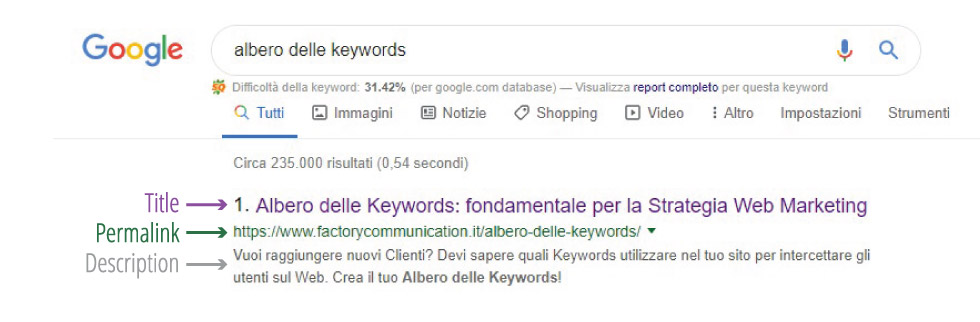
Meta descriptions consist of 2 values:
Again, it is essential to insert the keyword without abusing it. As much as possible you should insert it at the beginning of the sentence.
The
The main objective of the title and description is to clearly communicate to the user what that content is about.
Warning: if the title and description are not clear, the user will not open your content, making all your work in vain.
N.B. If you use WordPress, you can install the Yoast SEO Plugin. We recommend the paid version that offers so many features.
Especially if you are gaining experience in content creation in SEO mode, it can be a great support.
7. Short and clear Permalinks
The permalink consists of a first fixed part, related to the site domain, and a subsequent variable part.
The permalink of a page, represents the name used to save the page. Imagine that each article on your blog is the equivalent of a Word file.
Again, a keyword can be included in the permalink.
This technique in the jargon is referred to as keyword reach. Depending on the strategy we are adopting in the permalink we can include the main keyword, or a secondary one.
The advice is to make permalinks short and “talking” i.e., clear, both for the search engine and for users to understand which section of the site they are in.
8. Numbered and bulleted lists
If you are producing an extremely complex and information-rich article, our advice is to use both numbered and bulleted lists.
With bulleted lists you can add more value to the information you are presenting in your article.
It is definitely of greater effect “12 Tips for SEO Copywriting” than “Tips for SEO Copywriting.”
The number expresses and enhances the amount of information, help, advice you are giving the user.
Bulleted lists, on the other hand, allow us to list clearly and directly, multiple pieces of information, make the page more discursive.
If I want to read the features of my new car, I’d rather see a nice bulleted list than “look for information between the lines.”
9. SEO is also a must for images
Every item we upload to the web, can be indexed. Images are extremely important media.
Unlike social networks such as Instagram and Facebook, on websites each image is saved in a special space and must be completed with lots of additional information.
This topic is so articulated and complex that we decided to dedicate an article to it: SEO images: our 8-point checklist
10. Internal links
Internal links are useful for improving user experience and indexing.
There are several internal links (the words highlighted in purple) in this article. It is important to remember that link and landing page must be “consistent” that is, they must talk about the same topic.
N.B. We do not recommend the use of such forms:
If you would like to learn more about internal link building go to this link (for Google go to this link is meaningless).
Internal link building is useful for:
- The user who can navigate more easily and intuitively on the site, searching for information of interest to him or her.
- Google, which indexes all pages of the site more quickly and correctly.
11. Content ratio – html code
Everything is SEO even the “weight” in bytes of a page, consisting of both the content you have written and the related HTML code.
If you want to give it a try, right-click on this article and select the “View Page Source” option.
You will notice the amount of code in it. Content should have the highest ratio of text to code, where the text should be the dominant element.
Technically it is defined as signal-to-noise ratio (signal-to-noise).
The more text compared to the HTML page, the better the search engines will approach it.
12. Categories and Tags.
In a website, especially one made with a content editor such as WordPress, it is possible to specify for each article, two values: categories and tags.
In some respects these may seem like two similar functions, but they are not.
If you are making a complex website or blog, these two functions are extremely important.
Categories are used to separate and group articles into different sections.
TAGs, on the other hand, are defined as cross, that is, across articles. For example, an article that talks about the new features of Facebook Pages may have the TAGs: Social Media, Facebook Page, Marketing.
That is, topics that belong to 3 different sections of our site.
Both TAGs and categories are indexed by Google because they become recognizable static elements with a permalink.
As with articles, tags and categories must also be completed with:
- Title and description
- Image
- Title and description tags
Request an SEO consultation for your Copywriting Strategy. Thanks to the content created by our Copy, your company will increase visibility on the SERP and allow you to acquire new contacts and Clients.
SEO copywriter: summary
If you arrived at this article you probably typed one of these keywords into Google:
- editorial plan
- sites for copywriters
- copywriter seo milan
- seo copywriter milan
and in the search results you found our article.
Several years ago,lawyer Giuseppe De Lalla (link to review on the agency’s website) of Milan entrusted Factory Communication with the creation of his website and related seo strategy. I still remember it as if it were today.
I explained to the Advocate what benefits he could gain if he implemented an editorial calendar and consistently published content of value to his users.
Well, today his site receives tens of thousands of visits per month, his social channels have high engagement, and much of the work comes right from the web. Here, this is a practical example of a seo copywriter.
Are you interested in learning more about the topic related to SEO Strategies?
Read these articles: