



In this article we look at what a content marketing strategy is and how we can maximize its use in web and social communication to improve the marketing strategy and achieve the business goals we set.
The content mainly used on the web are: video, images, text, audio.
If you want to make the most of your work, remember that content can also be written according to the SEO rules and techniques. This will allow you to improve your site’s search engine rankings, increase business opportunities and your Brand Awareness.
In January 1996, Bill Gates wrote an article entitled Content is King, published on Microsoft’s website.
This, over time, has become a real mantra for everyone involved in content marketing.
“Content is where I expect much of the real money will be made on the Internet, just as it was in broadcasting […]”
If you have no way to read the whole article, no problem, I will give you a brief summary of the central points:
- Internet will allow everyone to publish informational and entertainment content at a low cost;
- all of which will lead to income derived from online advertising.
It was 1996, let’s not forget, and Gates certainly saw this coming.
“One of the most exciting things about the Internet is that anyone with a PC and a modem can publish whatever content they can create.”
So we can say that content marketing strategies consist of creating and publishing useful and valuable content on the Web for your customers and potential customers (buyer Personas)!

And now let’s look at our 7-point checklist.
Step 1. Content Marketing Strategy Gives Your Business Wings.
A leap in time.
How the Internet has changed marketing.
With the advent of the Internet and the Web in general, everything has changed.
Before the advent of the Internet, communication was done in a mode called push, that is, from companies to possible consumers. In marketing jargon, this strategy is referred to as outbound marketing.
That is, based on a message directed solely toward the customer. There are very few interactions and points of contact between the two actors.
The web has finally made people the protagonists using the web as an inexhaustible source of information, contacts, analysis, comparisons, reviews.
We have thus moved on to what is called “conversational marketing,” one of the aspects of content marketing strategy.
Traditional Marketing talks to people. Content strategy speaks to them.
Doug Kessler, Creative Director and Co-Founder of Velocity Partners.
Content marketing strategies are the evolution of inbound marketing, a strategy diametrically opposed to outbound marketing.
Basically, the company prepares various marketing activities, including content, to be found by new customers
Thus, the content marketing strategy has the ultimate goal of attracting potential customers through the creation and dissemination of quality and relevant free content that is informative and/or illustrative in nature.
The company thus has the opportunity to increase the user’s consideration of the company in providing the right product or service.
This results in an increase in web reputation (web reputation), visibility and people’s attachment to the Brand.
Step 2. The Values of content marketing strategy
Before explaining how to plan content through the editorial calendar and what benefits we can achieve, it is important for us to express its values.
As we report on the Spiritual Business page, for our agency, every marketing activity must be based on the fundamentals of ethical business.
To create the right credibility and user respect, a piece of content must be: Consistent, Original, Valuable, Different.
Consistent content strategy
A piece of content must be consistent with the pages of the site that host it.
This statement has a double meaning.
The technical one, that is, in order to increase the visibility of a website through content marketing strategies, it is essential that all content be written according to the mission of the website.
The ethical one. Often we read articles published on some sites, which are drafted to intercept the sentiment of people at that moment, but which have no correlation with the mission of the site.
This content is drafted only to intercept audiences and visits. Why?
Generally because they integrate banner ads, and it is the system the author has to monetize his work.
Aside from the technical and ethical aspects, the content is written to attract one’s potential customer, what we have defined as Buyer Persona.
Therefore, it is critical that we produce and publish valuable content that responds to his Web searches, i.e., his needs.
Item 3. Original content marketing strategy
Copy and paste, are the order of the day. On the Web, this aspect is taken to the nth degree.
The frenzy to publish so much content, can lead to taking the quickest route.
That is, I copy a little bit here and a little bit there, and the content is ready.
But this practice first leads to a penalty from Google, for “duplicate content.”
Moreover, we are not creating anything original for our user.
This can be verified, for example on Google News, when there is extremely important and high-impact news.
You read five articles and it is as if you had read only one. Where is the originality? Therefore, it is essential to make original content.
Item 4. Valuable and different content
This is perhaps the most important point.
Creating valuable content for the user who lands on our site means creating content that meets his or her needs, and solves one or more of his or her problems.
For example. You have a store that sells pet products and you want to create your blog by making content for users.
The ideas for creating them are truly many. It is sufficient to ask oneself:
- How can I make a difference?
- What are the questions the customer asks me every time they come to the store?
- How can I help him?
Of course making valuable and original content is really difficult.
It is a great effort, but that is what makes the difference.
Many times it means sharing your know-how and experience for free.
Meeting with some of my colleagues, I have been told so many times:
“but you’re a fool to publish all that content. To explain how to do a Facebook campaign, or how to use Google My Business. They won’t come to you anymore. They’ll do it all on their own.”
It would be like saying that it is enough to read a recipe to become Bastianich. I don’t think so.
Creating original, valuable and consistent content, on the other hand, generates the opposite effect.
It allows us to gain the trust of our potential audience, our target audience. We are not there to sell. We are there to explain.
Different content marketing strategies
The watchword is “different.”
It is important that the content be “beautiful,” but it is certainly more strategic that it be interesting and different.
Another important element we must take into consideration when producing content is that it is never “static.”
That is, the same content can live a thousand different forms depending on the context and the channel we use. For example, from a 10-minute video interview, we can make shorter ones. The same video interview can be transcribed into an article.
We addressed this topic in the last item of our checklist.
Step 5. The endless roads of content marketing strategy
Endless ways to make ourselves known and intercepted by our target audience.
Content takes different names depending on the type of content produced, and the communication channel used.
For this reason, if we decide to use different forms of communication, it is essential to prepare an editorial plan to define the type and format of content and where it will be published.
We report on the most popular forms of content marketing:
- Content writing: text content created according to seo techniques and placed on your website. In this case, the dominant element is text. The images are complementary.
- Article Marketing: Articles made to be placed on host sites. This activity has a dual purpose. Create visibility and business to the brand. Improve the ranking of its site through link building strategy, as the published article contains a link back to your site.
- Visual Marketing: Publishing images and videos. In this case, the media are the real protagonists. Examples are video tutorials on social networks, video guides, or info graphics.
- Storytelling: Storytelling has entered more and more into everyday jargon every day. It means telling stories that can excite and engage the user
- Viral Marketing: creation of viral content designed to engage and prompt users to share it via their social channels.
Step 6. How to multiply a content
If you plan a careful content marketing strategy there is the possibility of multiplying a piece of content by making it usable in different modes.
The starting point is the video.

The image we have given you, represents a frame of a video in the Full HD standard, that is, 1,920 x 1,080 pixels, 16/9 format.
A video made in this format can be posted on basically all social networks(YouTube, Facebook, Linkedin, Google My Business, Instagram) and on the website.
In contrast, the yellow box indicates the typical square format of Instagram.
If we keep these two different formats 16/9 (horizontal) and square in mind when planning the video and making the footage, it is possible to derive video sequences in the different formats without re-shooting.
Why use videos as a starting point for content creation and content marketing strategy?
On Social, videos are the communication media that generate the most Engagement (interactions) with users.
They have far surpassed photographs. Apart from this aspect, it is important to point out that if we plan upstream the structure of the video we can then generate additional media.
For example, starting from a 5/7 minute video interview, we can derive two additional 60/120 second mini-interviews + short quotes on video.
But this is not the end of the story, as the video interviews can be transcribed and thus result, by the same logic, in 1 well-structured article + a couple of targeted articles + some quotes.
In addition, during filming it is customary to take some photographs, which can be used, along with quotes, in the making of Posts.
If desired, the audio tracks alone can then be extracted from the videos for making podcasts.
This simple example provides insight into how the cost of making the video footage and related editing can be amortized through the production of additional content.
Now imagine making 10 video clips. If they are video interviews, generally filming never takes more than a couple of hours per interview.
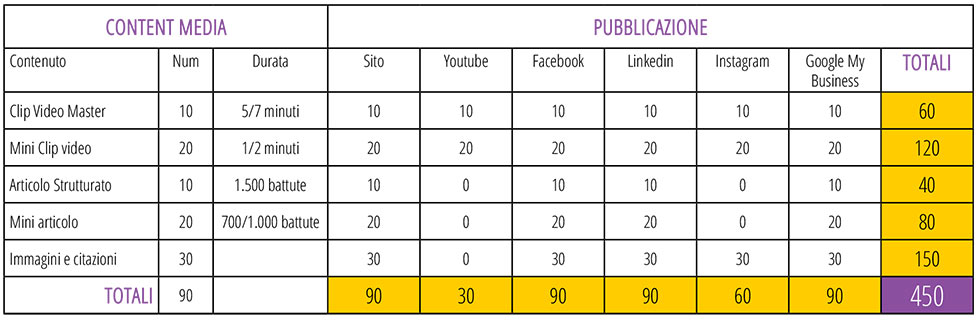
As you can see from the table, by making 10 video interviews lasting 5 to 7 minutes you can then create:
- 20 1/2 minute mini video clips
- 10 Structured articles of 1,500 characters in length
- 20 mini articles of 700/1,000 characters in length
- 30 images and quotes for social
The table also shows the different publications of individual content on the site and the different Social Channels.
Thanks to this simple solution we can publish:
- 90 contents on the site
- 30 videos on YouTube
- 90 posts on Facebook
- 90 posts on Linkedin
- 60 posts on Instagram
- 90 posts on Google My Business
For a total of 450 publications.
We can consider it a true multiplication of content. Clearly each Social will use Hashtags and shares typical of that channel.
Step 7. Context marketing or content marketing strategy: what is more important?
Context marketing: what is it?
Content marketing means, literally, content marketing. Context marketing, on the other hand, is nothing but context marketing.
But what is the exact definition of context?
According to the dictionary of the Italian language, it refers to:
“to the linguistic elements of a text, their whole and the relationships that bind them to each other so that they are only fully meaningful when taken as a whole.”
In short, context is “that thing” that allows us to understand the meaning of a speech or sentence.
Precisely because of the widespread editorial power we mentioned just above, the volume of content on the Web appears to be growing exponentially, which is why concern has arisen that, over time, we may experience a kind of loss of value of the same.
The path most of us take before drafting content is centered on the three Rs:
- Right person, reaching out to the right people;
- right message, offer the correct message;
- Right time, that is, taking advantage of the right time.
Here is the right formula of content marketing. But are we sure that this is really the case?
In fact, there is a fourth R: right context.
Context marketing is aboutadding a why, a who, a what and a when to all the content we direct to our users.
An example in this sense can be what we do when we deal with Local SEO, which is to provide perfect geo-localization to everything we produce for our digital channels. Adequate context, indeed.
The value of context for SEO
The future of SEO is closely related to the change of approach in the search process.
Google is constantly evolving, and its transforming algorithm allows it to return high-quality, relevant results in response to users’ searches.
To achieve this, its algorithm takes into account multiple pieces of information such as location and personal search history.
If you are in Milan and looking for a place to have lunch near the Central Station, you should Google “restaurant Milan near Central Station.”
Actually, if you are in Central Station and just type in “restaurant,” Google will return My Business tabs of the various places to spend your lunch break.
This is because your location affects the search result.
This development thus leads to several improvements:
- less work for the user as they can afford to formulate less specific queries;
- the result will be personalized and more valuable;
- interaction between user and search engine approaches that of a dialogue.
SEO is changing and evolving.
The positioning of a brand on the web is no longer only related to keywords (fundamental, let’s be clear), but also and above all to the context of use.
We are moving to a world where the user will be at the center, so you need to focus your efforts in contextual positioning.
Conclusions
The key to context marketing is to create content to achieve an added dimension, so the challenge with content marketing strategies does not really exist.
Contextual marketing simply serves as a guide for producing effective content relevant to user searches.
If readers find your content useful and understand what you are about, automatically Google will reward you. That’s why you should always use context marketing when you decide to create articles, videos and images for your channels.
Want to learn more about how marketing is evolving? Don’t miss these articles:
- Article marketing increases website visibility
- SEO copywriter: 14 useful tips for crafting your site content
- Google Duplex and artificial intelligence
- We cannot sell everything to everyone, we have to decide what to sell and to whom
- Five marketing trends to watch out for in 2019
- Creating a company page on LinkedIn for your Business
- 7 good reasons to use Linkedin in your social media strategy