




Positive reviews examples: in this article we analyze why they are important and how to get them from our customers.
Let’s start by saying that: a positive review demonstrates the quality of your products and services
Clearly, I will say it now, the key element is that customers are satisfied with our products, services, technical support, etc.
Today, reviews play a crucial role in our business.
Whereas in the past it was the company that had the reins of the conversation, today the decision-making power is completely in the hands of the customer.
Thanks to the tools at our disposal, often completely free of charge, we have the ability to search for the company that most inspires us with confidence. We can compare prices, offers, product range, etc.
In short, as users, we have at our disposal an endless catalog of probable answers to our needs.
But the Word Of Mouth (WOM), or Word Of Mouth, despite being the oldest method in the world, still stands out among the best performing marketing techniques.
That is why it is imperative to inspire trust and customer loyalty. In addition to giving us positive reviews on the web, they will become true Ambassadors of our Brand.
But how can we make ourselves chosen? How can we stand out from the competition?
The answer, is in the philosophy ofInbound Marketing.
Importance of reviews
As Inbound Marketing teaches us, to increase our business, what we need is to build strong and lasting relationships with our customers.
In fact, finding a new customer, costs 5 times more than retaining an existing customer. Because they already know our Brand, our products, our people… so minimum effort, maximum return!
Let’s look together at the differences between acquiring a new customer, and a repeat customer:
Regular customer
He already knows us, trusts us, so activities are definitely reduced.
We report the main ones:
- Strategies and activities to check the status of satisfaction and prompt action to resolve any problems
- If we adopt the philosophy of Inbound Marketing, we make it the real star, and periodically take care to provide useful information and tips to make the best use of our products and services
He knows us, he trusts us:
- He is satisfied with our services, and when he has the opportunity, he decides to purchase new products, upgrades, etc.
- Talk well about us to their friends and contacts, generating effective and profitable word-of-mouth advertising
- Interacts with our web and social channels
- Is predisposed to publish reviews on our channels
Basically, it is our best ally.
New Client
To acquire a new customer, we need to set up a series of activities.
We report the main ones:
- Implementation of the Strategy
- Advertising to make ourselves known
- Preparation of informational materials, print, web and social
- Implementation of pre- and post-sales business activities
Not only that, we also need to overcome his fears:
- Is prone to mistrust
- He will ask a thousand questions, and compare our services and products with those of competitors
- He will inquire and read reviews before choosing us
- It will be disinclined to interact with our channels
- Leave reviews only if they are negative
- Despite our efforts, only a portion of potential Customers will become Customers
Basically: We are a possible choice among many, why should he choose us?
Positive reviews examples: you must offer valuable content
But what does it mean?
We should not be afraid to share our know-how. Our skills, our working method, our values–these are distinctive features of our business.
If we offer solutions to our customers’ problems, or potential customers, in their time of need they will know where to find the answers they seek. From us! And we will have bypassed the competition, simply by proving that we are competent in our work.
At Factory Communication, we base the development of our strategies on Inbound Marketing.
Inbound Marketing puts people at the center of business strategies, with a vision in the medium to long term.
While on the one hand many companies adopt the “sell now” philosophy at any cost, Inbound Marketing aims to create lasting and valuable relationships with customers, and potential customers.
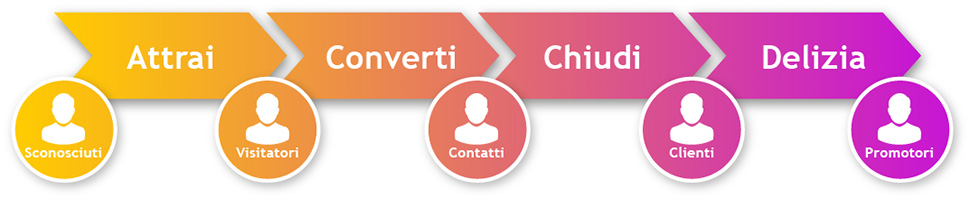
This philosophy is based on four basic steps: Attract, Convert, Close and Delight.
How positive reviews affect the buying process
Recently, research conducted by Hubspot Research, revealed that customers trust companies less and less.
Today, users prefer to rely on reviews because they reflect the views of ordinary people who are similar to them.
In fact, several studies have shown that 60 percent of consumers rely on reviews before deciding whether or not to purchase a product or service.
This explains the phenomenon ofInfluencer Marketing, which is increasingly widespread and, perhaps, almost out of control.
Classic testimonials, very much in vogue until a few years ago, are no longer so successful. Because, if before the user reacted with “WOW! If he uses it too, I want it too!”, today the common thought is:
“No wonder he advertises this Brand, who knows how much money he gets!”
Therefore, reviews by “ordinary” people, very similar to us, with the same interests and needs, generate more trust. And they convince us to purchase the product they are talking about.
By the same principle that the Testimonials of the past have little credibility because they are paid, the big Influencers are also losing credibility.
Knowing that Chiara Ferragni is paid 52,000 euros for an Instagram post does not make the post itself credible.
In fact, micro influencers, those who have 10,000 to 25,000 followers, and who write in-depth, unbiased articles, posts, and reviews, are gaining momentum.
But how do we get positive reviews from our customers?
Let’s see it together.
Strategies for getting positive reviews examples
To incentivize our customer to leave a review about us, it is important to study an ad hoc strategy. So setting a certain tone of voice, with a very specific focus on his interests and needs… And for our strategy, it definitely helps us to use a performing CRM.
At Factory Communication, we use the services offered by Hubspot.
First, we need to make sure that we make our request to the customer at the right time. Then it is necessary to study its position in the so-called “Buyer’s Journey”(Customer Journey).
To achieve satisfactory results, we need to make sure that we request our review at the most appropriate time. Otherwise, we may get the exact opposite of what we desire.
Think, for example, if we were asked for a review on a lawn mower when we have not yet received the product at home. The risk would be a negative review, precisely because of the long delivery time, bad Customer Service, and you name it.
Disaster!
Just to avoid these snags, and help you get positive reviews, below are some useful tips to help you achieve your goal.
How to get positive reviews examples
It is not on the list because it is something we have already discussed and take for granted.
The Customer must be satisfied with our products and services, and with the support they, over time, have received from our Company.
We report below, in 10 points, the activities we can implement to get positive reviews from our customers:
- We identify the right time, based on the Customer Journey
- We choose a development method
- We ask the client in person
- We take advantage of the customer’s “moments of happiness”
- Let’s make the process as simple as possible
- Let them know how much (little) time they will have to devote to it
- We use all the tools at our disposal
- We respond to all reviews, even the negative ones
- We share the positive experiences of our customers
- We first leave a positive review for our customers
1. We identify the right time, based on the Customer Journey.
There are some strategic moments in particular that are suitable for requesting a review on our products and services.
When the Client:
- Buys a product/service again, previously chosen
- “tag” our Company in a post on their social profiles, where they show one of our products, highlighting their purchase
- spends time on our website while exploring products or services in particular
Of course, these are just a few examples. But let’s try to keep the customer’s satisfaction in mind. In fact, just when he shows his satisfaction with our Brand, lo and behold, that will be the moment for us to get a positive review.
For example, last month I placed an online order at shopdisney.co.uk.
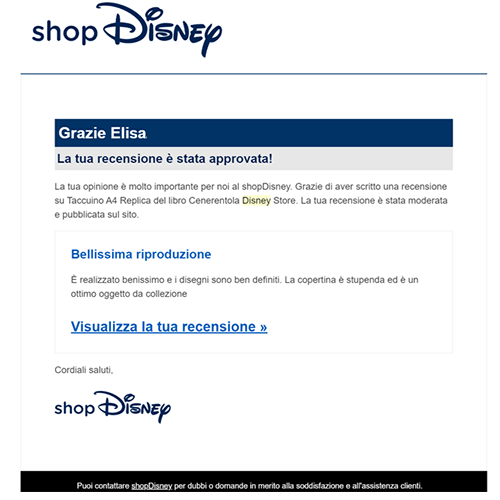
About a month after the purchase, Disney asked me for a review on the purchased product.
In this way, I was left with time to take advantage of what I purchased, enjoy it, and thank the Company.
Moreover, by notifying me that my review had been published on the Brand’s official website, it gave me importance.
So a very good Customer Experience!
Word of mouth: let’s make our customers and potential customers protagonists.
Of course, the same strategy can also be implemented with regard to services.
Think, for example, of a language learning application.
A strategic time to request a review might be, for example, when the user finishes a lesson. Or when they successfully pass a final test.
As we can see, strategic moments are very important, whether our business is about selling products or services.
2. We choose a development method
According to a recent study, 50 or more reviews of one of our products or services can lead to a 4.6 percent increase in conversion rate.
This fact is easily guessed from what we introduced at the beginning of our article. In fact, more reviews mean more evidence of the quality of our Brand. Therefore, more people trusting us.
Always remember, however, that recent reviews generate more engagement than dated ones.
Consequently, we need to study a method of developing our reviews. Here are some useful tips:
- We train our team to ask for reviews for each product or service offered.
- We incorporate the request for reviews into our Marketing Automation strategy
- We use a good CRM to identify our most satisfied customers (e.g., Hubspot), and encourage our team to improve the relationship with them
3. We ask the customer in person
If we have the opportunity to be in close contact with our customers, have coffee with them, or even go out to dinner with them, why not take advantage of it?
Obviously, communication is important here as well, so we do not recommend “getting off to a flying start.”
Let’s show interest in their opinions, in the result they got from our products or services. Let’s think about it. By asking a simple question, such as, “How did you like my lawn mower?”
From the answer to this question, we already have an advantage, because we will know whether his impression is positive, or negative. And of course, in the case of the first option, it will be much easier, and advantageous, to ask the customer for a review.
If our customer is satisfied with the purchase, let’s not miss the opportunity! Let’s make him participate, let’s inform him that his opinion is important to us.
Most of our customers will be happy to leave us a review, just offer them the opportunity to do so.
4. We consider the customer’s “moments of happiness”
When a customer is satisfied with the product he or she received, or the service we offered him or her, there, we can call that a “moment of happiness.”
And it is these moments that make all the difference. Because it is the moments of happiness that will most spur the customer to give us a positive review.
To take advantage of these moments, we can educate our Customer Service team. In this way, we could take advantage of the customer’s happy situation in the immediate. That’s right, when they prove to be satisfied with our Brand.
5. We make the process of getting customer feedback as easy as possible
If we do not give our customer an easy way to understand how to leave a review, this experience will become extremely negative for him. As a result, even if he is satisfied with our Company, he will not write his review.
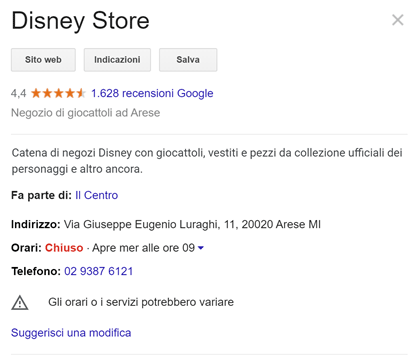
An example of an intuitive way to release reviews is found with Google My Business.
As we can see, each business card has 5 stars right below the name.
In addition, a call to action invites us to leave a review about the store in question.
This is a great way to incentivize users to “vote” for us.
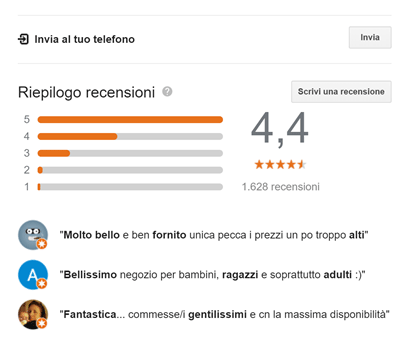
In addition to being an immediate and simple action, it allows in advance to know the average rating of all customers. And of course, we should aim to have an average between 4 and 5 (in the case of Google My Business).
Let us remember that a good customer experience enables us to achieve our goals. If our customer’s experience turns out to be frustrating for them, we will not achieve the desired result.
Indeed, we may make all our previous efforts in vain, achieving the exact opposite of what we desire.
6. Let them know how much (little) time they will have to devote to it
In order for our clients to devote time to us, we have to deserve it.
This is why it is important to follow the philosophy ofInbound Marketing, offering valuable content. Because only by offering our knowledge and expertise will we give our clients a real reason to devote their time to us.
In the case of reviews, we are implicitly asking our customers to devote their time to one of our interests. So the watchword is: be clear and brief.
Absolutely no to very long forms to fill out! Let’s follow the previous example of Google My Business: stars and a blank space.
Enough. That’s all we need.
Another good idea, is to anticipate the estimated time for the release of a review. So phrases such as “It will only take 2 minutes” or “Leave your review with one click” stand out.
In this way, we will let the customer know that his or her opinion is important to us, but at the same time, we will not waste his or her valuable time.
7. We use all the tools at our disposal
We have a lot of tools available to request reviews from our customers. So we try to integrate all of them to increase the number.
Some of the most widely used platforms for reviews include:
- Amazon
- Tripadvisor
- The Fork
- Booking
- Google My Business
So if we have a company page on some of these platforms, or all of them, let’s manage them in a way that makes them active and responsive to customer interactions.
We also make the platforms that perform best, in terms of reviews, highly visible on our website.
For example, if our Facebook page attracts the attention of a good number of customers, a link on our website, which links directly to the social network, would be optimal.
In addition, another advantage is precisely to offer the possibility for users not to leave the social network, to leave a review there.
8. We respond to all reviews, even the negative ones
It is important to make the customer feel that his or her opinion is important to us, whatever his or her rating is: so we should not only respond to positive reviews.
A recent study by Harvard Business Review, found that companies who responded to negative reviews, scored better overall, than those who did not.
So even in the face of this result, we understand how important it is to respond to negative reviews as well, not just positive ones.
We always try to maintain a calm tone, and not an argumentative one. We try to put ourselves in the customer’s shoes, and see if their problem could be solved in some way.
This task generally falls to the Customer Service team, so we instruct our team to keep the conversation professional and focused. But most importantly, active and detail-oriented.
In fact, we may even find that a review has been issued by mistake. This is the case, for example, when we find a star without a comment.
It could simply be a click error, connection error, etc. So don’t panic, and always act rationally.
9. We share our customers’ positive comments
A great way to incentivize customers to leave a review is to show them that other users have done so. And were rewarded with a publication for example.
A great tool for this strategy is Social Media.
In fact, for example, we can create Facebook posts to share a particularly positive review, giving our client visibility as well.
Instead, with Instagram, we can even create a featured album. Gathering all the positive feedback received, in the form of stories, into one album. And by tagging our customers.
This is a powerful marketing technique, reminiscent of Bandura’s Modeling. In fact, according to Bandura, individuals are inclined to imitate each other’s behavior if the latter receives a reward that might satisfy them as well.
So let’s think about it, because it could be a great tool for our strategy.
Another way to highlight the reviews that we like the most, we get it thanks to some sites, which allow users to state whether a review is useful, or not. This is the case with Google, Yelp, TripAdvisor, etc.
In such cases, reviews considered “most useful” are automatically moved up. Regardless of the date of release.
And this happens precisely because those reviews are considered the most read, the most accurate and the most truthful.
In this case, the most incisive reviews are highlighted automatically, regardless of our will. And this could still be a double-edged sword, because if the “most useful” reviews are negative, other users will read those very reviews first.
10. Let us be the first to leave a response to positive reviews
A fair exchange. A review for a review.
Of course, we need to focus on customers who have shown us their satisfaction. And perhaps with whom we have established a good relationship.
I would say let’s drop the customers we would never want to deal with. Our “anti-buyer personas“.
One tool that can help us with this is LinkedIn.
In fact, a typical conversation might be this:
Client: “Thank you for supporting me on LinkedIn! I really appreciate it.”
Corporate representative: “You’re welcome! I really enjoyed working alongside you these days, and I wanted to make sure other people knew how knowledgeable you are. If you also enjoyed our collaboration, I would appreciate your review of the product I recommended.”
This type of conversation, of course, we recommend it in case there is a real relationship with the client. In fact, confirming skills on LinkedIn at random, could be annoying and inconsistent. And in this case, we certainly cannot expect a positive return.
Strategy and Spiritual business
If your goal is to increase positive reviews of your Company, your Business cannot lackEthics.
So from creating valuable content, to responding to negative reviews, the values we believe in should never be put on the back burner.
If we want our customers to demonstrate their satisfaction to the public, we must prove that we are up to the task of satisfying them.
The techniques we have listed for obtaining positive reviews must be an integral part of our Marketing and Communication Strategy. And not an external application.
So let’s arm ourselves with a magnifying glass, because we need to take care of our strategy in every detail in order to achieve our goals and increase our business.
Did you find this article interesting? You can explore further by reading these articles.
- Marketing Automation: grows companies’ reputation and business
- 9 metrics to check the effectiveness of email marketing strategy
- You want to find new customers, do good content marketing
- Why investing in Marketing is not an option but an imperative?
- Those who do Community Marketing build an empire
- Buyer Journey Marketing: monitor results this way
- Emotional Marketing: when the brand puts its heart into it