



Until a few years ago, asking how much it costs to develop software meant asking how many hours of programming were needed.
Today, a growing share of that code is written by artificial intelligence, in timeframes that once seemed impossible.
The question remains the same; the answer has moved.
The case that best illustrates this is recent: a suite of applications for photos, video, graphics, and layout, released for free by a developer who claims to have built it with AI.
If building costs so little, where does the budget for a software project actually go? We’ll explain it starting from an external case and one of our own, with the hours counted one by one.
What happened with ArtCraft
Seven applications built with AI
On October 8, 2026, Tom’s Hardware reported on the project of a developer, known only by their Reddit username, who released a series of open-source applications written in Rust with the help of Claude, Anthropic’s model.
The stated goal: to offer free alternatives to several Adobe products and reach feature parity within a month.
The suite is called ArtCraft and includes PhotoCraft for photo editing, VectorCraft for vector illustration, FilmCraft for video, LightCraft for archiving and raw file development, PdfCraft for PDFs, EffectCraft for motion graphics, and DesignCraft for layout.
What the project says about itself
The PhotoCraft repository is honest about its limitations. It describes itself as being in early alpha and states that it is not yet ready to replace Photoshop in daily professional work.
Every menu item is linked to a command; however, the project warns, this measures the links, not the behavior. Tools, generative functions, and plug-in compatibility are missing.
More than 1,700 automated tests and a public security policy back up the work done.
The reactions tell the other half of the story. According to a Sonar survey cited in the same article, 96% of developers say they don’t fully trust AI-generated code.
Among the comments, file security, privacy, and the difficulty of independently verifying such a large volume of code come up repeatedly. This is exactly where the real cost of software is at stake.
How much does it cost to develop software today?
The cost of software depends less and less on writing the code, which AI speeds up, and more and more on four factors: deciding what to build, integration with existing systems, data security, and maintenance after launch.
A serious estimate is built on these factors, not on programming hours.
Code has become the least expensive part
For decades, the bulk of an estimate consisted of developers’ working days. With coding assistants, a feature that once took a week can now be ready in an afternoon, and a working prototype in just a few days.
This changes the conversation with those who need to invest: the prototype becomes a decision-making tool, not the end point.
Vibe coding: what it is and where it stops
Vibe coding is the name that has spread for a way of programming in which you describe in words what you want and let the AI write the code, correcting the result as you go. It works very well for exploring an idea and building personal tools.
It becomes insufficient when the software has to handle customer data, be used by multiple people with different permissions, communicate with the company’s management system, and remain operational for years: that’s where design, testing, and someone accountable for the result are needed.
When layout software arrived on every desk
In the mid-1980s, desktop publishing brought page layout to a desktop computer: work that once required typesetting and phototypesetting became possible in an office.
What stayed the same: the craft of deciding hierarchy, readability, and tone on a page. What truly changed: the cost of producing a page plummeted, and far more pages were produced, good and bad alike.
What this means for decision-makers today: as before, value shifts from production to choice.
Those who invest in software are paying less and less for the build and more and more for the judgment behind deciding what to build.
Our project: 325 hours to build JABE
What is JABE
JABE is the internal platform we have been building since April 2026 with AI. It brings together in a single tool keyword research, AI engine citation monitoring, CRM, project management, sales, finance, and a structured module for managing SEO, GEO, and AEO.
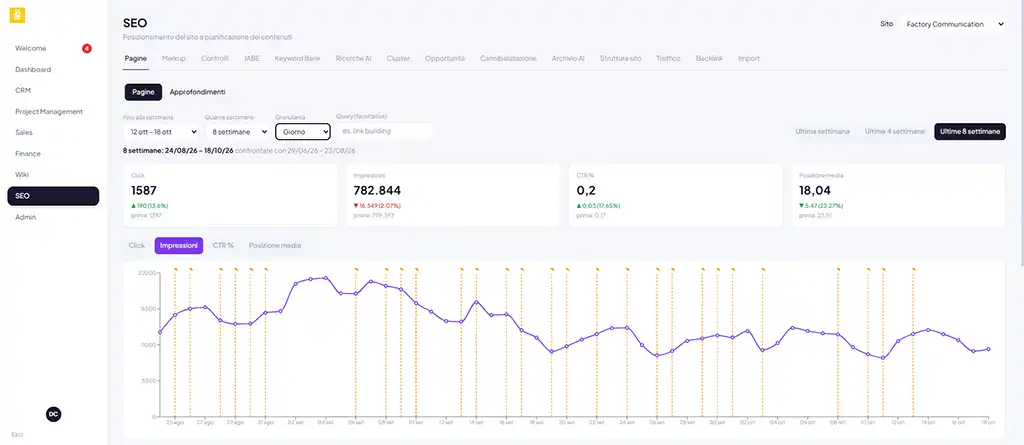
We built it because no commercially available software matched the way we work without forcing us to change it.
The hours, module by module
| Module | Status | Hours |
| SEO module | In progress | 145 |
| CRM module | In progress | 50 |
| Projects module | Completed | 40 |
| JABE and Claude integration | To do | 24 |
| Finance module | In progress | 23 |
| Sales module | Completed | 19 |
| Admin & security module | In progress | 11 |
| Dashboard module | In progress | 8 |
| Security review | To do | 4 |
| Notifications module | Completed | 2 |
| Archive module | Next step | — |
| Integration with Elementor | Next step | — |
| Integration with Fonio | Next step | — |
| Total | 325 |
Security lives within the modules, in authentication, permissions, and access control; the dedicated line refers to the overall review, which comes last.
What those hours bought
Looking at the table, writing the code is the part that weighs least in the story.
The SEO module absorbs nearly half the time because it’s our core process: those hours went into deciding which data to collect, how to connect it, and what to show to whoever has to make a decision.
Seven out of ten modules are still in progress or pending, and this is the second lesson: business software lives and evolves alongside the company, and maintenance is part of the cost from day one.
It’s the same approach we take with clients in AI software development: start from the process, build in short releases, and define security and maintenance before beginning.
What determines the cost of software
Before launch
The factors that weigh most are the complexity of the process being digitized, the number of systems to connect, the number of users with different roles and permissions, and the migration of existing data.
Software that communicates with a management system, CRM, and website requires more design work than a standalone tool, even when AI writes the code.
After launch: maintenance, security, updates
Custom software needs library updates, periodic security checks, fixes, and new features as the company evolves.
This is the item that estimates tend to leave out, and it’s the one that determines whether the investment holds up over the years.
The time of the people involved
Finally, there is the time of those who will use the software: defining the rules, testing the prototypes, learning the new tool.
This is a real cost, and also the first return: software built around real processes gives people back hours they can dedicate to higher-value work.
Custom Software or Off-the-Shelf Software: Which Is Best for an SME?
Standard software is the right choice when the process is common to many companies and the market already offers a mature solution.
Custom software is the right choice when the process is what sets the company apart, when multiple tools need to work together, or when adapting a standard product costs more than building one.
Often the right answer combines both.
When it’s worth buying
Accounting, payroll, electronic invoicing: these are regulated processes that are the same for everyone, where a widely used product offers regulatory updates and support that no in-house project can match at the same cost.
When it’s worth building
When the value lies in connecting tools together or in a way of working that the market doesn’t offer. A few examples from the industries we work in:
- Tourism & Hospitality: the hotel management system is bought; the dashboard that brings together bookings, reviews, and campaigns can be built
- Food & Beverage: the restaurant’s POS system is bought; the tool that connects sales, inventory, and suppliers can be built
- Fashion & Luxury: the collection management system is bought; the workflow that moves product sheets from the sample collection to e-commerce can be built
- Finance & Legal: the firm’s management system is bought; the assistant that drafts documents based on the firm’s files can be built
How to decide what to build
The questions to ask before writing code
Which process do we want to improve, and how do we measure the result? What data is needed, and where does it currently live? Who will use the tool, and with what permissions? Who will maintain it two years from now?
When these answers are clear, AI speeds up the build; when they’re missing, it only speeds up the production of code that will need to be redone.
The FARO method applied to software
The FARO method breaks the project down into four phases.
- Focus: choose the process with the clearest return.
- Architect: design the data, integrations, and security rules.
- Build: build with AI in short releases, with a prototype ready to test right away.
- Optimize and amplify: measure real usage and evolve the tool.
Anyone who still needs to understand whether and where to introduce artificial intelligence can start with AI consulting for businesses.
Time given back to people
The question many entrepreneurs ask themselves is whether AI will lead to staff reductions.
In our experience, well-built software takes repetitive steps off people’s plates and gives back time for work that requires judgment.
It’s the same principle we follow when designing AI agents: always under human supervision.
Tell us about the software you need
If you have a process that standard programs struggle to follow, let’s talk about it.
We start from there, from the value you want to achieve, before talking about code.
Frequently asked questions about the cost of software
It has reduced the cost of writing code, which is now faster.
The overall cost of a business project has shifted toward design, integration with existing systems, security, and maintenance, which remain the work of experienced professionals.
On the complexity of the process, the number of systems to connect, the users and permissions, data migration, security requirements, and the maintenance planned after launch.
The price is defined on a project basis, starting from these factors.
It depends on how many integrations it has, how much the company’s processes change, and how often security updates occur. It’s best to plan for maintenance in the project from the start, as a stable line item rather than an unexpected cost.
It changes their work: less time writing code, more time designing, testing, and securing. For a company, this means that the value of those who develop lies increasingly in the choices they make and their accountability for the outcome.
It’s only as secure as the process that verifies it. AI-generated code must be reviewed, tested, and protected like any other code: access control, data management, automated testing, and periodic checks are all part of the project.
With AI, a working prototype often takes just a few days or weeks, depending on the complexity of the process. It’s used to make decisions based on something concrete before investing in the full version.
For personal tools or prototypes, yes, and it’s a great way to clarify your ideas.
For software that handles customer data, multiple users, and integrations with the management system, design, security, and maintenance expertise is needed.
How the software will be maintained and by whom, who will own the code, how data is handled, what testing is planned, and how results are measured. The answers say far more than a daily rate.