


Home » Business Services » web development
Your company’s website works: the pages load, and the contact form is sent to your inbox.
But how long has it been since you looked at him through the eyes of someone who is evaluating you right now—perhaps while comparing three other suppliers in that same half-hour?
Today’s decision-makers read just a few lines, look for concrete evidence, and check on their phones to see if the website is responsive.
A well-designed website makes that decision easy.
In the following paragraphs, you’ll learn how a web project is developed—starting with the company’s goals—what it entails, how long it takes to take shape, and what factors influence the investment.
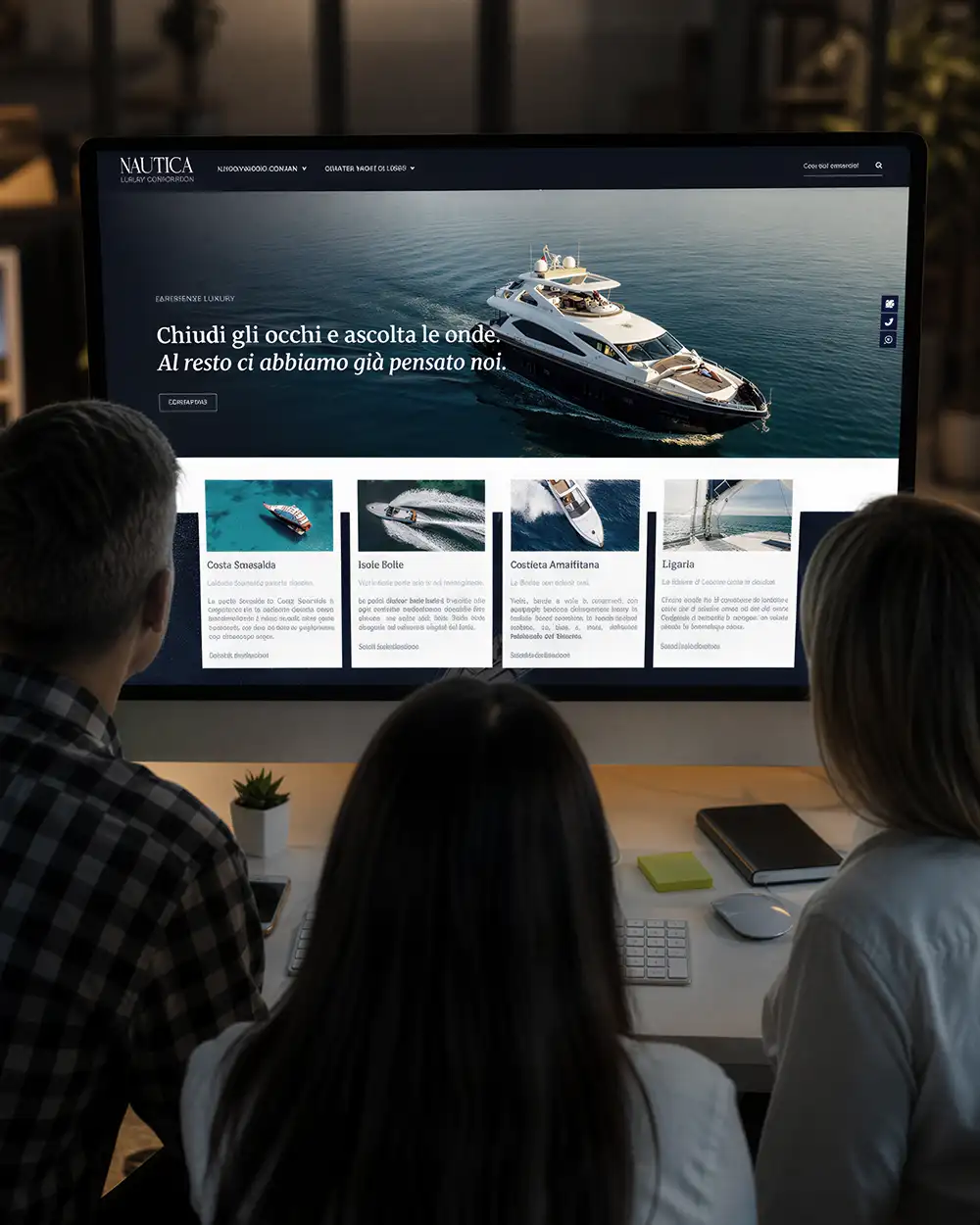

Many websites start off well and grow through subsequent additions: a page here, a section there, a service described in words from three years ago.
The result is a place that tells the story of the company as it once was, while the company itself has changed in the meantime: it has opened a new location, hired new employees, and shifted its focus to a new market.
The signs are clear. People come in and stay for just a few seconds. The phone rings with questions that the website could answer on its own.
Every change requires someone to make it, so changes keep getting put off. When someone calls you, they’re greeted by a menu that’s slow to open, and pages remain unresponsive for screen reader users.
This service is designed for business owners who view their website as a business tool, not a showcase to be revamped every five years.


Four steps in a fixed order, so that each decision is made when needed and none is made twice.
The same process guides every project, from a 10-page website to a platform with a members-only area: you can read about how the FARO method works on the dedicated page.
Company goals, target audience, data already available in Search Console and Analytics, and an inventory of what the current site does well.
This process yields a list of features the new site must enable.
Site map, navigation paths, one query per page, wireframes of the main screens.
The design process determines where each piece of content goes before a single line of code is written.
Design, development, content, performance, and accessibility go hand in hand.
Every page is tested on a phone before it’s tested on a monitor, because that’s where most people access the site.
After publication, the work continues: measurement, corrections, new content, visibility in search engines, and responses from AI engines.
A website becomes effective over the course of months, not on the day of its launch.
The process consists of four stages:
The duration depends on the number of pages, the languages involved, and integrations with company systems.
Six services that work together. Each has its own page, with deliverables and timelines.
Custom-built institutional and showcase websites that company staff can update themselves without having to call a technician for every little thing.
They’re built to be easily found, because their structure and content follow the strategy defined before development began.
Online stores and marketplace listings, with a product catalog, payments, and shipping integrated with your existing business management system.
An online store that’s easy to find keeps selling even when marketing campaigns are on hold.
Web pages designed with a single goal in mind, where every element is geared toward conversion and results are tracked on a campaign-by-campaign basis.
Companies with multiple locations or a franchise network cover their territory with one page per area.
Review of the current status, code and content updates, and accessibility statement: the website becomes accessible to everyone.
Short videos, native formats, and organic growth, where the algorithm rewards consistency.
Server selection based on actual traffic, certification, backups, and monitoring: a website’s performance starts with where it’s hosted.
Content, navigation, and user experience aren’t based on personal taste—they stem from two questions: Who are we talking to, and what market are we targeting?
From there, you decide what to write and how to organize it.
This is the SEO strategy, and it comes before development because it’s what the website will be doing for years to come.
It is a good idea to check four things:
Our portfolio of previously published work speaks to our approach better than any presentation ever could.
Two websites with the same number of pages can require very different levels of effort.
At Factory Communication, the project is defined following a meeting in which objectives, timelines, and constraints are clarified: these are the factors that drive the investment.
The same principle applies to timing. The website begins to produce measurable results in the months following publication, when the content is indexed, the pages appear in AI engine search results, and the initial data allows for course corrections.
When a website already exists, an analysis of its current state helps determine whether it makes more sense to expand the site or rebuild it, and to quantify the work involved before committing a budget.
Web development takes on different forms depending on what the company needs from its website on a daily basis.
Up-to-date menus, online reservations and orders, and restaurant listings that provide information to people searching on their phones just a few steps away.
Direct bookings alongside third-party booking platforms, an integrated booking engine, and multilingual pages that showcase the property and the surrounding area.
Catalogs designed to look like a store window, a shopping experience consistent with the brand’s positioning, and flawless performance even during product launches.
Clarity above all: clearly presented expertise, simple appointment requests, and content that complies with professional standards.
It depends on three factors: the number of pages, the languages to be supported, and integrations with existing systems.
A corporate website with pre-prepared content can be launched in a few weeks; a project that includes a restricted-access area and integration with a management system takes longer, and the timeline is determined together during the scoping phase.
Based on the factors listed above: scope of the project, custom features, integrations, content to be produced, level of accessibility, and post-launch support.
Each project undergoes a dedicated assessment after the first meeting, because two seemingly similar sites may require different levels of effort.
In most cases, WordPress, because it combines management autonomy, a wide range of expertise available on the market, and the freedom to switch providers.
When a project requires specific approaches, we work together to evaluate different solutions, explaining the advantages and implications of each.
Yes. The architecture, speed, title structure, and content are all optimized from the start for search engines and AI engine responses. Making changes after publication always costs more than designing things well from the beginning.
Content translation, management of language versions, accurate cross-language links, and the ability to tailor content by market. The languages remain independent of one another: each has its own pages and its own search engine ranking.
The website is undergoing maintenance: updates, backups, security checks, and performance monitoring. At the same time, we analyze the data and make changes to the content that can yield the best results, following a schedule agreed upon together.
Scope of work, timelines, ownership of code and content, access to hosting and domain registered in the company’s name, and support terms. These are the elements that allow you to switch providers at any time without losing the work you’ve done.
Yes, and that’s one of the most common requests. The website interfaces with the systems already in use at the company, so the data collected online goes where it’s needed without any manual steps. Integration is planned during the architecture phase, before development begins.
An hour together is enough to determine whether your current website can be improved or if it would be better to rebuild it, and to estimate how much work is actually needed.
The meeting is free and will still be useful even if the project doesn’t start right away.