



In this article we look at what LLMs are and why it is critical to enable the llms.txt function.
Let’s start by saying that artificial intelligence tools do not read your site the way search engines do, and this could be a problem for your Company’s business.
That is why I recommend you continue reading because you will find out how to deal with this revolution.
In recent years, artificial intelligence has revolutionized the way people search for information online.
At the center of this revolution are Large Language Models (LLMs), such as ChatGPT, Gemini, and Claude, tools increasingly used to answer questions, generate texts, and offer real-time assistance.
But what exactly are llm large language models and why is the llms.txt function becoming essential for those who manage a website?
What are LLMs
LLMs, an acronym for Large Language Models, are artificial intelligence systems based on deep artificial neural networks, particularly the “transformer” architecture.
These artificial intelligence models are trained on huge amounts of textual data, often collected from the Internet, books, articles and other sources, to learn natural language rules, semantics and relationships between concepts.
The operation of LLMs is based on two main stages:
- Unsupervised training: The model is exposed to large volumes of unlabeled text, learning to predict the next word in a sentence and to recognize complex language patterns.
- Optimization and fine-tuning: Next, the model is refined on specific tasks such as question answering or translation) through more curated or supervised data (fine tuned).
With this architecture, LLMs are able to understand the context of sentences, generate coherent responses, and adapt to a wide range of demands, from text analysis to content generation to code writing support.
Unlike traditional search engines, which index and analyze the entire content of a website, LLMs work differently: when they receive a query, they access only a small portion of the web in real time, often limiting themselves to what they can “see” at that moment.
LLMs’ challenges in understanding websites
This difference in operation leads to a major challenge: LLMs can easily miss key information, especially on very large or frequently updated sites.
Large Language Models do not read your site as a human would: when they receive a query, they extract only a portion of the available content (they cannot list every single page) and often struggle to distinguish between relevant information and side items (such as menus, advertisements, or code).
The result? Outdated, incomplete, or even incorrect answers on topics that affect your site or business.
Here’s how they can improve understanding of your site:
- Structure and data analysis: LLMs are ai systems that leverage the semantic structure of the site (HTML, tags such as
<article>,<section>, structured data such as schema.org) to quickly identify the most important parts and contextualize information. - Clear and organized language: Content written in a simple, clear and informative manner is easier for Large Language Models to interpret and summarize.
- Thematic clusters and hierarchy: Good organization of content into thematic clusters, with clear titles and logical progression, aids understanding and extraction of key information.
- llms.txt file: Introducing an llms.txt file provides LLMs with a “map” of the key sections of the site, explicitly indicating which content is prioritized and should be read first.
This reduces the risk of AI getting lost among secondary elements and improves the representation of your brand in the responses generated
SEO Content Vs LLMs
There are substantial differences between optimizing for traditional search engines and optimizing for language models such as ChatGPT, Gemini, or Claude. Let’s see why.
Traditional SEO: length, keywords and links
- ClassicSEO optimization favors long content, rich in strategic keywords and with a good structure of internal and external links. This is because search engines such as Google also evaluate the depth, authority and relevance of content through these signals.
- Long content tends to rank better because it covers a topic comprehensively, increases the chances of including related keywords and gaining backlinks, elements that strengthen a site’s reputation and visibility.
- However, length is not a direct ranking factor: what really matters is the ability to answer users’ questions in a comprehensive and authoritative manner.
LLMs: clarity, structure and synthesis
- Language models do not read and evaluate content the way search engines do. They often do not analyze the entire site, but extract information from portions of text, preferring content that is clear, well-structured, and easily citable
- The large language model llm prioritize:
- Accuracy and clarity of information
- Text structure (summaries, FAQs, tables, clear heading)
- Direct, self-contained answers without the need to scroll through long texts full of redundant keywords.
- Redundancy, excessive length, or over-optimization can even penalize comprehension by an LLM, who is likely to “get lost” among superfluous details or poorly scannable text
Summary: SEO vs. LLM
| Feature | Traditional SEO | Optimization for LLMs |
|---|---|---|
| Content length | Often long, thorough | Essential, clear, well-structured |
| Focus | Keywords, links, authority | Accuracy, conciseness, direct answers |
| Structure | Heading, meta tags, internal/external links | Summaries, FAQs, tables, visual clarity |
| Reading mode | Full scanning and indexing | Extraction of snippets and timely responses |
| Risk | Over-optimization, scattered text | Uncitable content if too long |
It is not true that content for LLMs must be “short” in an absolute sense, but it must be essential, clear and well-organized.
The winning strategy today is to integrate traditional SEO best practices with those designed for AI models: in-depth, yet easily scannable content, with summary sections and key information highlighted.
In this way, your site will be effective for both Google and the next generation of AI assistants.
llms.txt: a guide for artificial intelligence
This is where the llms.txt function comes in-we could call it the new Robot.txt.
This is a markdown file created specifically to guide LLMs to the most important content on your site.
This file provides a kind of map, indicating:
- What your site is about
- Where the key pages are located
- Clean, plain text versions of your core content
This file is not intended for search engines. It is intended for AI assistants who are trying to provide accurate answers based on your content.
With llms.txt, LLMs can quickly access the most relevant information, avoiding getting lost among superfluous items and ensuring more accurate and up-to-date responses to users.
Practical benefits
- Direct access to key information: LLMs can quickly find the most up-to-date and relevant answers without having to explore the entire site.
- Reduction of errors and misunderstandings: A clear structure and the use of llms.txt decreases the likelihood of AI giving outdated answers or answers based on incorrect data.
- Increased visibility and authority: A site optimized for LLMs is more likely to be cited correctly and stand out in AI-generated responses.
Why it is critical to enable the llms.txt function.
Activating the llms.txt feature, for example through Yoast SEO, offers many advantages:
- Improve the quality of AI responses: Guide language models such as ChatGPT and Gemini to your most relevant content…
LLMs will have direct access to your best content, reducing the risk of errors or outdated information. - Control over storytelling: You can guide AI toward what you want represented about your business, influencing users’ perceptions of your brand.
- No technical complexity: With tools such as Yoast SEO, the llms.txt file is generated and updated automatically, without the need for manual intervention.
- Ready for the future of search: More and more people are relying on AI assistants to find information. Having a site optimized for LLMs means being a step ahead in the new era of online search.
With applications such as Yoast SEO, you can preview the file before publication. If you prefer to have more control, you can also manually create or manage the llmx.txt file by visiting the developer documentation.
In what cases is the llms.txt function particularly useful?
This feature is especially useful if your site contains:
- Documentation or support content: If you run a software company with a help center, such as a page explaining how to configure the product.
- Product Guides or FAQs: If you have a page that answers customers’ frequently asked questions, such as “How to return an item” or “Comparing rate plans.”
- Educational articles: If you publish tutorials or explanations, such as “What is structured data?” or “How to improve site speed for SEO.”
- Regularly updated blogs: If your blog covers current topics, such as “The latest Google algorithm update: What to know in 2025” or “The 10 best SEO tips for ecommerce sites.”
- A large amount of content: If you run a news site, university portal, or ecommerce with hundreds (or thousands) of pages. AI tools can miss key content if you don’t address it directly.
Do you have Yoast SEO Premium? Activate llmx.txt with one click
If you too have decided to use Yoast SEO Premium on your site, activating llmx.txt is a no-brainer.
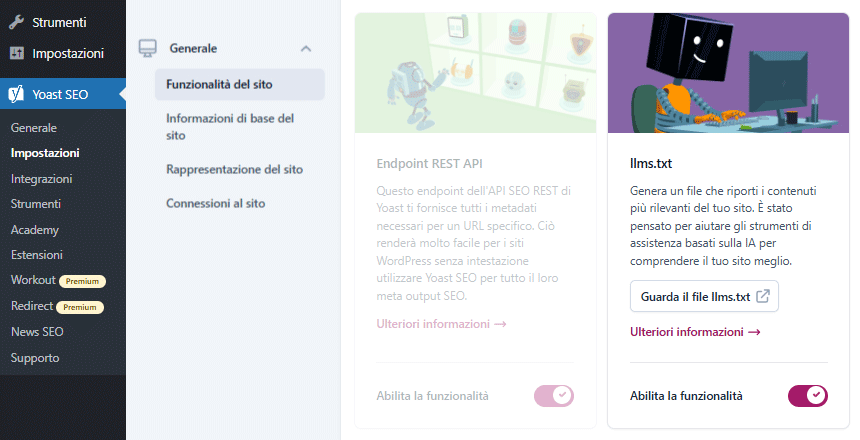
- Access the Settings section of Yoast SEO
- Go to “Site Features”
- Go to the “APR” section and activate the “llmx.txt” tab.
llms.txt conclusion
LLMs are changing the landscape of online research and information use.
Enabling llms.txt is now a strategic choice to ensure that your content is understood and enhanced by artificial intelligence, giving users more accurate answers and better representing your business in the digital world.
If you want to improve the ranking of your website or eCommerce request an SEO Consultation from our Agency.
AI for Online Marketing and SEO Positioning
Are you interested in d deepening the topics of artificial intelligence applied to your company’s marketing strategy and SEO positioning? Read these articles:
- Google Deep Thinking Ratio: what changes for Italian SMEs in the next 3 years
- How AI crawlers are changing the rules of the game for online sellers
- Artificial intelligence applied to marketing in 2026
- Google AI Mode: make the most of it for your Business
- 4 ways to use AI in your marketing strategy
- Machine Learning vs Artificial Intelligence
- AI Writing Tools for Content Marketing: yes or no?
- Chatbot eCommerce: why use it?
- Google Duplex and artificial intelligence