



An entrepreneur considering whether to redesign their website probably has one of these questions—or all three—on their mind: What am I risking losing? How long will it take? Who should I entrust this to?
What search engines index, however, is almost always a three-word phrase.
In August 2026, we analyzed twenty topics using Answer The Public to see what aspects of that question remained in the data returned by the tools.
Three things came to light, and none of them was what we were looking for.
What We Measured
Twenty themes, 4,420 strings
We collected all the autocomplete suggestions that search engines return for twenty topics—the ones that appear below the search bar as you type. A total of 4,420 strings.
The themes belong to two distinct groups:
- Nine pertain to the technical maintenance of a site,
- Eleven: the method used to plan content.
Distance helps us determine whether a behavior is consistent or depends on the topic.
Why We Reclassified Instead of Trusting
Answer The Public organizes suggestions into categories, and one of them is called “questions.” The quickest way would be to look at that list.
We checked each line individually using JABE, the platform we use for SEO data analysis: all 4,420 strings, identifying grammatical structures and interrogative forms in both Italian and English, based on criteria we developed ourselves.
It was the most useful decision in the analysis, and the reason for this is evident in the second result.
Four out of five lines do not contain a verb
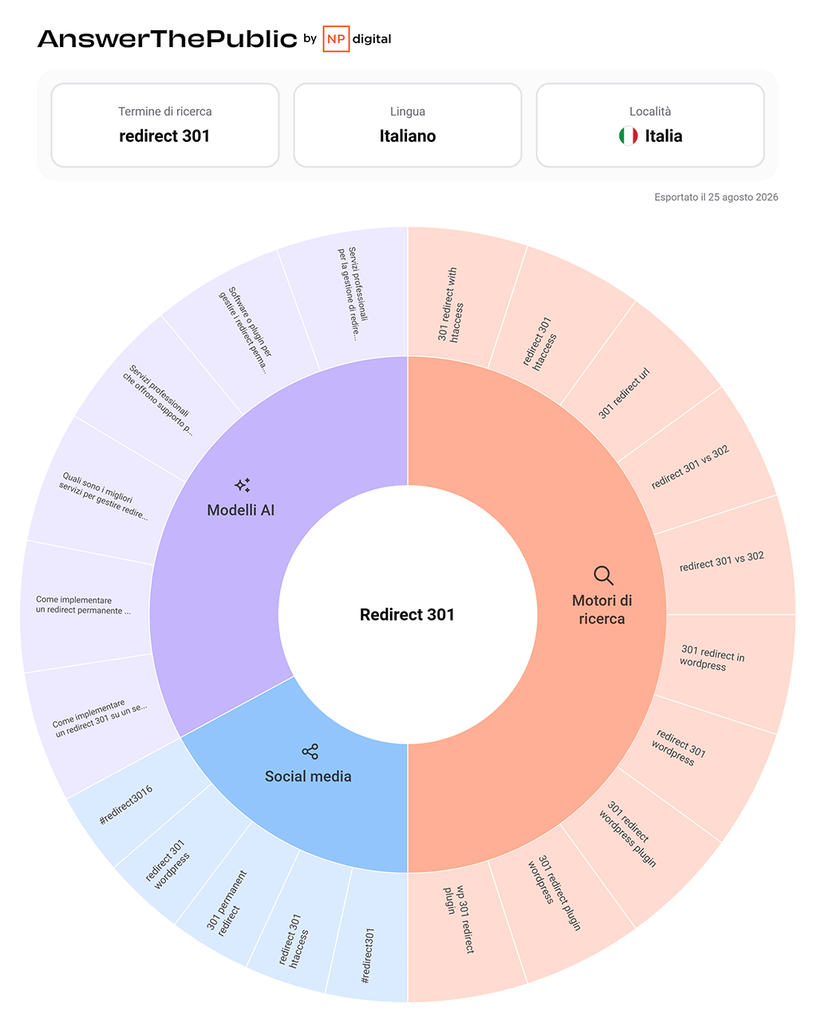
The first finding concerns form. Of 4,420 suggestions, 78.7 percent contain no grammatical structure: they are sequences of terms strung together, such as “redirect 301 htaccess” or “keyword planner adwords.”
There are 942 strings with a structure remaining. Of these, less than half are questions: 455 in all, or 10.3 percent of the total.
A sequence without a verb does not contain a “why.”
It’s the subject line, not the intention: “301 redirect .htaccess” doesn’t reveal whether the writer wants to learn how to do it, check how someone else did it, or find someone to handle it.
These are three different situations that produce the same string.
Where the phenomenon is most evident
We collected 979 suggestions for“generative engine optimization”—the highest number in the analysis—and 816 of them lack structure: 83 percent.
Inthe “keyword planner,” there are 508 out of 606; in“permalink,” there are 511 out of 601.
The percentage drops where the terminology is common: “editorial plan” stands at 73 percent, “404 error” at 75 percent. When the topic is familiar, searchers type in more than just a keyword—and they still make up the majority.
Who typed those strings?
We don’t know, and no tool knows either. Auto-complete records what is typed without distinguishing who is typing it.
Among those search terms are people who have a problem to solve, those who are monitoring competitors, those who work in the industry and are looking up a term, and those who are studying for an exam.
When it comes to a technical topic like redirects, it’s reasonable to assume that a significant portion of the traffic comes from industry professionals.
One possibility remains: it is not possible to separate them. What we observe is the form, and that is the basis for our reasoning.
The practical impact on search volume
The research volume counts keystrokes, not people or needs.
A high number can come from a thousand potential customers or from a hundred professionals who verify the same thing ten times.
There is also the issue of scope.
The search terms come from six different platforms, while search volume and cost per click come only from Google: this is stated in Answer The Public’s own documentation, which highlights it as important.
The number appears alongside suggestions gathered from other sources and covers only a portion of that material.
It is still a useful piece of information, but it answers a different question than the one we expect.
That is why, in our method, volume is the last of the five evaluation criteria: the others come first
- communication objectives
- consistency with what one actually does
- the ability to find the right person
- the potential to be mentioned in the generated responses.
Why doesn’t search intent appear in keyword research tools?
Because these tools track the search terms entered into search engines, and 78.7 percent of those terms do not contain a verb.
Without a verb, there is no discernible intention: the subject is clear, but the reason is not. The research volume counts how many times a sequence was written, not how many people had that need.
The tool recognizes one-seventh of the questions
The second finding came to light while we were validating the data.
Answer The Public classifies 67 of the 4,420 search strings as “questions,” or 1.5 percent.
When reclassified by grammatical form, using criteria that recognize both Italian and English interrogative forms, the number of questions comes to 455: 10.3 percent. Seven times as many.
The reason is that the classification recognizes Italian modifiers—such as “come,” “cosa,” “quale,” and “perché”—but not their English equivalents.
In our complete research archive—36,272 search strings—there are 628 that begin with “how,” “what is,” or “is it,” and they all end up in categories other than “questions.” None of them are in the correct category.
Anyone who reads that number without verifying it will conclude that there are no questions. There are seven times as many, and they’re somewhere else.
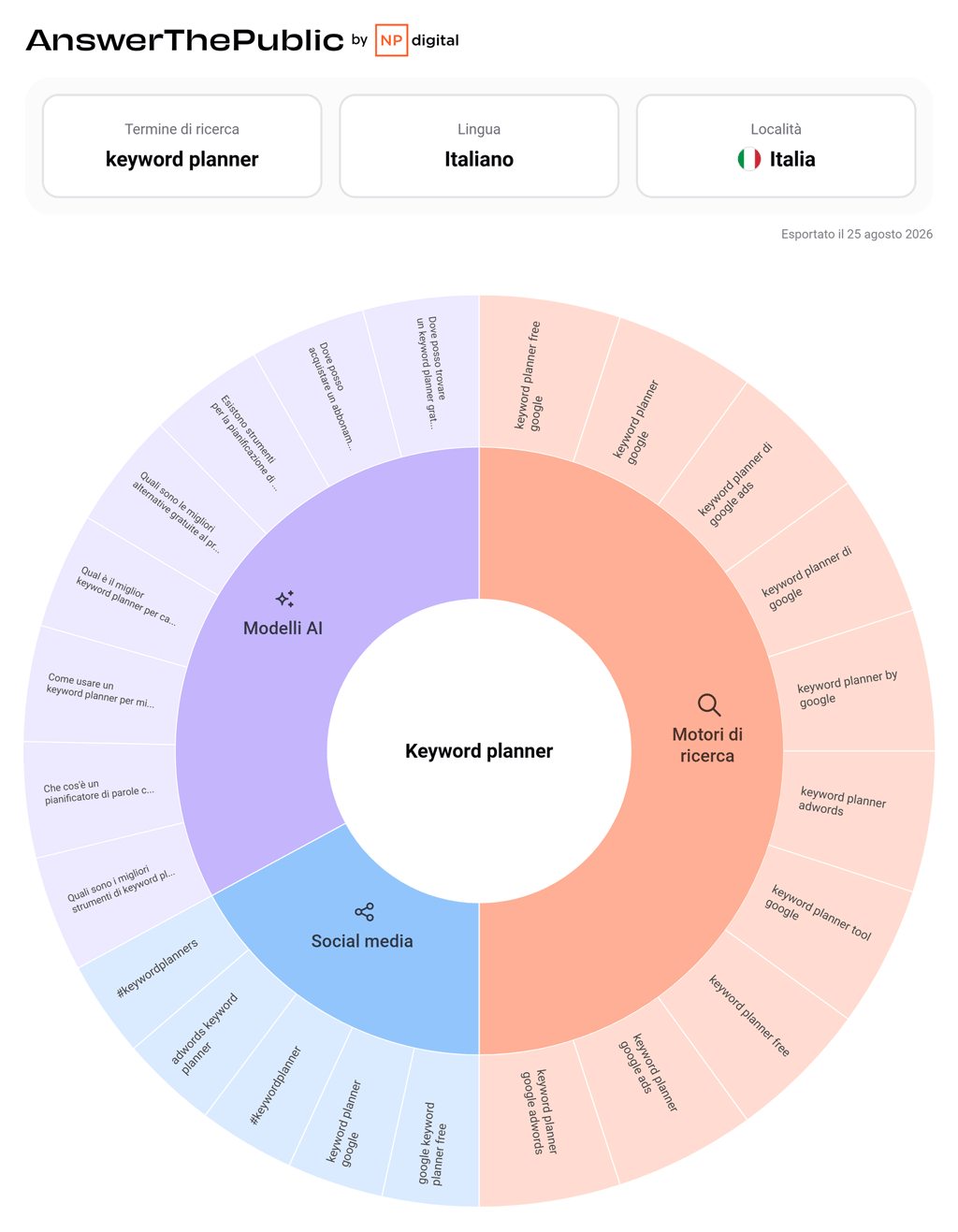
[IMAGE 2]
File: keyword-planner-search-engines-and-AI-models.png
Alt: Answer The Public’s keyword planner wheel, showing ten variations of the same string on the search engine side
Caption: Same tool, “keyword planner” seed, same date. A selection of the 606 suggestions gathered on this topic.
[H2]
The panel on AI prompts doesn’t observe—it generates
The third result changed the article we were writing.
The tool has a section dedicated to conversational models, which promises to show how people phrase their questions when talking to an assistant.
We wanted to compare it with autocomplete.
One detail made us suspicious: each topic yielded exactly twenty-five prompts. Always twenty-five, across twenty different topics. Such a consistent number doesn’t come from mere observation.
The instrument’s documentation confirms this, in no uncertain terms.
The page explaining how data is collected states that AI-generated suggestions are based on the keyword, language, and location you’ve set, and adds:“These aren’t pulled from live search data.”
He then concludes by urging us to view them as sources of inspiration, not indicators of demand.
The text can be found on the support page titled“How AnswerThePublic Collects Data.”
There is a second item on the same page. The list of platforms analyzed includes Google, Bing, YouTube, TikTok, Instagram, and Amazon.
ChatGPT and Gemini don’t appear: the section dedicated to conversational models doesn’t include a sixth channel; it generates suggestions based on what you’ve typed.
These are predictions from a model about what people might ask. They are not the questions people have actually asked.
Why This Distinction Matters to Decision-Makers
A dashboard that displays forecasts using the same visualizations as observed data leads to creating an editorial plan based on what a model predicts, under the mistaken belief that one is working on what people are asking for.
It’s not a bad tool—it’s an inspirational tool presented alongside measurement tools, and the difference is explained on a support page that almost no one ever opens.
What Changes for Those Creating an Editorial Plan
Look at the shapes, not just the numbers
Recurring phrases say more than the book itself. “How to create,” “template,” and “free” appeal to those who want to go it alone.
“Which agency,” “how to choose,” “how much does it cost,” and “who to trust” are the questions that come to mind when someone is evaluating a partner. These are different categories and lead to different content.
And since the automatic classification has proven to be incomplete, it is best to search for those forms in the complete list using your own criteria, rather than in the section that the tool labels as “questions.”
Writing Self-Contained Answers
A paragraph that fully answers a question—one that is understandable even when taken out of context—is much more likely to be featured than a page that merely introduces itself.
Ask the questions instead of reading them from a panel
If no tool actually monitors conversations with assistants, the only way to know what they return is to ask them.
Choose the questions you want to address, ask the assistants before publishing, and make a note of who is mentioned. Then repeat the process at thirty and sixty days.
It takes longer than reading a color wheel, but it has the advantage of measuring something that actually exists.
The Limitations of This Analysis
Two sources, two populations
The people who type into a search engine and those who ask a virtual assistant aren’t necessarily the same, and we have no way of verifying this.
For this reason, the article does not argue that demand has shifted from one channel to another; rather, it argues that the measurable channel records strings that lack any discernible intent.
The perimeter, as stated
Twenty topics, in Italian, all technical or methodological. This applies when the subject matter is complex and the person searching lacks the vocabulary to summarize it in three words. These are also the topics on which the most costly decisions are made.
For some of them, the search term is in English even for users searching in Italy: “redirect 301 htaccess” is spelled that way everywhere.
We took this into account by identifying interrogative forms in both languages, and that is precisely where the second finding emerged.
Frequently asked questions
The intent behind a search is the actual goal of anyone who types or asks a question: to understand a concept, compare options, find a provider, or complete a purchase.
A single word can conceal different meanings, and recognizing them is what distinguishes useful content from content that no one was looking for.
It remains useful, however, as a final criterion. Count the keystrokes, not the people: that number includes potential customers, competitors checking things out, and industry professionals.
A high volume of inquiries from prospects who won’t become customers is worth less than a low volume of inquiries that lead to a decision.
Because over the past twenty years, people have learned that search engines work best with just a few words. Compression is an adaptation to the tool, and it tells us nothing about how the search query was formulated before it reached the search bar.
By reading the text around them. Phrases like “how to create,” “template,” and “free” indicate people who want to go it alone.
Phrases such as “which agency,” “how to choose,” “how much does it cost,” and “who to trust” indicate that someone is evaluating a potential partner.
This needs to be verified. In our analysis, the automatic classification system recognized one-seventh of the interrogative forms present, because it was calibrated for Italian modifiers and did not account for English ones.
Reclassifying the complete list using our own criteria yielded a number seven times greater.
It depends on the source, and you’ll need to check the documentation. Some panels generate prompts using a language model based on the keyword, rather than analyzing real conversations.
They’re useful for generating ideas, but less so for estimating demand.
Choose the questions you want to be mentioned in, ask your assistants about them before publishing, and note down who is mentioned. Then repeat the process at thirty and sixty days.
You need a specific starting point; otherwise, it’s impossible to distinguish a result from a coincidence.
The number of topics to analyze, the depth of the competitive analysis, the amount of content to be written or rewritten, and the duration of the monitoring. The number of languages and the status of existing content also play a role. The first signs typically become apparent between sixty and ninety days.
What’s left to do when the tools aren’t enough?
None of the three items we found were on the countertop.
They emerged by reclassifying, using our own criteria, what a tool had already classified, and by tracing the origin of a piece of data that seemed reliable.
It’s the least visible part of consulting work—and the one that determines whether an editorial plan has a solid foundation.
AI doesn’t replace judgment here; it makes it possible to apply that judgment to thousands of lines of data rather than just a sample. At Factory Communication, we always start here: understanding what a piece of data actually measures before building a strategy around it.
If you want to know what the data in your industry reveals, the first step is to have a conversation.