

One of our pages is the top organic result on Google for a search that generates hundreds of views per month. A position that, until recently, we would have celebrated. The clicks that page receives, however, remain near zero.
It sounds like a paradox. Instead, it is the clearest sign yet of how online search is changing in 2026, and we have observed it on our own site, with data in hand.
This article tells what we found out, why it is good news disguised as a problem, and what it means concretely for your business.
The figure that surprised us
The page in question is about eCommerce development with WooCommerce. Opening Google Search Console we found three numbers: 219 impressions, average position 2.7, zero clicks.
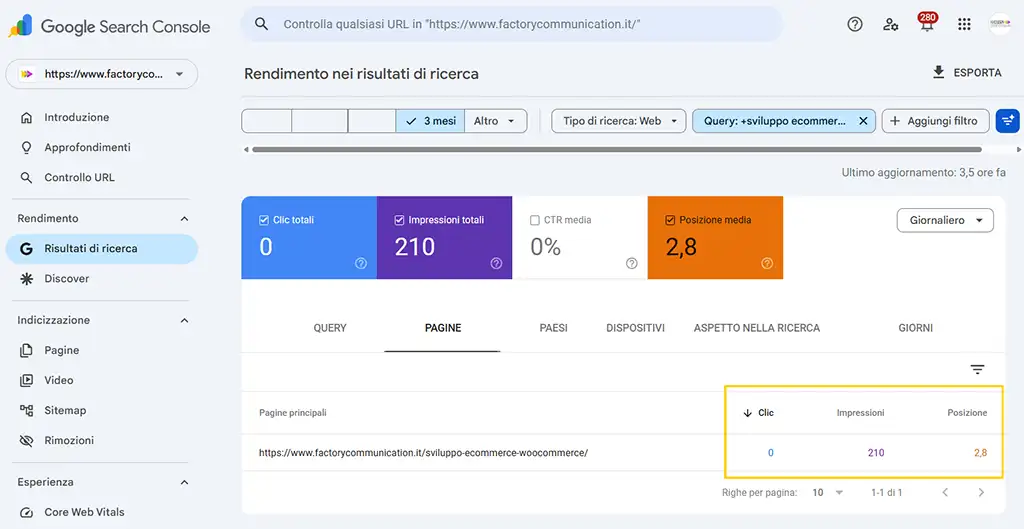
Translated: Google shows our page among the very first results for that search, hundreds of times. People see it. Yet they come to the site in near-zero numbers.
Usually, when clicks remain low in the face of so many views, the explanation is a matter of depth: you are lower than you think. Here the position was already excellent. Therefore, another reading was needed.
The survey: three checks to read the data
To correctly interpret such a number, we followed three simple verifications-the same ones we recommend to any entrepreneur who wants to understand his or her research data.
First check – the actual SERP
We searched the query in an anonymous browsing window, with location on Milan, so that we could observe the results page in its neutral form, as any user in our area sees it.
Second check – Search Console
We wanted to isolate the views generated by AI Overview. Google launched the report dedicated to these metrics on June 3, 2026, with a phased release that started in the UK; in Italy, at the moment, it remains on the way. For this we relied on direct observation of SERPs.
Third check – the trend over time
We compared the last three months with the previous three months to distinguish a stable situation from a recent phenomenon.
The discovery: what really occupies the top of Google
This is what fills the screen, from top to bottom, before we get to our first organic result:
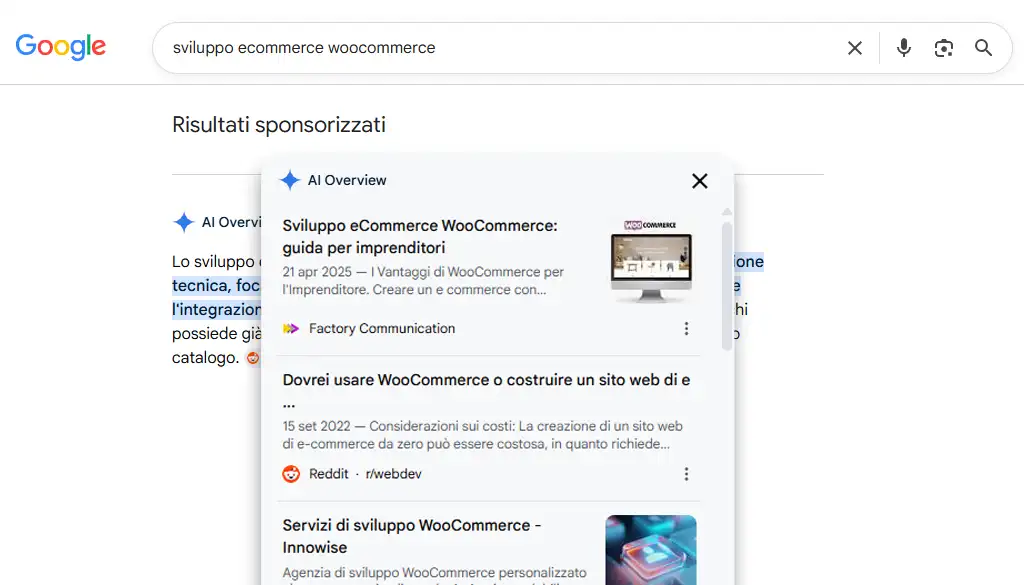
- an AI Overview-the box with the response generated by artificial intelligence-and within it our page appears twice as a cited source;
- some sponsored ads;
- A section of YouTube videos;
- And finally, underneath it all, the third organic result: us.
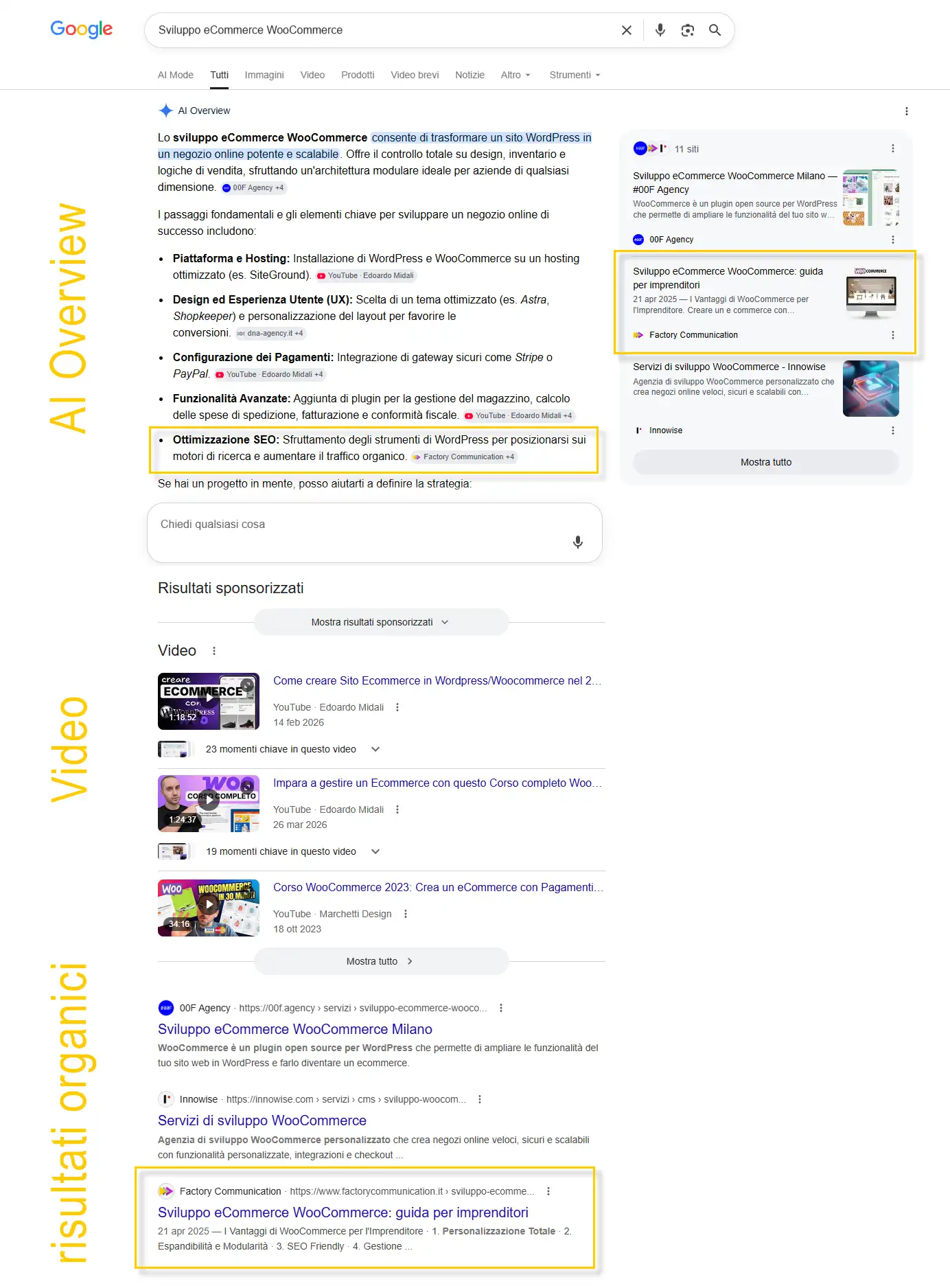
Imagine the results page as the entrance to a large bookstore. It used to be that the customer would come in and look for the right shelf: those who were well placed would be found.
Today there is an assistant on the threshold who immediately answers the question and summarizes the best titles, even citing you among his sources. The customer gets what he is looking for there, at the door, and often considers his need already satisfied.
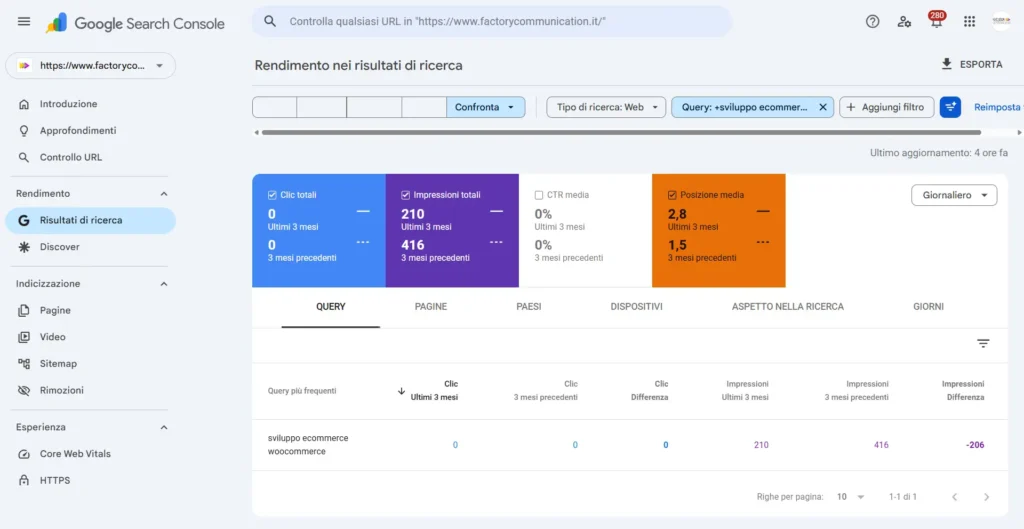
The third check added a valuable detail: in the last three months we are at position 2.7; in the previous three we were at 1.6.
A small variation that, in another scenario, would have required action. Here it weighs little: with AI Overview, ads, and video above us, the difference between first and second organic place changes little about what the user experiences.
The flip side: citation is a victory
Herein lies the point that transforms the case. Appearing twice inside the AI Overview means that Google considers our content authoritative enough to build its response on it.
We are already winning the new game: that of presence inside the AI response.
It changes, accordingly, the metrics to look at. Search Console counts clicks, so it tells only part of the story and underestimates the real value of the page.
That value has shifted from traffic to the site to the presence of the brand within the response that people read first.
This is exactly the heart of the discipline we call GEO, Generative Engine Optimization, and AEO, Answer Engine Optimization: optimizing content to become the source that AI assistants choose and cite.
Because it happens right now
AI Overviews have gone from experimental novelty to daily presence in a short time: they now accompany about half of all Google searches.
In parallel, more and more people are addressing their questions directly to assistants such as ChatGPT, Gemini, and Perplexity, who answer conversational questions and cite a small number of sources.
The result is a new point of contact between you and the customer: the AI-generated response. Whoever is mentioned in that response enters the customer’s consideration from the very first moment, well before there is any mention of clicks. That is why presiding over that moment has become a marketing goal in its own right.
What it means for your business
The lesson applies far beyond WooCommerce and crosses all the industries we work in, from Food & Beverage to Tourism, from Fashion to Professional Consulting.
The principle is simple: today, being first on Google is a great place to start, and the next step is to be in on the artificial intelligence response.
For an entrepreneur, this all translates into a concrete question: when a potential customer asks Google, ChatGPT or Perplexity for advice in your industry, does your brand appear in the answer?
The four levers on which we acted
To turn a good organic position into a stable presence inside AI responses, we work on four fronts.
- Citeable content. A clear and concise answer in the opening, crisp definitions, structured data, and a FAQ section with schema marking-all make for an easy text for an IA to read and cite.
- Snippet that conquers the residual click. Those who pass the AI Overview deserve a reason to choose you. In our case, shifting the message from “I’ll tell you how to do it” to “we’ll make it happen for you,” with portfolios and real cases.
- Pathway to conversion. Internal links that take someone looking for a provider to the page designed to meet that very need.
Appropriate size. AI citation tracking tools, along with reading direct traffic and assisted conversions, alongside classic organic clicks.
Does your brand appear in AI responses in your industry?
Factory Communication’s GEO/AEO consulting starts with an analysis of your positioning within AI assistants-Google AI Overview, ChatGPT, Perplexity-and lays out a concrete plan to become the source they cite.
Book a GEO/AEO consultation and find out where to start.