

Carefully selected creators, content that stands the test of time, results that speak for themselves.
Many entrepreneurs end up here after their first experience with creators: content posted, a few likes, and then a lull in the data.
The difference between a campaign that leaves a lasting impression and one that fades away almost always lies in what happens before and after publication, in the choice of profiles, and in analyzing the metrics.
On this page, you’ll find out how we work: how we select creators, the process from analysis to measurement, the sectors where we have the most experience, and three projects with their actual numbers.
We’ll guide you through the entire process, but the final decision is up to you.

The stories that define a brand come from three directions:
Each one takes on a different form when its scope is a specific territory.
Most suppliers focus on only one of these areas. As a result, the entrepreneur finds himself coordinating multiple stakeholders for a single strategy, with conflicting messages, metrics based on different criteria, and decisions that are delayed while waiting for a unified framework.
We bring them all together under a single framework: a single point of contact, a single set of indicators that can be compared over time.
This applies to brands that target end consumers, and it also applies to B2B influencer marketing, where the authoritative voice of a recognized professional carries as much weight as the size of their following.
The pattern is always the same: you choose a creator based on the number of followers, agree on the content, and check the reach the next day.
The post stays up for forty-eight hours, then disappears, and for the next campaign, we start from scratch.
Micro-influencer marketing has made this phenomenon more apparent: with small, highly targeted profiles, the outcome depends almost entirely on the quality of the selection.
A profile that aligns with the product generates saves and shares; a profile chosen for its size generates views that don’t go any further.
Three elements—which come into play both before and after publication—make all the difference: an objective translated into measurable indicators, verifiable selection criteria, and the continued use of the content even after the campaign ends.


Let’s look at who’s already talking about the brand, how competitors in your industry are positioning themselves, and which creators have an audience that truly overlaps with yours.
This yields a list of potential creators, backed by audience data.
The selection process starts anew for each project: we choose profiles based on the specific brief, because the right creator for a food launch is different from the right one for a fashion campaign.
We translate the business objective into an influencer marketing strategy with agreed-upon metrics: brand awareness, in-store traffic, event attendance, and online conversions.
The metrics are selected here, before contacting anyone.
Selection, briefing, contract negotiation, production, editorial calendar.
Artificial intelligence helps us validate profiles to identify inflated followings and genuine connections; our team members remain at the heart of editorial decisions and our relationships with creators.
Even after the campaign ends, the content continues to do its job: product pages, paid campaigns, emails, and the brand’s social media channels.
The data collected informs the analysis of the next campaign, which thus begins with a solid foundation.
An influencer marketing campaign consists of four phases:
The duration ranges from two to six weeks, depending on the scope of the project.
Campaigns featuring selected creators are at the heart of this page.
These campaigns are complemented by three specializations, each with its own scope, deliverables, and timeline: they can be launched independently or as part of an integrated project.
Content created by people who are already buying: video reviews, unboxing videos, before-and-after comparisons, and testimonials.
Usage rights and privacy are managed from the very beginning, ensuring the materials can be used on the website, in paid campaigns, and in emails.
This is where UGC, influencer marketing, and proprietary content come together.
Development of authoritative voices over time, both within and outside the company.
Here, the creator becomes part of the brand’s voice, with a multi-year plan for training and editorial partnerships rather than one-off collaborations.
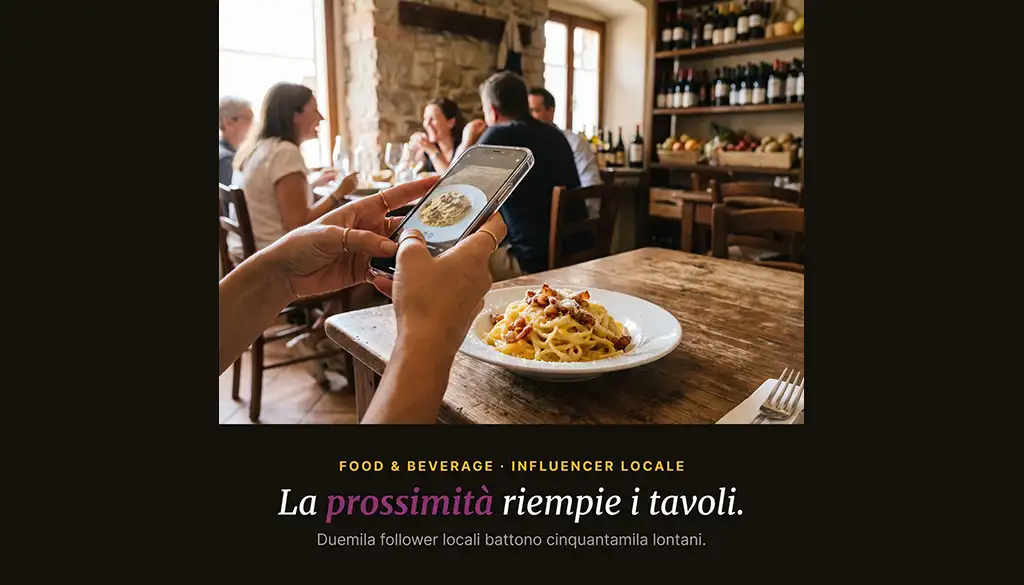
Campaigns targeting a specific geographic area: a local area, a city, or a province.
Creators who are deeply connected to the local area, content that resonates with people who can actually visit the store, and metrics tied to actual foot traffic.
| If your goal is… | Where to start |
|---|---|
| Introduce the brand to a new audience quickly and widely | Campaigns with selected creators — the service described on this page |
| Turning Satisfied Customers into Brand Advocates Through Credible Content | UGC marketing |
| Building an authoritative voice over time: internal ambassadors or creators | Creators and influencers |
| Bringing people to a physical location: a venue, a store, an event | Local influencer marketing |
Many projects combine two approaches: campaigns and user-generated content (UGC) for a product launch, and local campaigns and brand ambassadors for a retail chain opening new stores.
The purpose of the first meeting is for us to recognize this together.
A self-service platform provides access to a database of profiles and contact tools: the company retains control over candidate selection, briefs, and the evaluation of results.
A managed platform takes responsibility for the entire process, from selecting creators to analyzing the final data.
The platform is best suited for those with a dedicated in-house team; outsourced management is best suited for those who prefer to delegate the process.
Factory Communication’s registered office is in Milan, and its operational headquarters are in Crema: Lombardy is the region we know best, from downtown venues to manufacturing facilities in the province.
For those looking for influencer marketing in Milan, this means in-person meetings when needed, local creators who have already been identified, and firsthand knowledge of neighborhood audiences.
From here, we manage projects throughout Italy and for some clients abroad.


Three clients, three different sectors, three services of our operational structure activated on specific brief. No long narrative: client, service, key KPIs. For those who want to delve deeper into each case, dedicated pages are available on our website.

Six creators specializing in anime, manga, and Japanese culture, with 42 posts—including Reels and Stories—from February 26 to March 29, 2025.

Presented by Ambassador Luigi Contessi, featuring:
A campaign for the gluten-free menu based on content created by the restaurant’s customers.
The most effective campaigns we manage start with companies that have about twenty employees. The factor that matters more than company size is the clarity of the objective: a launch, a grand opening, a season, or a product to promote. With a clearly defined objective, even a campaign featuring just three creators can yield meaningful results.
Yes, and that’s the most common scenario. In these cases, we handle the operational side—selection, briefings, contracts, production, and reporting—and meet with you twice: once at the beginning to define the objectives and once at the end to review the results.
Let’s start with the audience data: actual overlap with your target audience, quality of the following, engagement rate by audience segment, alignment of values with those of the company, and history of collaborations. Validation tools help us identify artificially inflated followings. Research begins anew for each project, based on the specific brief, and the final proposal includes a detailed justification for each profile.
The metrics are agreed upon before the campaign begins. For brand awareness, we track qualified reach, interactions, and the percentage of the audience outside the follower base; for drive-to-store, we track traffic using trackable codes; for events, we track actual attendance compared to registrations; and for product launches, we track conversions using dedicated tracking parameters.
A campaign featuring three to five local micro-influencers can be up and running within two or three weeks of the signed brief. A nationwide multi-creator campaign takes four to six weeks. Projects that span multiple areas can take six to eight weeks, to allow time for the initial analysis.
Each service operates independently. Most projects start with one, consolidate it over the first three to six months, and integrate the others when the return on investment justifies it. The matrix above helps you identify the starting point that best aligns with your current goals.
Five elements: number of creators involved, follower base, requested formats (including Reels, Stories, and brand-specific content), duration and scope of usage rights, and platforms covered. A local campaign with micro-influencers and a national campaign with established profiles operate on entirely different scales: during our first meeting, we’ll work together to define a sustainable scale that aligns with your goals.
All sponsored content includes the disclosure required by AGCOM’s guidelines for creators’ commercial communications. This provision is included in the contract, and verification takes place prior to publication, along with content approval.
Tell us where you are and where you want to go. We’ll respond with a preliminary analysis and a concrete action plan.
Read all the articles in the blog section dedicated to influencer marketing →