


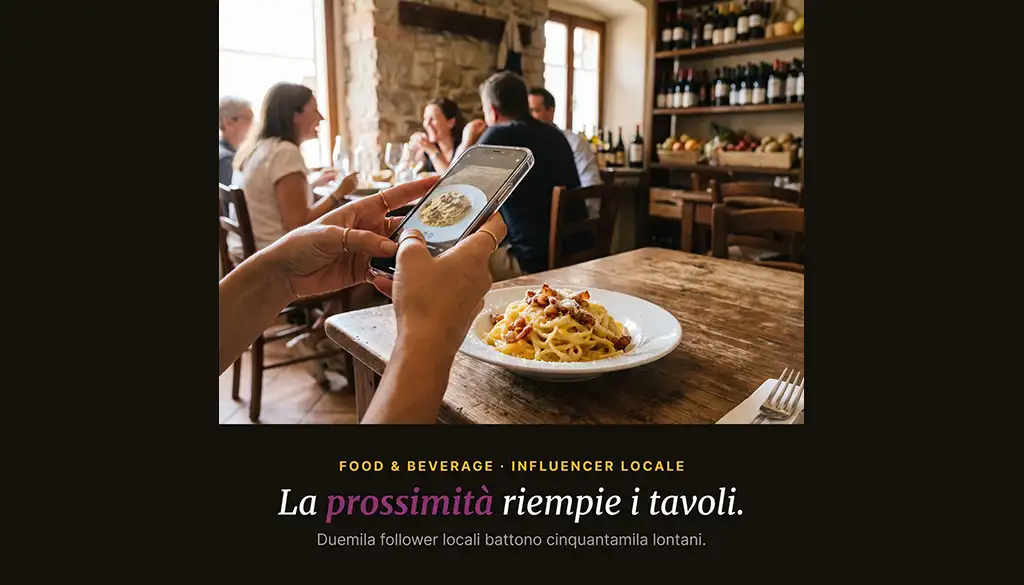
A restaurant thrives when people who live or work within a few kilometers know it exists, trust what it has to say, and, sooner or later, walk through the door.
This is the real challenge in restaurant marketing: proximity. And it’s exactly the arena where local influencer marketing truly shines.
A story posted by a local creator, seen by a few hundred residents, brings more people to the tables than a national campaign seen by tens of thousands of people far away.
In this guide, we’ll look at how it works, how to choose the right creator, how to structure a collaboration, and how to truly measure results.
Why proximity matters more to a restaurant than coverage
For a physical restaurant, value stems from proximity and is based on two factors. The first is geographic: the people who can physically reach the restaurant are the ones who generate actual foot traffic.
The second is thematic: a message aimed at an audience with a specific interest—cooking, food intolerances, special occasions—converts much better than a generic message.
A nationwide campaign reaches a huge number of people who will always remain hundreds of kilometers away from the table; a local campaign speaks to those who can actually sit down at it.
Local influencer marketing operates precisely along these two axes.
It complements other ideas for attracting customers to a restaurant and rounds out an existing restaurant marketing strategy by adding the most valuable asset of all: the trust built by a real person with their local community.
What is local influencer marketing for a restaurant?
Local influencer marketing for a restaurant involves engaging creators who are deeply rooted in the restaurant’s local community—people who live in the city, already frequent that area, and whose community consists mainly of residents of the same area—to share their dining experience.
The goal is to reach those who can actually walk through the door, using the credibility of a personal recommendation rather than an advertisement.
This geographic aspect is often complemented by a niche component: food-focused creators who can describe a dish with expertise, or profiles specializing in a specific topic—such as special dietary needs—that allow the restaurant to reach a segment that would otherwise be difficult to target through traditional communication channels.
This is where food micro-influencers come into play: they’re often more effective than big names, precisely because their audience matches the kind of customers the restaurant wants to attract.
Nano, micro, and macro influencers: Which one should you choose for your restaurant?
Think about the difference between a megaphone in a crowded square and a word whispered in your ear by a friend you trust. The megaphone reaches many more people; however, it’s your friend’s word that makes you get up and try that restaurant.
It is the same logic that distinguishes the three categories of creators.
- Nano-influencers (up to 10,000 followers):
Extremely high engagement and a hyper-local audience. Each piece of content comes across as advice from neighbors. - Micro-influencers (10,000–100,000 followers):
The ideal balance between reach and credibility, with a community that is still close-knit and recognizable. - Macro-influencers (over 100,000 followers):
High visibility, with a less localized presence and an audience spread across the entire country.
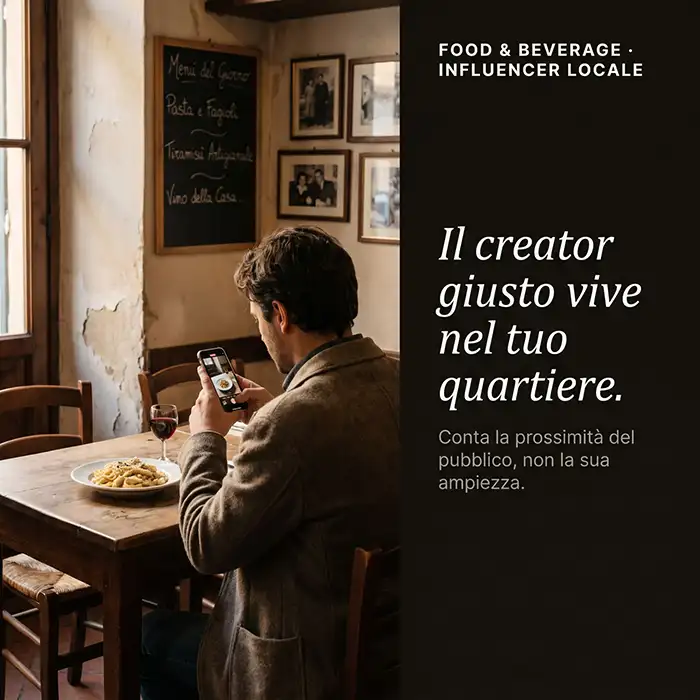
For a local restaurant, “nano” and “micro” are almost always the most effective choices: the geographic quality of the customer base matters more than its size.
A profile with 2,000 truly local followers and an 8% engagement rate generates more bookings than a profile with 50,000 followers scattered throughout Italy.
How to Find the Right Local Food Micro-Influencers for Your Restaurant
The search begins with geographic and category-based keywords—such as #foodmilano or #ristorantitorino—and continues with a qualitative assessment.
There are three metrics that really matter: the engagement rate (how much the audience interacts, beyond just the number of followers), the relevance of the content to the food industry, and, above all, how local the audience actually is.
The cities where followers live reveal much more than the total number of followers.
A look at the comments rounds out the picture: a community that engages in conversation, asks questions, and responds is a real community, capable of turning content into a visit.
There are also platforms dedicated to structured creator searches, which are useful when you want to compare multiple profiles using consistent criteria.
How to Structure a Collaboration, from Selection to the Creative Brief
The most successful restaurant marketing campaigns share a common structure that can be replicated at any type of restaurant.
The story works best when it’s structured in stages: a teaser that sparks curiosity before the visit, a real-time account of the experience at the venue, and a summary posted in the days that follow, which highlights the key messages and encourages exploration.
The core message always remains concrete and recognizable: a signature dish, a detail of the experience, or an offering designed to meet a specific need.
What is unique is remembered and shared, and sparks spontaneous conversation.
At Factory Communication, we approach every collaboration by starting with this specific, tangible detail and a clear brief—deliverables, timelines, tone, and transparency—so that the creator can tell the story freely while remaining true to the venue’s actual experience.
This project can be set up through a dedicated influencer marketing consultation or managed operationally by influencer marketing services.
Local Influencer Marketing in Action: The Pizzikotto and Old Wild West Cases
Some campaigns carried out in the restaurant industry clearly demonstrate how this logic translates into practice, with different approaches based on the same method.
In the case of Pizzikotto, which has locations in several different cities, the decision was made to engage multiple local micro-influencers—one for each city—each deeply rooted in their own food community.
The narrative was built around a distinctive and tangible feature of the product—one that could easily be showcased during the in-store experience and spark conversation.
In this way, the campaign was able to expand into multiple regions while preserving the local authenticity of each activation.
In the case of Old Wild West in Milazzo, which was tied to the launch of a gluten-free menu, the strategy focused on a local food-focused creator who could frame the experience as the discovery of a menu designed to meet a real need.
Targeting a specific niche—people with celiac disease and gluten intolerance—delivered the message to those who were truly seeking it, with far greater relevance than generic food-related communication.
Other Old Wild West promotions tied to in-store events take on yet another form: local creators are invited to enjoy a special moment at the restaurant and share it in real time, turning their participation into content that the community perceives as an experience shared by a friend.
What these campaigns have in common is their approach: selection based on geographic and thematic proximity, a multi-stage narrative, and a message built around a specific detail.
Grand openings, events, or menu launches: when local influencer marketing shines
There are times when immediate visibility matters more than anything else, and the grand opening is the prime example. Inviting three to five local micro-influencers to the opening generates authentic content, social media buzz, and early, spontaneous reviews—just when the restaurant needs to get its name out there the most.
The same logic applies to the launch of a new menu, a themed event, or a special evening: specific occasions that give creators a story to tell and give the audience a reason to make a reservation.
AGCOM’s Rules on Influencers: What You Need to Know Before Starting a Collaboration
Transparency is an integral part of a successful collaboration. AGCOM guidelines and the Code of Self-Regulation for Commercial Communication require that sponsored content be clearly identifiable as such through clear indicators such as #adv or #sponsored.
This rule also applies when the compensation is a meal offered in exchange for content, a very common practice in the restaurant industry.
For restaurant owners, ensuring proper disclosure offers a twofold benefit: it protects them from potential penalties and strengthens public trust, as customers appreciate transparency.
A partnership that is openly declared is even more credible, because it shows that a business communicates honestly. This principle is fully consistent with ethical marketing that respects people.
How to Measure the Results of a Local Influencer Marketing Campaign
The evaluation of results focuses on how many people viewed the content and, above all, on how many of them actually stopped to engage with it.
The most useful metrics are: content reach and impressions; engagement, with a particular focus on saves and comments; percentage of new audience reached; traffic to the social media profile or website; bookable reservations tracked via promo codes or dedicated links; and organic mentions in the days that follow.
Saves and the percentage of new visitors, in particular, provide a much better indication of the actual impact on foot traffic than coverage alone: they show that the content has made an impression and that new people have discovered the venue.
It is on the basis of these indicators that we should interpret a campaign.
Would you like to develop a local influencer marketing strategy for your restaurant?
For a restaurant owner, the key question is how many of the people who could actually come into the restaurant a content creator is able to reach—with a message that can get them to sit down at a table.
Se vuoi costruire una strategia su misura per il tuo ristorante — dalla scelta dei creator locali al racconto per fasi, fino alla misurazione dei risultati — la consulenza influencer marketing ti affianca nel definire obiettivi, metodo e collaborazioni, integrando il local influencer marketing con la tua presenza social già attiva.
The first step is a conversation about your venue and the audience you want to attract.
Frequently Asked Questions About Local Influencer Marketing for Restaurants
The starting point is the deliverables: how much content, in what formats, with what publication schedules, and which messages to highlight. It’s also worth putting in writing the rights to reuse the content on the restaurant’s channels and how the partnership will be made visible to the public. A clear agreement from the start protects both parties and makes the campaign measurable: you know what to expect, and you know what to evaluate at the end.
Nano-influencers (up to 10,000 followers) offer very high engagement and a hyper-local audience. Micro-influencers (10,000–100,000) combine good reach with strong credibility. Macro influencers (over 100,000) guarantee broad visibility but have a more diluted local presence. For a local restaurant, nano and micro influencers are almost always the most effective choice.
Search Instagram and TikTok for location-based or category-based hashtags (for example, #foodmilano or #ristorantitorino) and evaluate the engagement rate, the consistency of the content, and how truly local the audience is. Comments help you determine whether the community is genuine and active. There are also dedicated platforms for more structured and comparable research.
Yes. AGCOM guidelines and the Code of Self-Regulation require that sponsored content be clearly identified with labels such as #adv or #sponsored. This rule also applies when the compensation is a meal offered in exchange for content. Ensuring proper disclosure protects the restaurant owner and strengthens public trust.
The geographic quality of the audience matters more than the absolute number of followers. A profile with 2,000 highly local followers and a 6–8% engagement rate can be worth more than one with 50,000 followers scattered throughout Italy. For local restaurants, the proximity of the audience is the decisive factor.
This is one of the times when it pays off the most. Inviting three to five local micro-influencers to the grand opening generates authentic content, social media buzz, and the first spontaneous reviews—just when the restaurant needs immediate visibility. The same goes for a menu launch or a special event.
The key KPIs are reach and impressions, engagement (with a focus on saves and comments), the percentage of new audience reached, traffic to the profile or website, bookable reservations tracked via promo codes or dedicated links, and organic mentions in the days that follow. Saves and new audience metrics best reflect the actual impact on in-theater attendance.
For individual campaigns or those involving just a few creators, in-house management with a clear brief can work well. When you want to scale up, select profiles in a structured way, or coordinate multiple collaborations simultaneously, relying on a consultant or a specialized agency yields more reliable results and frees up valuable time for the restaurant owner.