

Home » Business Services » Marketing and Communication » naming
A company’s name is the communication decision that is made most quickly and changed least often.
It often comes about one evening, among partners, as they sit with a sheet of paper; then it remains for twenty years on signs, on invoices, and in the conversations of customers who talk about you when you’re not there.
It’s worth asking how well that name will hold up over time.
It will need to work over the phone and in an email, on packaging and on a search engine, in Italian and perhaps in another language.
It must be available as both a trademark and a domain name.
This page explains how to come up with a name that works for all of this.
However, there is only one starting point: the criterion.
People looking for a new name usually come up with two overlapping questions.
Brand naming answers the second question even before it answers the first.
A list of beautiful names is a matter of personal taste, and tastes vary from person to person even within the same group.
A list of names based on an explicit criterion, on the other hand, is evaluated in light of a shared goal: who we want to reach, what we want them to think, in which languages, and in which markets.
The right name thus becomes the result of a shared criterion. This is the approach we take to every brand identity and corporate identity project, with naming as the first step.
In the following sections, you’ll find the process, types of names with real-world examples, trademark verification, and frequently asked questions.

Corporate naming is a long-term endeavor. The name must be able to withstand entry into markets that are currently only hypothetical, the launch of products yet to be conceived, and perhaps a generational shift.
That’s why it’s best to keep it broad: a name that accurately describes today’s business may not be broad enough in ten years.
Product naming takes the opposite approach. It has a defined target audience, a specific promise, and a precise place within the brand architecture.
In this context, conciseness is an advantage, because the name needs to quickly convey who it’s aimed at and what changes for those who choose it.
The difference becomes clear when comparing the two projects. Nautica Luxury Corporation articulates the category and positioning of an entire service company; Stop Allergeni sums up the benefit of a specific offering in just two words.
Both work, for opposite reasons.

Brand naming is the strategic process of choosing a name for a company, product, or service.
It includes an analysis of positioning and competitors, the generation of candidate names, phonetic and semantic verification in the target languages, and a trademark availability check prior to the final decision.
The term refers to both the company name and the names of individual product lines. For a brief definition of the term, please see the “naming” entry in our glossary.
What we do at each stage and what you receive at the end of each one
FARO is the approach we take to every project. It brings together our five areas of expertise: no matter which path we choose, the phases and metrics remain the same, which makes it possible to compare different campaigns.
What We Do
We redefine the market: what the company does, who its target audience is, what its competitors are called, and which lexical spaces are already occupied.
This is the basis for our selection criteria, which are agreed upon and documented in writing before any name is proposed.
What You Get
A map of competitors and the agreed-upon selection criteria, set out in writing prior to the generation process.
What We Do
We explore different styles—evocative, descriptive, functional, and inventive—to arrive at truly distinctive alternatives.
What You Getfr
A shortlist of names, each accompanied by its strategic rationale.
What We Do
We evaluate how each name sounds and what it evokes in the target languages, then review registered trademarks, domain names, and digital channels.
What You’ll Receive
The verification report for each application accepted for presentation.
What do we do
We compare the final list with the initial criteria and complete the name with the accompanying phrase.
What You’ll Getfr
The chosen name and tagline, ready for signage, promotional materials, and communications.
The decision is up to the company; our job is to keep it informed. For more information on the principles behind this process, you can read our article on naming strategy.
We choose names based on criteria agreed upon with the company’s leadership, and then we verify that they are acceptable from a phonetic, semantic, and legal standpoint.
The result is a name that remains recognizable as the company grows, enters new markets, and changes its product offerings. The final decision is yours: our job is to make it clear.
Eight registers, eight different selection criteria
We’ve been working on naming for over twenty years, across a variety of fields and industries: companies and products, restaurants and insurance, e-commerce, boating, and digital services.
Name types reflect strategies even more than styles, and each one solves a different problem: choosing the register always comes before choosing the word. Here are eight examples from projects we’ve completed.
A portable safety flashlight named after the most familiar light source there is.
The metaphorical register works when a noun is meant to reassure rather than simply describe, and draws on images that the audience already has in mind.
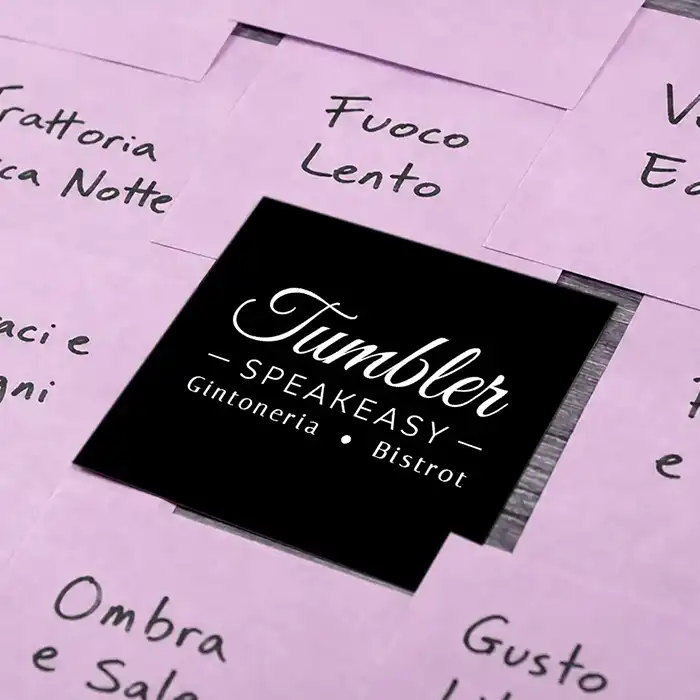
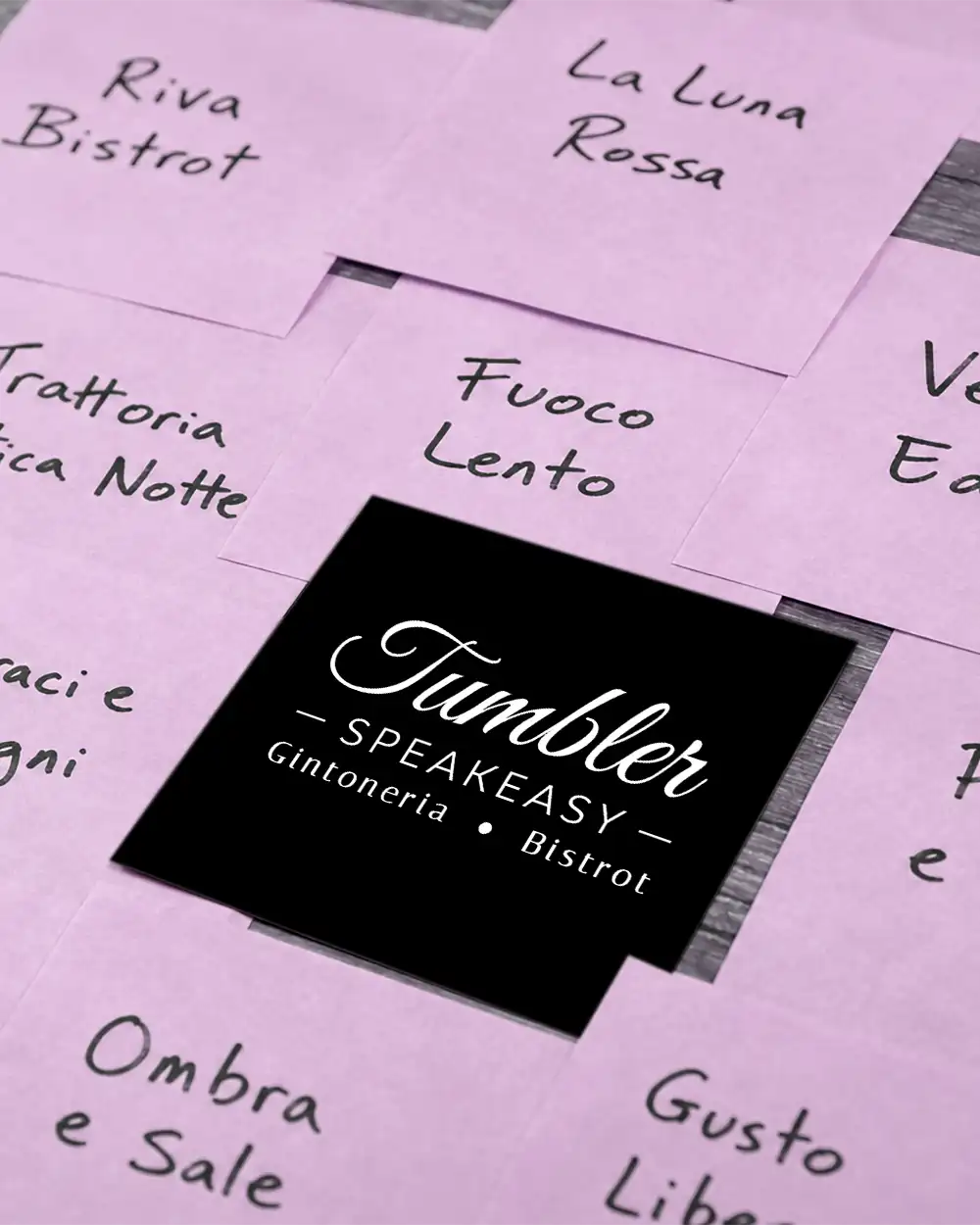
Two references in a single name: the bartender’s tool and the imagery of American speakeasies.
It works because both references are familiar to the people who frequent the club.
The name conveys the benefit the moment you read it.
This approach is suitable when the audience is looking for a specific solution to a specific problem, such as managing allergens in the food service industry.
This is a topic we also addressed in the case study on the gluten-free menu.
Two words that describe the expected result rather than the product.
In the insurance industry, the name instills confidence while remaining within the lexical constraints of a regulated market, where every promise must be carefully calibrated.
A Milanese dialectal expression for “the house of taste.”
Choosing to use dialect means sacrificing immediate understanding outside the local area, but gaining a sense of local roots and recognition in return.
This choice is justified only by considering the restaurant’s actual customer base—and that is precisely the kind of assessment that makes a restaurant marketing strategy worthwhile.
It comes from combining “electric” and “exchange.”
The new word preserves the original’s meaning and remains available as a trademark, because it was created alongside the project.
Built on sound rather than meaning.
A style well-suited to digital projects, where brevity and distinctiveness matter more than description: the product builds its meaning over time.
Nautica Luxury Corporation states its full category and positioning; the acronym N.L.C. is used as a shorthand for everyday use.
This is the logic behind many historic brands: the full name conveys meaning, while the acronym inherits that meaning once the market has come to recognize it. In the luxury sector, this dual form adds a sense of understated elegance.
Strong names share five characteristics:
The most common difficulties arise when the availability check is done after the decision has been made rather than before, or when the name describes the current business too precisely.
A sixth criterion concerns time: it’s worth asking whether the name will still be relevant to the company ten years from now, given that the products and markets are still just hypothetical at this point.
Registration protects the name and grants the owner the right to use it in the specified classes of goods.
In Italy, the application is filed withthe UIBM; forthe European Union, it is filed with the EUIPO.
It is advisable to check availability while screening applications and to file the trademark before the public launch, so that the final choice is already protected.
A name that sounds good in Italian may have different meanings elsewhere, so it’s important to check the names in the languages of the target markets before making a decision.
The audit covers three areas:
For companies that export, this preliminary review prevents them from having to change their name just as they are entering a new market.
We focus on four sectors where reputation carries particular weight, because brand identity and the quality of human relationships are key assets.
For each person, the criteria for choosing a name differ, and the analysis that precedes that choice changes accordingly.
Names that convey the product’s origin and character while remaining easy to pronounce on first hearing. This is the sector where we’ve worked most often, from restaurants to bars.
Names that set the tone for the guest experience and work well in the languages of the target markets—from facilities to services.
Names that project a high-profile image and hold their own in international markets, with phonetic and semantic verification in the target languages.
Names that convey reliability while adhering to the industry’s lexical conventions, where the promise must be carefully tailored.
It depends on how well-known the current name is. If it’s already recognizable to customers, it’s often best to keep it and focus on the tagline and visual identity. A new name becomes the best choice when the company enters different markets or when the current name isn’t very distinctive.
The process consists of four phases: analysis and positioning, generation of proposals, linguistic and brand review, and final validation with the tagline. The duration depends on the number of languages and markets involved; we establish the timeline during the first meeting, along with the selection criteria.
It includes four deliverables: the positioning analysis based on the agreed-upon selection criteria, the shortlist of candidates with the rationale for each, the linguistic and brand review report, and the tagline that accompanies the name. Each element is delivered and discussed together.
Yes. Every submitted proposal has passed phonetic and semantic checks in the target languages and a search for prior rights regarding registered trademarks, domain names, and digital channels. This verification takes place during the selection process, so the final shortlist already consists of names that can be protected.
An initial meeting to work together to define the selection criteria.