


Home » Business Services » influencer marketing » local influencer

A thousand people living where you are are worth more than 100,000 scattered throughout Italy.
It sounds like an exaggeration until you look at what’s actually happening: people who follow a profile about their neighborhood run into the person at the market, recognize the places in the photos, and when the person recommends a spot, they’re recommending it to people who can walk there.
The distance between the back of the room and your venue’s entrance is the key factor.
Below, you’ll find out how to choose local influencers, what content to share with them, and how to measure who actually engages with it.
A business that relies on a specific customer base faces a problem that national campaigns cannot solve.
The content reaches a lot of people, the view counts go up, and none of those people can walk through the door—they live 400 kilometers away.
The second way to make a mistake is more subtle, and it can happen even when you stay within the country.
You choose the local profile with the largest following, agree on the content, and publish a curated post.
The problem is that that profile has built its audience around a specific topic, while your audience is based on geography: there may be very little overlap between the two.
Then there’s the question that no one addresses before leaving: how do you know if it worked?
A venue that’s packed on a Saturday night can’t tell how many of those people came for a specific event, unless someone has set up a way to identify them.
That approach needs to be developed before the campaign, not after.

It works where the customer physically goes, or where the sales territory is defined by a specific geographic area.

FARO is the approach we take to every project. When applied to a specific area, it introduces a variable that doesn’t exist elsewhere: the radius within which a person might decide to come to you.
Let’s define our scope and objective: to raise awareness in a new area, fill uncovered time slots, and support a grand opening.
This will determine how we measure the number of visitors.
We identify the profiles within that reach and verify the audience’s origin.
We develop the brief, the schedule, and the agreements, with content usage rights already in place.
We organize site visits because local content works best when people can relate to the place.
We oversee production and publication, incorporating agreed-upon revisions.
We review the results for the selected metrics, repeat the approach with the profiles that drove traffic, and repurpose the best content for advertising within the target audience we’re interested in.
Let’s start with the service area: the area from which people can reach the location.
Within that area, we look for profiles that reflect recognizable contexts and feature interactions with local residents, verifying the audience’s geographic origin.
A profile with many followers who are far away is worth less than a small one with followers who are nearby.
Let’s identify the actual area where your customers come from—which varies greatly between a neighborhood café, a destination restaurant, and a hotel.
Within that area, we look for well-established businesses and check where their customers live, rather than focusing on how many there are.
We organize shoots right where the action is, because local content works best when viewers can recognize the place.
The brief balances what needs to be shown with the freedom to tell the story in the profile’s own voice, within agreed-upon formats and timelines.
We handle compensation, the amount of content, timelines, usage rights, and the transparency requirements that apply when the collaboration is paid.
Before departure, we arrange for ways to identify arriving guests: reference codes, tracked reservations, searches for the business name, and requests for directions.
The content that attracted people then becomes targeted advertising within the audience we’re interested in.
Anyone can take a product photo, anywhere. A video shot inside your store, featuring the people who work there and the street view from the window, exists in only one place in the world.
That’s what makes local content hard to imitate and credible to someone who lives two blocks away: they recognize the place even before reading its name.
With metrics based on location, not on views.
The campaign period is compared with the previous one, for the same season.
Regional campaigns have a different cost structure than national ones: the fees for individual roles are lower, and the focus shifts to casting and organizing the shoots.
The initial effects on a local campaign become apparent quickly—often within two or three weeks—because the target audience is small and the response is immediate.
We define the scope during a meeting, then we put in writing what it includes.
The method remains the same; what changes are the questions people ask, the channels they use, and the timing of their decisions. These are the four areas where we have the most expertise.
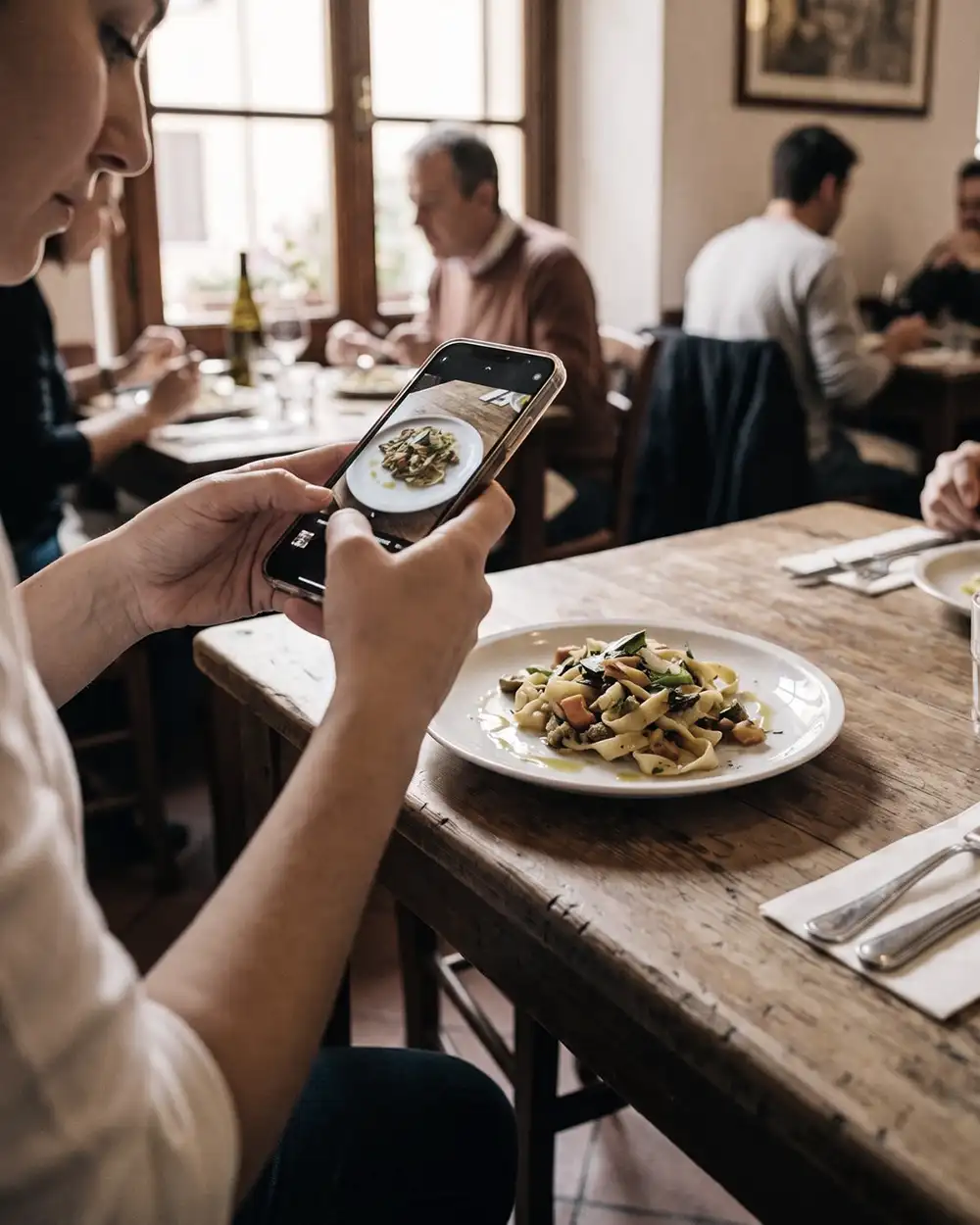
This is the sector where local content pays off the most: people choose where to eat by looking at what’s nearby, and a video shot inside the restaurant reaches those who can make a reservation tonight.
Here, the local area is the attraction. Local stories describe what’s around the property and reach people who are already considering that area for a vacation.
Stores and boutiques that cater to a city-wide clientele: seeing someone wearing a particular item in the city center is just as valuable as a recommendation from a friend.
Professional firms and consultants operating within a province: here, local voices help build recognition, with a focus on what can be said.
Much less than you might think. In a city-wide audience, a profile with a few thousand people—who are actual residents—generates more visits than one with 100,000 scattered followers.
Let’s look at the geographic origin of the followers, the language and region from which the interactions come, and the locations that the profile typically features. A local profile showcases recognizable places.
As a rule, it’s better to have several small profiles rather than one large one. Ten accounts that engage with nearby communities cover a territory more effectively than a single one, and the cost per piece of content remains low.
In most cases, yes, and that’s what makes the content credible. Visits are scheduled during agreed-upon time slots so as not to interfere with operations.
First, by establishing the methods for identifying it: a code to cite, a reservation with a reference number, and trends in searches for the name and requests for directions during that period.
Yes, and the structure changes: each location has its own scope and voice, while the message and formats remain the same across all locations. Comparing retail locations then becomes a useful metric.
These are two distinct yet complementary strategies. Local SEO reaches people who are already looking for you; local word-of-mouth reaches people who didn’t know you existed.
Local campaigns have a quick impact: the initial effects on reservations and visits are often evident within two or three weeks, because the target audience is small and decisions are made immediately.
A meeting helps you understand where your customers come from, what you want to achieve, and how long it will take.
From there, we derive the target audience, the appropriate profiles, and ways to identify those who are reached through the campaign.
Factory Communication works with companies and small and medium-sized businesses throughout Italy and has offices in Milan and Crema.