

Home » Business Services » SEO » link building
Every link that matters stems from a relationship, rather than from a technique.
People who land on this page have usually already tried something: a purchased backlink package, a one-time guest post, or a consultant who promised a top-three ranking within three months.
And they’ve realized that their ranking hasn’t changed at all.
Link building works, but it works the same way relationships do: slowly, selectively, and only when there’s something worth mentioning.
In the following paragraphs, you’ll find out what really happens when another website links to you, which techniques are effective today, and how to build a campaign that will continue to yield results next year as well. It’s worth taking a few minutes to read.
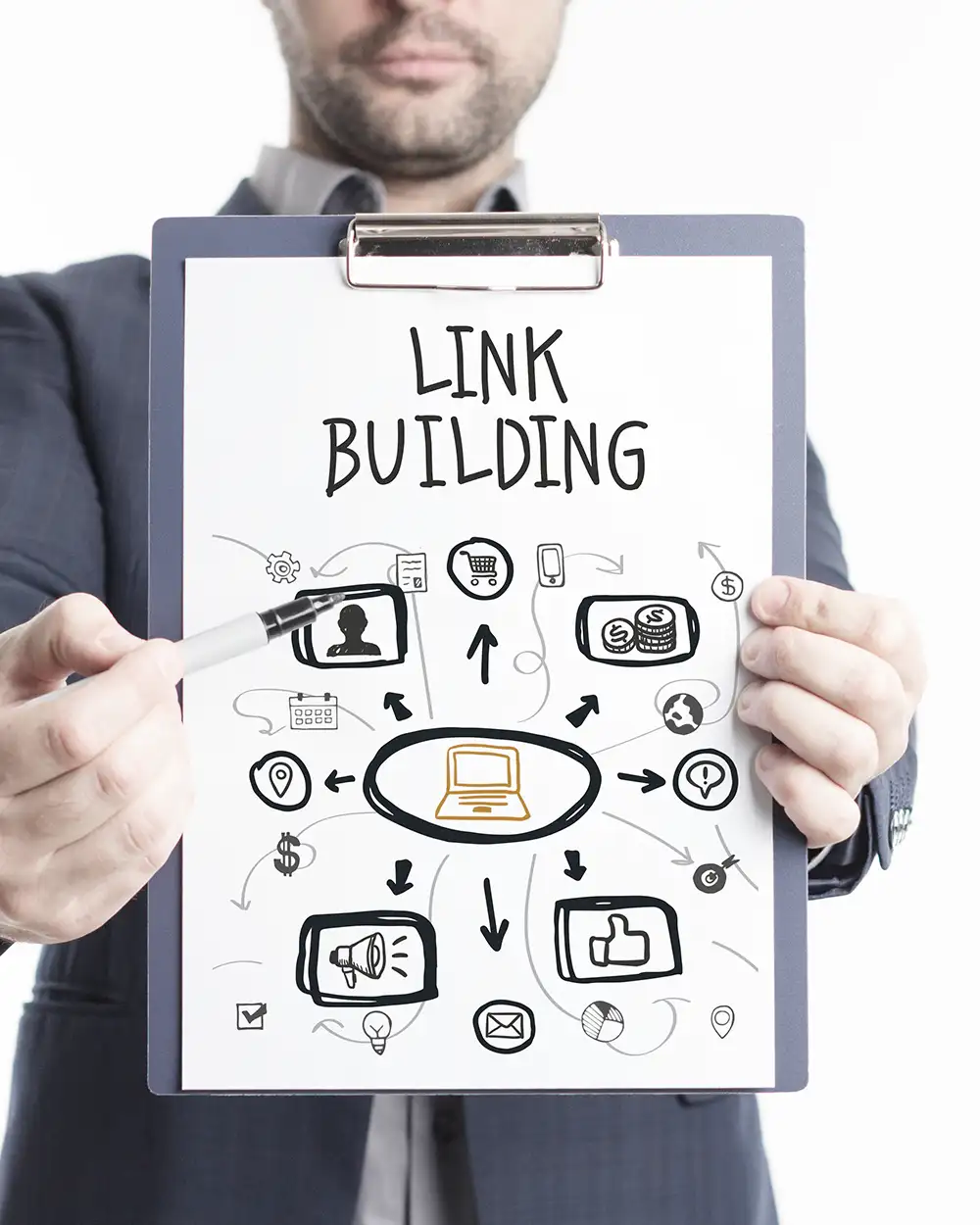

Link building is the strategic process by which a website acquires inbound links (backlinks) from other websites.
Every backlink works like a citation: whoever includes it is telling their readers—and the algorithms—that that content is worth paying attention to. It’s the digital version of word of mouth.
When an industry publication cites your in-depth article as a source, it’s doing the same thing as a professional who recommends a colleague: it’s putting its own reputation on the line to vouch for yours.
Google has been tracking this exchange since 1998, when the PageRank algorithm was born out of the very idea that links between pages measure a document’s value.
Since then, the system has been refined: today, the quality and thematic relevance of the source matter much more than the absolute number of links. A single link from an authoritative journal in your field carries as much weight as hundreds of generic mentions.
Three factors determine the value of an inbound link:
Popularity measures how well-known a website is; authority measures how well it is recognized as an expert on a specific topic.
A general-interest portal can be extremely popular yet remain marginal for your industry, while a niche blog read by just a few thousand specialists can send you a much stronger signal.
The goal of an effective strategy is to become the go-to source on a specific topic. It is the combination of these two signals—not their sum—that shifts rankings in the SERP.
A link-building campaign is based on data and proceeds through verifiable steps. Here’s how we work.
The starting point is always the same: figuring out what’s already linking to your site. With Semrush, we analyze your entire backlink profile, measure the authority of the referring domains, assess the level of toxicity, and map the distribution of anchor text.
At the same time, let’s take a look at the profile of your direct competitors: it shows where your industry is having conversations and which sources are already available to mention companies like yours.
This phase is part of the overall SEO audit.
The analysis leads to a plan: which pages of the site to prioritize, with which anchor text, and on which publications.
We select publishers one by one, evaluating their topic relevance, actual organic traffic, editorial quality, and the composition of their outbound link profile. The guiding principle is simple: we publish where your ideal customer already reads.
A link lives within a piece of content. We write articles, research pieces, and in-depth analyses that publishers accept because they provide value to their readers, applying the rules of SEO copywriting.
Each publication complies with Google’s guidelines and transparently discloses the nature of the agreement, using the correct rel attributes.
Every month, we verify that the links remain active and indexed, track the performance of our rankings for target keywords, and monitor changes in domain authority.
The report is easy to understand even for those who aren’t familiar with SEO: what was published, where, and what the impact was.
This sequence describes a repeatable backlink-building workflow that integrates with other SEO consulting activities for businesses.
Link-building techniques that stand the test of time share one common trait: they also provide value to the site hosting the link.
Building relationships with publications, bloggers, and industry editorial teams remains the most reliable strategy.
A byline article in a specialized magazine brings a backlink, perceived authority, and qualified readers.
It takes time to build these relationships, which is why this approach offers an advantage that’s hard to replicate.
Original research, proprietary data, comprehensive guides, and free tools attract organic citations.
This is the mechanism that makes Wikipedia one of the most linked-to sites in the world: it contains material worth citing.
Producing data that your industry hasn’t yet measured is often the fastest way to get linked to by those writing about that topic.
It involves identifying broken links on authoritative websites and offering the webmaster equivalent, up-to-date content.
The benefit is mutual: the publisher fixes a broken link, and you get a relevant citation.
Your brand is already mentioned online more than you might think. Turning a text mention into an active link is often as simple as making a polite request.
In addition to this, there are vertical directories , trade associations, and specialized portals, which, in some industries, carry as much weight as a major publication.
Understanding link categories helps you analyze your backlink profile with a critical eye.
Editorial links are the most valuable: they result from the independent decision of an editor who considers your content a useful resource.
Sponsored links result from commercial agreements and must be marked with the rel=”sponsored” attribute.
User-generated links found in comments and forums are marked with rel=”ugc”.
Affiliate links are in a category of their own, as they follow their own commercial logic.
When you publish an article in a media outlet as part of a campaign, it’s worth checking in advance which attribute will be applied to the link: this is information that any reputable publisher is happy to provide.
Exact-match anchor text—which matches the target keyword—is the most effective and should be used sparingly.
The partial anchor includes the keyword within a broader phrase and strikes an excellent balance.
Generic or branded anchors preserve the natural profile. A healthy profile alternates between all three forms, just as a group of independent editors citing the same site would.
Monitoring transforms link building from a one-off activity into a controlled process.
Google Search Console shows you the domains linking to your site, the most linked-to pages on your site, and provides a link disavowal tool.
The free versions of Ahrefs Backlink Checker, SEMrush, and Majestic allow you to check an initial sample of backlinks, providing information on the attribute, anchor text, and source authority.
In our day-to-day work, we use Semrush because it integrates backlink analysis with the other components of a web marketing strategy: organic search rankings, competitors’ keywords, and the technical health of the website.
This allows you to view the connection profile within the broader context, rather than as an isolated piece of data.
A backlink profile is kept healthy with a monthly check: active links are verified, publishers who have modified or removed a link are flagged, and domains with high toxicity scores are isolated.
For the latter, the process is straightforward: export the list in .csv format and upload it to the Disavow tool in Search Console. It’s a maintenance task, much like pruning: it’s done regularly and judiciously.
An e-commerce site has an extensive internal linking structure and categories that compete for high-value commercial search queries.
In these cases, link building works on two levels: it strengthens category pages with relevant links and feeds the blog with shareable content that passes authority to the product pages.
The specific approach is described on the page dedicated to SEO for e-commerce.
When a project involves multiple markets and languages, the selection of publishers changes: you need native sources for each country and consistent management of the different language versions, as described on the International SEO page .
For businesses with a local presence, however, backlink building is integrated with local SEO and local citations.


Yes. Backlinks remain among the key signals that Google and other search engines use to assess a domain’s authority.
The quality criteria have changed: what matters now are editorial links on thematically related sites, embedded in content that algorithms recognize as reliable sources.
The same citations that strengthen organic rankings also increase the likelihood of being cited in AI-generated responses.
A link-building agency provides three things that are difficult to build in-house in a short amount of time:
There is also a contextual factor. An Italian agency communicates directly with publishers, media outlets, and bloggers in the domestic market; it understands the language and the business environment in which it operates.
For a company that sells in Italy, links from relevant .it domains have a more direct impact on Italian SERPs.
At Factory Communication, we devote hundreds of hours each year to internal training, because algorithms change and the techniques that worked two years ago now need to be revised.
We work with entrepreneurs who focus on medium-term results and choose to grow in a transparent way: link building is exactly this kind of investment.
Food magazines, guides, and specialized blogs are natural sources for food and beverage producers.
A product’s reputation grows where it is already being discussed by experts.
Travel websites, local guides, and destination blogs help travelers make their choice before booking.
That’s where a link generates visibility and bookings.
Industry magazines, publishing platforms, and recognized voices in the fashion world: editorial coverage in the publications your clients actually read.
In these fields, the credibility of the source is the decisive factor.
We work with professional portals, technical journals, and industry publications that stand up to scrutiny by an expert reader.
Link building is the process of acquiring backlinks from other websites to your own. Google interprets every high-quality link as a signal of authority and trust, and uses it as one of the factors that determine organic search rankings. The more relevant and authoritative links pointing to a site, the greater its ability to climb the SERPs.
Internal link building involves links between pages on the same website: it helps Google understand the site’s structure and distributes authority among the pages. External link building, or off-page link building, involves acquiring backlinks from other domains. The two activities are complementary and are part of a comprehensive SEO strategy.
An effective campaign begins with an analysis of the existing backlink profile, continues with the identification of authoritative sources in the industry, and involves the creation of content worth citing. The most effective techniques remain digital PR, editorial guest posts, broken link building, and link earning through original research and data.
Results take time to materialize. On average, the first improvements in search rankings become visible between the third and sixth month after launch, depending on the competitiveness of the industry, the number of backlinks acquired, and their quality. Link building is an investment that continues to yield results for years to come.
Yes. Backlinks remain one of the most important ranking factors even in the age of artificial intelligence, because Google continues to use them to assess a domain’s authority. What has changed is the required level of quality: today, editorial links on thematically related sites are what matter most, and these are also the ones most frequently cited by generative models.
White-hat link building follows Google’s guidelines: it is based on high-quality content, digital PR, and disclosed editorial partnerships. Sponsored links result from commercial agreements and remain fully legitimate when marked with the rel=”sponsored” attribute. A professional agency chooses the safest and most effective approach on a case-by-case basis.
An Italian agency has direct access to publishers and media outlets in the domestic market, understands the language and cultural context in which the company operates, and builds relationships with authoritative .it websites. For a company that sells primarily in Italy, backlinks from relevant Italian domains have a more direct impact on domestic SERPs.
Through a monthly review: active and indexed links are verified, changes in the authority of the source domains are monitored, and sources with high toxicity scores are identified. These sources are exported in .csv format and uploaded to the Disavow tool in Google Search Console.