

Home » Business Services » SEO » International SEO
Growing your business abroad starts with understanding how the people you want to reach conduct their searches.
Many Italian companies enter foreign markets with a translated website and the impression that this is enough.
Then they discover that in France people are looking for one thing, in Spain another, and that the most commonly used word in the destination country is precisely the one the translation left out.
The difference between a multilingual website and one that generates demand abroad lies right there, in people’s actual search behavior.
On this page, you’ll find information on how we approach architecture, keywords, and content on a country-by-country basis, which languages we support, and what factors influence the investment.
In five minutes, you’ll have the criteria you need to make a decision.
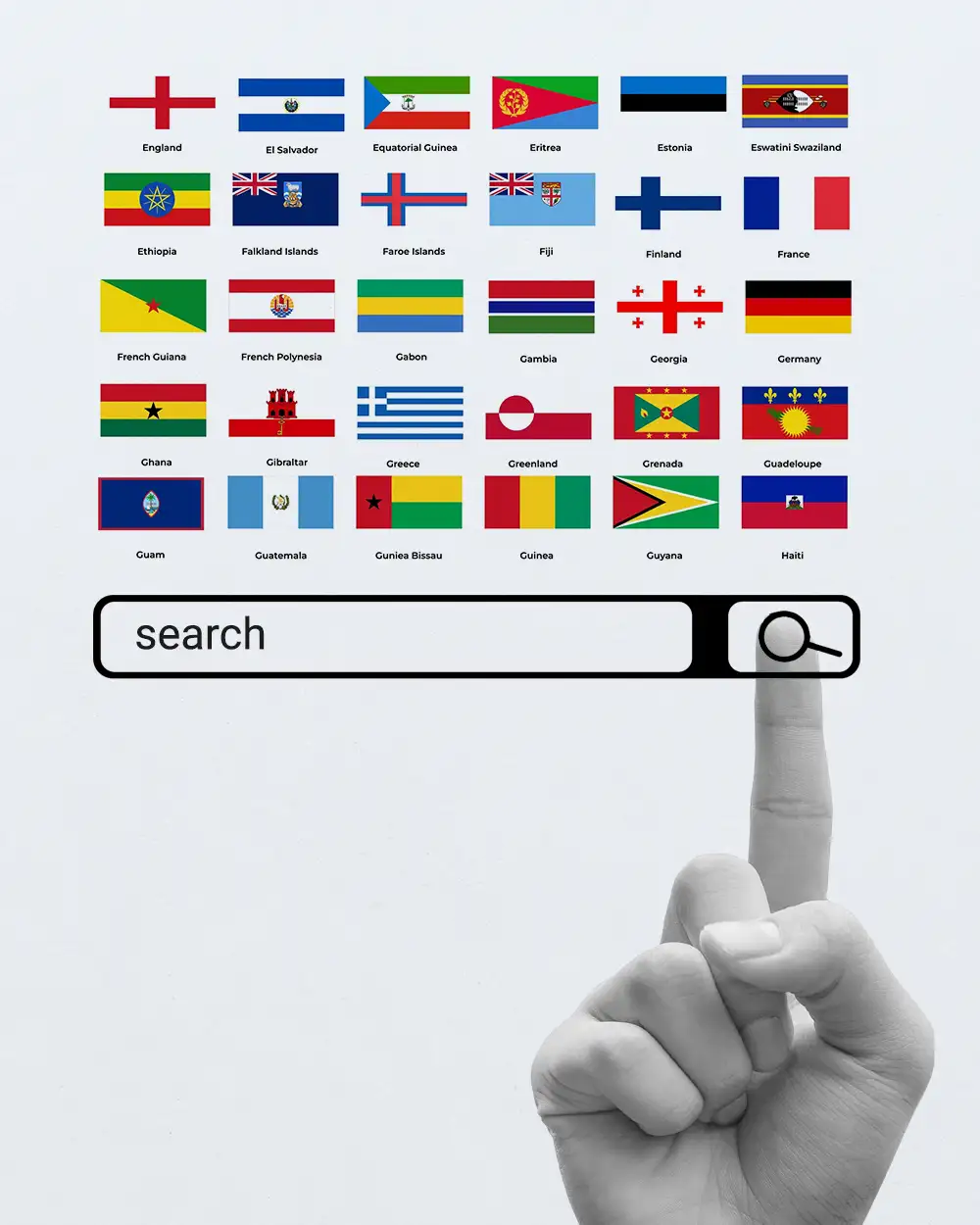

International SEO makes a website visible in search engines across multiple countries and in multiple languages.
It includes keyword research for each market, selecting the domain architecture, implementing hreflang attributes, and producing content in the native language.
It differs from translation because it starts with the actual needs of each country. The rest of the work revolves around this definition.
An effective strategy brings together three elements that are often considered separately: the technical aspects of the website, the language of the content, and knowledge of the target market.
When these three factors align, overseas placement becomes a natural result of the quality of the work.
Demand varies from country to country
The same product generates different search queries depending on the cultural context.
An Italian food company that, in Italy, is searched for by the name of its specialty product, is searched for in the English-speaking world based on the occasion for which it is consumed.
Anyone working on international SEO starts here: conducting research in the target market’s language, using that country’s search volume data, before deciding which pages to create.
Every market has a different SERP
The results page varies from country to country: the competitors, the presence of ads, the prominence of AI Overviews, and the type of content that Google ranks highly all differ.
A page that was first published in Italy, then translated and published in Spain, enters a different competition.
Overseas positioning takes this asymmetry into account right from the initial analysis.
We work with Italian companies that are expanding into three language regions, with native-speaking staff for content creation and editing.
This is the area with the highest competition and the greatest return when the strategy remains selective.
Anyone looking for SEO services in English almost always finds generalists: what makes the difference is a keyword research analysis based on data from the United Kingdom—not a translation from Italian.
A market that values attention to linguistic precision and consistency across the website, marketing materials, and brand messaging.
Here, native-language editing is just as important as technical optimization.
The choice between European Spanish and Latin American variants affects the way people formulate their searches, and thus the keyword map.
This is the decision that kicks off the project.
For companies that operate in both the domestic and international markets, these efforts are coordinated with local SEO activities, so that investments in Italy and abroad reinforce one another.
A step-by-step approach that brings strategy and content into the company one step at a time.
The four phases of FARO—the Factory method —apply to every project and vary in depth depending on the number of markets involved.
Let’s start with our international business goals and the current state of the website: its structure, supported languages, Search Console data by country, and the rankings of local competitors. At this stage, a comprehensive SEO audit that covers all language versions is helpful.
We define the priority markets, the keyword map for each language, and the structure of the multilingual website.
This is the point at which you decide which pages to translate, which to rewrite from scratch, and which to create specifically for a particular market.
Next comes execution: technical implementation, content creation with native-speaking contributors, SEO copywriting tailored to local demand, and link building on sources in the target country.
We track rankings, traffic, and conversions separately by market, with reports that are easy to understand even for sales staff.
The markets that perform best receive more resources; the others are recalibrated based on the data collected.
For most SMEs, subfolders in the format sito.it/en/ remain the most efficient choice: they centralize authority within a single domain.
Country-code domains convey the strongest geographic signal and require dedicated resources for each country.
Subdomains fall somewhere in between. They determine the number of markets and internal resources.
The Role of hreflang
The hreflang tag signals to search engines the relationship between the different language versions of the same page, so that each person receives the version tailored to their country, and the versions add value rather than competing with one another.
It is the technical element that we most often find partially configured on multilingual websites that are already online.
We’ve dedicated an in-depth page to this topic: hreflang implementation.
Working with an international SEO agency is the most effective choice in four common situations.
Before launching a project, it’s worth figuring out whether it’s really necessary: we’ve written about this in our article on when an international SEO strategy is needed and when simply translating the website is enough.
For those looking to establish a comprehensive presence in the Italian market, SEO consulting for businesses is the way to go.
In Factory Communication, markets are opened one at a time, with each one being verified before moving on to the next.
The investment required for an international SEO project depends on four factors:
The initial analysis reveals which combination yields the most solid return
Each added language comes with its own keyword research, native-language editing, and dedicated editorial plan.
Two markets cost less than twice as much as one; five cost more than twice as much as two, because coordination increases.
A website that’s already well-organized has a head start.
When hreflang, sitemaps, and version management are incomplete, the first part of the work involves corrections and must be addressed before the content.
The same keyword requires different levels of effort in France and the United Kingdom.
Local competition determines how much content is needed and how long it takes to see the first results.
Machine translation reduces costs but cannot keep up with local demand. The volume of pages that actually need to be written in the local language is the biggest expense—and it’s also the one that produces the most lasting results.
This includes analyzing target markets, defining the website’s multilingual structure, conducting keyword research for each language, technically implementing hreflang tags, and producing localized content. This is followed by measuring results on a market-by-market basis, with separate reports for each country.
Translation converts a text from one language to another. International SEO starts with the question: it examines how people search in that country—using which keywords and with what intent—and builds content based on that. Sometimes the best-performing page in a foreign market is one that isn’t even on the Italian site yet.
Three criteria are useful. The first: ask how keyword research is conducted in the target language and what data sources are used. The second: verify their expertise in multilingual architecture, including hreflang. The third: understand how the results are presented, because a report that’s easy to read by market is what makes SEO a key driver of business decisions.
An online store has many more pages to manage: categories, product listings, filters, and variants all add up for each language. The process begins with deciding which categories to launch first for a given market, and then optimizing the product listings based on the terms actually used in that country.
Currencies, shipping times, and tax information are included in the product listing because they influence the purchase decision.
The hreflang attribute is an HTML attribute that tells search engines which pages are linguistic or geographic versions of one another.
When configured correctly, it directs each person to the right version and allows the versions to add value rather than compete with one another.
Metrics are reported separately by country: rankings for selected keywords, organic traffic, leads, and sales generated by each language. Aggregated data hides which markets are performing well and which are stagnating. The report displays the columns side by side, so decisions about future investments are based on hard numbers.
Yes. With the right structure, content produced by native-speaking contributors, and a backlink profile built on local sources, an Italian company can achieve solid results in foreign markets while maintaining its operations in Italy.
The first signs typically appear within three to six months; establishing a solid position takes nine to twelve months. The timeframe varies depending on the domain’s authority, the competitiveness of the chosen market, and the volume of content published in that language.
Tell us which markets you want to expand into. Let’s take a look together at the website, the data, and the concrete opportunities in the country you’re interested in.