

For years, reports on campaigns featuring creators have opened with the same metric: how many people watched and for how many seconds.
Watch time, view rate, and thumb-stop ratio have become standard terms in briefings, and the engagement rate is the metric used to determine whether a collaboration was successful.
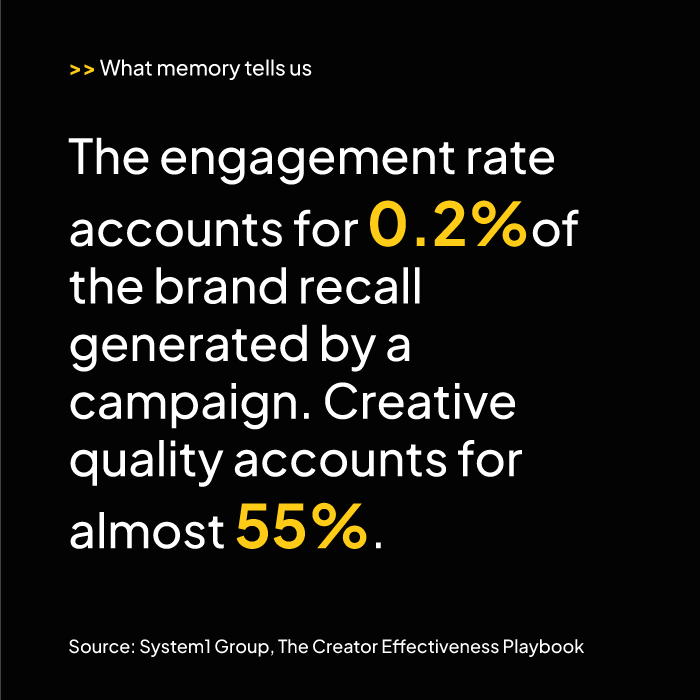
A study published by System1 Group, *The Creator Effectiveness Playbook*, sought to determine to what extent that metric actually predicts how well a campaign is remembered. The answer is 0.2%.
In the same model, the quality of creativity accounts for nearly 55% of the variance.
The ratio between what the industry measures every day and what determines the outcome is nearly five to one.
This article explains where that difference comes from and what, in practice, changes for a company that is planning its next rollout.
What Does a Creator Campaign Really Measure?
The study: 1,217 job postings, eight markets, more than 182,000 people
The study analyzed 1,217 paid ads on TikTok across eight markets, including Italy, which were tested on over 182,000 users and cross-referenced with more than 350 Brand Lift Studies, representing a total of $70.5 million in advertising spend and 23.6 billion impressions.
Scale matters because it allows you to isolate variables.
With smaller numbers, correlations become apparent; with these, we begin to distinguish between what causes the effect and what merely accompanies it.
The gap between brand-created content and content created by a creator
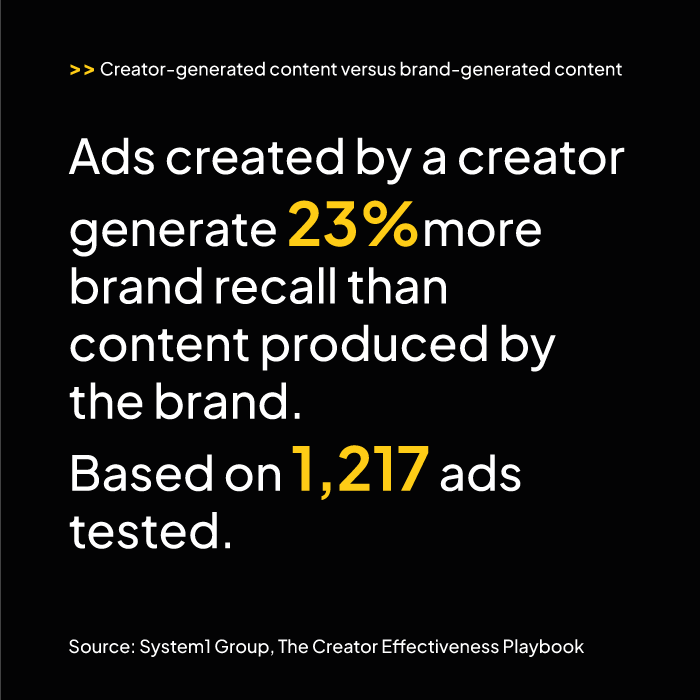
The opening statistic is clear: ads created by a creator generate 23% more Brand Memory Lift than content produced directly by the brand.
Brand Memory Lift indicates the extent to which a campaign increases the likelihood that the brand will be remembered by those who saw it.
The value of the study lies in its explanation of that 23 percent, rather than in the number itself.
What does memory add to what attention already tells us?
Five seconds of screen time have different weights.
Content can catch the eye and fade away, or it can leave a lasting impression: it depends on how it’s crafted, even more than on how often it’s viewed.
System1 calls this phenomenon “Compound Equity.”
Given the same amount of exposure time, creative work that combines emotional impact with immediate brand recognition leaves a much stronger impression.
The engagement rate remains a useful metric for understanding how content spreads; recall indicates whether that spread has left a lasting impression.
What metric predicts how well a creator campaign will be remembered?
Creative quality.
In the System1 model, based on 1,217 TikTok ads, creative quality accounts for nearly 55% of Brand Memory Lift, while the engagement rate accounts for 0.2%.
Creative quality can be broken down into two measurable elements: the audience’s emotional response and brand recognition within the very first few seconds.
The Two Factors That Shape Brand Memory
The audience’s emotional response
Taken on its own, the ability to generate a positive emotional response explains about 28% of the Brand Memory Lift.
It is already more than 100 times as informative as the engagement rate, and it pertains to a dimension that no platform dashboard automatically provides.
Brand recognition in the first few moments
The second lever is what System1 calls “Fast Fluency”: the brand’s ability to be recognized within the very first few seconds of the content.
Content that captures viewers’ emotions right from the start doubles brand recall. By adding recognizable branding in the very first moments, the effect triples.
When the brand enters the market late
This is where a common mistake in collaborations with creators often creeps in.
To preserve the authenticity of the content, many briefs place the brand toward the end of the video. As a result, the audience remembers the creator and the story, while the brand fades from their memory.
We see the same problem in some television commercials as well, especially those with a humorous theme, where the “situation” is the real star of the commercial and the brand isn’t shown until the very end.
The industry has learned how to create effective entertainment and openings. The next step is to ensure that, within that entertainment, the brand remains visible right from the start.
How many seconds does a brand have to make itself recognizable in a content creator’s post?
Two.
The study’s operational recommendations suggest including two to four native brand elements within the first two seconds of the content, accompanied by visual and audio cues.
Combining the two sensory channels doubles the effectiveness of recognition compared to using just one.
How much does a creator’s fame weigh against brand consistency?
Recognition among the target audience
Creators with over one million followers achieve an average recognition rate of 23.5% among their target audience, compared to8–10% for lesser-knownmicro and macro creators.
It is a real gap, and it has less of an impact on the final result than the cost of the collaboration might suggest.
Consistency as a Multiplier
What determines memorability is, above all, “Brand Fit”: how naturally the audience perceives that brand’s presence within the creator’s content ecosystem.
When the fit is high, the emotional response is up to 23% greater than in collaborations that are perceived as forced.
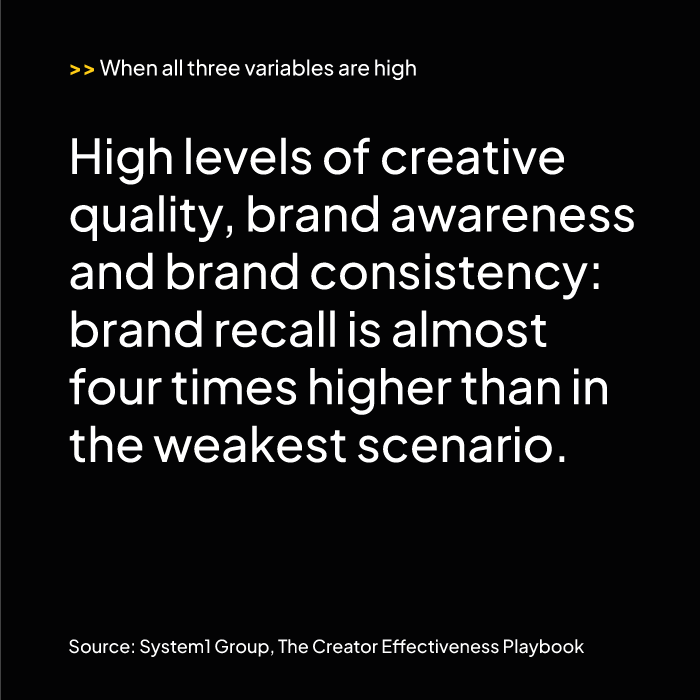
When creative quality, brand awareness, and consistency are combined—with all three factors at high levels—the Brand Memory Lift reaches nearly four times the result of the weakest scenario.
Consistency is the only one of the three that can be chosen during the selection process, and it is also the least expensive.
What We See in Food Campaigns Featuring Local Creators
Anyone who works with small-scale creators on a daily basis is familiar with this effect.
Collaborations with local food creators often yield better brand results than much more expensive campaigns, and the same is true when the campaign is tied to a local event.
The reason lies in perceived credibility, rather than in the budget.
It’s the same logic that underpins our creator validation standard, which is based on qualitative factors as well as audience numbers.
The selection of the profile, the development of the brief, and the comparison between micro and macro creators are separate topics covered in the framework of influencer marketing.
What Changes in the Brief and the Planning Process
Before the talent show: the need that the content addresses
The study calls for reversing the usual order.
Before choosing a creator, it’s best to identify the human or cultural need that the content aims to address, determine which part of the creator’s ecosystem that need naturally resides in, assess the actual level of recognition among the target audience rather than the total number of followers, and confirm that the brand can credibly occupy that space.
Market research is a fundamental part of any marketing and communication strategy.
Prioritize entertainment
During the briefing phase, the recommendation is to prioritize entertainment over product exposure.
A solid strategy combined with a weak brief still produces better results than a weak strategy with a flawless brief: the sequence matters, and neither phase can be replaced by the other.
What Happens to the Memory After Publication
Adaptation to formats and reuse throughout the funnel
There is one aspect that the study only touches on, but which deserves to take center stage in planning: the memory created through engagement with creators lives on beyond the original content.
When that content is amplified, adapted to different formats, repurposed for paid channels, and redistributed throughout the funnel, its full recall potential is realized.
It’s probably the next frontier in influencer marketing effectiveness, and it has more to do with the lifespan of the content than with its production.
A campaign that measures the ROI of a creator campaign without taking this phase into account leaves the most cost-effective part of the result on the table.
Where the FARO Method Comes In
The method we use at Factory Communication is called FARO: focus, design, implement, optimize, and amplify.
That’s exactly why the final phase exists. Content published just once is an investment used only once; the same content, when adapted, redistributed, and repurposed, continues to build brand awareness for months.
This is the point at which developing an influencer marketing strategy stops being just a posting schedule and becomes a system.