


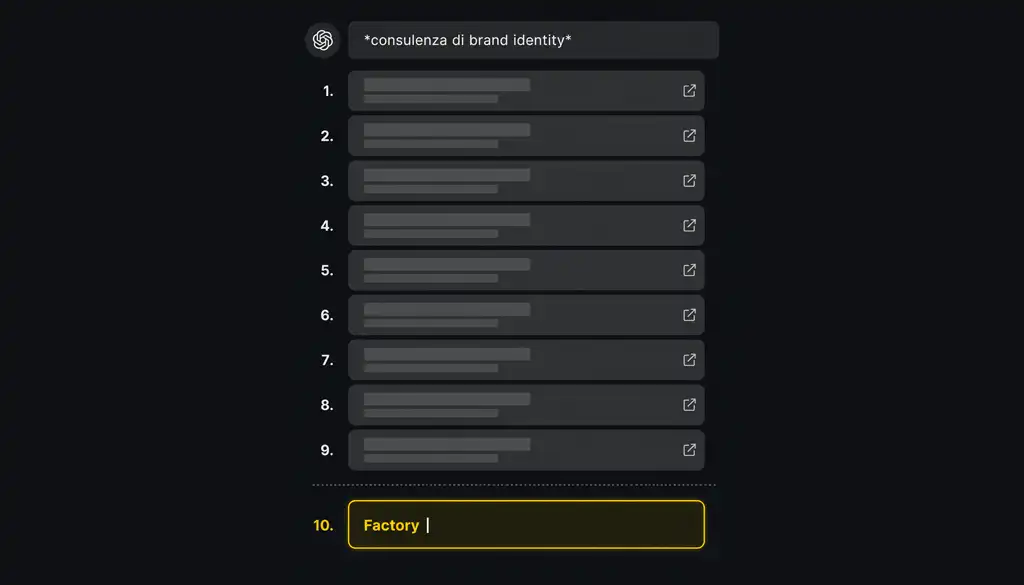
We asked ChatGPT who it recommends for brand identity consulting. Our name wasn’t on the list.
Here’s how we verified this—because search volume alone isn’t enough to decide what to write anymore—and how you can perform the same analysis for your industry.
Let’s start at the end, because that’s the most uncomfortable part.
On August 14, 2026, we asked ChatGPT a question that a potential client might ask at any time: where to find consulting services for corporate brand identity.
ChatGPT responded by citing nine sources and naming four organizations. Factory Communication was not among the nine sources. It was not among the four names.
Zero out of nine.
We’re not saying that we’re invisible to AI in general: that would be a claim we haven’t tested, and it wouldn’t make sense to make such a claim.
For that single query, on that single day, with that single model, the result is zero.
But it is a precise, verifiable, and repeatable number—and it is the starting point for a project we have just begun.
This article explains how we got here, what we’ve learned about how models choose whom to nominate, and how you can conduct the same analysis for your industry.
What Are AI Citations?
When a generative model answers a question about products, services, or suppliers, it doesn’t make things up: it consults web pages and constructs its answer based on them. The pages it consults are the sources, and the names that appear in the text are brand mentions.
These are two different things, and it’s worth keeping them separate.
A citation is a source: the bot read that page. A mention is a name that appears in the response read by the user. You can be cited as a source without being named, and—more rarely—named without being cited.
For a company, both are important. The mention is what the potential customer sees. The citation is what explains why that name appeared—and therefore the one you can work on.
Can you see AI citations in Google Search Console?
It’s one of the questions people ask most often about this topic, and the short answer is no.
Search Console measures your site’s performance in Google Search: impressions, clicks, average position, and search queries.
It also tracks traffic coming from pages featuring an AI overview, but it doesn’t tell you whether ChatGPT, Gemini, Perplexity, or Claude mentioned you in a response to a user.
Those conversations take place elsewhere and, as a rule, do not generate any data within Google’s tools.
The same applies to Google Analytics: you can see referral traffic from chat.openai.com or other domains when a user clicks a link, but the vast majority of AI responses do not generate clicks. The name is read, evaluated, and the conversation continues in the chat.
This problem is very similar to that of AI Overviews, which we’ve already discussed in a dedicated case study: you can rank first on Google and still get zero clicks. Here, the issue is even more extreme, because there isn’t even a SERP to look at.
If you want to know whether the AIs mention you, you have to ask them. There is no shortcut within the tools you already use.
How to Measure AI Citations: The Method
The method we used can be replicated without proprietary tools and consists of four steps.
1. Ask the right questions
There’s no point in measuring how well a model describes you if you ask it about you by name: it will respond correctly because it will read your website. What you need to measure are the queries a customer might use to search for you without knowing who you are.
These are questions such as: where to find a supplier of X, which agencies specialize in Y, and how to choose a consultant for Z.
In our case, we collected these questions from Answer The Public, which, since 2026, has been returning via API not only search suggestions from Google, Bing, YouTube, TikTok, Instagram, and Amazon, but also the prompts that people ask ChatGPT and Gemini on a given topic.
We’d already discussed this in a guide to the tool; the section on AI prompts is the new feature that changes how it’s used.
2. Generate real responses
The next step is to have the model actually answer those questions and save the answer along with the date.
3. Extract citations and mentions
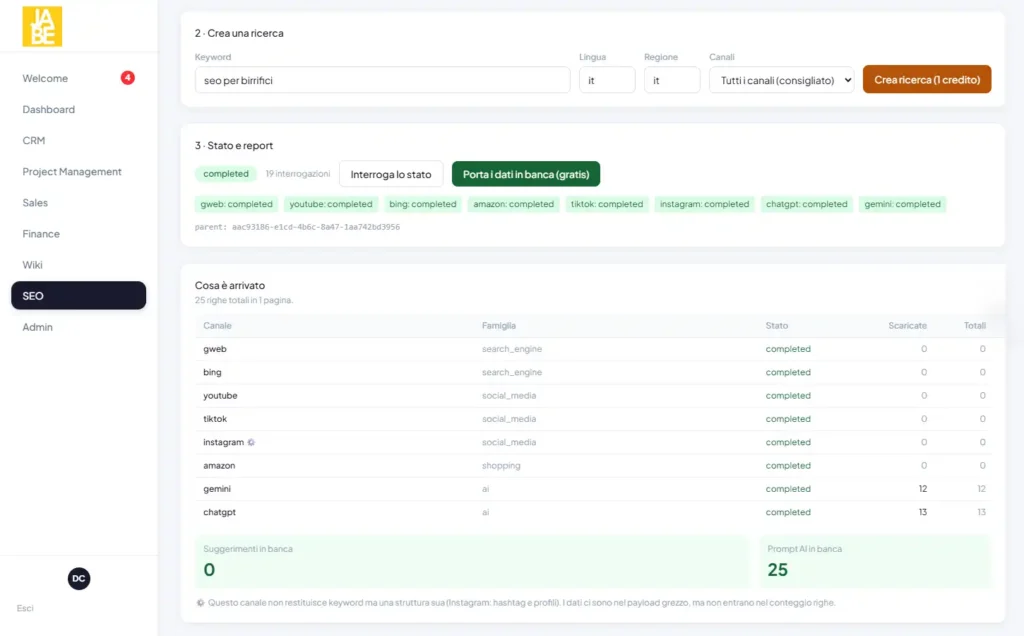
From each response, two lists are generated: the sources consulted, with their URLs and titles, and the brands mentioned.
We’ve automated data collection within JABE, the management system we built to bring together CRM, projects, administration, and SEO data all in one place.
Citations and mentions are entered into searchable tables, along with the date they were recorded, rather than into a spreadsheet that has to be compared manually.
However, the data is the same as what anyone would get from the tool’s interface:automation saved us time; it didn’t give us different information.
4. Record the date of the survey and repeat it
It’s the step that almost everyone skips, and it’s the only one that makes a measurement a measurement. A single measurement is a snapshot; two measurements taken at different times are data.
The cost of the entire assessment, in our case: fewer than twenty questions, out of a monthly quota of two hundred.
What we discovered along the way: Search volume no longer reflects demand
We had set out for a different reason. We were designing the new site structure, with vertical pages under the SEO services: SEO for restaurants, for breweries, and for food e-commerce.
The problem was obvious to anyone who has ever opened a keyword research tool: those verticals have no search volume.
We surveyed eleven topics. Here are the results:
| Topic Covered | Search Suggestions | Questions Asked of AI Systems |
|---|---|---|
| brand identity | 2.336 | 25 |
| corporate identity | 716 | 25 |
| seo consultant | 408 | 25 |
| corporate identity | 182 | 25 |
| SEO for Restaurants | 4 | 25 |
| SEO for Food and Beverage | 0 | 25 |
| SEO for Food Companies | 0 | 25 |
| SEO for Breweries | 0 | 25 |
| SEO for Wine E-commerce | 0 | 25 |
| SEO for vegan food companies | 0 | 25 |
| SEO for vegan e-commerce | 0 | 25 |
A technical clarification, so that the number 25 doesn’t mislead you: it’s a constant of the tool, which always generates thirteen ChatGPT prompts and twelve Gemini prompts for each topic. It does not measure how often a topic is requested.
The actual data is in the left column. Zero. Not “few”: zero autocomplete suggestions, across eight different channels, for six out of seven verticals.
Anyone who decides on a website’s structure based solely on search volume would eliminate all those verticals. And according to traditional logic, they would be right.
But are those twenty-five questions true?
The risk was that the tool would have expanded on the topic in a mechanical way, generating generic questions about SEO with the niche tacked on. We opened the twenty-five SEO prompts for breweries. Here are some of them, just as they appeared:
- Ideal e-commerce platforms for selling craft beer online
- How to Increase Online Reviews for Breweries Using SEO Techniques
- Best Practices for SEO on Google My Business Listings for Breweries
- Average cost of SEO consulting tailored to the beverage industry
- Agencies Specializing in SEO for Breweries in Italy
None of them are generic. And most importantly: these aren’t questions about SEO—they’re questions about a brewery. The person asking them isn’t studying a subject; they’re looking for someone who understands their industry.
That question leaves no trace on Google. Not because it doesn’t exist, but because it can’t be summed up in three words.
The mistake that taught us the most useful rule
My first attempt at going vegan didn’t go well, and it’s worth sharing because there’s a lesson to be learned from that mistake.
We had searched for “vegan products SEO.” About half of the results had nothing to do with SEO at all: where to buy vegan products for kids, what are the best vegan skincare products, and where to find deals and discounts.
The tool had interpreted “vegan products” as a purchase intent and had responded to the consumer instead of the business owner.
We rephrased the same question in two different ways:
| Topic | Related prompt |
|---|---|
| SEO for vegan products | about 12 out of 25 |
| SEO for vegan food companies | 25 out of 25 |
| SEO for vegan e-commerce | 25 out of 25 |
The rule: The subject line must refer to the business, not the product.
Company, e-commerce, brewery, restaurant, manufacturer. Not “products,” “items,” or “food.” If the subject is missing, the model interprets it as merchandise and delivers it to the wrong audience.
This applies to search queries, but it applies just as much to the name of the page you’ll write. And it has a direct impact on a website’s architecture: a section called “SEO for Food” is too generic. You need verticals organized by topic, not by product category.
One final observation: vegan food companies and vegan e-commerce sites provided different responses.
The first one is about producers, local strategies, and content. The second is about product descriptions, link building, platforms, and reviews. They aren’t the same audience, and they probably aren’t the same page.
How the models choose whom to nominate
Now that we had demonstrated that the demand exists, the most interesting part remained: what determines who ends up in the answer.
We generated two actual ChatGPT responses to two different questions and analyzed the sources the model actually consulted. The result is clearer than we expected.
First question: “Where can I find consulting services for corporate brand identity?”
Nine sources are cited. Eight are agency news pages. The ninth is an industry directory, Sortlist.
No blogs, no magazines, no comparison articles. The agencies the model has read about: Key-One, Markeven, Groweb, Cose Agency, Brandsider, BresciaDigital, Doctor Web.
With all due respect, these are not the leading names in the industry. They are medium-sized agencies, some of which are regional. They appear for a specific reason: they have a dedicated page for that service, and that page explains what it includes.
Second question: “Agencies specializing in brand identity with a portfolio of Italian clients”
Seven top-tier firms: Bliss, Interbrand Italia, Leftloft, Robilant & Associati, Boraso, Run Design, and SAY. Their clients include Ferrari, Pirelli, Campari, and Juventus.
Two questions, two completely different basins.
- The practical question —” Where can I find this service?”—benefits the page owner.
- The question of reputation — who are the best —favors those with a reputation and well-known cases.
These are two separate games, each played with different tools. The first is won by writing well. The second requires years of work, a press office, and high-profile clients.
For most Italian companies, the first game is the one that counts, and almost none of them are playing it.
What do the pages mentioned have in common?
We looked at the descriptions that the model extracted from the nine sources. The common thread is strikingly simple: they list what the service includes.
One focuses on creating a brand identity, including logo design, naming, and taglines. Another focuses on logos, corporate identity, and brand guidelines. They don’t claim to be the best. They simply state what they do, in specific and verifiable terms.
The template references the page that answers the question, not the page that appears.
If we had to condense the entire article into a single line, this would be it.
The Questions No One Answers
When analyzing the prompts collected across all topics, certain questions recur in every sector without exception.
The price.
- How much does it cost to develop a complete corporate identity?
- Average Costs of SEO Services for Vegan Food Companies.
- Average cost for SEO consulting tailored to the beverage industry.
On Google, there are keywords related to cost, but they almost always lack measured search volume—there are too few to be recorded. In AI prompts, they are a constant feature across every single industry we examined.
People ask about the price. They’ve just stopped asking the search engine, because the search engine never told them.
The criteria.
- What products to include in a corporate branding package.
- How to Assess Quality Before Buying.
- Mistakes to Avoid.
- Differences Between SEO for Vegan and Traditional Food Companies.
These are the questions asked by those who are about to make a purchase but don’t yet know what to ask. Answering them means defining the standard by which you will be evaluated—and that standard will be your own.
Examples.
- Each vertical includes a call for concrete examples.
- When it comes to brand identity, traditional research also reveals an interesting variation: PDF examples.
- People are looking for material they can download and access.
The common thread: a helpful answer is a criterion, not a self-promotion. And that’s exactly the kind of content the models mention.
How We Chose the Keyword for This Article (and Why We Almost Got It Wrong)
This section wasn’t planned. We’re adding it because it happened while we were writing, and it illustrates the method better than any explanation could.
Once the article was finished, we asked ourselves the obvious question: Which keyword should we target?
The initial assumption was that there weren’t any. Such a new topic in Italian, with books on the subject presumably nonexistent. We were about to choose a formulation based on intuition.
Then we verified it using the same tools mentioned in the article. Here’s what we found:
| Formulation | Monthly volume |
|---|---|
| references to | 30 |
| You can view the mentions in Google Search Console | 20 |
| Agency for Brand Awareness Campaigns | 20 |
| How to Measure Citations to | 10 |
| Measuring brand mentions | 10 |
| Track website citations | 10 |
| Audit References to the Website | 10 |
| How to Improve Backlinks to Your Website | 10 |
When looked at line by line, each statement seems irrelevant: ten searches a month don’t justify an article.
But the last five lines are the same question phrased in five different ways. Taken together, they account for fifty monthly searches on a topic that didn’t exist twelve months ago.
This is the classic dynamic of long-tail keywords, and it’s particularly tricky when it comes to an emerging topic: search volume is spread out across various variations, and anyone looking at a single keyword might conclude that no one is searching for that topic.
There’s more. One of the highest-volume queries is a complete question— you can see the mentions in Google Search Console —to which the answer is “no.”
Twenty people a month look for data that doesn’t exist. That’s the paragraph at the beginning of this article, and we would never have written it without looking at the numbers.
And finally, an example illustrating the rule regarding the subject.
- When querying “mention monitoring,” ChatGPT’s prompts correctly referred to brand mention monitoring.
- The folks at Gemini were focusing on other things: the cost of software for monitoring AI-generated academic citations, and professional platforms for tracking the use of AI in research.
The term “AI citations” on its own is ambiguous: it can refer to citations within AI responses, or to academic citations related to AI. It’s exactly the same pitfall as “vegan products,” but on a different topic.
That’s why the correct anchor text isn’t simply “AI quotes” but AI quotes from the brand or the website. The subject must always be named.
A detail that’s more important than it seems: having a method with a name
In its response regarding top-tier agencies, ChatGPT mentioned the name of one agency’s proprietary work method.
It’s no coincidence. Generative models repeat what they find written down, named, and attributable. A method with a name is an entity that the model can handle, reference, and return.
We use a four-step method we call FARO—the Factory Communication method:
- F — Focus · With the data in hand, you can see where the real profit lies. We don’t “analyze everything,” but rather “narrow our focus to what matters.”
- A — Architecting · Strategy as a structural project, not as a list of activities.
- R — Execute · Implementation, including content and campaigns.
- O — Optimize and amplify · The action that corrects and the result that extends.
And it was eye-opening to realize, while conducting this analysis, that it doesn’t have its own page on our website. It’s mentioned here and there, within service descriptions.
For a generative model, something that is merely hinted at does not exist.
After all, this article is the “Analyze” phase applied to ourselves.
Our stated starting point
Let’s go back to the issue we started with.
In response to the question of where to find consulting services for corporate brand identity, ChatGPT cited nine sources. Factory Communication was not among them, nor was it among the brands mentioned.
We are stating this openly for three reasons.
- The first is that anyone who reads it can verify it in thirty seconds: hiding it would be foolish as well as dishonest.
- The second point is that it’s a number, not a perception. We’ve recorded the survey results along with the date, and asking the same question again in three months will yield comparable data. It’s not that “we feel we’re more visible”—it’s one value compared to another.
- The third point is that an agency that explains how to measure something but then doesn’t disclose its own figures is engaging in advertising, not public disclosure.
Here’s what we’ll do, in order:
- a separate page on the method,
- Vertical pages organized by professional topic covering the sectors in which we truly excel,
- content that directly addresses questions about costs and criteria instead of beating around the bush,
- a new survey conducted several months later.
If it works, we’ll write about it. If it doesn’t work, we’ll write about that, too—that’s the part nobody usually talks about, and it’s the most useful.
How to Measure Your Brand’s AI Mentions: An Operational Overview
- Write down the questions a client would ask when looking for you without knowing you.
Not “What does Factory Communication do?”, but “Which agencies specialize in X?” - Always name the professional entity.
“SEO for breweries,” not “beer SEO.” “AI brand mentions,” not “AI mentions.” It’s the difference between reaching a business owner and reaching an entirely different audience. - Don’t rely on search volume as your only criterion.
will tell you that your verticals don’t exist. It’s just telling you that no one types them in three words. - Consider all the possibilities before ruling out an option.
Five sets of ten questions each amount to fifty research topics—not five irrelevant topics. - Record the date of each measurement.
Without a date, it’s not a measurement—it’s just an impression. - Re-measure them after a few months.
It’s the only way to tell the difference between an improvement and a feeling.
If you’d like to learn more about the big picture, we’ve also written about what SEO, GEO, and AEO are and how to get found by language models.
What this analysis does not demonstrate
For the sake of intellectual honesty, the limitations.
We have demonstrated that demand exists where traditional tools fail to detect it, and we have observed which sources a model consults to generate a response.
We have not yet demonstrated that answering those questions leads to being cited. It is a reasonable hypothesis that is consistent with our observations, but it remains a hypothesis until we publish our findings and conduct further measurements.
And the sample is small: two responses, a single model, a single day. The patterns described must be confirmed across multiple questions, on Gemini, and repeated over time before they can be considered stable.
Anyone who promises you certainty about how generative AI works today, in August 2026, is trying to sell you something. We’re telling you about a measurement method and the initial results it has produced. We’ll figure out the rest as we go, and we’ll write about it here.
If you’d like to discuss how to track AI citations in your industry, please contact us. If you’d rather do it on your own, this article has everything you need—that’s exactly why we wrote it.
Happy Ferragosto to everyone
, Donato Cremonesi